Divide a ball into shells of equal thickness, like the layers of an onion. If the material is equally dense everywhere, the outer shells have more area, so the outer shells are heavier.
Now suppose you want every shell to weigh the same. How should the density thin out with the distance from the centre? There is only one answer: in inverse proportion to the square of the distance, that is, as 1/r².
This is the “n = 2 uniqueness theorem” of my first paper (Paper 01). The calculation is over in three lines. Even so, I have kept it as the starting point of more than 1,100 papers. On this page you can move the theorem with your own hands and check it as you go, and I explain why I regard these three lines as the foundation.
This article summarizes papers that I published myself as preprints; they have not been peer reviewed. The interactive figures and the numbers calculated specially for this page are marked as such where they appear.
Key points
- The shells of a ball weigh the same at every radius only when the density is 1/r². Comparing radius 1 with radius 2 is enough to show it.
- The exponent 2 is the dimension of the sphere’s surface, and the shell weight 4π is its area. The theorem draws out the two names of the surface of a sphere.
- The same condition means that the field wells up nowhere, and that the flow through a surface of any shape stays 4π.
- Real clouds keep the 2 as well. The peak of the shell weight lies at the radius where the local exponent is exactly 2. The Bohr radius of the hydrogen atom, the marker radius of a galactic halo and the most probable speed of gas molecules are all this point.
- The density exponent n is also the exponent of the period law T² ∝ rn. n = 2 sits exactly at the centre of the mirror that swaps the spring (n = 0) and Kepler (n = 3).
- But 2 is not one thing. When the dimension of space is moved, it splits in two, and the two coincide only in three dimensions.
- Level the shells
- Theorem and proof
- What 2 and 4π are
- 4π for any shape
- The 2 in real clouds
- Orbits and the mirror
- Two kinds of 2
- Noether and others
- Known, and mine
- Within the corpus
- Questions
- Papers and sources
Level the shells
Move the density exponent n in the figure below. The density is 1/rn. The circle is a cross-section of the ball: the depth of colour shows the density, and the number of dots shows the weight of each shell. The bars also show the shell weights. Only one value of n makes the bars level.
Move the slider. Touch the circle or a bar to see the numbers for that shell.
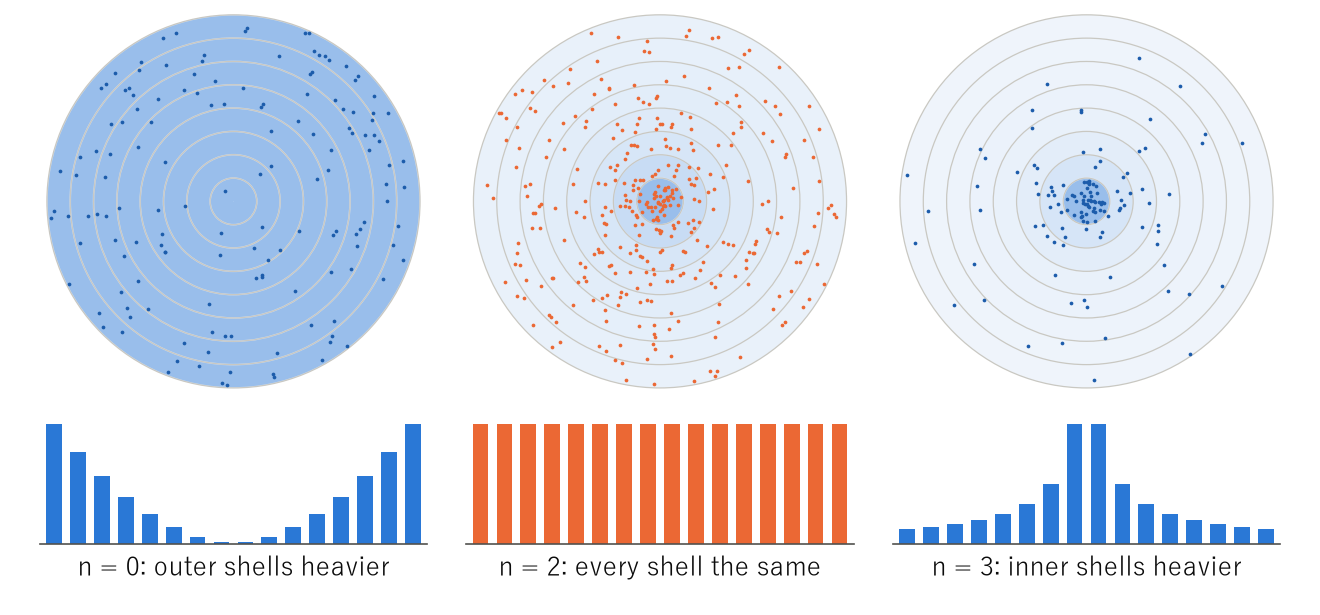
When n is below 2 the outer shells are heavier, and when it is above 2 the inner shells are heavier. At exactly 2, doubling the radius makes the area 4 times larger and the density 4 times smaller, so the weight of the shell does not change.
In my papers I have called this state, where the growth of the area and the fall of the density exactly cancel, zero tension (Paper 02). It is a word from the fishing I learned as a boy, and it means keeping the line neither taut nor slack.
The theorem and its three-line proof
In three-dimensional space, consider a distribution of density ρ(r) = 1/rn. The weight of the shell at radius r per unit thickness, dm/dr = 4πr2−n, takes the same value at every radius only for n = 2. That value is then 4π.
The weight of a shell is the product of its area 4πr² and the density.
$$\frac{dm}{dr}=4\pi r^{2}\,\rho(r)=4\pi\,r^{\,2-n}$$The proof takes three lines.
- Since 4π is not 0, we only need to ask whether r2−n is constant.
- At radius 1 its value is 1, and at radius 2 it is 22−n. A power of 2 equals 1 only when the exponent is 0, so if it is constant then 2 − n = 0.
- Conversely, if n = 2 then r⁰ = 1, and the value is 4π at every radius.
The answer is the same without assuming a power. If the shell weight 4πr²ρ(r) has the same value C at every radius, then ρ(r) = C/(4πr²) follows at once. Whatever form the density is allowed to take, only 1/r² remains.
But “at every radius” cannot be dropped. Among powers it is enough to compare radii 1 and 2, but if the form is left free and the demand is weakened to “the same whenever the radius is doubled”, infinitely many solutions that ripple with a logarithmic period get through (Paper 1053).
Nothing here is difficult. So why call it a theorem? Because the question points the other way.
| Direction | Question | Answer |
|---|---|---|
| Forward | How does the mass inside a ball of density 1/r² grow with the radius? | In proportion to the radius. Astrophysics knows this as the singular isothermal sphere |
| Inverse | Which exponent levels the shells? Is there any other? | Only 2 (Paper 01) |
The forward calculation is in the textbooks. But as far as I have been able to find, nobody had asked it the other way round, stated it as a theorem and started a body of work from it. I take the simplicity of the tool not as a weakness but as a sign that this direction had been left open.
2 and 4π are two names of the sphere
Only two numbers appear in the theorem: the exponent 2 and the shell weight 4π. Both come from the surface of the ball.
- 2 is the dimension of the surface. The surface of a ball is two-dimensional, so when the radius grows λ times, the area grows λ² times.
- 4π is the area of a sphere of radius 1. It is the same number as the solid angle of all directions.
So the theorem takes a solid ball and draws out the dimension and the area of its surface. Changing the dimension of space makes this easy to see.
| Space dimension d | Shape of a shell | Exponent n that levels the shells | Shell weight then |
|---|---|---|---|
| 1 | two points | 0 | 2 |
| 2 | circle | 1 | 2π = 6.283185 |
| 3 | sphere | 2 | 4π = 12.566371 |
| 4 | three-dimensional sphere | 3 | 2π² = 19.739209 |
| 5 | four-dimensional sphere | 4 | (8/3)π² = 26.318945 |
Each dimension has exactly one levelling exponent, and it is d − 1 (Paper 114). Punching holes in the surface does not move this exponent; only the dimension moves it (Paper 1052). 4π is the face this theorem shows in three dimensions.
Where the number 4π comes from, and how it is read in the equations of physics, is summarized in the article “What is m = 4π?” (in Japanese). Here I follow the theorem itself.
The ball becomes a straight tube
The special character of n = 2 shows in another way too. With the step in distance dr and the spread of directions dΩ, the weight inside a ball can be written dm = ρ r² dr dΩ. Put in ρ = 1/r², and r² disappears.
$$dm=\frac{1}{r^{2}}\;r^{2}\,dr\,d\Omega=dr\,d\Omega$$Distance and direction have come cleanly apart. Stretch all the shells to the same width, and the ball becomes a straight tube whose length is the radius and whose cross-section is the full range of directions. This is what “independent of the radius” amounts to.
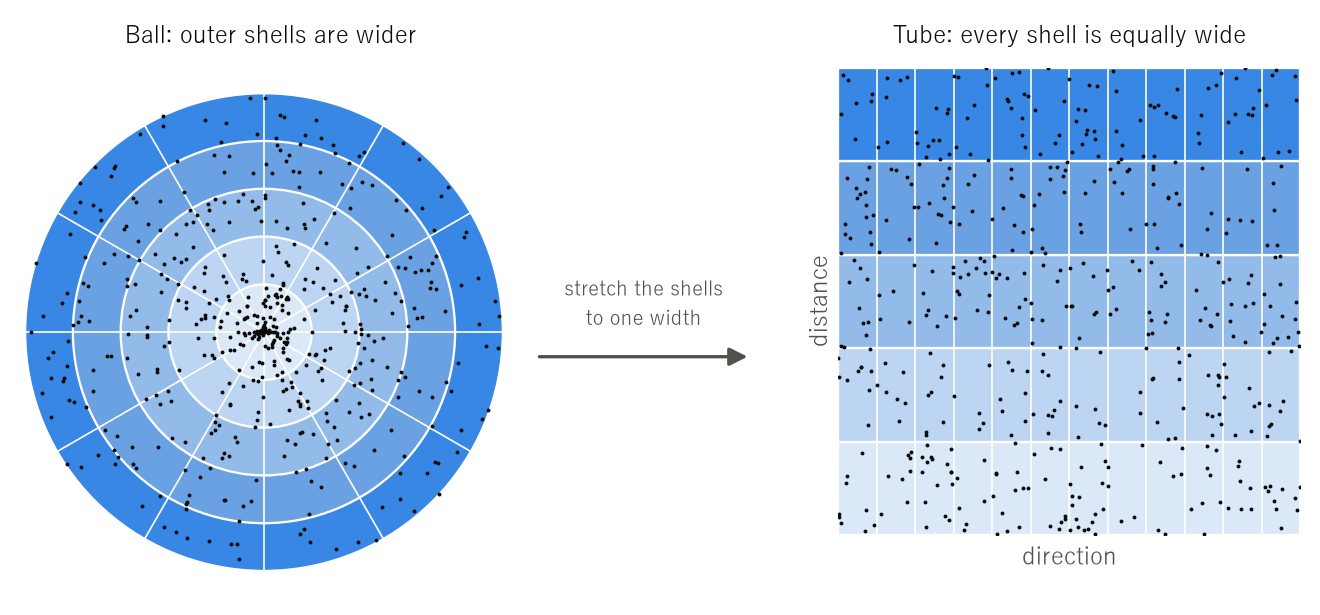
You can even make this with dice. Choose a direction at random and a distance evenly between 0 and 1, and mark a point: the density of the points is exactly 1/(4πr²). I checked this for this page with 4 million points. A thin shell at radius 0.905 had density 0.09707, against 0.09716 from the formula.
A field that wells up nowhere, and 4π for any shape
The theorem has another face. Place an arrow pointing away from the centre at every point of space, and make its length 1/rn. Calculate the quantity that measures how much this field wells up (the divergence), and the same 2 − n as in the theorem appears.
$$\nabla\cdot\frac{\hat{\mathbf r}}{r^{\,n}}=\frac{2-n}{r^{\,n+1}}$$Only for n = 2 does the field well up nowhere, apart from the single point at the centre. The flow through a surface then no longer depends on its shape or size. This is the content of Gauss’s law, and the theorem’s 4π is the same solid angle as the 4π in Gauss’s law and Coulomb’s law (Paper 13).
Try it in the figure below. This experiment is not in the papers; it was made for this page.
Grab the white circles and pull the surface into any shape you like. The gold point moves up and down, and can even leave the surface.

Here are the numbers side by side. For this page I integrated the flow of the field through each surface.
| n | sphere radius 1 | sphere radius 2 | cube half-edge 1 | cube half-edge 2 | lumpy bag |
|---|---|---|---|---|---|
| 1 | 12.566371 | 25.132741 | 15.348248 | 30.696497 | 10.053096 |
| 2 | 12.566371 | 12.566371 | 12.566371 | 12.566371 | 12.566371 |
| 3 | 12.566371 | 6.283185 | 10.445037 | 5.222519 | 20.705191 |
If the surface is star-shaped as seen from the centre, the reason takes one line. The flow through it can be written as an integral over directions of the distance R, ∫R2−ndΩ, and only for n = 2 does R vanish from the formula. What remains is ∫dΩ = 4π.
Given conservation, n = 2 appears of itself
Why is 1/r² so common in nature? The theorem gives one way of answering. Suppose something conserved streams out of a point in all directions at a constant speed. What a shell of thickness 1 contains is what left during one and the same length of time, so it neither grows nor shrinks as it travels outward. If the contents of a shell are the same at every radius, then by the theorem the concentration can only be 1/r².
Sunlight is like this. A shell 1 m thick spreading at the speed of light holds about 1.28×10¹⁸ J of energy at every radius. That number is the Sun’s luminosity divided by the speed of light.
The solar wind has the same form. The Sun sheds roughly 1 to 1.5 billion kg as wind every second, at a speed of about 400 km/s. A shell 1 m thick holds 2.5 to 3.75 tonnes, and wherever the speed can be taken as nearly constant, this weight does not change with the radius.
The theorem does not say why things are conserved. It only translates the fact of conservation into the number “exponent 2”. The cause lies with conservation, and the theorem is its interpreter. In Paper 01 I also restated the same condition in the language of screen pixels and rendering load. That part is a reading by metaphor.
The 2 survives in real clouds
The density of a real cloud is not 1/r² everywhere. Even so, the 2 does not vanish. Measure the slope of the density at each radius, and call n the local exponent if the density looks like 1/rn near that radius. The growth of the shell weight can then be written as the following identity.
$$\frac{d}{dr}\bigl(r^{2}\rho\bigr)=r\,\rho\,\bigl(2-n(r)\bigr)$$Here is 2 − n again. Where the local exponent is below 2, the shells get heavier going outward, and where it is above 2, they get lighter. The peak of the shell weight lies at the radius where the local exponent is exactly 2 (Paper 1096).
Choose a cloud and move your cursor or finger over the figure. At a peak, the lower curve crosses exactly 2.

Each of these peaks has a name of its own.
- The 1s electron cloud of hydrogen: the local exponent is 2r (taking the Bohr radius as 1), and the peak is at the Bohr radius. I searched all the peaks of eight states, and the local exponent was 2.000000 every time (Paper 1096).
- The halo around a galaxy (NFW shape): the local exponent goes from 1 at the centre to 3 far out. Astronomers write the radius where it equals 2 as r₋₂ and use it as a marker of the halo’s size. It is also known that the peak of r²ρ lies there.
- The speeds of gas molecules: counting the same shells in the space of velocities gives Maxwell’s distribution. The peak is the most probable speed √(2kT/m).
In each case the theorem’s 2 survives as “the one point that fixes a size”. The theorem itself is the state where this peak has spread out flat without end, so that every radius is a summit. That is why a 1/r² cloud has no marker of size. Check it with the “theorem’s cloud” button.
On the orbits: a ruler of exponents
Now consider something circling inside a ball of density 1/rn. The enclosed mass grows as r3−n, so the orbital speed v and the period T behave as follows.
$$v^{2}\propto r^{\,2-n},\qquad T^{2}\propto r^{\,n}$$The density exponent n has become the exponent of the period law. Kepler’s third law T² ∝ r³ is the case n = 3: when the mass gathers at the centre, the enclosed mass no longer depends on the radius, which in these formulas is the end point n = 3. The force of a spring is the force inside a uniform ball, n = 0.
| n | What kind of distribution | Enclosed mass | Orbital speed | Period squared | Force | Near point to far point |
|---|---|---|---|---|---|---|
| 0 | inside a uniform ball (spring) | r³ | r | constant | r | 90° |
| 1 | r² | r1/2 | r | constant | 103.9° | |
| 2 | the theorem’s distribution | r | constant | r² | 1/r | 127.3° |
| 3 | mass gathered at the centre (Kepler) | constant | r−1/2 | r³ | 1/r² | 180° |
The angles in the last column are for nearly circular orbits. Spring, theorem and Kepler now stand on one ruler.
The n = 2 row has the shape of galactic rotation. Rubin and Ford showed in 1970, in the Andromeda galaxy, that the orbital speed does not depend on the radius. Here the Solar System and the Milky Way are compared on the same T² scale.
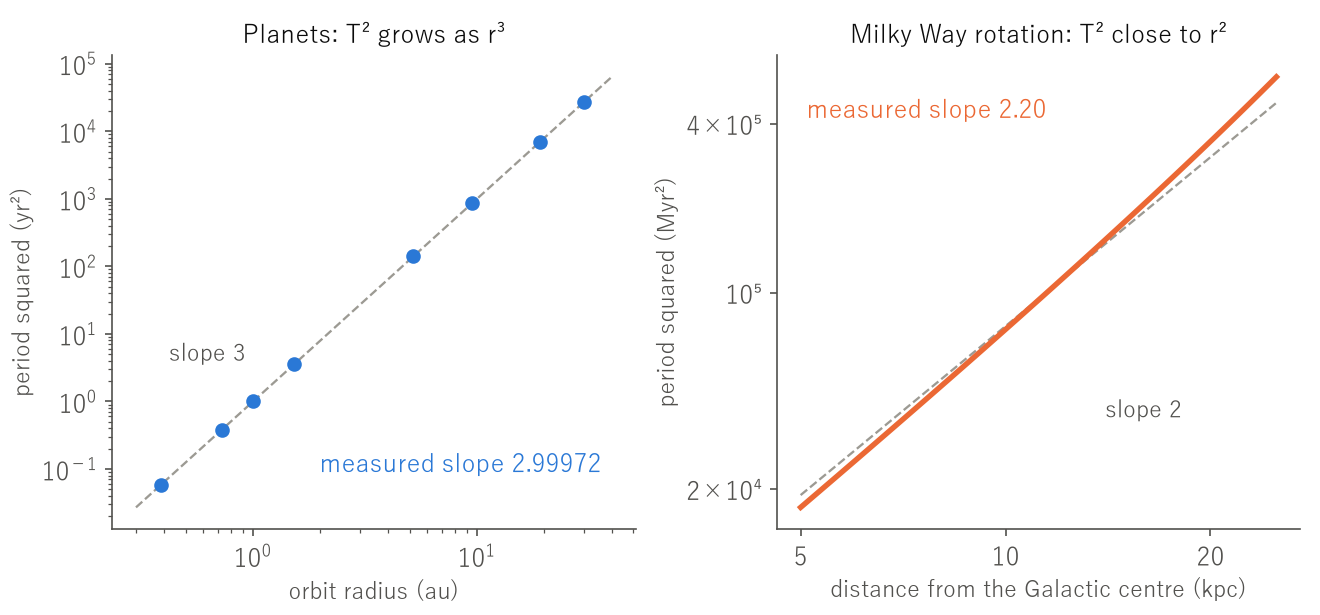
Reading the Milky Way as a ball, each parsec of shell thickness carries a mass of about 12 million suns, nearly the same at every radius. What flat rotation fixes is the density and the enclosed mass, not the whole of the arrangement inside (Paper 910). What that mass is made of is not asked here.
Change the exponent n and the launch speed. Moving the tip of the arrow up and down also changes the speed. The second panel is the mirror image.
- Form of the force
- Near point to far point
- Nearly circular orbits: 180°/√(4−n)
- Time average of speed squared
- Mirror partner

There are three things to look for in this experiment.
The first is the angle. On a nearly circular orbit, the angle swept from the near point to the far point is π/√(4−n). For n = 0, 2 and 3 it is 90°, 127.2792° and 180°. The angle for n = 2 is the geometric mean of the spring’s 90° and Kepler’s 180°. It is the same √2 as in the relation κ = √2 Ω that galactic dynamics uses for the frequency of oscillation where the rotation is flat.
The second is the average. The time average of the speed squared has the same value for orbits of every size and shape only when n = 2. However you change the speed in Experiment 4, the display stays at 1. In the calculation for this page, launch speeds of 0.4, 0.8 and 1.3 gave 1.00010, 1.00006 and 0.99988. For n = 1 the value moves: 0.72003, 0.87999 and 1.22994. This is the orbital face of the fact that the shell weight does not depend on the radius.
The third is the mirror. Square the ellipse of a spring using complex numbers, and it becomes the ellipse of Kepler. Bohlin wrote this down in 1911 and Kasner in 1913, and Arnold presented it in a book; I counted it in Paper 1072. Extended to power-law forces, it fixes pairs of forces. In terms of the density exponent, the relation is this.
$$(4-n)(4-N)=4$$The partner of n = 0 is N = 3, so spring and Kepler swap places. The partner of n = 1 is 8/3. And between 0 and 3, the exponent that is its own partner is n = 2. The values of 4 − n run 4, 2, 1, a geometric sequence, so n = 2 sits exactly at the centre of the mirror. I checked with six exponents that the mapped curve takes the shape of an orbit of the partner force: the residual was at most 2.41×10⁻¹¹, and when the partner exponent was deliberately shifted by 0.2 it jumped to at least 5.92×10⁻³. What the mirror carries is the shape of the orbit; time does not carry over unless it is measured anew.
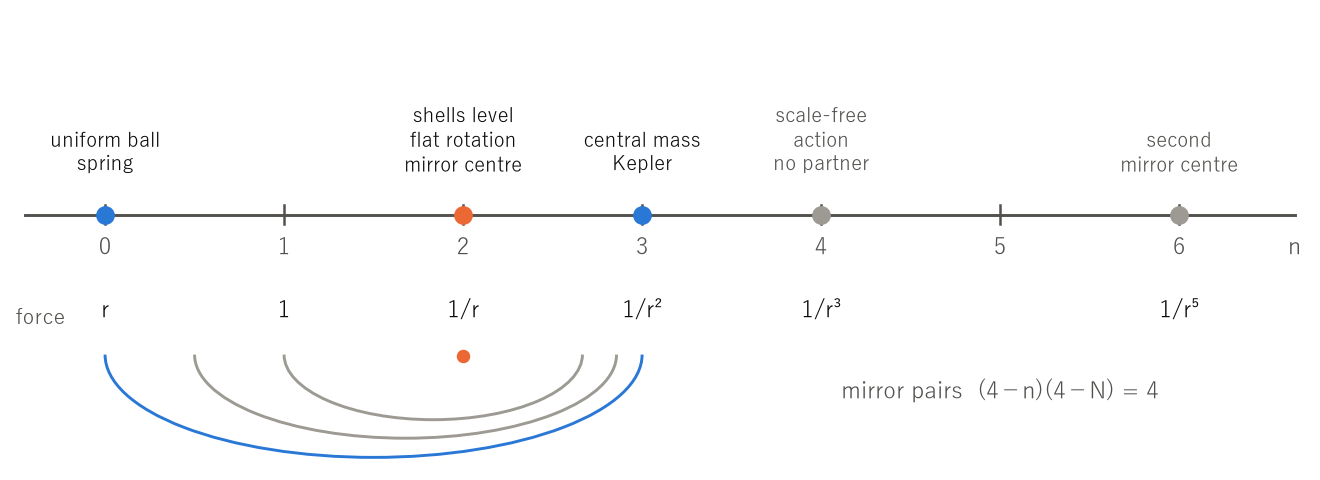
All orbits close only in the two cases of Bertrand’s theorem (1873), which are n = 0 and n = 3 on the ruler. The theorem’s n = 2 does not close. It sits at the centre of the mirror between the two that do.
2 is not one thing
So far I have written about various 2s as if they were the same. But by the rule of my papers, being the same number is not enough to say that two things share a root. You have to see what must be moved to make them different things. I call the thing moved a separator (Paper 300). Here the thing to move is the dimension of space.
Change the dimension of space with the slider. The blue lines move with the dimension; the gold lines do not.

- The 2 that moves with the dimension (d − 1): the exponent that levels the shells, the exponent of a field that wells up nowhere, the fall-off of the force from a point, the dimension of the sphere.
- The 2 that stays when the dimension moves: the exponent of flat rotation, the exponent of an isothermal ball of gas, the density exponent that gives the same balance as a black hole at every radius (Paper 1092), the centre of the mirror.
The flat-rotation exponent stays because the orbital speed squared varies as r2−n in every dimension. An isothermal ball of gas, too, solved as a power from the pressure balance, has n = 2 as its only solution in every dimension. That is because the product of the gravitational constant and the density is an inverse time squared in every dimension (Paper 1092).
The same thing happens with 3. The end point where the mass gathers at the centre moves with the dimension, and the inverse-square force that always closes does not. The two coincide only in three dimensions, so only in three dimensions do orbits under the gravity of a point always close.
Three dimensions is where the moving lines and the fixed lines cross in two places at once, at 2 and at 3. This is one of my reasons for calling this theorem the foundation. On a short theorem, numbers that come from the shape of the sphere and numbers that come from gravity and orbits overlap in this dimension alone. I do not merge the reasons for the overlap into one root. I keep them apart and say that they overlap.
Side by side with other theorems
I have drawn a map of the famous theorems as a whole in the article “Famous Theorems, Laid Out with Their Assumptions”. Here I compare in detail only the theorems on the same shelf as the uniqueness theorem.
Compared with Noether’s theorem
One of the most famous theorems in physics is Noether’s theorem (1918). Set side by side, the two clearly do different kinds of work.
| Noether’s theorem | The n = 2 uniqueness theorem | |
|---|---|---|
| What goes in | A continuous transformation that leaves the action unchanged (a symmetry) | The demand that the shell weight not depend on the radius |
| What comes out | A conserved quantity: what is conserved | An exponent: what value it has |
| Tools | The calculus of variations and the action | Only the area of a sphere |
| Laws of motion | Needed | Not needed |
| Type | Makes a correspondence (from symmetry to conserved quantity) | Selects (from the real numbers to one) |
| If broken | Break the symmetry and the matching quantity changes | Drop the demand and any exponent will do |
They are not rivals but different links of one chain. The 1/r² of light and wind connects in this order.
- Noether’s theoremIf the laws stay the same when time is shifted, energy is conserved
- Divergence theorem (Gauss’s theorem)If the flow is steady, the same amount passes through every shell
- The n = 2 uniqueness theoremIf every shell holds the same amount, the concentration can only be 1/r²
- Gauss’s lawThe coefficient of that field is 4π, and the potential is 1/r
Noether’s theorem says what is conserved, and the uniqueness theorem says what the exponent must be if it is conserved. The questions pass from one to the other exactly.
If a symmetry is fixed first, the Noether framework can also select an exponent. The action stays unchanged when distance is scaled by λ and time by λ² only if the potential is 1/r² and the force is 1/r³. This is the form of the model of de Alfaro, Fubini and Furlan (1976). It corresponds to n = 4 in Figure 3, which is also the exponent with no mirror partner. The number is again 2, but this is the 2 of a potential, a different root from the 2 of the theorem.
A line-up of selecting theorems
Like the uniqueness theorem, the theorems below select a few out of a wide field of candidates. What each one moves and what remains, and what happens when an assumption is removed, give each its character.
| Theorem | What is moved | Condition | What remains | If removed |
|---|---|---|---|---|
| n = 2 uniqueness theorem | Density exponent (all real numbers) | Shell weight independent of the radius | The single value 2 | Change the dimension and it moves to d − 1 |
| Converse of the shell theorem (Newton 1687, Gurzadyan 1985) | Force exponent | A spherical shell exerts the same force as a point at its centre | The two forces of inverse square and spring | In four dimensions the inverse square drops out and 1/r³ remains |
| Bertrand’s theorem (1873) | Form of the central force | All bound orbits close | The two forces of inverse square and spring | Does not move when the dimension changes |
| Ehrenfest (1917) | Dimension of space | Planetary orbits can circle stably | Three dimensions or fewer | Four or more have no stable orbits |
| Hurwitz’s theorem (1898) | Dimension of numbers | Multiplication preserves length | The four values 1, 2, 4, 8 | No three-dimensional numbers can be made |
| Birkhoff’s theorem (1923) | Spherically symmetric vacuum solutions | Einstein’s equations | The one Schwarzschild solution | Drop spherical symmetry and the solution is no longer unique |
| Lovelock’s theorem (1971, 1972) | Form of the equations of gravity | Four dimensions, no divergence, up to second order | Einstein’s equations (with a cosmological term) | In five or more dimensions other terms are allowed |
The shell theorem and Bertrand’s theorem ask different questions, yet leave the same two forces. But this too is an overlap of three dimensions. Integrating the force of a shell for this page, the ratio in three dimensions is 1.000000000 for the inverse square, while in four dimensions the inverse square falls to 0.900743404 and 1/r³ gives 1.000000000. The shell side moves with the dimension; the Bertrand side does not.
Seen in this line-up, the place of the uniqueness theorem is clear. One thing remains, the candidates are all the real numbers, and the only tool is the area of a sphere. And while the other theorems bring in laws of motion or field equations, the uniqueness theorem brings in no law at all. So it can be set before any of the others. That is why I made it my starting point.
Other theorems called “uniqueness theorems”
Textbooks of electromagnetism have a theorem of the same name: fixing the boundary values determines the solution of Poisson’s equation uniquely. General relativity has theorems saying that the form of a black hole is determined by a few quantities. Both are theorems of the type “the solution is unique”. What my theorem makes unique is not a solution but an exponent.
What is known, and where my own work begins
Here I want to be exact.
- What is known: that mass is proportional to the radius in a 1/r² distribution (the singular isothermal sphere); Gauss’s law; the fundamental solution of Laplace’s equation; Bertrand’s theorem; that the peak of r²ρ lies where the slope is −2; the map between spring and Kepler; that the exponent of the period follows from scaling (mechanical similarity).
- What my papers added: fixing the exponent as a theorem from the single condition that the shell weight is uniform (Paper 01); the staircase m(n) = 4π/(3−n) and the number of layers of 4π (Papers 01 and 02); restating the peaks of electron clouds with the local exponent (Paper 1096); separating the 2 of the shell from the 2 of the horizon balance (Paper 1092).
- What this page newly organizes: reading n as the exponent of the period and putting spring, theorem and Kepler on one ruler; that the centre of the mirror is n = 2 and that the angle there is a geometric mean; reading the orbit-independent average of the speed squared as a face of n = 2; moving the dimension and putting the crossings of 2 and 3 on one page. All the formulas are rearrangements of known ones, and none of this has yet been written up as a paper.
No new law of physics is claimed. The theorem says nothing about the cause of gravity’s inverse square, or about the nature of dark matter. The value m = 4π is the value under the choice of units that sets the density coefficient and the radius to 1.
Within the corpus
At the end of October 2026 I have 1,103 papers. Of these, 70 list Paper 01 among their references, and 21 name the “uniqueness theorem” in their text. I counted the 70 by reading the references one entry at a time.
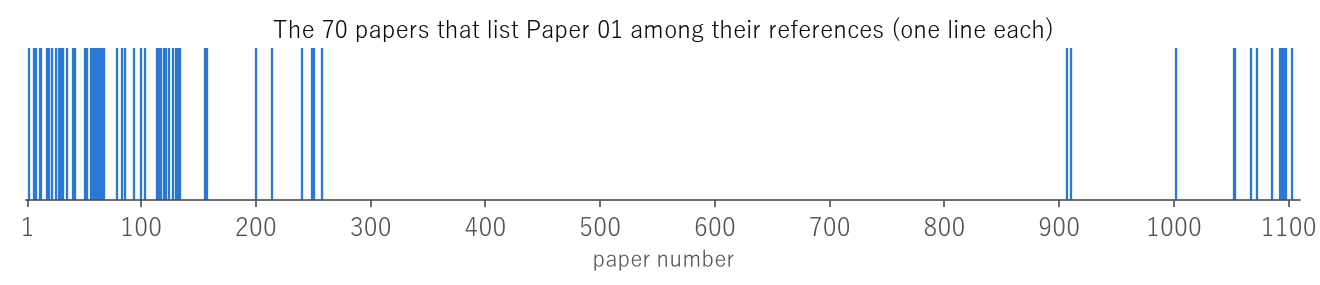
When something strange comes up, I go back to this theorem. If you want to read further, I suggest this order.
- Paper 01, “The Uniqueness Theorem of n = 2 for Spherically Symmetric Density Distributions”: the theorem itself.
- Paper 02, “The 4π Mass Cancellation Theorem”: the same fact written from the side of the integral.
- Paper 79, “The Hidden Symmetry Unique to n=2”: why inverse-square orbits close.
- Paper 114, “Which Objects Know They Are in Four Dimensions?”: that n = d − 1 exists in every dimension.
- Paper 117, “Scale Invariance Fixes an Exponent — in Four Different Ways”: separating the ways in which exponents of the same look are selected.
- Paper 157, “A Census of the Twos”: examining the 2s of the corpus with a single test.
- Paper 910, “A Flat Rotation Curve Fixes the Density There and Imposes Only the Enclosed Mass on the Inside”.
- Paper 1052, “Two Kinds of Subtracting One: One Counts Holes, the Other Counts Dimensions”.
- Paper 1053, “Weakening Scale Invariance to a Single Ratio Loses the Uniqueness of the Exponent”.
- Paper 1072, “Squaring the Ellipse of a Spring Gives the Ellipse of Kepler”.
- Paper 1092, “The ‘2’ of the Inverse-Square Density Is Two 2s, and the 2 of the Shell Mass Meets the 2 of the Horizon Balance Only in Three Dimensions”.
- Paper 1096, “The Weight per Skin of the Electron Cloud Peaks Where Its Local Exponent Is Exactly 2, and for Circular States That Radius Is Bohr’s n²”.
The full text of Paper 01 and a graph in which n can be moved are also on the theorem page of the paper archive. Articles that carry the same exponent over to surfaces and maps are “A Map of Inverse-Square Laws” and “Add Up the Dots on Graph Paper, and the Answer Depends on the Shape”. The 4π of the shell is read inside the proof of the Poincaré conjecture in “Reading the Poincaré Conjecture from the Uniqueness Theorem”.
Questions
Is this a proof of the inverse-square law?
No. What the theorem says is a fact of geometry: if the contents of a shell do not depend on the radius, the concentration is 1/r². Why gravity or light spreads as a conserved flow lies outside the theorem. Given conservation and three dimensions, this theorem fixes the exponent at 2.
Why call a one-line calculation a theorem?
Because the question points the other way. It does not ask “what happens with 1/r²?” but “what exponent levels the shells, and is there any other?”, and it shows that there is exactly one. I believe the weight of a theorem is set not by the length of its calculation but by what comes out of it.
Wasn’t this already known as the singular isothermal sphere?
Yes. The 1/r² distribution itself was known. The singular isothermal sphere of astrophysics has the form ρ = σ²/(2πGr²). What I added is to state it as the one exponent selected by the uniformity of the shells, to read it as a family across dimensions, and to place it at the start of the corpus.
Why is three dimensions special?
The theorem itself does not select three dimensions; every dimension has its exponent d − 1. What is special is that only in three dimensions does this exponent coincide with the dimension-independent 2 and 3. You can check this in Experiment 5.
How does this differ from the article “What is m = 4π?”
That article covers where the number 4π comes from and how it is read in the equations of physics. This page covers the theorem that stands before it, and how the theorem connects with other theorems and phenomena.
How far can the calculations in the figures be trusted?
The experiments calculate on the spot in your browser. The steps of the integrals and orbits are coarse, so the last digits move. The numbers in the text and tables were calculated separately at high precision.
Papers and sources
All the papers are published under CC BY 4.0. The record of Paper 01 is on its YOI record page.
These are the main sources checked for this page.
- Archimedes, On the Sphere and Cylinder: the area of a sphere is four times that of its great circle.
- Kepler, J. (1604). Ad Vitellionem paralipomena, quibus astronomiae pars optica traditur: the intensity of light and the square of the distance.
- Newton, I. (1687). Philosophiae Naturalis Principia Mathematica, Book I, Propositions 70 and 71: the shell theorem.
- Gauss, C. F. (1840). Allgemeine Lehrsätze in Beziehung auf die im verkehrten Verhältnisse des Quadrats der Entfernung wirkenden Anziehungs- und Abstoßungs-Kräfte.
- Bertrand, J. (1873). Théorème relatif au mouvement d’un point attiré vers un centre fixe. Comptes Rendus.
- Hurwitz, A. (1898): the theorem on composition algebras.
- Bohlin, K. (1911), Kasner, E. (1913), Arnold, V. I. (1990). Huygens and Barrow, Newton and Hooke: the map between spring and Kepler.
- Ehrenfest, P. (1917). In what way does it become manifest in the fundamental laws of physics that space has three dimensions?
- Noether, E. (1918). Invariante Variationsprobleme.
- Birkhoff, G. D. (1923). Relativity and Modern Physics.
- Chandrasekhar, S. (1939). An Introduction to the Study of Stellar Structure; Binney, J. & Tremaine, S. (2008). Galactic Dynamics: isothermal spheres and rotation.
- Rubin, V. C. & Ford, W. K. (1970). Rotation of the Andromeda Nebula from a Spectroscopic Survey of Emission Regions.
- Lovelock, D. (1971, 1972): the uniqueness of the Einstein tensor.
- Landau, L. D. & Lifshitz, E. M. Mechanics, §10: mechanical similarity.
- de Alfaro, V., Fubini, S. & Furlan, G. (1976): conformal mechanics of the inverse-square potential.
- Gurzadyan, V. G. (1985). The cosmological constant in the McCrea-Milne cosmological scheme.
- Navarro, J. F., Frenk, C. S. & White, S. D. M. (1996, 1997): the NFW shape.
- Mishra, W. et al. (2019): the mass loss of the solar wind (1 to 1.5 billion kg per second).
- Eilers, A.-C., Hogg, D. W., Rix, H.-W. & Ness, M. K. (2019). The Circular Velocity Curve of the Milky Way from 5 to 25 kpc.