A tackle box gets messier the longer you use it. Hooks of similar shape and lures of the same colour end up in one compartment, although they were really meant for different kinds of fishing.
Physics has something of the same problem. The 2 of the inverse-square law, the 2 of least squares, the 2 of quantum probability. The 4π of Gauss’s law, the 4π of the diffusion formula, the 4π of E=4πc². The same number, the same symbol, the same name turns up all over the textbooks, and it looks as if one reason lies behind them all.
Comparing them by eye will not tell you whether they really are the same. You have to move something and see whether only one of them moves. If only one moves, they are different things. In my papers, the thing you move is called a separator. Two things found to come from different sources have distinct roots; two that share a source have the same root.
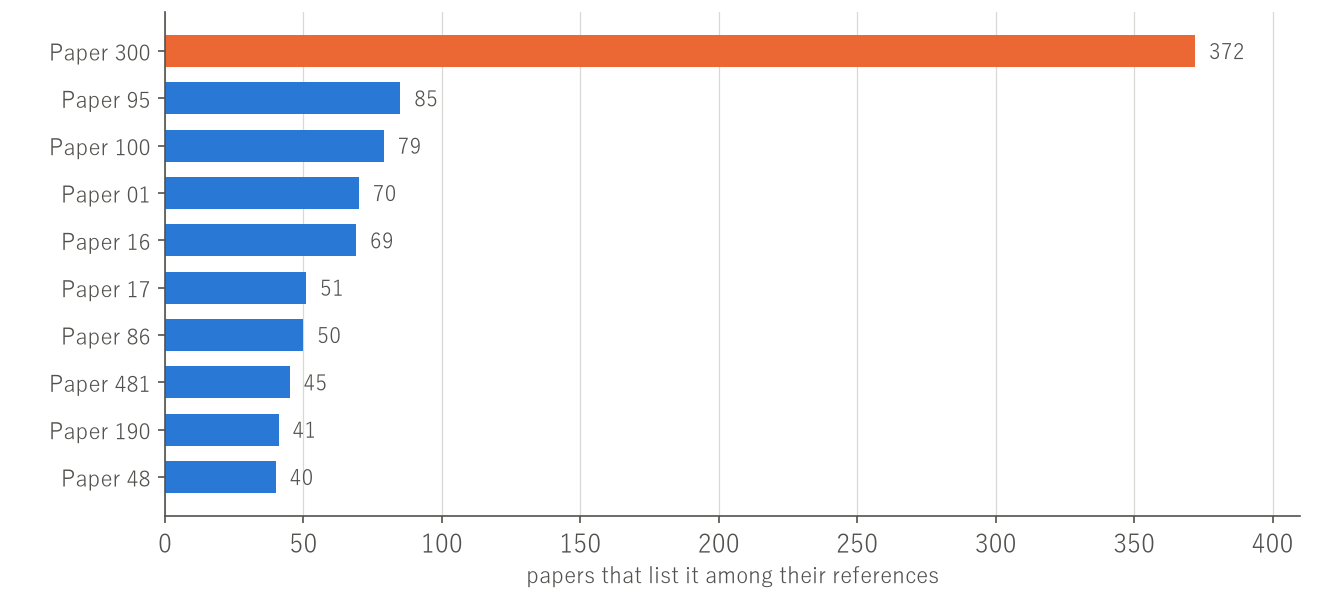
Separators appear in 949 of my 1,103 papers. Paper 300, which gathered the criteria for this judgement in one place, is the most cited of all my papers: 372 of them list it among their references. But the word is my own coinage and hard going for a first-time visitor. On this page I explain the tool from the beginning, with sliders you can move.
This article summarizes papers that I published myself as preprints; they have not been peer reviewed. The interactive figures and the numbers calculated specially for this page are marked as such where they appear.
Three terms
- Separator
- For two things that look the same: what has to be moved before they behave differently. A separator is that thing. It is stated in one sentence, in the form “the separator is whether … or …”. In my Japanese papers the word is bunrishi.
- Distinct roots
- The number or the look is the same, but the source (the root) is different. In Japanese, bekkon.
- The same root
- Two things met in different places really do share one source. In Japanese, dōkon.
Key points
- The same number, the same name or the same form does not make two things the same. The starting point is that numerical agreement alone does not count as the same root.
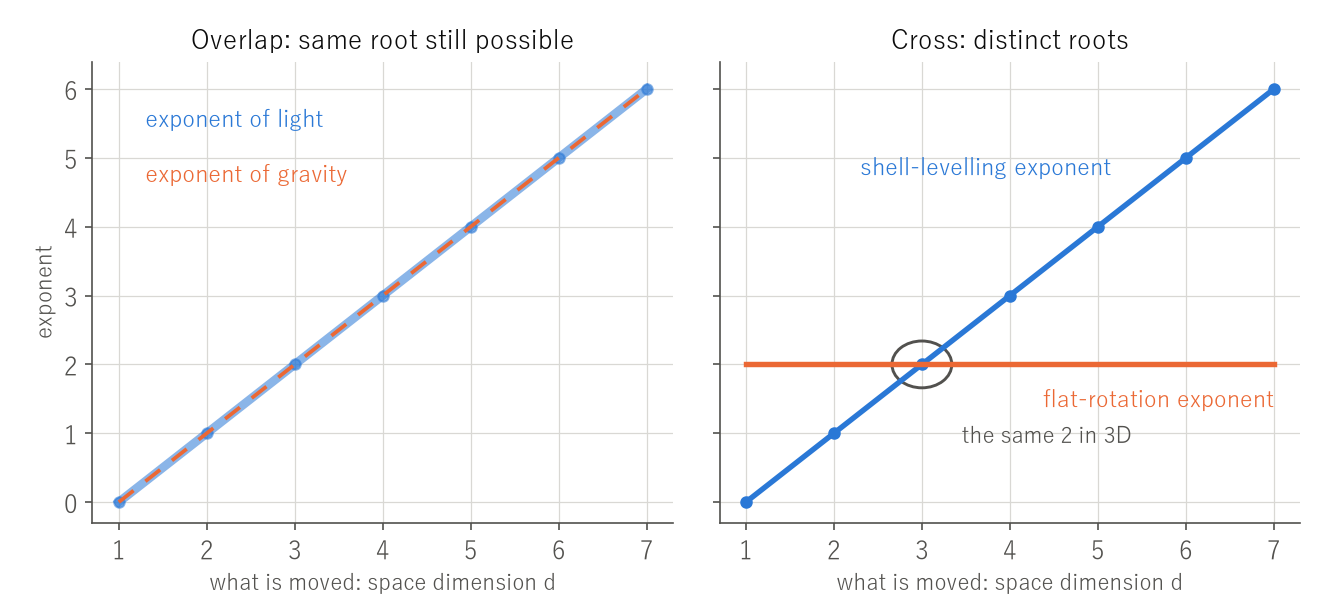
- Move something. If the two lines stay together, the same root remains possible; if they cross and part, the roots are distinct.
- A separator cannot be placed wherever you like. It is the split you find when you shake the box.
- “It does not move” needs an object. Some numbers do not move with the units, yet move with energy.
- Numerical agreement is cheap. Allow more formulas and any number gets hit.
- The answer can be yes as well as no. If it were always no, it would be a premise, not a judgement.
- The tool can slip. In my own inspection, one separator in five was not working.
- Try it on the Moon
- Defined by two lines
- Shake the tackle box
- One name, two things
- Unmoved by what?
- Agreement is cheap
- When the answer is yes
- How to use it
- A record of slipping
- Similar ideas
- Known, and mine
- Within the corpus
- Questions
- Papers and sources
Try it on the Moon and the Sun
Look up, and the Moon and the Sun are almost the same size. That is why the Moon can just cover the Sun in a total eclipse. The Sun is about 400 times wider than the Moon and also about 389 times farther away. Is there some deep reason why these two ratios are so close?
Let us move something and see. The Moon is now drawing away from the Earth by about 3.8 cm a year, so a knob called the era changes how large it looks. Try it in the figure below.
Choose a pair, then move the slider or run your finger across the figure. Watch whether the lines part or stay together.
- apparent diameter of the Moon
- apparent diameter of the Sun
- difference
Only the Moon’s line moved. Run backwards at the present rate, the two lines cross about 280 million years ago. Today the Moon looks 0.97 times as large as the Sun, and we simply happen to live near the crossing. There is no common reason for their similar sizes. The two have distinct roots, and the separator is the era.
The buttons switch to pairs from physics.
- Two 2s: the exponent that levels the weight of spherical shells and the exponent of flat galactic rotation are both 2 in three dimensions. Move the dimension and only one moves (Paper 1092; the uniqueness theorem page).
- Two “one fewer”s: the links joining a row of beads are one fewer than the beads, and the shell exponent is one fewer than the dimension. But make the row into a ring and only one moves. One was counting holes, the other dimensions (Paper 1052).
- Field and spectral line: a single spectral line of an atom splits into three in a magnetic field (the Zeeman effect). Different states had been lying on top of each other.
- Light and gravity: the exponent of light thinning out and the exponent of point gravity weakening move together when the dimension changes. The lines do not part.
- Adsorption and electrons: Langmuir adsorption from surface chemistry and the Fermi distribution from solid-state physics. A change of variable makes the difference 0 (Paper 284).
Defined by two lines
All of this fits into one picture.
Take two quantities that show the same value or the same form, and move one of the conditions. If only one of them moves, or the two move apart, they have distinct roots. The condition that was moved is called their separator.
A numerical agreement looks at a single point on a line. If you stand where two lines cross, different lines show the same value. The only way to see the lines themselves is to move. In the words of Paper 300, a separator answers “what must be moved for same and distinct to exchange?”
A separator is stated in one sentence, in the form “the separator is whether … or …”. Here are some from actual papers.
| Paper | What was split | Separator |
|---|---|---|
| Paper 1052 | two kinds of “one fewer” | whether it moves when the topology is changed |
| Paper 1055 | the digits of the speed of light being near 300 million | whether the digits move when the units are changed |
| Paper 1056 | how the fine-structure constant moves | whether the number moves when the units change or when the energy changes |
| Paper 1058 | two kinds of “exact” | whether a quantity has a dimension, is an integer, or is neither |
| Paper 1092 | the two 2s of the density 1/r² | the dimension of space |
| Paper 284 | the family of adsorption formulas | whether the number of seats is finite |
| Paper 1102 | soap film and chain | whether a length constraint gives the freedom to shift up and down |
| Paper 1104 | the bend of a sheet of paper and the bend of the Earth | whether a curvature is fixed by lengths within the surface or seen from outside |
A separator does its work where look and root disagree. In a table, those are these two cells.
| Same root | Distinct roots | |
|---|---|---|
| Same look | the 1/r² of light and the 1/r² of gravity | the shell 2 and the rotation 2; Moon and Sun |
| Different look | Langmuir adsorption and the Fermi distribution | the ordinary case, with nothing to split |
Shake the tackle box
Imagine a box with no partitions and six tokens marked 2 inside. Each is a 2 that appears in physics or mathematics as a “square”. In Paper 157 I put one question to them: what must be moved for that 2 to move? The box below does the same.
Move the three sliders. “Shake the box” moves all three at once.

- The inverse-square 2: the 2 of 1/r² for light and gravity. It moves with the dimension of space.
- The least-squares 2: the square used when fitting a line through data. It moves with the assumed shape of the errors. With the heavy-tailed Cauchy distribution, the error using squares swelled to 128.3741, while the error using absolute values stayed at 0.2632.
- The Itô 2: the square of the jitter of Brownian motion. It moves with the roughness of the path.
- The Born 2: the 2 in quantum probability being the square of the amplitude. The total is preserved under the transformation only for squares, so there is nowhere for it to move.
- The Clifford 2: a 2 in the very definition of the algebra. There is no parameter to move.
- The flat-rotation 2: the exponent of galactic rotation. It stays put when the dimension of space moves.
Shake the box, and the tokens go to their own rooms and partitions appear. This is the important part. I did not put those partitions where I chose. The box was shaken, and that is where it split.
A classification can use any axis you like. A separator cannot. If you slide in a partition and both sides behave alike, it separates nothing and has to come out again. A separator is not placed; it is found.
Notice the three tokens that did not move, too. They have not been shown to share a root. All we know is that these three knobs did not split them.
One name, two things: the speed of a wave
Numbers are not the only things that can be split. Names can be too. “Wave speed” actually covers two speeds: the speed of a crest (phase velocity) and the speed of the packet (group velocity). For light in a vacuum they are equal, so one word is enough.
The thing to move is the relation between the frequency ω and the wavenumber k. If ω is proportional to k to the power s, the group velocity is s times the phase velocity.
Move s. The gold dot is one crest; the triangle marks the centre of the packet.
- group velocity ÷ phase velocity

In deep water, the packet moves at half the speed of the crests. In a matter wave it is the reverse, twice the speed. The two lines cross at s = 1, and we can say “wave speed” in one word only when we are talking about that crossing. The separator is whether the speed of a wave depends on its wavelength.
“It does not move” needs an object
There is more than one knob. The digits of the speed of light, 299,792,458, and the inverse fine-structure constant, 137.035999177, both look like awkward numbers. Are they awkward in the same way? Try two knobs.
Press a button to switch to that condition. The rows that moved change colour.
| Quantity | Value now | What moves it |
|---|---|---|
| digits of the speed of light | 299,792,458 | the units |
| inverse fine-structure constant | 137.035999177 | the energy |
| proton-to-electron mass ratio | 1836.152673 | neither |
| step number of the quantum Hall effect | 1 | an integer, with no values in between |
The digits of the speed of light move with the units, because they are a record of human rulers (Paper 1055). 137 does not move with the units, but with energy it moves to 128.939785 (Paper 1056). The mass ratio moves with neither. The step number is an integer and cannot take values in between as things are changed continuously (Paper 1058).
Saying “this number does not move” means nothing by itself. It becomes a judgement only when you say what it does not move with. Two things that one knob cannot split are often split by another.
Numerical agreement is cheap
Even so, when numbers match exactly, it feels as if there must be a reason. The feeling is very strong. Eddington derived 136 for the inverse fine-structure constant, and when measurement turned out closer to 137 he added one (Paper 101). So how easy is a numerical agreement to come by? Count for yourself.
Choose a target or type any number. Widening the tolerance or adding formulas makes more of them hit.
- formulas tried
- mean of 40 random targets

Counted over the same 10,769 formulas as Paper 1056, 16 formulas hit 1/α within a tolerance of 1 percent. The mean for 40 random targets is 15.00, almost the same. At 5 percent the figures are 81 and 77.18. What sets the number of hits is not the target but the number of formulas and the width of the tolerance.
Narrow the tolerance to 0.0263 percent, the distance of 1/α from 137, and the hits fall to 0. Raise the formulas to 61,684 and (47/6)·π5/2 = 137.031777 hits. It looks as if it might mean something, but random targets also get 1.08 hits on average.
Of course, not every agreement is an accident. Balmer’s formula for the spectral lines of hydrogen (1885) looked like number-matching, and Bohr (1913) found its root. The Titius–Bode law for planetary distances failed at Neptune. At the moment of discovery the two look alike. To tell them apart, one has to examine not the agreement but what produced it.
When the answer is yes
You might think a separator is a tool for saying “these are different”. It is not. When I counted in Paper 300, of the 298 papers before it, 43 had answered “distinct roots” and 23 “the same root”. The ratio is 1.87 to 1, and 6 papers did both. If the answer were always no, it would be a premise, not a judgement. That there are two kinds of answer is the evidence that a judgement is being made.
Here are some examples of yes.
- The π of solid angle and the π of the Gaussian integral have the same root: they move together when the dimension moves. The π of Ramanujan’s series, by contrast, has no dimension to move (Paper 31).
- The 2π of the Unruh effect and of Hawking radiation have the same root (Paper 142).
- The 4π in the rate at which a cell captures molecules has the same root as the 4π of Gauss’s law, because the equation is the same (Paper 249).
- Langmuir adsorption and the Fermi distribution have the same root: a seat is either empty or holds one (Paper 284).
To say yes, it is not enough that the lines appear to overlap, because a knob that fails to split two things may be followed by one that succeeds. Paper 300 gathered five criteria that had been scattered through the corpus.
| Criterion | What it looks at | What it demands |
|---|---|---|
| Moving a variable (Papers 31, 36, 101) | whether the agreement lasts when things are moved | not one point, but under motion |
| A correspondence preserving identity (Paper 56) | whether there is a correspondence between the objects | not values, but a correspondence |
| The path (Paper 279) | which derivation it came from | not the result, but the route |
| What a quantity carries (Paper 116) | properties such as the mass dimension | not the number, but the dimension |
| The count of maps (Paper 153) | what was dropped | not the look, but what was dropped |
Here is one example of what a quantity carries. The 4π of solid angle has no units. The 4π put in for the m of E=mc² (E=4πc²) carries the units of mass. The number is the same, but the seat is different, so the roots are distinct (Paper 60).
The five do not say the same thing. But none of them accepts “the values agree” as evidence. The strongest form is the definition in Paper 56, which states that numerical agreement alone does not count as the same root. What one examines is not the agreement but what produced it. Whether the five can be folded into one, Paper 300 left open: to ask whether criteria share a root, you need a criterion.
How to use it: five steps
- List everything called by the same name, number or form.
- For each, write what has to be moved for its value or form to change: the dimension of space, the choice of units, boundary conditions, ratios of size, ways of counting, and so on.
- Actually move it. If the answers part, what you moved is the separator. State it in one sentence.
- Give the parted things separate labels.
- If they do not part, keep them as candidates for the same root and check them by path or correspondence. Write down separately what can and cannot be said.
The procedure is not limited to physics. Whenever you wonder whether two things called by one word are really the same, it applies, in any field. An AI can help too: the MCP server of my papers contains this procedure under the name bunrishi.
The tool slips
Use the same tool a thousand times and it wears. Every hundred papers I run a census, counting my own papers by machine, and the separator went through that inspection too.
In Paper 600 I read the 39 papers numbered 501 to 599 that answered “the same root”. Of these, 30 (0.769231) were calling two results of a single formula the same root. If both come from one formula they could never have had distinct roots, so no judgement had been made. On the other hand, there was not a single case of what Paper 300 had feared, the same root on numerical agreement alone.
In Paper 700 I read the 188 separators that could be extracted. Of these, 32 (0.206452) used only words already in the title, and 28 of them (0.875000) merely restated it. In a paper titled “X is two things”, the separator “X splits into two” separates nothing. So I added a rule: a separator must contain at least one word that is not in the title.
Try telling which ones work and which ones slip.
Answer each one with the buttons.
A paper titled “Mass is two things”, with the separator “that mass splits into two”.
It restates the title. It does not say what has to be moved.
The separator of the digits of the speed of light and 137: “whether the number moves when the units are changed”.
What is moved is named, and only one of them actually moves.
“Energy and momentum come from the same formula, so they have the same root.”
Things known to come from one formula could never have had distinct roots. No judgement was made.
“Both come to 12.566, so the two 4πs have the same root.”
That is numerical agreement alone. Nothing was moved.
The separator of the two speeds: “whether the speed of a wave depends on its wavelength”.
Where it does not depend, the two overlap; where it does, they part.
Side by side with similar ideas
The procedure of moving something to check it is not my invention. It is ordinary science, and it has long had several names. Set side by side, they show where the separator sits.
| Name | What is moved | What it tells | How the separator differs |
|---|---|---|---|
| Mill’s methods of difference and concomitant variation (1843) | one circumstance | a candidate cause | Mill looks for causes. The separator asks whether two things are the same thing |
| Intervention (Pearl) | a variable fixed from outside, do(x) | correlation or causation | The same split between seeing and moving. The separator is also used on formulas and constants |
| Lifting a degeneracy (Zeeman 1896) | an outside force such as a magnetic field | that states of equal energy are different | A separator at work inside physics itself |
| Leibniz’s law | nothing moved; properties compared | same properties, same thing; a different property, different things | One differing property is enough. The separator names that one |
| Point-separating functions (Stone–Weierstrass theorem) | a family of functions | whether any two points can be told apart | A mathematical condition for having enough tools to tell things apart |
| Separator in category theory | arrows out of an object S | whether two arrows are equal | The same name and the same shape. My word is used to part the sources of quantities |
The last row even shares the word. In category theory, an object S is called a separator if comparing through arrows out of S is enough to tell two arrows apart. The shape of the idea, that a test which tells two things apart makes them different, was already inside mathematics.
What is known, and where my own work begins
- What is known: the procedure of changing a condition and watching the result; the ideas in the table above; the facts of physics and mathematics used on this page (the Zeeman effect, phase and group velocity, Gauss’s law and so on).
- What my papers added: the name separator and the one-sentence form; the rule that every paper states its separator (every paper from number 301 on has one); gathering five criteria for the same root (Paper 300); checking with my own counts whether it works, and changing the rule (Paper 600 and Paper 700); each individual split (the census of 2s, the speed of light and 137, “one fewer” and others).
- What this page newly organizes: the picture of lines that overlap or cross, the example of the Moon and the Sun, the box that is shaken, the form of the number-matching machine. The formulas are all rearrangements of known ones, and none of this has yet been written up as a paper.
A separator tells you whether two things are different. It does not tell you why a value is what it is. I have no answer to why 137 is 137. No new law of physics is claimed.
Within the corpus
At the end of October 2026 I have 1,103 papers. Counted in the Japanese body text, leaving out the references, separator appears in 949 papers (5,296 times), distinct roots in 543 (2,135 times) and same root in 387 (1,029 times). The first separator is in Paper 23, and from number 301 on there is not one exception.
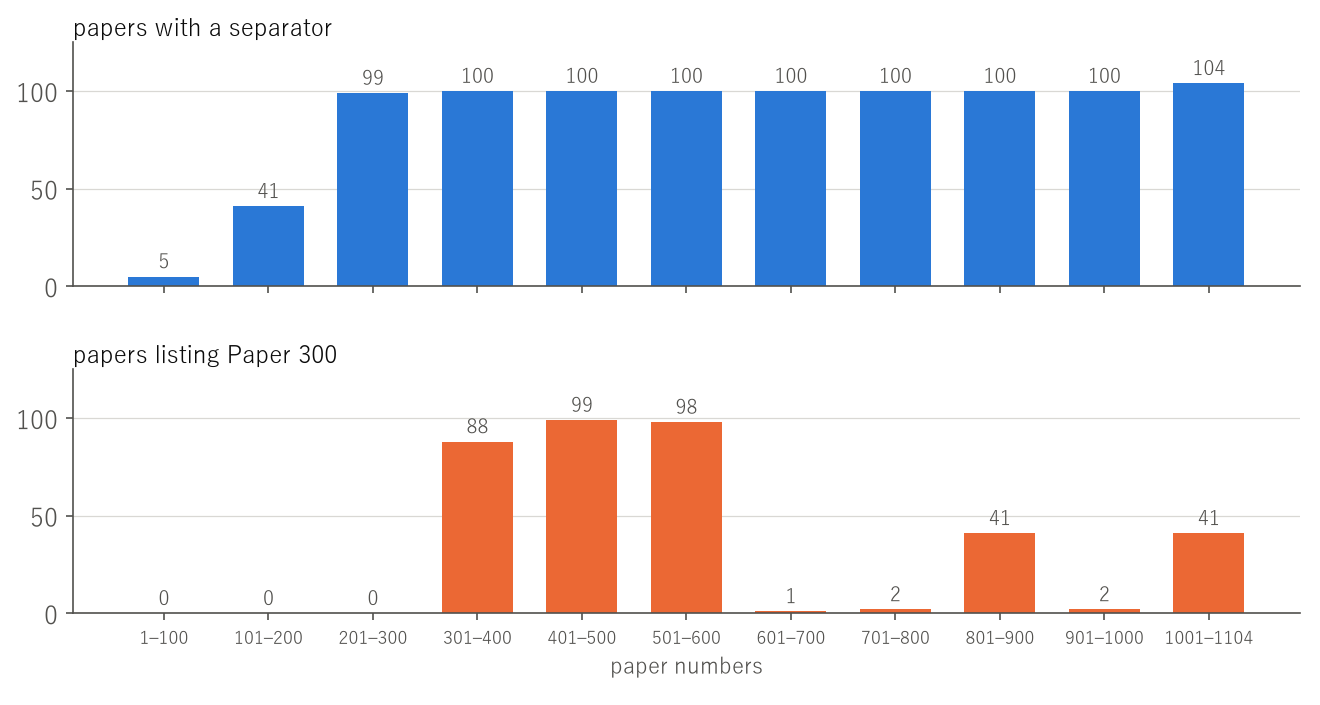
372 papers list Paper 300 among their references, 33.7 percent of the whole. Counted by reading the references one entry at a time, that is 4.38 times the 85 of Paper 95 in second place.
If you want to read further, I suggest this order.
- Paper 300, “The Three Hundredth Census: Whether Two Things Share a Root Is Decidable”: the gathering of the criteria.
- Paper 56, “A Structural Study of the 4π Patch”: the definition that numerical agreement alone is not the same root.
- Paper 100, “The Crossing of Royal Roads”: the rule that one word can have several distinct roots.
- Paper 16, “The Equals Sign Has Distinct Roots Too”: the equals sign split into six.
- Paper 157, “A Census of the Twos”: the source of Experiment 2.
- Paper 600, “The Six Hundredth Census”, and Paper 700, “The Seven Hundredth Census”: inspections of the tool itself.
- Paper 1052, “Two Kinds of Subtracting One: One Counts Holes, the Other Counts Dimensions”.
- Paper 1055, “The Speed of Light Is Near Three Hundred Million Because Length Is Decimal and Time Is Sexagesimal”.
- Paper 1056, “The Fine-Structure Constant Does Not Move with the Units, but It Moves with Energy”.
- Paper 1058, “There Are Two Kinds of Exactness: One Is Set by the Units, the Other Is Unmoved by Continuous Deformation”.
Related essays are on note (in Japanese): on the separator, on 4π, on the digits of the speed of light, on 137 and on units.
Questions
How are the Japanese words said?
In my Japanese papers, separator is bunrishi, distinct roots is bekkon, and the same root is dōkon. The English papers use separator, distinct roots and the same root.
How is this different from classification?
A classification can use any axis you like. A separator can sit only where things actually split when moved. If they do not split, that axis is not a separator.
If two things have distinct roots, are they unrelated?
No. It only means that their sources differ. That two distinct roots coincide at one place can itself mean something. The coincidence of 2 and 3 in three dimensions is discussed on the uniqueness theorem page.
If no separator is found, do they have the same root?
No. One simply was not found. The same root remains a candidate. To claim it, you show the path of derivation or a correspondence.
Is every numerical agreement an accident?
No. Some, like Balmer’s formula, turn out to have a root. An agreement is a reason to investigate, not evidence of the same root.
Has this anything to do with battery separators?
No. “Separator” is a common word in many fields. On this page it is a word for parting the sources of two things that look the same.
Papers and sources
All the papers are published under CC BY 4.0. The record of Paper 300 is on its YOI record page.
These are the main sources checked for this page.
- Mill, J. S. (1843). A System of Logic: the methods of difference and concomitant variation.
- Leibniz, G. W. (1686). Discours de métaphysique, section 9: the identity of indiscernibles, behind what is now called Leibniz’s law.
- Balmer, J. J. (1885), Bohr, N. (1913): the formula for the spectral lines of hydrogen and its explanation.
- Zeeman, P. (1896–1897): the splitting of spectral lines by a magnetic field.
- Eddington, A. S. (1946). Fundamental Theory: by way of Paper 101.
- Pearl, J. (2000). Causality: intervention and the do notation.
- nLab, entry “separator”: the separator of category theory (also called a generator).
- Stone–Weierstrass theorem: families of functions that separate points.
- Titius–Bode law: its failure at Neptune (discovered in 1846).
- Lunar laser ranging: the Moon’s recession of 38.30 mm a year.