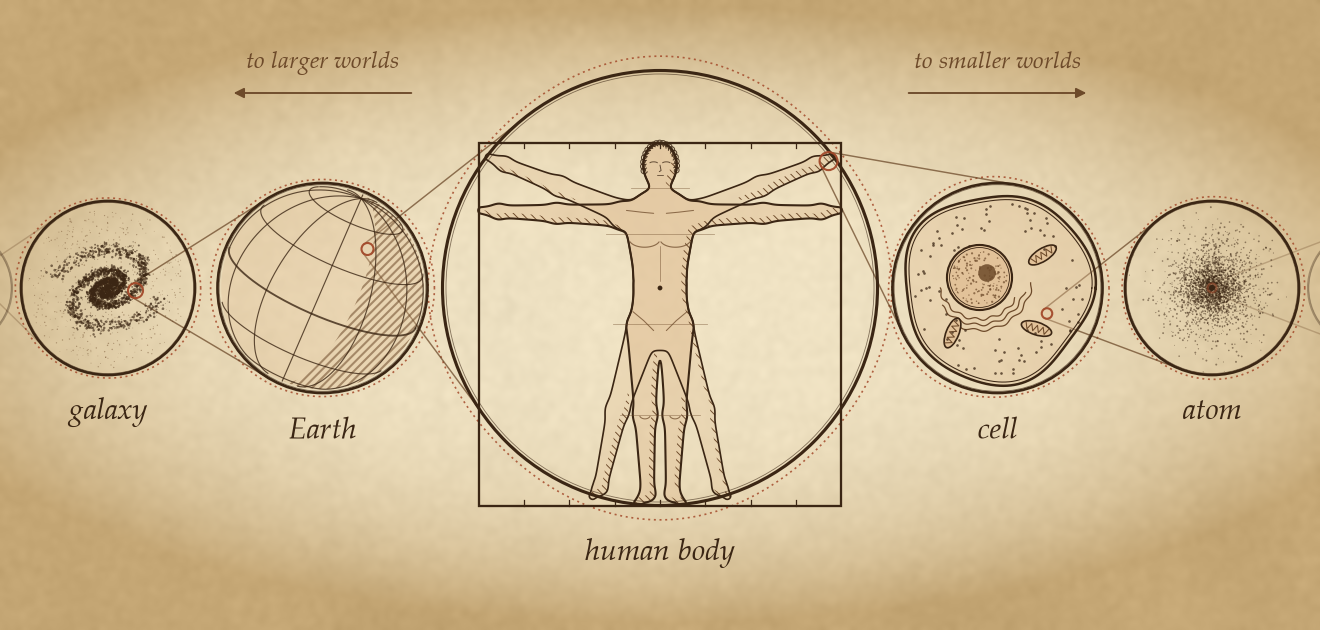
Even a thing as irregular in shape as the human body might, if cut up well, turn into pieces that each look from outside like a simple “capsule”. That is, whatever happens inside, from outside it can only look like a fixed form. I decided to check this idea by calculation.
The capsules really exist. Rearrange the contents of a cubic box substantially, and the gravity outside does not change at all. What can be read from outside is “one number per angular pattern”, that is, only what can be drawn as a pattern on a single skin. But what decided this was not the shape of the contents. It was the form of the equation that the field of gravity or electricity obeys.
The calculations in this article were made for this page or come from papers that I published myself as preprints; they have not been peer reviewed.
Key points
- For forces that weaken as the square of the distance, like gravity and electricity, what can be read about the contents from outside a closed skin is only “one number per angular pattern”. The rest of the contents cannot be seen from outside at all.
- The shape does not matter. When the density inside a cube was rearranged in a set form, from 0.100 to 1.225, the change of the gravity outside was only the size of the computing error.
- What decides how many numbers can be read from outside is the order of the equation the field obeys. Second order gives 1, fourth order 2 and sixth order 3; for fields not produced by such local equations, the count does not stop.
- 4π remains on the skin only for a massless field. The “area law”, by which information is fixed by the size of a boundary, comes from yet another reason.
- Rearranging the box
- Moving the contents to the skin
- Numbers readable from outside
- Why the count is fixed
- When 4π remains
- Numbers inside and outside
- How this differs from holography
- The intuition of modules
- Questions
- References
Rearranging the inside of the box does not change the outside
Take a cubic box with edges of length 2, filled uniformly with matter of density 1. Now rearrange the contents. Thin out one place and thicken its surroundings, by exactly the same amount, so that the total mass does not change.
There is a set way to choose the form of the rearrangement. Take a smooth bump φ that lives only inside the box, and move the density in the form of its “bending” (the Laplacian Δφ). The bump is shifted away from the centre of the box, and its shape differs in length, width and height.
The slider changes the strength of the rearrangement. The buttons change the force law.
- density inside (thinnest place)
- density inside (densest place)
- change of the field outside (largest of 4 points)
With the slider at 1, the density inside moves from 0.100 to 1.225. The thinnest place is a tenth of the original. Even so, as long as the force is gravity (a force that weakens as the square of the distance; as a field, 1/r), the change of the field at the 4 points outside is only the size of the computing error. As far as measurements from outside go, this box cannot be told from the uniform box.
Change the force law with the buttons, and the story changes. If the force weakened as the cube of the distance (a field of 1/r²), the same rearrangement would change the field outside by up to 0.048%. That looks small, but it is many orders of magnitude above the computing error, and the rearrangement can be seen from outside.
For the Yukawa field (a field with mass, which weakens sharply far away), this rearrangement can also be seen (up to 0.025%). But fit the form of the rearrangement to the Yukawa field, as (Δ−1)φ, and it becomes invisible again. What decides the form of the rearrangements invisible from outside is not the contents but the field equation.
Moving the contents onto a single skin
If there are this many rearrangements invisible from outside, something extreme should be possible: moving all the contents onto the skin outside.
Place one point of mass 1 inside a ball of radius 1. Replace this point with a thin film on the skin, denser where it is closer to the point. Moved in a set form (the Poisson kernel), the field outside becomes exactly the same as that of the point.
The slider moves the point from the centre to near the skin. The thickness of the skin’s line shows the density of the film.
- density of the film (largest ÷ smallest)
- field at the centre (film)
- field at the centre (point)
- field outside (z = 2): film and point
With the point at 0.6 from the centre, the density of the film differs by a factor of 64 between its densest and thinnest places. The skin remembers where the point inside was. At the centre the fields differ, 1.000 for the film and 1.667 for the point, but outside the skin the field is the same everywhere (at z = 2, 0.714 for both).
With the point at the centre, the density of the film is the same everywhere, 1/(4π). 4π is the surface area of a ball of radius 1, that is, all directions (the full solid angle). Moving the contents onto the skin puts 4π in the denominator.
How many numbers can be read from outside
The film on the skin is a drawing whose density changes with angle. Such a drawing can be split into angular patterns, sorted by how fine they are. The total amount is pattern 0, a lopsidedness pattern 1, an elliptical stretch pattern 2, and they get finer from there. Of the same fineness ℓ there are 2ℓ + 1 patterns, differing in direction (the spherical harmonics). The Earth’s gravity and magnetic field are also measured as numbers arranged by these patterns.
So I count how many numbers one pattern of the scattered mass inside carries outward. The way of carrying, from 20 radii inside to 20 radii outside, is made into a table, and I look at how many independent numbers that table can carry (the number of singular values). The way of carrying is set by the fineness ℓ alone, not by the direction.
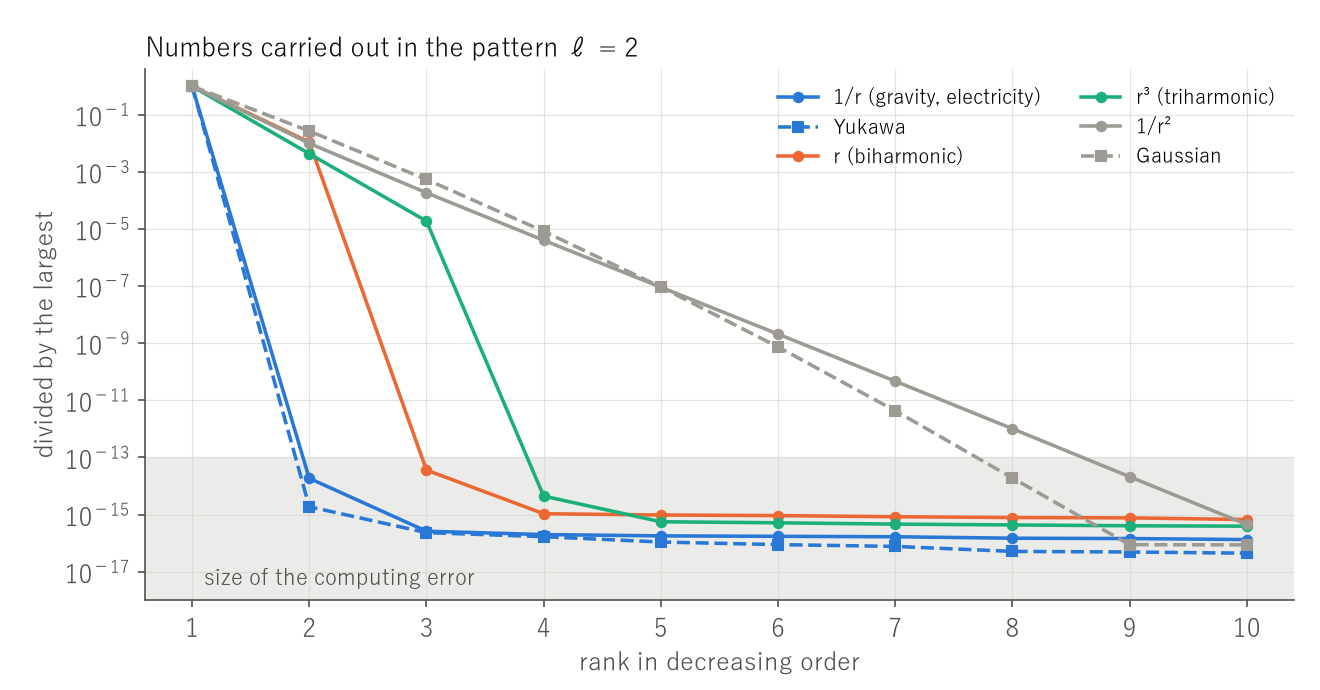
The buttons choose the field and the slider chooses the angular pattern ℓ. The heights of the bars are on a scale in steps of 10.
- numbers leaving (above 10⁻⁹)
- equation the field obeys
For the field of gravity or electricity (1/r), the count is 1 in every pattern. The second value drops at once to the size of the computing error. The Yukawa field also gives 1. For r (biharmonic) the count is 2 and for r³ (triharmonic) 3, and there too the values drop like a cliff. But for 1/r² and the Gaussian, the values keep falling smoothly, and where to cut depends on where the line is drawn. In the paper the same count was made for 18 fields, and 10 of them stopped at a fixed count (Paper 1107).
Why the count is fixed
In empty space, the field of gravity or electricity obeys a second-order equation called Laplace’s equation. Second order means that quantities differentiated twice with respect to position enter the equation. The Yukawa field and the Helmholtz field (waves of sound or light) are also second order. r (biharmonic) comes from a fourth-order equation, and r³ (triharmonic) from a sixth-order one. 1/r² and the Gaussian come from no local equation whose form stays the same under rotation, of any order.
When a field comes from a second-order equation, one number per pattern on the skin is enough. Fourth order needs 2 and sixth order 3. The number of numbers leaving is half the order of the equation that produces the field (when several equations produce the same field, the lowest order is counted). This link has long been known in mathematics (Almansi’s expansion, 1899). Conversely, for fields not produced by such equations, even the fine scattering inside leaks out little by little, and the count does not stop.
The difference shows when the formula of the field is split into angular patterns. Split the formula of 1/r, and each term fits exactly into one pattern. Split the formula of 1/r², and one term spreads over several patterns. In the paper I confirmed that the coefficients of this spreading enter only one pattern for 1/r, only two patterns for the biharmonic, and every even pattern for 1/r².
4π remains on the skin only for a massless field
That one number per pattern leaves, and that the total on the skin is kept whatever the radius, are different matters. I measure how much of the field from a point source passes through the skin of a sphere (the flux), changing the radius.
The slider changes the mass κ of the field. κ = 0 is a massless field, like gravity or electricity.
- flux (radius 1)
- flux (radius 4)
For κ = 0 the flux is 4π = 12.566 at every radius. This is Gauss’s law. With κ = 1 the flux falls: 9.246 at radius 1 and 1.151 at radius 4. Even so, as Experiment 3 showed, the Yukawa field still sends out 1 number per pattern. One number of pattern 0 also leaves, but the flux falls with the radius and no longer shows that number as it is.
So that one skin can stand for the contents (the equation being local and of second order) and that 4π is kept on the skin (the field being massless) have different reasons. For electricity, the field being massless corresponds to a property called unbroken gauge symmetry, which allows no mass. That a charge can be measured as “an integral over a distant sphere” is known as Noether’s second theorem (Paper 107).
Numbers inside and numbers outside
Dividing the inside finely lets me count how large the part invisible from outside is.
Choose into how many radial steps the inside is divided, and up to which degree the angular patterns are taken.
- unknowns inside
- numbers visible from outside
- visible fraction
Dividing the radius into 20 steps and the angular patterns up to degree 10, there are 2420 unknowns inside and 121 numbers visible from outside, a visible fraction of 5%. The numbers visible from outside amount to one pattern on the skin; the numbers inside amount to a volume. The finer the inside is divided, the larger the invisible part.
There are also problems in which the boundary does decide the inside. Put electrodes on the surface of a body and measure the correspondence between voltage and current, and how easily electricity passes inside is fixed uniquely (when that ease does not depend on direction; the Calderón problem, Paper 99). Both are problems measured on the boundary, yet this one is decided and the scattering of mass is not. The difference is what is measured: “a correspondence from functions on the skin to functions”, or “one function on the skin” (Paper 1051).
Where this agrees with holography and where it differs
That “the boundary represents the contents” is also said under the name of holography. But physics has at least three things fixed by the size of a boundary, each for a different reason. The first is the field numbers seen so far. The reason was that the field obeys a local second-order equation.
The second is the amount of information. Take matter bound only between near neighbours, like atoms, and cut it into a part and the rest. In a warm state, the information shared by the part and the rest (the mutual information) is bounded from above by the bonds that cross the cut alone, and grows with the area of the cut, not with the volume of the part. This holds at any temperature (Wolf and colleagues, 2008). Their paper cites the holographic principle and then writes that something similar emerges from the established laws of classical and quantum physics. That the “entanglement” of the lowest state grows with area was shown by calculation for a massless free field by Srednicki (1993). In the lowest state, however, this does not hold for every kind of matter.
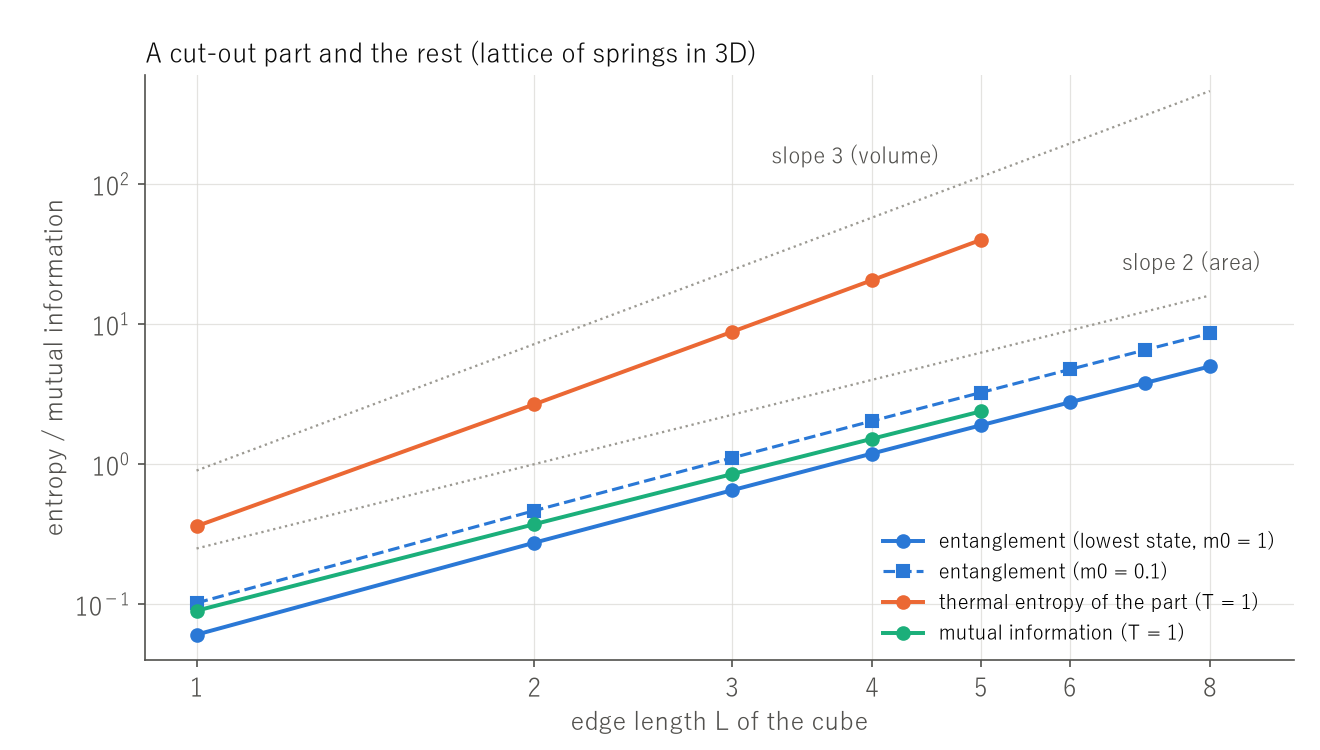
In the paper’s calculation, the entanglement grew as the 2.07th and 2.08th power of the edge, the mutual information as the 2.02nd power, and the thermal entropy of the part as the 2.95th power. The thermal entropy grows with volume, the shared information with area. The reason is that the interactions are only between near neighbours, a reason separate from the order of the field equation.
The third is the holography of gravity. The entropy of a black hole is set by the area of its horizon (Paper 1093). In quantum gravity, that the energy becomes a boundary term is one of the footholds of the idea that information sits on the boundary (Laddha and colleagues, 2021). The “one number per pattern visible from outside” seen here is a separate story, about classical fields. The two overlap only at one point: in gravity, the energy appears on the skin as the number of pattern 0.
The gravity of a human body is far from this bound. Treat a 70 kg object as a ball of the same volume, and the compactness of its gravity, 2GM/(Rc²), is 4.07×10⁻²⁵; the thermal entropy of a body is only 10⁻⁴² to 10⁻⁴⁰ of the area bound set by gravity.
On the intuition of modules
Back to the first idea. Even an irregular thing, cut up, looks from outside like simple capsules, one per piece. This turned out to be correct. For gravity and electricity, however a thing is cut, only the pattern on a single skin leaves, and as long as a movement does not change that pattern, the inside can move unseen from outside.
But what decides this was not the density inside being 1/r² (the m = 4π of Paper 02). Whatever the density, if the field equation is local and of second order, the pieces are capsules. The other “2” of the density 1/r² lay on the side of the property that makes the masses of spherical shells equal (Paper 01) and of the balance of a horizon (Paper 1092). On a scale of centimetres, most of a body has a nearly uniform density and is not a module of density 1/r². Even so, the capsule property holds.
Questions
Can nothing at all about the contents be known from outside?
Not nothing. One number per angular pattern can be known, for example the total mass (pattern 0) and the lopsidedness of the centre of mass (pattern 1). What cannot be known is the rest: the scattering that does not change the pattern on the skin.
Does this confirm the holographic principle?
No. The holographic principle is about gravity and the bound on entropy, and this page does not show it. What was confirmed here is that there are three things fixed by the size of a boundary, each for a different reason.
Does it hold even when the shape is not a sphere?
It does. Experiment 1 uses a cube, and the bump of the rearrangement is shifted from the centre. A rearrangement Δφ invisible from outside can be made inside any shape.
Papers and references
All the papers are published under CC BY 4.0.
- Paper 1107, “When the Field Equation Is of Second Order, the Interior Can Be Read from Outside a Closed Skin Only as One Number per Angular Pattern”: the source of the calculations on this page.
- Paper 01, “The Uniqueness Theorem of n = 2 for Spherically Symmetric Density Distributions”: the density 1/r² that makes the masses of spherical shells equal.
- Paper 02, “The 4π Mass Cancellation Theorem”: m = 4π.
- Paper 99, “Reading the Interior from the Boundary”: the Calderón problem.
- Paper 107, “The Two Noethers”: charge as an integral over the boundary.
- Paper 1051, “Whether the Boundary Determines the Interior Depends on What Is Measured and How Much”: the numbers of unknowns and of data.
- Paper 1092, “The ‘2’ of the Inverse-Square Density Is Two 2s, and the 2 of the Shell Mass Meets the 2 of the Horizon Balance Only in Three Dimensions”: the two 2s.
- Paper 1093, “In Three Dimensions the Entropy of a Black Hole Is the Same Number as the Area of the Horizon’s Cross-Sectional Disk, and the Shadow Disk in the Photographs Is 27/4 Times Larger”: the entropy of gravity.
- Srednicki, M. (1993). Entropy and area. Physical Review Letters.
- Wolf, M. M., Verstraete, F., Hastings, M. B., and Cirac, J. I. (2008). Area laws in quantum systems: Mutual information and correlations. Physical Review Letters.
- Laddha, A., Prabhu, S. G., Raju, S., and Shrivastava, P. (2021). The holographic nature of null infinity. SciPost Physics.