Draw a circle of radius r on flat paper, and its circumference is 2πr. What happens if we do the same on the Earth? Take a place, join up every point exactly 1000 km away from it along the ground, and you get a ring. Walk once round the ring, and it is not 2π×1000 km = 6283.19 km but 25.77 km shorter.
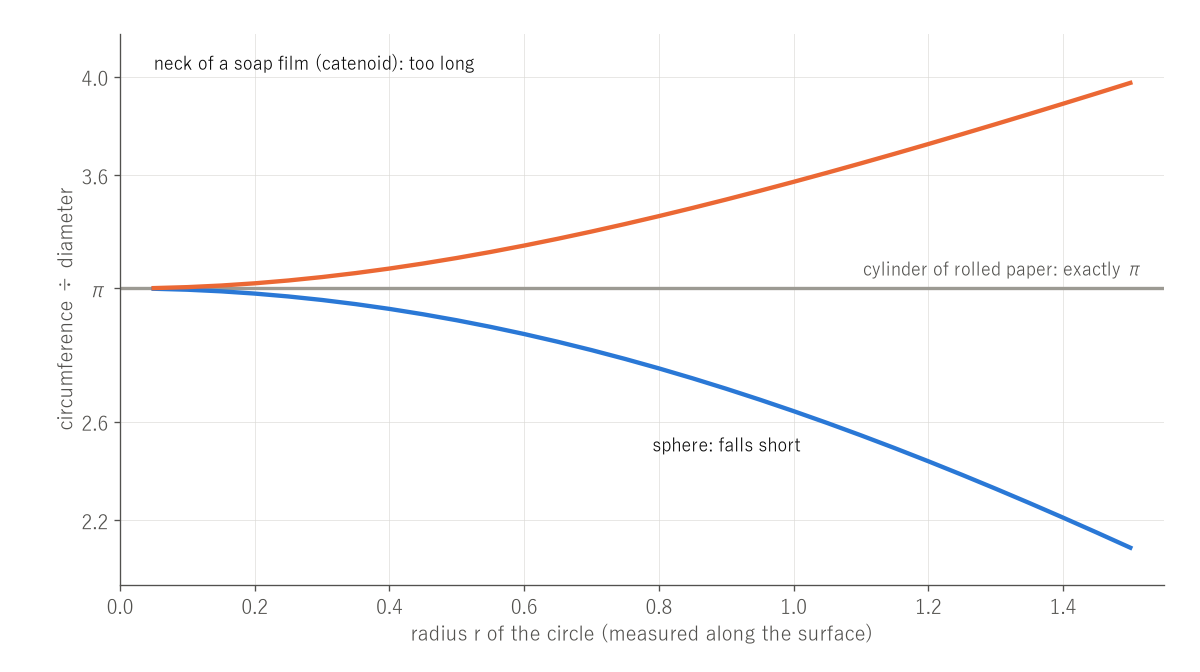
This shortfall is the plainest sign that the Earth is round. And you can get it without leaving the Earth, just by measuring lengths on the ground. In Paper 1104 I checked, on several curved surfaces, what this shortfall actually measures. The answer was a little surprising. On a cylinder made by rolling paper, the circumference falls short not at all. On a soap film that is not curved on average, the circumference is instead too long.
This article summarizes papers that I published myself as preprints; they have not been peer reviewed. The numbers for the Earth and the orange were calculated for this article.
Key points
- A circle drawn on a curved surface (the ring of points at the same distance from a centre, measured along the surface) has a circumference that departs from 2πr. On the Earth, a circle of radius 100 km falls 25.7993 m short and one of 1000 km falls 25.767863 km short.
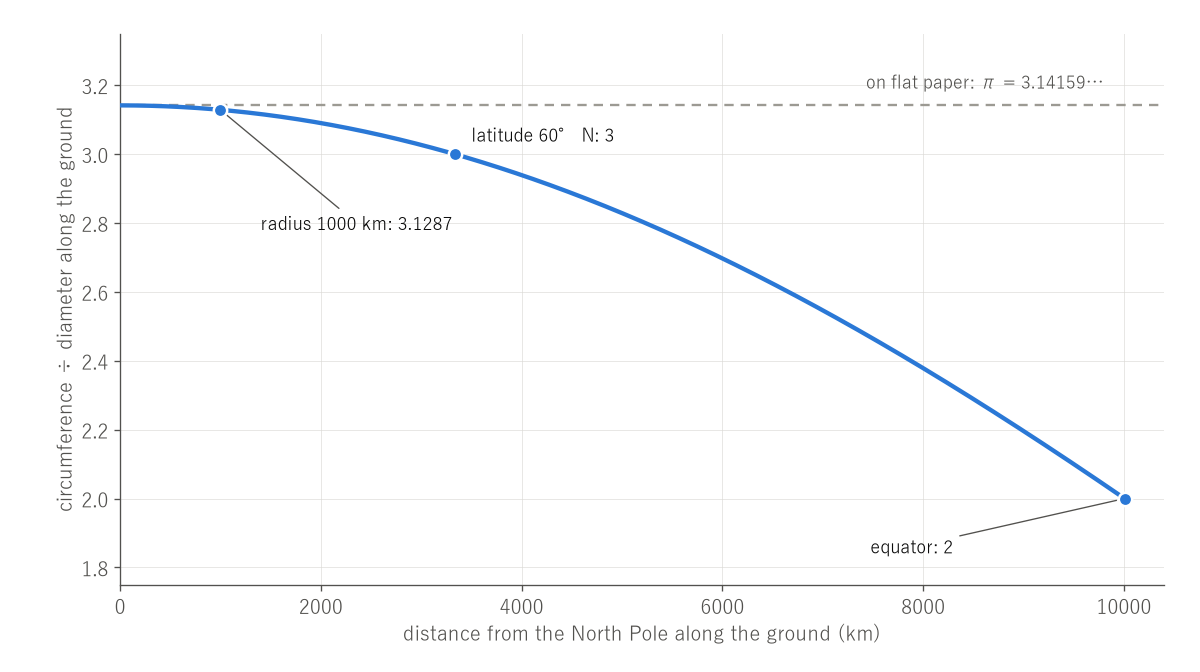
- The circumference divided by the diameter measured along the ground (a measured π) is smaller than π on the Earth. Measured from the North Pole, it is exactly 3 for the line of latitude 60° N and exactly 2 for the equator.
- Dividing the shortfall by the cube of the radius gives the curvature of the surface. Measuring a circumference is enough to know the curvature without leaving the surface.
- A cylinder of rolled paper looks curved from outside, yet circles on it are exactly 2πr. On a soap film that is not curved on average, circles are too long. What the circumference measures is the curvature within the surface (the Gaussian curvature), not the curvature seen from outside.
- Change the dimension of space, and the fractions by which things fall short change.
Circles on the Earth
Take the Earth as a sphere of radius 6371 km. The ring of points at distance r from the North Pole along the ground (a line of latitude) has circumference 2πR sin(r/R), shorter than 2πr. A circle of radius 10 km falls 0.0258 m (about 2.6 cm) short, one of 100 km 25.7993 m, and one of 1000 km 25.767863 km.
For small circles the shortfall is well approximated by πr³/(3R²). At 1000 km this gives 25.799626 km, about 0.03 km from the true value.
Here I call the circumference divided by the diameter along the ground a measured π. On flat paper it is π = 3.14159…, but on the Earth it gets smaller as the circle grows. For a circle of radius 1000 km it is 3.128708722. And centred on the North Pole, neat values appear. The line of latitude 60° N is the circle 3335.8 km from the North Pole along the ground; its circumference is 20015.1 km and its diameter along the ground is 6671.7 km. Their ratio is exactly 3. Go on to the equator, and it is exactly 2.
Checking it with an orange
You can check the same thing in the kitchen. On an orange whose peel has a radius of 4 cm, draw a circle of radius 3 cm along the peel. Its circumference is not 2π×3 = 18.8496 cm but 17.1315 cm: 1.7181 cm, nearly a tenth, short (ratio 0.9089). Measure it with a thread laid along the peel, and it is large enough to see by hand.
Circles at sea: the ring where a star stands at the same altitude
When you measure the altitude of a star at sea, you learn that you are somewhere on the ring of points from which that star appears at that altitude. The ring is a circle on the ground centred at the point beneath the star. In navigation one uses only a tiny part of the ring around oneself, so the ring is treated as a straight line (I made the same approximation in Paper 807).
Look at the whole ring, and the roundness of the Earth comes out. With the star at an altitude of 60 degrees, the ring has a radius of 3335.8 km along the ground, and its circumference is only 0.954930 of 2π times its radius. At an altitude of 30 degrees the radius is 6671.7 km and the ratio 0.826993; the length missing is as much as 7252.4 km.
The shortfall gives the curvature
So what does the shortfall measure? On a sphere of radius 1, shrinking the circle, I computed 3(2πr − C)/(πr³): the shortfall divided by the cube of the radius, times a fixed number. It was 0.992030409 at radius 0.4 and 0.999980000 at 0.02, approaching the curvature 1 of the sphere. The value found in the same way from the shortfall of the area also approached 1, and the fraction by which the circumference falls short approached exactly twice the fraction for the area (1.999987).
That curvature follows from the shortfall of circumference and area of small circles is a fact known since Bertrand, Diguet and Puiseux showed it in 1848. What matters is that only lengths on the surface are measured. Even a small creature living on the surface could tell, with a single tape measure, whether its surface is curved. In 1828 Gauss showed that there is a curvature fixed in this way by lengths on the surface alone.
On a cylinder of rolled paper, nothing is missing
This is the part I found most interesting. A cylinder is clearly curved when seen from outside. Yet circles drawn on it, of radius 0.5, 1.5 or 3.0, had circumferences of exactly 2πr (the difference was less than one part in a million million).
The reason is simple. A cylinder is just flat paper rolled up. Draw a circle of radius 3 cm on paper and then roll it: lengths on the paper do not change, so the circumference stays 18.8496 cm. What the circumference measures is the curvature within the paper, and rolling the paper does not create any.
On a soap film, the circumference is too long
There is also the opposite case. A soap film stretched between two rings (a catenoid) is a surface whose curvatures in two directions cancel, so it is not curved on average (Paper 1102). Yet a circle drawn on its neck had a circumference longer than 2πr: 1.001662520 times 2πr for a circle of radius 0.1. The curvature from the shortfall approaches −1 (−0.999900019). The average of the two curvatures is 0, but their product is −1. How this film breaks as the rings move apart is in the article “A Soap Film between Two Rings Breaks at a Gap of 1.3255 Radii”.
It measures the product, not the average
At six points (a sphere, a cylinder, the neck of a soap film, and the outside, inside and top of a doughnut, or torus) I lined up the curvature found from the shortfall. Put the product of the two curvatures (the Gaussian curvature) on the horizontal axis, and the points sit neatly on the diagonal. Put the average curvature there, and they do not line up at all. The cylinder and the top of the doughnut have an average curvature of 0.5 but no shortfall, and the neck of the soap film has an average of 0 but a value of −1.
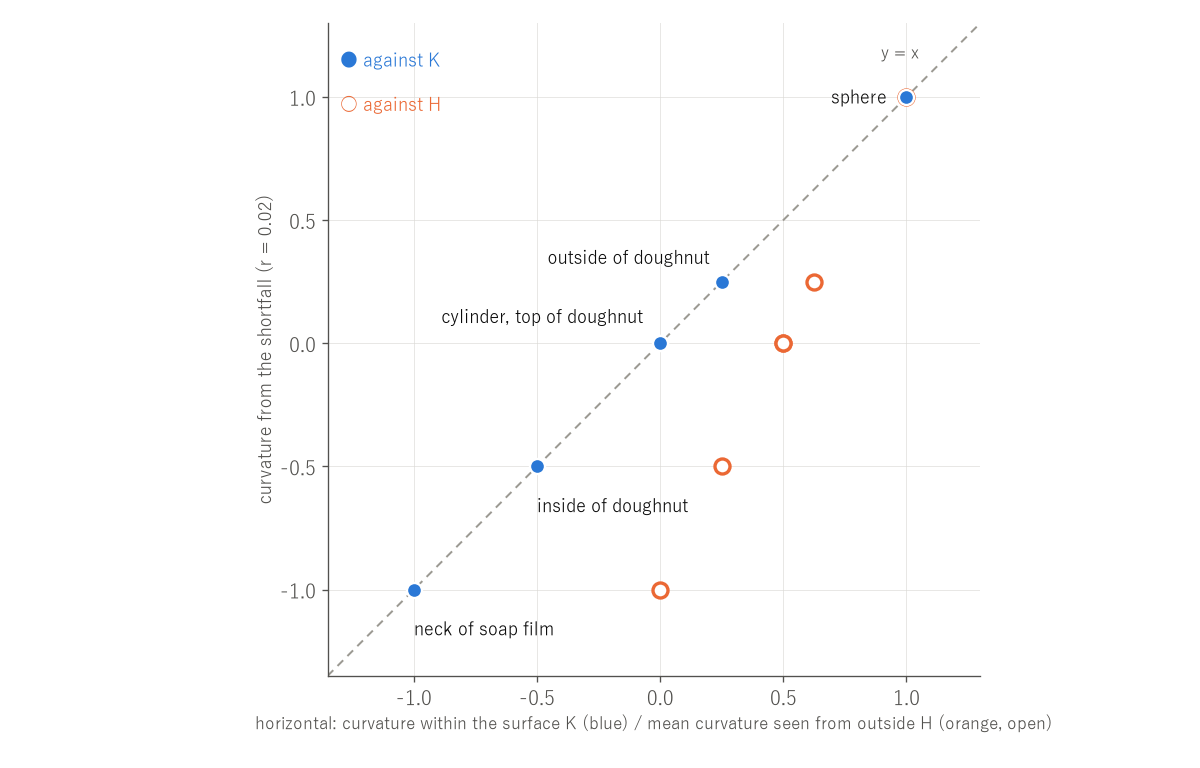
What the circumference measures is not the curvature seen from outside but the curvature you can measure by walking on the surface. That is what I most wanted to convey in Paper 1104.
Changing the dimension
The same happens in curved spaces of three or more dimensions: the surface area and volume of a ball fall a little short of those in flat space. The ratio of the two fractions was 2 in two dimensions (circumference and area), but it is 1.666667 in three (surface area and volume) and 1.5 in four. In a space of negative curvature there is an excess of the same size instead. The space of velocities in relativity is an example (Paper 60).
What this story does not say
- It claims no new theorem. That curvature follows from the shortfall of small circles has been known since 1848; Paper 1104 goes as far as checking it numerically.
- The Earth was taken as a perfect sphere of radius 6371 km. The real Earth is slightly flattened, and the fine numbers change a little.
- The real corrections of celestial navigation (such as the bending of light by the air) are not included.
- The connection between the curvature of space itself and gravity is not entered.
Frequently asked questions
What happens to a circle drawn on a map?
A map that draws distances from the centre correctly has to stretch the circumference, which falls short on the Earth, out to 2πr on flat paper. That is why every map distorts somewhere (Paper 409).
Is it a coincidence that the line of latitude 60° N has “π = 3”?
It is not. The circumference of the line of latitude 60° N is exactly half the equator. Its distance from the North Pole is π/6 times the Earth’s radius, so its diameter along the ground is π/3 times the radius. Half the equator (π times the radius) divided by this is exactly 3.
Why can the average curvature not be measured this way?
The circumference depends only on lengths on the surface. Bending or rolling paper without stretching it does not change lengths on the paper. The average curvature changes under such bending, but the product of the two curvatures does not (Gauss’s Theorema Egregium). That is why it is the product that shows up in the circumference.
The original papers
- Paper 1104 “A Circle of Radius 1000 km Drawn on the Earth Falls 25.77 km Short of 2πr, While a Circle on a Cylinder of Rolled Paper Falls Short Not at All”
- Paper 1102 “A Soap Film between Two Rings Breaks at a Gap of 1.3255 Radii, While a Chain of the Same Shape Always Hangs”
- Paper 807 “A Celestial Fix Improves with a Right-Angle Crossing Against Random Error and with Surrounding Stars Against Common Bias”
- Paper 60 “c as the Ball of Velocity Space”
All the papers are published under CC BY 4.0.