Bend two equal rings out of wire, hold them facing each other, and draw them out of soapy water: a film with a narrow waist spans between them. Pull the rings gently apart, and at some point the film suddenly breaks. The gap at that moment is 1.3255 times the radius of the rings; for rings of radius 5 cm, 6.627 cm.
The cross-section of the film has the same shape as a hanging chain (a catenary). Yet a chain keeps its hanging shape however long it is made. The shape is the same, so what separates the two? In Paper 1102 I checked it with numbers.
This article summarizes papers that I published myself as preprints; they have not been peer reviewed.
Key points
- The film between the rings breaks when the gap exceeds 1.325486839 times the radius: 6.627 cm for rings of radius 5 cm.
- Below that, the film has two possible shapes, a thick neck and a thin neck. The thin one collapses when shaken.
- Once the gap exceeds 1.055394794 times the radius, even the thick neck has more area than two flat films spanning each ring (two disks).
- A chain always hangs because its fixed length gives it the freedom to shift its shape up and down. The film has no such freedom.
- Three films meet at 120 degrees, and four edges of films meet at 109.4712206 degrees. This angle comes from the same root as the angle between faces of a regular octahedron.
An experiment you can do at home
Bend two rings of radius 5 cm out of wire, put them face to face on one axis, and draw them out of soapy water. A film with a waist spans between the rings. Widen the gap little by little: the waist gets thinner and thinner, and once the gap passes 6.627 cm the film breaks, leaving a flat film on each ring.
Another landmark is 5.277 cm. While the gap is smaller than this, the waisted film has less area than the two flat films. Since a film tries to make its area small, this is the border below which the waisted film “wins”.
The film has the shape of a hanging chain
The film between the rings takes the shape of least area. Its cross-section is the same catenary as a hanging chain. With R the radius of the rings, h the gap and a the radius of the waist in the middle, the condition that the film has radius R at the rings fixes the relation between gap ÷ radius and the waist.
The film has two shapes
Working it out, for any gap below the limit there were always two film shapes satisfying the condition. When the gap equals the radius, the waist is 0.848338 times the ring radius for the thick one and 0.235095 times for the thin one.
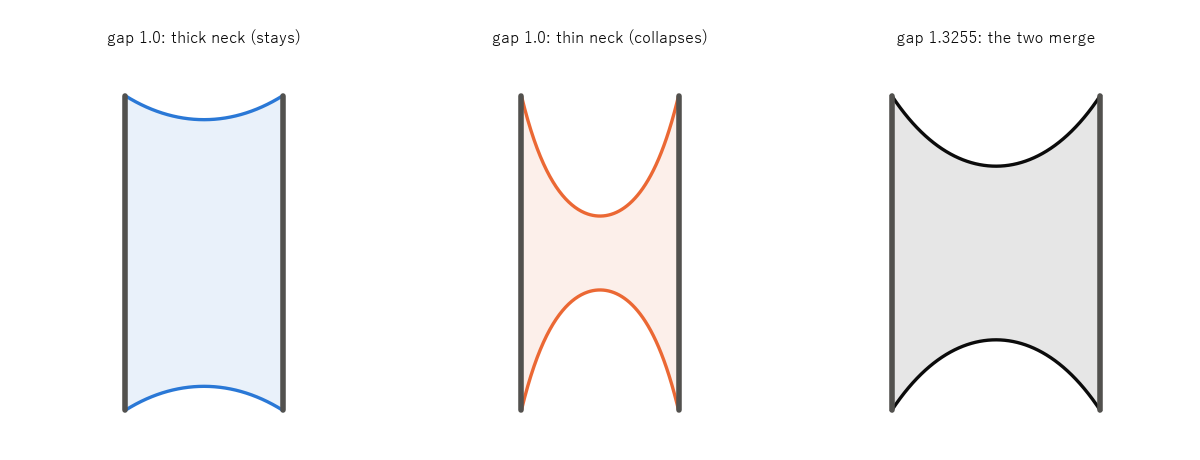
To see which one actually appears, I shook the film a little while keeping both ends fixed and computed how its area changes. The thick neck gained area when shaken (18.521973 with the gap equal to the radius), and the thin neck lost area (−7.421269). A film that can be shaken in a direction that lowers its area just keeps collapsing. What you see in the experiment is the thick neck.
At a gap of 1.3255, the film vanishes
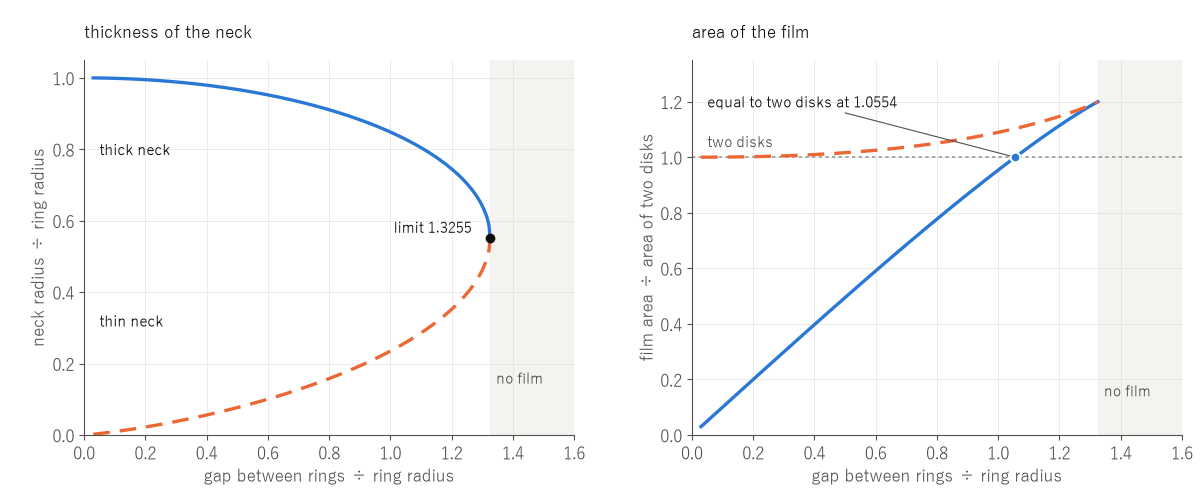
As the rings move apart, the thick neck gets thinner and the thin neck gets thicker, and the two approach each other. At a gap of 1.325486839 times the radius they merge into one, and beyond that there is no film shape at all. The waist at that point is 0.552434125 times the ring radius.
Beyond 1.0554, two flat films are smaller
Comparing areas makes the story more interesting still. The area of the thick-neck film equals that of two flat films (disks) at a gap of 1.055394794 times the radius (Goldschmidt, 1831). Between there and the limit of 1.3255, the thick-neck film has more area than two disks, yet it stays without collapsing, because it cannot turn into two disks without first breaking.
At the limit, the ratio of areas is 1.199678640, the same value as the number t that sets the limit (the number satisfying tanh t = 1/t). I noticed this in the calculation and confirmed that the formulas make it so.
Why does a chain always hang?
With the same catenary, a chain hangs however long it is. For a chain whose ends are 2 apart, every length from 2.05 to 100 had a shape; the sag is 0.195335 for length 2.05 and 49.845746 for length 100.
The difference is that the length is fixed. The shape of a chain is a catenary shifted up or down. Because its length is fixed, choosing the amount of shift lets it satisfy its three conditions (two ends and the length) every time. A film has no fixed length. And shifting the cross-section of a film up or down makes its mean curvature non-zero (−0.247651), so it is no longer a film shape. The film can satisfy the conditions at the rings only with the thickness of its waist, and once the gap opens far enough it can no longer do so.
Whether what is minimized (for the chain the height of its weight, for the film its area) comes with a constraint: that is the dividing line, the separator, named in Paper 1102.
The angles at which films meet
When bubbles gather, their films meet at fixed angles (Plateau’s laws). Three films meet at 120 degrees, the same angle that appears when a point is added to shorten the total length of a network (Paper 770). Where four edges of films meet, the angle is 109.4712206 degrees. This is the same value as the angle between adjacent faces of a regular octahedron (Paper 209); both come from the directions of the diagonals of a cube.
Circles on the film have too much circumference
A soap film is a surface whose curvatures in two directions cancel, so it is not curved on average. Yet a circle drawn on the film has a circumference longer than 2πr: 1.001662520 times 2πr for a circle of radius 0.1 on the neck. I wrote about this in the article “A Circle of Radius 1000 km on the Earth Falls 25.77 km Short”.
What this story does not say
- It claims no new theorem. The shape of the catenoid, the limit of the gap, Goldschmidt’s solution and Plateau’s laws are all known facts.
- That the thick neck does not collapse was checked with one way of shaking only; it is not a proof.
- Why a film thins and when it bursts (draining and evaporation of the liquid) is not treated (the colour of films is in Paper 588).
- Only equal rings placed on the same axis were treated.
Frequently asked questions
In a real experiment, can the film break before 6.627 cm?
Yes. Over time the liquid drains from the film and it thins, so it can burst before the limit. What Paper 1102 counted is the limit beyond which a film shape does not exist at all.
Is it the same mechanism as a stream of water from a tap breaking up?
No. A stream of water has liquid inside, and it breaks when ripples longer than its circumference grow (Paper 309). The film between the rings has no liquid inside; it breaks because, as the gap opens, its shape itself ceases to exist.
Is it a coincidence that 109.47 degrees equals the angle of the octahedron?
No. Both come from the angle between the directions from the centre of a cube to its corners (whose cosine is −1/3).
The original papers
- Paper 1102 “A Soap Film between Two Rings Breaks at a Gap of 1.3255 Radii, While a Chain of the Same Shape Always Hangs”
- Paper 588 “A Soap Film Turns Black Not Because the Film Is Gone”
- Paper 309 “The Length That Divides Gravity from Surface Tension Is Nobody’s Size”
- Paper 770 “Adding One Point Shortens the Total Length of a Network, and the 120-Degree Angle Decides Whether It Does”
- Paper 209 “Equal Volume Is Not Enough to Cut and Reassemble”
All the papers are published under CC BY 4.0.