Build up a ball of density 1/r² to radius 1, and the mass inside is 4π. The growth of volume, r², exactly cancels the density, 1/r², and what remains is the full angle of the sphere, 4π (the uniqueness theorem and its partner, the 4π mass cancellation theorem).
This 4π is the size of a sphere around a single point. Paper 258 lined up how 4π disappears and 2π appears once the source is no longer a point. This page checks two things beyond that. When masses are laid in a row or spread in a sheet, at what distance does 4π turn into 2π? And are the 2π of a line and the 2π of a sheet the same thing? We keep three-dimensional space as it is and change only the arrangement.
The calculations in this article were made for this page or come from papers that I published myself as preprints; they have not been peer reviewed.
Key points
- The number of directions in which the field can spread is 3 for a point, 2 for a row (a line) and 1 for a sheet. The figures that enclose them have sizes 4π (a sphere), 2π (a circle) and 2 (the two sides).
- So the far field is m/r² for a point, 2λ/s for a line and 2πσ for a sheet, and the power of distance falls by one each time: 2, 1, 0 (constant).
- The switch happens at distances comparable to the spacing. For a row the near and far laws cross at half the spacing, for a square lattice at 0.399 of the spacing. Beyond that, far away, the difference shrinks by roughly a factor of e every 0.159 of the spacing.
- The 2π of a line is the circumference of the circle around it; the 2π of a sheet is 4π divided by its two sides. They are different things. In SI units the 2π stays with the line and the sheet has 2; in Gaussian units the 2π stays with the sheet and the line has 2. The two 2π never stand side by side in field formulas written in the same units.
- The “Bouguer slab” 2πGρh of gravity surveying is the 2π of a sheet. To use it 1 m above a sufficiently thin slab, you need a flat extent of radius about 100 m.
- Enclosing figures
- In a row
- In a sheet
- Back to a point
- 2π of a line and a sheet
- Other 2π
- Bouguer slab
- Separator
- Questions
- References
The figures that enclose a point, a line and a sheet
The gravitational field of a point can spread in every direction: three directions. Lay masses in a row and the field can spread only in the two directions perpendicular to the line. Spread them in a sheet and only the one direction perpendicular to the sheet remains.
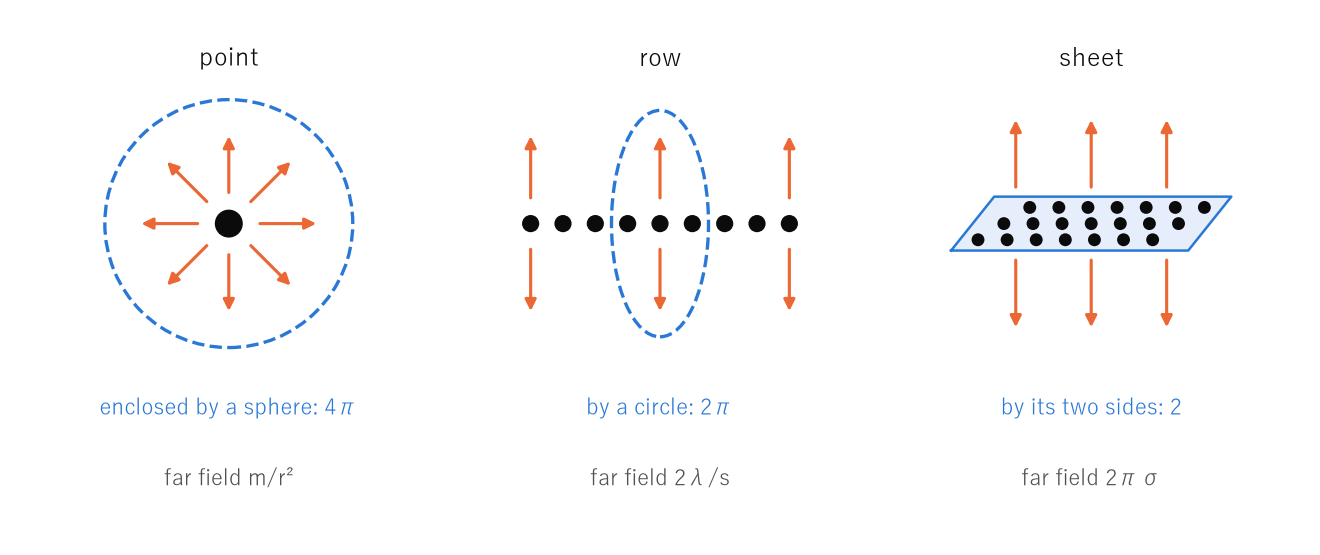
The enclosing figure has size 4π for the sphere around a point, 2π for the circle around a line, and 2 for a sheet, from its two directions, up and down. The integral of the 4π mass cancellation theorem works the same way: for a line, a cylinder of density 1/s has mass 2π per unit length out to radius 1; for a sheet, a layer with density uniform across its thickness has mass 2 per unit area for thickness 2.
In the usual way of writing gravity with G, the total field coming out of a mass is 4π times the mass, by Gauss’s law. Dividing by the size of the enclosing figure gives the coefficient of the far field: 4π ÷ 4π = 1 for a point (m/r²), 4π ÷ 2π = 2 for a line (2λ/s), and 4π ÷ 2 = 2π for a sheet (2πσ). The “exponent 2” of the uniqueness theorem becomes 1 for a line and 0 for a sheet. In every arrangement the exponent is one less than the number of directions in which the field can spread.
In a row, the far field sees the 2π of a circle
Lay unit masses in a row at unit spacing and measure the field at different distances from the line. Close by, only the nearest mass is seen, so the field is 1/r². Far away the row looks like a single line, and the field is 2/s. The two laws cross at half the spacing, where both equal 4. The true field there is 4.905, 1.226 times the value of either law.
Choose a row or a sheet, and level with (above) a mass or midway, then change the distance with the slider. The buttons jump to fixed distances.
- true field (G = 1, mass 1)
- ratio to the near law 1/r²
- ratio to the far law
- local exponent
On the far side, the difference between the true field and 2/s drops quickly: 1.2435% at distance 1 and 0.0032% at distance 2. Far away it shrinks by roughly a factor of e every 0.159 of the spacing (1/(2π)); closer in, it shrinks a little more slowly. Beyond the spacing, the 4π of a point can no longer be seen; only the 2π of the circle around the line remains. The same happens with sound: Paper 456 notes that very close to a road each car sounds like a point source, while farther away the road becomes a line source (sound adds intensities, so the distance of the changeover is not the same as for the field of gravity).
Midway between two masses, the near behaviour is different. The pulls of the two neighbours point almost along the line, up and down, and cancel. A little remains perpendicular to the line, in proportion to the distance (about 16.83 times the distance, that is 14ζ(3) times). The field peaks at 3.361 at distance 0.375, and far away it settles on the same 2/s as level with a mass. The far field forgets where along the row you stand.
In a sheet, the far field sees 2π, half of 4π
Choose “sheet” in Experiment 1, and the masses are spread on a square lattice of unit spacing. The near law 1/z² and the far law 2π cross at a height of 0.399 of the spacing. The true field there is 1.508 times 2π. On a triangular lattice the crossing comes down to 0.371 of the spacing.
The far 2π is 4π divided by 2, because the field splits into the two directions above and below the sheet. At height 1 the field is 0.80% stronger than 2π above a mass and 0.69% weaker above the gap between four masses, and both approach 2π at the same rate. Above the gap, the field has no peak and approaches 2π from below.
Real arrangements have ends, and far away they return to a point
Real arrangements are not infinitely long. Paper 258 also notes that a finite length returns toward 4π at the ends; here we check with numbers where the field returns to a point as we move from the middle of the arrangement to farther than its whole size. For a row of 101 masses, the local exponent is 2 close by, near 1 in between (its lowest value is 1.002), and 2 again far away. The line law 2/s and the law that treats the whole row as one point, 101/s², cross at distance 50.5. For a 101×101 sheet the exponent falls from 2 to near 0 (its lowest value is 0.031) and, from a height of about 40.3, returns to 2. That height is 1/√2 of the radius 57.0 of the circle of equal area.
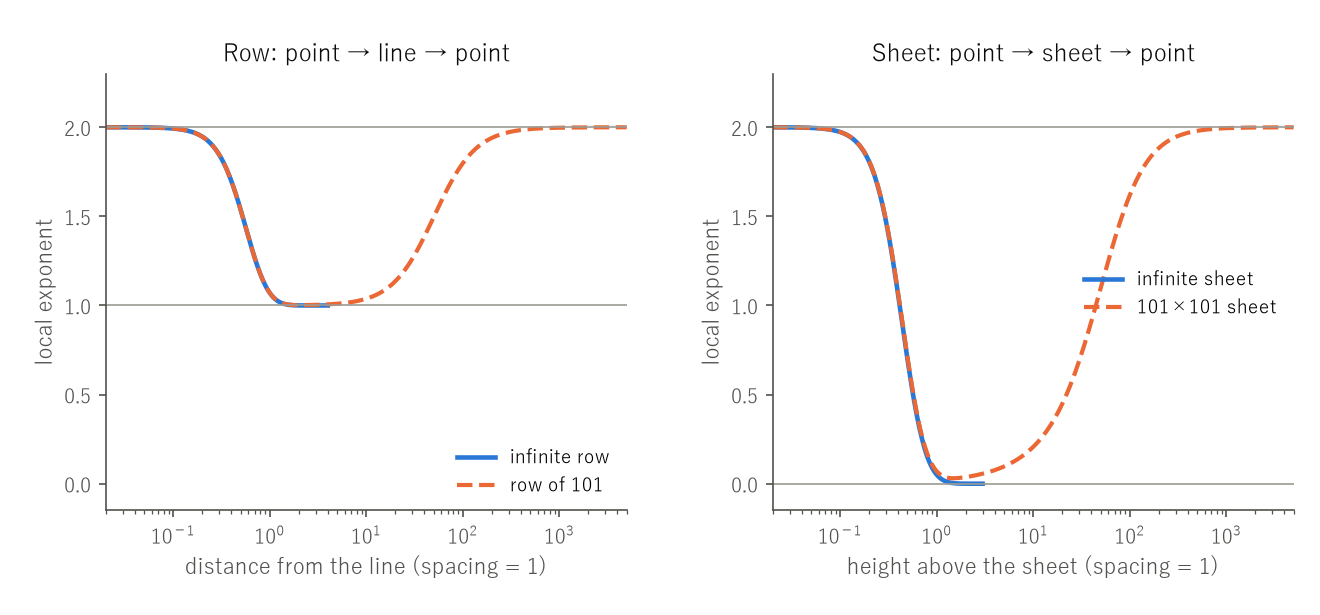
With two lengths in the arrangement (the spacing and the size of the whole), there are two switches. Close by one sees the 4π of a single point; in between, the 2π of the circle around the row or the 2 of the sheet; far away the whole arrangement becomes one point, and it is 4π again.
The 2π of a line and the 2π of a sheet trade places with the units
The 2π of a line and the 2π of a sheet look like the same number, and Paper 258 also lined them up as the 4π of a point halved. But they come from different places. The 2π of a line is the circumference of the circle around the line itself, the angle of one turn around it. The 2π of a sheet is 4π divided by the 2 of its two sides, the apparent spread (a hemisphere) of a wide sheet seen from one side.
There is a reason the two are the same number. The area of a sphere, 4π, is the circumference of its equator, 2π, times its diameter, 2 (4π = 2 × 2π). In the integral of the 4π mass cancellation theorem, too, 4π splits into 2 times 2π. So 4π divided by 2 equals the circumference 2π, and 4π divided by 2π equals the 2 of the two sides. We still call them different things because, as we see next, changing the units or the arrangement moves them separately.
The difference shows when the units are changed. SI units for electricity count the strength of a source by the amount of flow leaving it, so the sizes of the enclosing figures, 4π, 2π and 2, stay in the denominators of the fields of a point, a line and a sheet. In the other common system, Gaussian units, 4π divided by those sizes, 1, 2 and 2π, stays as the coefficients. The usual way of writing gravity with G has the same form as Gaussian units.
| arrangement | SI units | Gaussian units |
|---|---|---|
| point | q/(4πε₀r²) | q/r² |
| line | λ/(2πε₀s) | 2λ/s |
| sheet | σ/(2ε₀) | 2πσ |
In SI the 2π stays in the field formula of the line and the sheet’s has 2; in Gaussian units the 2π stays in the field formula of the sheet and the line’s has 2. Changing the units makes 2π and 2 trade places between the field formulas of the line and the sheet, and the two 2π never stand side by side in field formulas written in the same units. They appear together only when the line is written in SI and the sheet in Gaussian units. Here “disappears” means that the 2π cancels against the 4π of the units inside the field formula; the circumference and the hemisphere themselves do not go away. Outside field formulas the circumference stays in every system of units (in Paper 1088 the 2π of the ring in Bethe’s formula appears, in the same Gaussian units, together with the sheet field 2πσ). That the 4π of a point moves with the convention of units, and moved rather than vanished, was shown in Paper 306; for a line and a sheet, too, the convention moves where the 2π sits inside the field formulas.
Two more 2π
The 2π that appear on this page have at least four origins: besides the circumference of a line and the coefficient of a sheet, there are the two below. We do not call them the same root just because the number agrees; we separate them by what moves them (the judgement of Paper 300).
- 2π of the period: the 2π in the rate of approach to the far law (far away, a factor of e every 0.159 of the spacing). It is the angle that counts one period of the arrangement as one turn of a wave. Neither changing the units nor switching between a row and a sheet moves it (the 2π of a line’s circumference moves to 4π or 2 when the arrangement changes).
- 2π of the 4π mass cancellation theorem: the value of m(n) = 4π/(3−n) at n = 1. Moving the density exponent n moves this one alone.
Moving the spacing separates the coefficient of a sheet from the 2π of the period. With the spacing set to 1, the sheet field 2πσ and the rate of approach 2π look like the same number. With spacing 2 they split into 1.571 for the sheet field and 3.142 for the rate. When each cell of the lattice holds one mass, their ratio on any lattice is “1 ÷ the distance between the two nearest masses”, so they agree only when that distance is set to 1. On a honeycomb lattice, with two masses per cell, the ratio is 1.155 (2/√3) and this relation breaks.
Changing the shape of the lattice, on the other hand, does not separate the two. Going from a square to a triangular lattice moves the rate of approach to 7.255 (4π/√3), but the sheet field moves to the same 7.255. What separates them is the choice of units and the kind of quantity (the sheet field is an acceleration, the rate of approach an inverse length).
A real sheet: the Bouguer slab
In gravity surveying, the gravity above a wide slab of thickness h and density ρ is corrected as 2πGρh. This is called the Bouguer correction, and its 2π is the coefficient of a sheet: written with G, gravity takes the form of Gaussian units, so the 2π of a sheet is what one sees. For density 1 g/cm³ and thickness 1 m it is 0.0419 mGal; for 2.67 g/cm³, a value often used for rock, it is 0.1120 mGal (1 mGal is 10⁻⁵ m/s²).
Change the radius of the disc and the height of the gravimeter. The slab has density 2.67 g/cm³ and is taken to be thin compared with the height (gravity is shown per metre of thickness).
- ratio to a wide slab (2πGρh)
- gravity (per metre of thickness)
- ratio to the point law
- radius needed for 99%
A slab counts as “wide” only when the height is much smaller than its extent. To come within 99% of 2πGρh on the axis of a thin disc, the radius must be at least 99.995 times the height: a flat extent of radius about 100 m at 1 m up, and about 1000 m at 10 m up. Going higher, the field moves over to the point law. The two laws cross at a height of 0.707 of the radius (1/√2), where the true field is 0.423 of the wide slab (1 − 1/√3). The factor 2π(1 − z/√(z² + a²)) in the field of the disc is the apparent spread of the disc seen from that point, the quantity that Paper 258 described as levelling off at 2π for a sheet source.
The separator: the size of the enclosing figure itself, or 4π divided by it?
A separator says what has to be moved for one thing to become another. Here it is whether the 2π is the size of the figure enclosing the arrangement itself, or 4π divided by that size. The 2π of a line is the size of the enclosing circle itself and stays in the SI denominator. The 2π of a sheet is 4π divided by its two sides and stays in the Gaussian coefficient. The two are the same number because 4π = 2 × 2π, and changing the units makes them trade places.
The 4π of a point gives way to the law of a line or a sheet where the distance becomes about the spacing. Closer than that, you see the 4π around a single point, and the field weakens as the square of the distance. Farther away, you see the figure around the arrangement, and the field is 2λ/s or 2πσ. Beyond another length, the size of the whole arrangement, the 4π of a point comes back.
Questions
Are the lines and sheets really infinitely long?
No. “Far away” on this page means farther than the spacing but closer than the size of the whole arrangement. Even for a row of 101 or a 101×101 sheet, the line or sheet law fits well in between, and farther still it returns to a single point.
Is it a coincidence that the two 2π are the same number?
They are the same number with different origins. The 2π of a line is a circumference and the 2π of a sheet is half of 4π; in field formulas, SI keeps the first and Gaussian units keep the second. They are equal because the area of a sphere, 4π, is the circumference 2π times the diameter 2. The sheet field and the rate of approach agree when the spacing is set to 1, but they split at spacing 2.
Is it the same for electricity?
Yes. Whenever the force falls as the inverse square of the distance, electricity takes the same form. The 4π, 2π and 2 in the denominators of the SI formulas are the sizes of the figures that enclose a point, a line and a sheet.
Papers and references
All the papers are published under CC BY 4.0.
- Paper 1112 “A Point’s 4π Gives Way to a Line’s or a Sheet’s Law at About the Spacing, and the Two 2π Trade Places with the Units”: the basis of the calculations on this page.
- Paper 258 “4π Appears Only When the Source Is a Point”: 4π disappears once the source is no longer a point.
- Paper 456 “Doubling the Distance Does Not Halve the Noise”: near a road each car is a point source, farther away the road is a line source.
- Paper 01 “The Uniqueness Theorem of n = 2 for Spherically Symmetric Density Distributions”: the exponent for which the shell mass does not depend on the radius.
- Paper 02 “The 4π Mass Cancellation Theorem”: the mass within radius 1 is 4π.
- Paper 1088 “The Same 4π/m, but the 4π of the Plasma Frequency Is a Solid Angle and the 4π of Bethe’s Formula Is Twice the 2π of a Ring”: the difference of the fields on the two sides of a sheet.
- Paper 306 “How Many ‘Base’ Units There Are Is a Promise”: where 4π sits moves with the promise of units.
- Paper 1052 “Two Kinds of Subtracting One: One Counts Holes, the Other Counts Dimensions”: why the exponent is one less.
- Paper 300 “The Three Hundredth Census: Whether Two Things Share a Root Is Decidable”: separating equal numbers by what moves them.
- National Institute of Standards and Technology (2024). CODATA Recommended Values of the Fundamental Physical Constants: 2022. NIST.
- Hinze, W. J., Aiken, C., Brozena, J., et al. (2005). New standards for reducing gravity data: The North American gravity database. Geophysics.