Physics and mathematics are full of things that cannot be otherwise. Squash a ball however you like, and the total bending of its surface comes to the same number. Without friction, a spinning top keeps spinning. The equation of degree 5 has no formula like the quadratic formula. In three-dimensional space, gravity and light both weaken with the square of the distance.
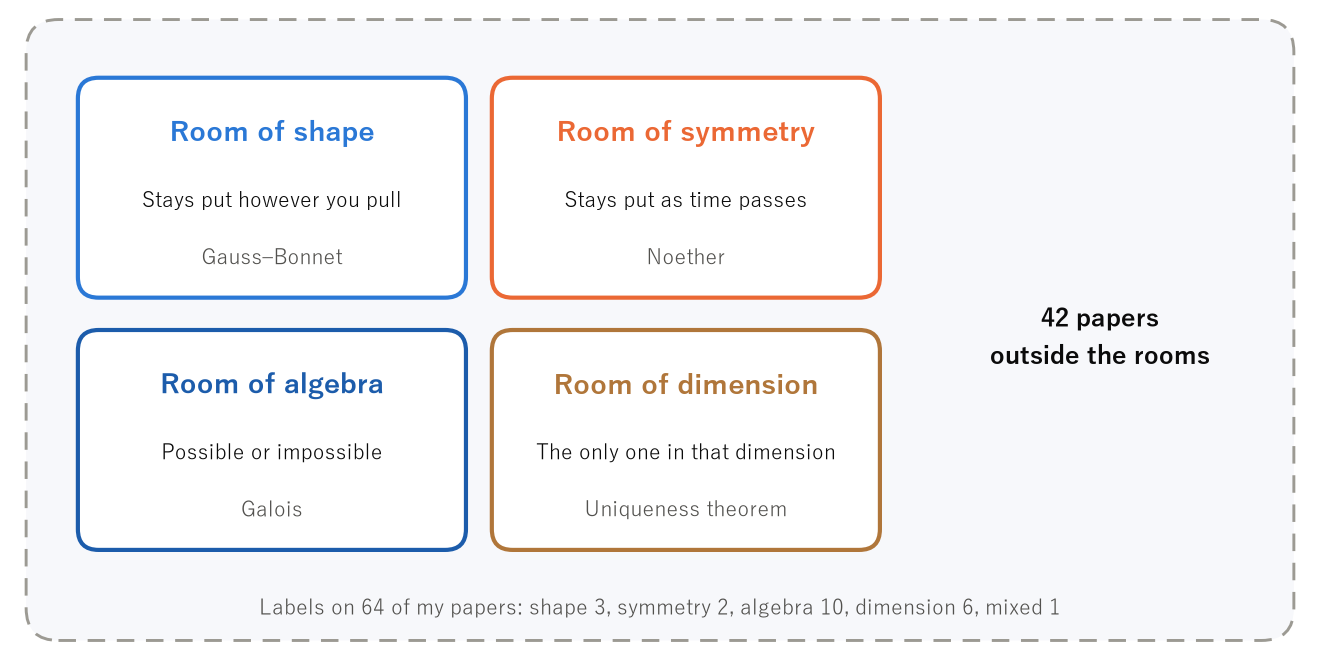
We say all of these are “fixed”. But ask why, and the answers are of different kinds. In Paper 86 I sorted this “why” into four kinds: shape, symmetry, algebra and dimension. On this page I call each of them a room.
There is a simple way to tell the rooms apart: try to break things. What refuses to break, and how it breaks when it does, differs from room to room. Here we walk through the four rooms, breaking things with sliders and buttons. At the end I tell you what happened when I counted the rooms and found they were not enough. That count, in Paper 1050, comes from rereading my own papers.
This article summarizes papers that I published myself as preprints; they have not been peer reviewed. The sorting into rooms is my own classification, and it does not weigh my work against the theorems of Gauss, Noether and Galois. What it separates are kinds of being fixed. I made the moving figures for this page.
Key points
- “Fixed” comes in kinds. Shape, symmetry, algebra and dimension fix things in different ways.
- To tell them apart, try to break them. Make a hole, break a symmetry, raise the degree, change the dimension. Something different moves in each room.
- Rooms can connect. But being connected is not the same as being the same.
- When I read the 64 of my papers whose titles claim “unique”, “only one” and the like, 42 fell outside the four rooms. Adding rooms still left 29 with no name.
- Room of shape
- Room of symmetry
- Room of algebra
- Room of dimension
- Comparing the four
- The 42 outside
- What slips through the net
- The count stays open
- Questions
- Papers and sources
The room of shape: however you pull, the total does not move
Picture a polyhedron such as a die. The angles of the faces meeting at a corner do not add up to a flat 360 degrees. Call the shortfall the angle defect of that corner. On a cube, three 90-degree angles meet at each corner, so the defect is 90 degrees. There are 8 corners, so the total is 720 degrees.
Let us try to break that total.
Drag a point to change the shape. Drag where there is no point to turn the whole thing.
- Vertices V
- Edges E
- Faces F
- V−E+F
- Defect of the grabbed vertex
The defect of a single corner moves a lot. The 60 degrees of the regular icosahedron can become 113.87 degrees. The total stays at 720.00 degrees.
The reason lies in the triangle. In any triangle, the angles add up to 180 degrees. So when all the faces are triangles, the total defect is 360V−180F, which depends only on the numbers of vertices and faces. Because the faces and edges satisfy 3F=2E, this can be rewritten as 360×(V−E+F). Moving the vertices changes none of these counts.
Making a hole changes V−E+F from 2 to 0, and the total jumps from 720 degrees to 0. It passes through no values in between. What sets the number in this room is not the fine detail of the shape but its type: how many holes it has. The same statement for smooth surfaces is the Gauss–Bonnet theorem. And 720 degrees is 4π in radians.
More precisely
On a closed oriented surface M, the integral of the Gaussian curvature K is ∫K dA=2πχ(M), where χ is the Euler characteristic. The sphere has χ=2, giving 4π, and a surface with g holes has χ=2−2g. The polyhedral form is Descartes’ theorem on angular defect, treated in Paper 224 and Paper 67.
The room of symmetry: as time passes, it does not run down
In the next room, “does not move” means something else. Instead of kneading a shape, we let time run.
Spin a ball on a spring around a flat table. If it is pulled equally hard in every direction, its angular momentum is conserved. If the spring’s strength does not change with time, its energy is conserved too.
Noether’s theorem says this is no accident. If the law stays the same when you rotate things, angular momentum is conserved. If it stays the same when you shift time, energy is conserved. Each way of changing things that leaves the law alone comes with one conserved quantity.
You can check the pairing by breaking one symmetry at a time.
“Rotation break” makes the pull depend on direction. “Time break” makes the spring’s strength change with time. The dotted line in each graph is the level a conserved quantity would keep.
- Wobble of the energy
- Wobble of the angular momentum
| What is broken | Wobble of the energy | Wobble of the angular momentum |
|---|---|---|
| Nothing | 0.00% | 0.00% |
| Rotation only (0.4) | 0.00% | 197.53% |
| Time only (0.4) | 184.10% | 0.00% |
| Both (0.4) | 168.05% | 242.92% |
Break only the rotational symmetry and only the angular momentum wobbles, while the energy stays put. Break only the time symmetry and the reverse happens. Each conserved quantity depends only on its own symmetry.
The difference from the room of shape is that an input is needed. The 720 degrees stay put without being asked. The conserved quantities here appear only when the symmetry is there. Both are said not to move, but they refuse to move against different things.
More precisely
If the action S=∫L dt is invariant under a continuous transformation, there is one corresponding conserved quantity. Time translation gives energy, space translation gives momentum, and rotation gives angular momentum. The model in the experiment gives a ball of mass 1 the potential U=½k(t)(x²+(1+ε)y²) with k(t)=1+δ sin(1.7t), solved by the velocity Verlet method with step 0.01. See Paper 80 and Paper 84.
The room of algebra: possible or impossible
In the third room, what does not move is not a value. What is fixed is whether something can be done at all.
Quadratic equations have a formula. So do those of degree 3 and 4. Degree 5 has no formula written with only addition, multiplication and radicals. Ruffini and Abel showed this, and Galois explained why, in the language of rearranging the solutions.
An equation of degree n has n solutions, so they can be rearranged in n! ways. Now take the “difference” of two rearrangements a and b: do a, do b, undo a, undo b. If the order of a and b does not matter, you are back where you started. If you are not, what is left is the difference.
Collect all the differences and the family of rearrangements shrinks. Using one level of radicals corresponds to taking the difference once. If repeated differences bring you down to 1 rearrangement (doing nothing), a formula exists.
Choose a degree and press “Take the difference” a few times.
| Degree | Rearrangements as differences are taken | Formula |
|---|---|---|
| 2 | 2→1 | yes |
| 3 | 6→3→1 | yes |
| 4 | 24→12→4→1 | yes |
| 5 | 120→60→60→… | no |
| 6 | 720→360→360→… | no |
Why does it stop at 5? You can see it by hand. Let a and b be moves that rotate three balls, and take their difference. Compare 4 balls with 5 balls.
Reading down: a, b, undo a, undo b. Move a rotates the three balls on the left, and move b rotates the three on the right.
With 4 balls, the two rotations overlap too much, and their difference is a pair of swaps. Take the difference again and that form disappears. With 5 balls, the two rotations can be placed so that they overlap in just one spot, and their difference is another three-ball rotation. Three-ball rotations survive forever, so the count never drops below 60. Five is the number of places that gives the rotations room to keep escaping.
Note that the missing formula concerns the general equation of degree 5, with letters for coefficients. Particular equations such as x⁵=2 can be solved with radicals.
More precisely
An equation is solvable by radicals exactly when its Galois group is solvable, which means that repeated commutator subgroups reach the trivial group. The commutator subgroup of the symmetric group S₅ is A₅, and that of A₅ is A₅ itself, so the series stops. In Experiment 4, the commutator of a=(1 2 3) and b=(3 4 5) is a 3-cycle. See Paper 85.
The room of dimension: the only one in that dimension
The fourth room holds a theorem of my own.
Suppose the density thins out as 1/rⁿ with distance r from a centre. Take shells of equal thickness. The area of a shell grows as you go outward, while the density falls. In three dimensions the area grows as r², so only at n=2 do the two cancel, and every shell weighs the same. For any other exponent, either the outer or the inner shells are heavier.
This is the uniqueness theorem of Paper 1. Change the dimension of space and the answer moves. In four dimensions it is n=3 (Paper 8).
The thickness of each ring shows the weight of that shell. If the graph lies on the dotted line, every radius has the same weight.
- Shell weight exponent d−1−n
- Shell weight at twice the radius
What sets the exponent here is not shape, not time and not rearrangement. It is the dimension of space. Impose one condition, and the dimension narrows the answer to a single point. You can move this theorem in much more detail on the uniqueness theorem page.
More precisely
In three dimensions with ρ(r)=r⁻ⁿ, the mass growth of a spherical shell is dm/dr=4πr²⁻ⁿ, which is independent of the radius only for n=2. In general dimension it goes as r to the power (d−1−n), leaving only n=d−1. Then the total inside the unit ball equals the full solid angle, which is 4π in three dimensions (Paper 2).
Comparing the four: unmoved by what?
Set side by side, the four rooms show that the same word “fixed” covers different things.
| Room | Question | What is fixed | How to break it | Representative |
|---|---|---|---|---|
| Shape | What stays put under any deformation? | A number (720 degrees, 4π) | Make a hole | Gauss–Bonnet |
| Symmetry | What stays put as time passes? | A conserved quantity | Break the symmetry | Noether |
| Algebra | What separates the possible from the impossible? | Whether it can be done | Change the degree | Galois |
| Dimension | What is the only one in that dimension? | A single exponent | Change the dimension | Uniqueness theorem |
The same word does not mean the same room. Galois’ rearrangements and Noether’s rotations are both called symmetry, but one is a discrete swap and the other a smooth change. No conserved quantity appears from the rearrangements of Experiment 3.
Rooms can also connect.
- Room of dimensionIn three dimensions, only n=2 levels the shells
- From therecomes the form that weakens with the square of the distance
- Room of shapeAdded over all directions, it gives 4π
It looks like a single chain. But the ways of breaking it differ. Make a hole and the 4π moves, while n=2 does not. Change the dimension and n=2 moves. Different things move them, so they are different rooms. Being connected is not the same as being the same. Not treating rooms as one on the strength of a matching number was the central point of Paper 86.
Each of these comes from one of my papers. The labels are those of the table in Paper 1050.
Every map must distort something. No map keeps both angles and areas.
The sphere’s curvature does not vanish on any map. Room of shape (Paper 212).
Pass a current, and the weight of metal deposited is fixed exactly: 1.185494 g of copper for 1 A over 1 hour.
Conservation of charge decides it. Room of symmetry (Paper 713).
The sexagenary cycle has 60 pairs, not 120.
The greatest common divisor of 10 and 12 is 2, so only half the pairs appear. Room of algebra (Paper 605).
A random walker in two dimensions always comes home. In three dimensions, that is no longer so.
What decides the return is an exponent in the denominator set by the dimension. Room of dimension (Paper 199).
“Always terminates” and “always correct” cannot be traded for each other.
This is about computational procedures, and it fits none of the four. The next section is about this “none” (Paper 844).
The 42 outside the rooms: four were not enough
In Paper 86 I wrote “at least four”. I did not write that four was all. Whether it is can be counted. So in Paper 1050 I held a roll call of my own papers.
So as not to choose by taste, I had a machine pick, from the 1,048 papers of that time, every title containing a word for “unique”, “sole”, “only one”, “nothing but”, “alone” or “always”. There were 64. I read them one at a time and gave each a label.
| Label | Papers |
|---|---|
| Shape | 3 |
| Symmetry | 2 |
| Algebra | 10 |
| Dimension | 6 |
| A mixture of two or more | 1 |
| None | 42 |
About two thirds fell outside the four rooms. Another reader would label some papers differently, so I froze the labels in a table for anyone to check. Press the dots below to read the titles one by one.
The next move is to add rooms. Adding causality (things decided by order alone) and the information bound (no more can fit than this) to make six seems natural. Let us try.
Add rooms with the buttons above, and the labels on the dots change. Press a dot to see the paper’s title. A “?” is a dot that is still in no room.
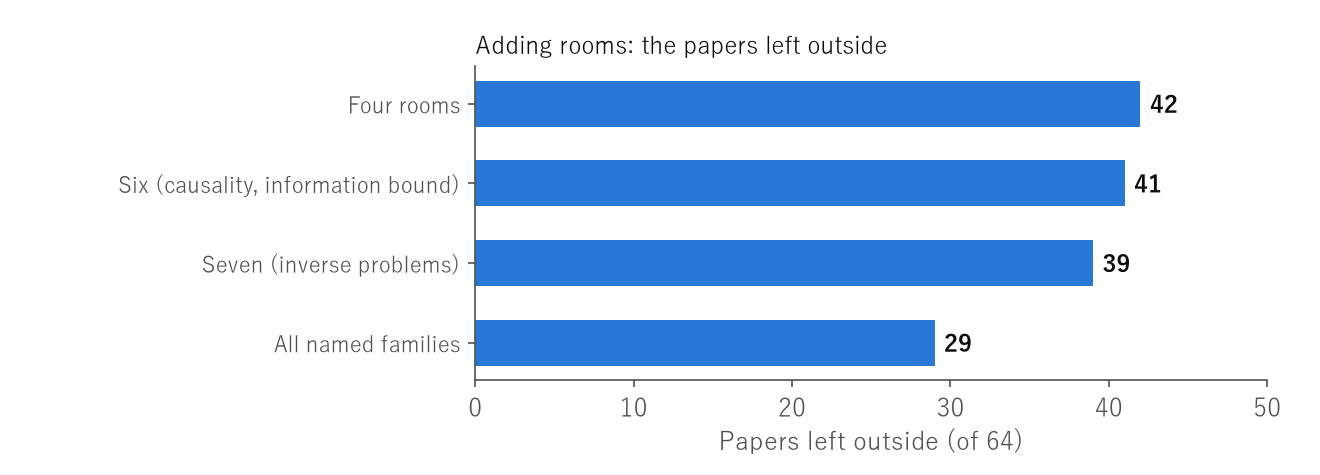
Going to six brought back just 1 paper. Adding inverse problems to make seven still left 39. Add measure, things not decided by procedure, units and conventions, and logic, giving every name I could, and 29 remain. The remainder shrinks but does not reach 0.
What slips through the net: the information bound
With six rooms, 0 papers landed in the room of the information bound. It is not that no such papers exist. Paper 73, Paper 88 and Paper 112 are about it, yet none is among the 64. A bound says “no more than this fits”, not “this one alone”. There is no reason to put “unique” in the title. It is another kind of being fixed, finer than the mesh of the roll call.
So does the information bound belong in the room of shape? The bound is set by the area A of a sphere (Bekenstein; A/4 in Planck units), and the 4π of the room of shape also lives on a sphere. They look like one room. This too can be tested by breaking. Change the radius.
Move the radius with the slider. On both axes, one division is a factor of 10.
- Curvature integral
- Area bound A/4
Two quantities from the same sphere respond to the radius in completely different ways. One ignores the radius and the other grows with the area. So having an area in it is not enough to put something in the room of shape. The fear in adding a room is that it was really an old room all along, and changing the scale is how you check.
The count of rooms stays open
I did not close the count. I cannot say how many rooms would be enough. What I can say is that four were not enough, six were not enough, and after every name I could give, 29 papers were left.
Those 29 include the ceiling height that sets the volume of smoke, the horizon, and the middle of a tree. Each of them can be called something that cannot be otherwise, yet the kind of “cannot be otherwise” still has no name. Some of them may share a room, or each may be a room of its own.
When Gauss noticed the total of the bending, when Noether tied symmetry to conservation, and when Galois explained an impossibility through rearrangements, a room got its name. That the count stays open means that there is still room to find an unnamed “cannot be otherwise”. The next one to name a room may be you, reading this page.
Questions
Were the four rooms a mistake?
No. Paper 86 separated four; it did not say four was all. Paper 1050 added the count that had not been written. One thing did come out, though. At the time of Paper 1050, 46 papers cited Paper 86, the last being number 175, and the 874 papers after it never cited it. Paper 300, written around the same time, was then cited by 334 papers, the highest being number 1027. There is no sign of a refutation, and I have not measured why the citations stopped.
Can the four be merged into one?
Not on this page. Connecting and being the same are different things. Counting them apart was the point of Paper 86.
How many rooms are there in all?
I do not know. Paper 1050 showed by count that four are not enough. It does not say how many would be.
The 64 are only the author’s papers. Is this about the whole world?
What can be said concerns the 64 of my papers whose titles claim uniqueness. But the theorems behind the four rooms belong to everyone, and the subjects of the papers left outside (smoke, the horizon, the centre of a tree) are about the world. The numbers would move if the unit of the roll call changed, so the same method can be used to count any other collection of papers.
Papers and sources
All the papers are published under CC BY 4.0. The two this page is based on are Paper 86, “The Four Roots of Necessity” and Paper 1050, “Four Roots of Necessity Are Not Enough, and Neither Are Six”.
- Gauss, C. F. (1827). Disquisitiones generales circa superficies curvas; Bonnet, O. (1848): the Gauss–Bonnet theorem.
- Descartes, R. (1860). De solidorum elementis: the theorem on angular defect.
- do Carmo, M. P. (1976). Differential Geometry of Curves and Surfaces. Prentice-Hall.
- Noether, E. (1918). Invariante Variationsprobleme. Nachr. Ges. Wiss. Göttingen.
- Galois, É. (1846, posthumous). Œuvres mathématiques, ed. J. Liouville.
- Bekenstein, J. D. (1973). Black holes and entropy. Physical Review D.
- Zeeman, E. C. (1964). Causality implies the Lorentz group. Journal of Mathematical Physics.