In “What Is a Separator?” I wrote about a fishing tackle box. That page was about the dividers inside the box. This page is about a small case that goes in the box.
I am better at moving sideways between fields than at digging deep into one. I wanted to leave the tools I used on the way in a form anyone can carry off. The programming world has places such as the old CPAN for Perl, where parts are lined up on a shelf for anyone to use. I call the attempt to do the same for geometry and physics the Jig Shelf. This page is its first entry.
A jig is an auxiliary tool for repeating the same operation accurately. This one was born from the calculation in Paper 1105. It weighs the part of the curvature of space called W as if it were wrinkles, so I named it the wrinkle-removing jig.
Here is the formula where it was born. Think of the four-sphere as a stack of three-dimensional shells, and describe how squashed a shell is by v, the ratio of the Hopf fibre to its base. A round shell has v = 1. The amount of wrinkles along the path is this 𝒴.
$$\mathcal{Y}[v]=\int\frac{E^{2}+G^{2}}{3v}\,dt$$ $$E=\ddot v+v^{3}-v,\qquad G=3v\dot v$$𝒴 is the sum of the amounts of the two orientations of W, and on the sphere it is exactly f, the share of W. E and G vanish together only when every shell is round. The letter 𝒴 is my initial and is not the Yamabe constant Y.
Split this sum again into two squares, and the cross term becomes just a difference of the following U. So on a path whose shells are round at both ends, the value at a single shell gives a lower bound, without knowing the shape of v in between.
$$U=-\dot v^{2}+v^{2}-\frac{v^{4}}{2}$$ $$\mathcal{Y}[v]\ \ge\ \max_{t}\bigl[(1-v^{2})^{2}+2\dot v^{2}\bigr]$$In other words, the most squashed shell sets the floor of the wrinkles. This quantity, together with the procedure of cutting at a shell and pressing from both sides, is what I call the wrinkle-removing jig. The manual on this page is that shape with the nouns taken out, so that it can be carried to other fields.
This text summarizes a paper that I published myself as a preprint, which has not been peer reviewed, together with trial runs done anew for this page.
Manual
- In a word
- Split into two squares and press at the ends.
- What it does
- Gives a lower bound (a floor) on a quantity without computing the path in between.
- What you plug in
- A quantity that can be written as a sum of two squares, whose cross term is decided by the end values alone.
- When it fails
- When the cross term remains after going once around a loop.
- Where it has crossed
- Four-dimensional geometry, thermodynamics, trading costs.
Key points
- If the quantity you want is a sum of two squares and the cross term is decided by the end values alone, you get a lower bound without computing the path in between.
- Cut the path somewhere, and the single most effective point sets the floor. In four-dimensional space it is the most squashed shell; in crossing a hill, the highest peak; in trading, the largest position.
- On a path that sits exactly on the floor, the order of the equation drops by half.
- The same procedure ran in three fields. Some parts did not cross, however, such as the half wall.
- There is one way to tell when it fails. If the cross term does not return to 0 after one loop, this tool cannot be used.
- When to use it
- Procedure
- Try to break the floor
- Crossing record
- When it fails
- Try it in your own field
- Known work and mine
- References
When you can use it
If you can answer yes to the following three questions, you can plug your problem in. No specialist knowledge is needed.
- Is the quantity you want a sum of squares taken at each moment, such as the square of a speed, a displacement or a force?
- Do the squares divide into two kinds, one on the side of what you move and one on the side of the place or state?
- When you add up the product of the two along the path, is the total decided by the start and end values alone, whatever happens in between?
The third is easy to check. Send the path once around a loop and see whether the total of the products returns to 0.
The procedure, in verbs only
All it uses is the expansion of a square that you learn in middle school.
$$p^{2}+q^{2}=(p-q)^{2}+2pq$$The left side is the quantity you want. The first term on the right is at least 0. If the second term is decided by the end values alone, you can state a lower bound without knowing the middle. I divide this into five verbs.
| Verb | What you do |
|---|---|
| Split | Split the quantity into a sum of two squares |
| Gather | Gather the cross term into a difference of end values |
| Cut | Cut the path partway. Each side of the cut gets its own floor |
| Reach | Write the path on which p and q are equal. This path sits exactly on the floor |
| Stay | Add the price of staying put along the way |
The important verb is “cut”. Even if the start and the end are the same place, a path that goes through a high place has a higher floor when you cut it there. You need not know the shape of the whole path; the single most effective point decides the lower bound.
In “reach”, the equation becomes lighter. The equation of a stationary path is a second-order differential equation, but a path on the floor is written by a first-order one. In Paper 1105, a fourth-order equation became second-order and then fell to a linear equation.
Try to break the floor
Try it here. You can pick from three fields. Change the speeds or the length of the stay as you like, and the cost does not go below the floor.
Pick a field and move the four sliders. Can you push the cost below the floor?
- Cost
- Floor
- Cost ÷ floor
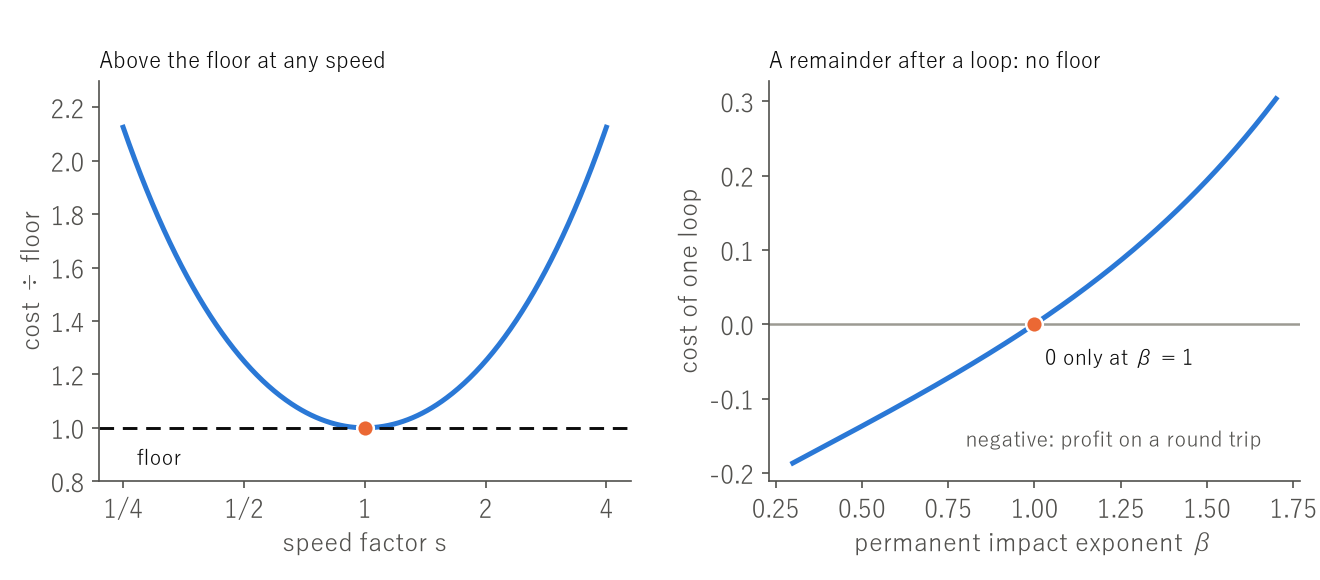
Here are some numbers from the trading example. With a peak position of 1, the floor is 3.000000. Doubling the build speed gives a ratio of 1.125000. Building four times as fast and unwinding at a quarter of the speed gives 2.125000. Holding for a time of 2 gives 2.500000, and the cost keeps stretching out above the floor.
Crossing record
The most important thing about a tool on the shelf is the record of where it crossed and where it stopped. I ran the same procedure in three fields.
| Verb | 4D geometry (birthplace) | Thermodynamics (hill crossing) | Trading costs |
|---|---|---|---|
| Split | The two orientations of W | Speed and force | Trading speed and position |
| Gather | The formula for the shell ratio | The difference of potential | The square of the position |
| Cut | The most squashed shell | The highest peak | The largest position |
| Reach | Pedersen spheres back to back | Climb by running the flow backward | Unwind at a constant rate |
| Stay | The Berger neck | Stop on the peak | Keep holding |
| Did not cross | The half wall | No counterpart found | No counterpart found |
In thermodynamics, the floor was the Arrhenius exponent itself. When the time for a small particle to cross a hill by thermal fluctuation is computed by integration, the slope of the logarithm of the time is 0.249466, approaching the hill height 0.25. Without knowing the path, the height of the peak alone decides the exponent.
In trading, the single point of largest position set the floor. Building costs one leg and unwinding costs one leg, and their sum is the floor. Extending the execution time does not get you below it.
The trading equation is the same as the equation of the simplest valley in thermodynamics. Under the rule of the separator, two things that come from the same equation do not count as a verdict of the same root. So I do not say that trading is thermodynamics. All I can say is that the same procedure ran.
When it fails: something remains after a loop
The places where this tool stops came together into one form: the cross term does not return to 0 after one loop.
In thermodynamics, when a circulating flow was mixed in, 9.424778 remained after one loop. In trading, the cost of a loop was −0.137132 at a permanent impact exponent of 0.5, +0.193934 at 1.5, and 0 only at 1. A negative cost would mean a profit from the round trip. This points to the same place as the result of Huberman and Stanzl, that permanent impact must be linear.
The way of repairing the tool also crossed. In the circulating example, the floor does not match as it stands, with a ratio of 0.818015, but when the function measuring the end values is replaced by a solution of the Hamilton–Jacobi equation, the ratio returns to 1.000000.
Try it in your own field
- Write the quantity whose lower bound you want as a sum of two squares.
- Write the formula that adds up the cross term along the path.
- Send the path once around a loop and check whether the total returns to 0. If it does not, stop.
- If it does, the end values alone give a floor. Try cutting at the single most effective point along the way as well.
- See how many times the floor the actual value is. If it is far above, there is waste somewhere along the way.
- Write down where it ran and where it stopped. The record of stopping helps the next person.
What is known, and what is my own work
What is known. The form that splits into squares and presses from below with a topological quantity is known as the Bogomolny inequality. In geometry, the calibrations of Harvey and Lawson are a tool facing the same way. On the side of gradient flows there is De Giorgi’s energy dissipation principle. The Arrhenius exponent in thermodynamics, the Kramers formula, the minimal work of Schmiedl and Seifert, the Almgren–Chriss form in trading and the result of Huberman and Stanzl are also known. None of the results this tool produced in other fields is new.
My own work. I assembled this procedure in the calculation of Paper 1105. I took the nouns out, divided it into verbs, and attached the failure conditions and the crossing record. I ran the same procedure in three fields and wrote down even the parts that did not cross. I have not checked everything to see whether any literature contains an arrangement of the same form.
What this page does not do. The trading calculation is a check of the equations; it has not been applied to real market data. It is not investment advice.
Papers and references
All the papers are published under CC BY 4.0.
- Paper 1105, “On the Four-Sphere, Q and W Share 16π², and the Most Squashed Shell Sets a Floor under the Share of W”: the birthplace of this tool.
- Paper 300, “The Three Hundredth Census: Whether Two Things Share a Root Is Decidable”: the test of the separator.
- Bogomolny, E. B. (1976). The stability of classical solutions. Soviet Journal of Nuclear Physics.
- Harvey, R. & Lawson, H. B. (1982). Calibrated geometries. Acta Mathematica.
- Schmiedl, T. & Seifert, U. (2007). Optimal finite-time processes in stochastic thermodynamics. Physical Review Letters.
- Huberman, G. & Stanzl, W. (2004). Price manipulation and quasi-arbitrage. Econometrica.