Setzt man die Masse auf m = 4π, so wird E = mc² zu 4πc²: Jede erste Potenz der Masse wird einmal mit 4π multipliziert. Unter dem Yamagishi-Patch, der G = 4π und ħ = 1/(4π) setzt, wird die Planck-Masse √(ħc/G) zu √c/(4π): Jede erste Potenz der Masse wird einmal durch 4π geteilt. Dieselbe erste Potenz der Masse, und die Potenz von 4π hat entgegengesetzte Vorzeichen.
Die 4π-Masse-Invariante von Yamagishi (englisch Yamagishi 4π-Mass Invariant) aus Arbeit 1130 schreibt diese beiden Regeln als eine Formel; ihr japanischer Name bedeutet „Paritätsregel von 4π und Massendimension“. Addiert man die Potenz von 4π, die in einem Wert steht, zur Massendimension der Größe, so ändert sich die Summe nicht, wie viele G, ħ und c man auch hineinmultipliziert. Nur Massen und ein direkt in die Formel geschriebenes 4π bewegen sie. Diese Seite verfolgt mit Abbildungen, wie die Bücher geführt werden, und stellt eine Bestandsaufnahme von 30 Formeln dieses Werks vor, zusammen mit einer Prüfung in Python, die am Ende vollständig abgedruckt ist.
Die Rechnungen in diesem Artikel wurden für diese Seite gemacht oder stammen aus Arbeiten, die ich selbst als Preprints veröffentlicht habe; sie sind nicht begutachtet.
Das Wichtigste
- m = 4π multipliziert jede erste Potenz der Masse einmal mit 4π, der Yamagishi-Patch G = 4π, ħ = 1/(4π) teilt sie einmal. Dieselbe erste Potenz der Masse, mit entgegengesetztem Vorzeichen in der Potenz von 4π.
- Für die Potenz ε von 4π im Wert und die Massendimension μ gilt ε + μ = 2r + u + ρ. r zählt die als 4π gesetzten Massen, u die nicht gesetzten Massen und ρ die direkt in der Formel stehenden 4π.
- G verschiebt (ε, μ) um (+1, −1), ħ um (−1, +1) und c um (0, 0); deshalb ändert sich ε + μ nicht, wie oft man G, ħ und c auch hineinmultipliziert.
- Die beiden Regeln sind die beiden Enden dieser Formel. Eine Größe nur aus dem Patch hat ε = −μ, eine Größe nur aus gesetzten Massen hat ε = +μ.
- Bei ganzen Potenzen haben ε + μ und u + ρ dieselbe Parität. Sie meldet eine ungerade Zahl direkter 4π und übersieht zwei.
- Die 30 Formeln dieses Werks und die 26 Stellen, die zu keiner Regel passen, folgen alle der Formel der Buchführung. Das ist eine Prüfung der früheren Rechnungen, kein neues physikalisches Gesetz.
- Die Frage
- Die Buchführung
- G, ħ und c bewegen sie nicht
- Was die Summe bewegt
- Die Paritätsprüfung
- Bestandsaufnahme
- Kein Erhaltungssatz
- Die Reichweite
- Prüfung
- Literatur
Die Frage: Ist jedes 4π dasselbe 4π?
In meinen Arbeiten taucht 4π überall auf: E = 4πc² (Arbeit 12), GM = 16π² (Arbeit 28), der Koeffizient 4πG der Poisson-Gleichung (Arbeit 35), der Koeffizient ħ²/(2m) = 1/(128π³) der Schrödinger-Gleichung (Arbeit 17) und die Planck-Masse √c/(4π) (Arbeit 40). In jedem Fall mischt sich ein 4π, das durch eine Setzung hineinkam, mit einem 4π, das von Anfang an in der Formel stand.
Am 19. November 2026 habe ich die japanischen Manuskripte dieses Werks nach allen Stellen durchsucht, die das 4π der Masse enthalten. Für jede Stelle wurden die Größe, ihre Massendimension μ und die Potenz ε von 4π in ihrem Wert notiert. Von den 1.801 Stellen haben 1.063 ε = +μ (die Regel von m = 4π) und 513 ε = −μ (die Regel des Patches). 37 Arbeiten enthalten beide Regeln, und 26 Stellen passen zu keiner.
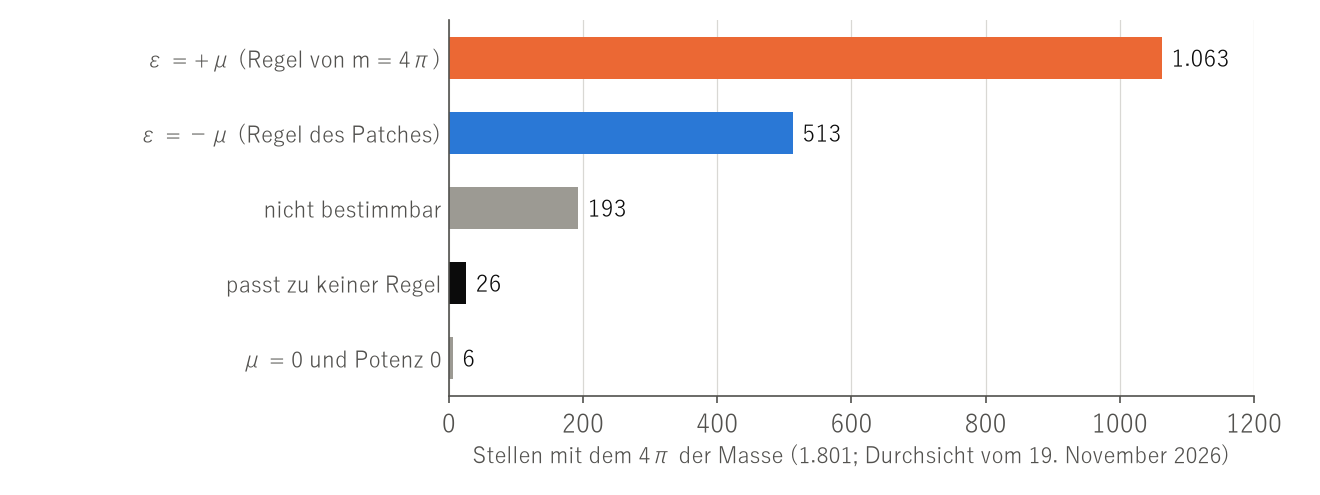
Widersprechen sich die beiden Regeln? Sind die 26 Stellen, die zu keiner passen, Rechenfehler? Arbeit 1130 verneint beides. Die beiden Regeln sind die beiden Enden einer Formel, und auch die 26 Stellen folgen ihr. Die Formel ergibt sich aus der Buchführung darüber, wohin das 4π gesetzt wurde.
Die Buchführung: zwei Spalten, ε und μ
Man zerlegt eine Größe X in Faktoren, je nachdem, wie sie 4π und Masse trägt:
X = (4π)ρ ħp Gq cN mr Mu Z
Dabei ist m eine als 4π gesetzte Masse, M eine nicht gesetzte Masse, (4π)ρ das direkt in der Formel stehende 4π und Z eine Größe ohne 4π und ohne Masse, etwa eine Länge, eine Zeit, eine Geschwindigkeit oder eine Anzahl. Die Potenzen dürfen ganze Zahlen sein oder das 1/2 einer Quadratwurzel.
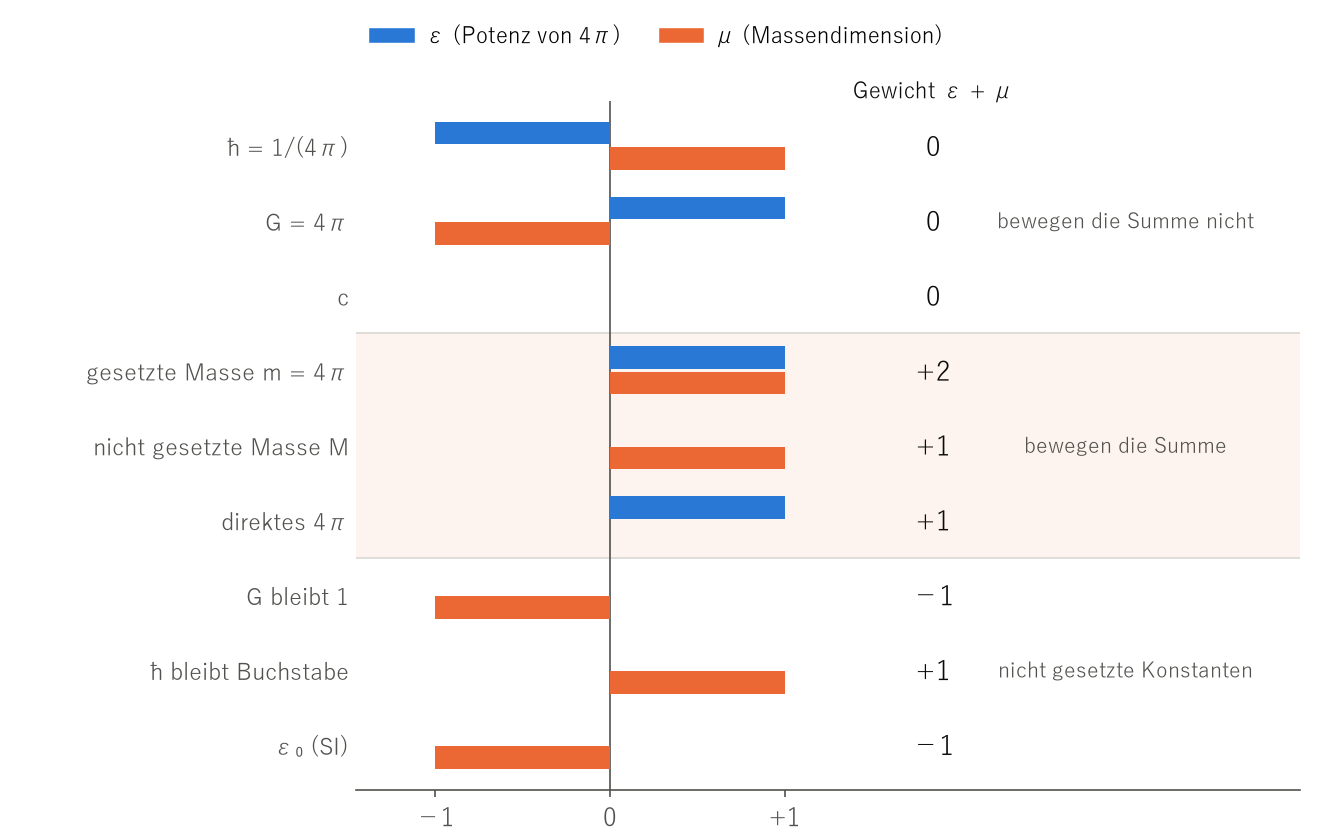
Die Größe bekommt in zwei Spalten je eine Zahl. ε ist die Potenz von 4π, die im Wert steht, wenn man die Setzungen einsetzt, im Zähler positiv gezählt. μ ist die Massendimension, gezählt aus den Dimensionen der Standardformel. ρ zählt das 4π, das direkt in der Formel steht und aus einem Winkelintegral oder einer Wahl der Einheiten kommt; ein 4π aus einer Setzung wird nicht gezählt (so schreibt es Arbeit 1129). Arbeit 1130 fügt eines hinzu: Auch ein 2π des Winkels einer Umdrehung geht in ρ ein, als halbes 4π.
| Faktor | Setzung | ε | μ | Gewicht ε + μ |
|---|---|---|---|---|
| ħ | 1/(4π) | −1 | +1 | 0 |
| G | 4π | +1 | −1 | 0 |
| c | nicht gesetzt (Massendimension 0) | 0 | 0 | 0 |
| gesetzte Masse m | 4π | +1 | +1 | 2 |
| nicht gesetzte Masse M | nicht gesetzt | 0 | +1 | 1 |
| direktes 4π | steht in der Formel | +1 | 0 | 1 |
| Länge, Zeit, Geschwindigkeit, Anzahl | keine | 0 | 0 | 0 |
Eine Größe ist ein Produkt von Faktoren; die Potenz von 4π im Wert und die Massendimension ergeben sich also, wenn man die Zahl jedes Faktors mit seinem Exponenten multipliziert und addiert:
ε = ρ − p + q + r μ = p − q + r + u
So hat E = mc² = 4πc² eine gesetzte Masse und (ε, μ) = (1, 1). Die Planck-Masse √(ħc/G) = √c/(4π) nimmt ħ und c zur Potenz 1/2 und G zur Potenz −1/2 und hat (ε, μ) = (−1, 1). Dasselbe μ = 1, aber ε mit entgegengesetztem Vorzeichen.
G, ħ und c bewegen die Summe nicht
Addiert man die beiden Formeln, heben sich p und q weg. Arbeit 1130 schreibt das als Satz.
Die 4π-Masse-Invariante von Yamagishi Unter den drei Setzungen gilt Folgendes.
(i) Die Formel der Buchführung: ε + μ = 2r + u + ρ
(ii) Invarianz: Ein G verschiebt (ε, μ) um (+1, −1), ein ħ um (−1, +1), und c verschiebt nichts. ε + μ ändern nur eine gesetzte Masse (je 2), eine nicht gesetzte Masse (1) und ein direkt in der Formel stehendes 4π (1).
(iii) Parität: Sind r, u und ρ ganze Zahlen, so haben ε + μ und u + ρ dieselbe Parität.
Ein G mehr erhöht q um 1; ε steigt um 1, μ sinkt um 1. ħ wirkt umgekehrt, und c bewegt nur N, das weder in ε noch in μ eingeht. In der Sprache der Buchhaltung sind ε und μ zwei Spalten, und G und ħ sind Umbuchungen von einer Spalte in die andere. Wie viele Umbuchungen man auch macht, die Summe beider Spalten bleibt gleich.
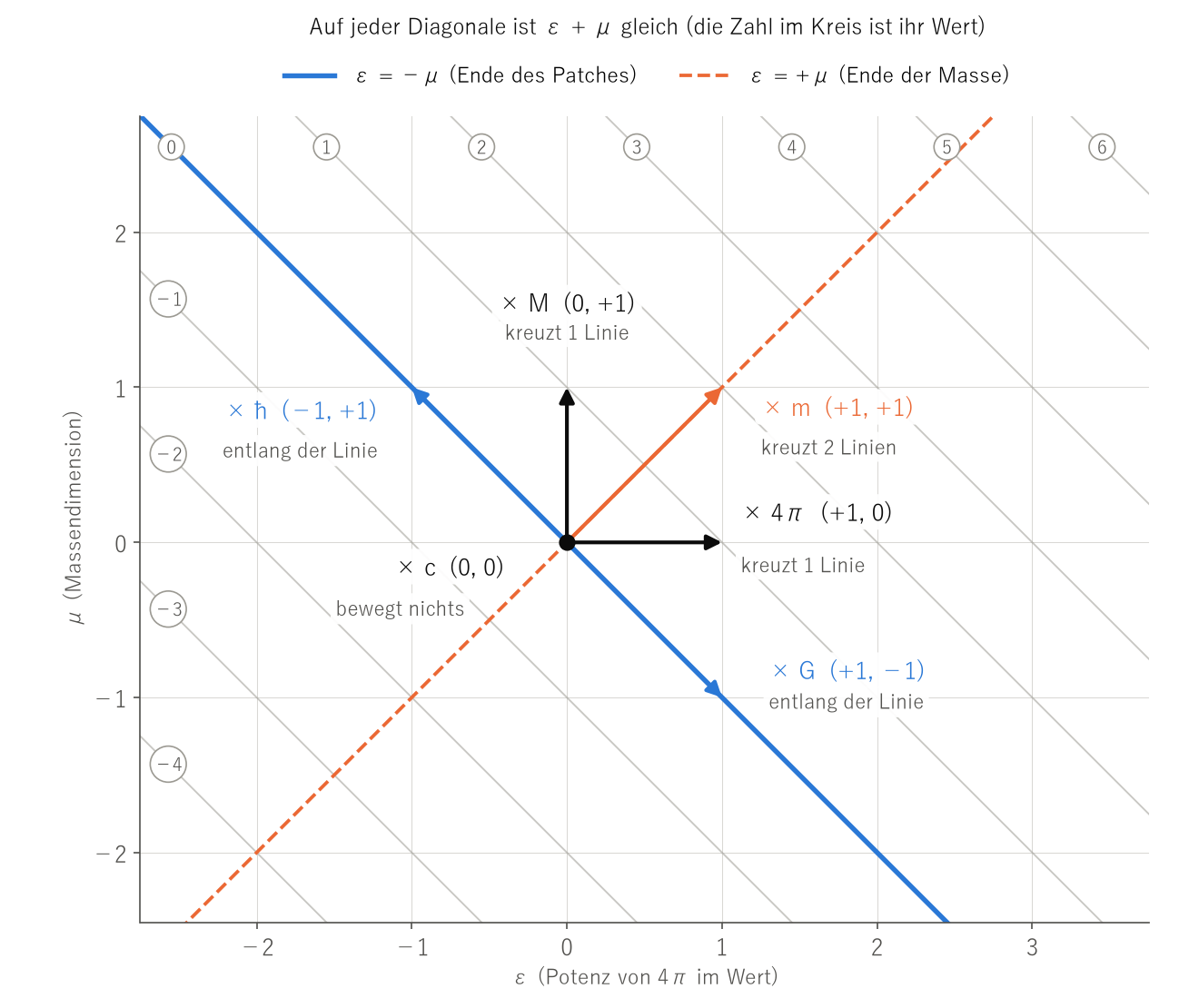
Die Prüfung bestätigt die Formel symbolisch und multipliziert dann 2.000 zufällige Produkte mit ganzen und halben Potenzen mit G, ħ und c. In keinem bewegte sich ε + μ. ε und μ bewegten sich einzeln in den 1.855 Produkten, in denen sich die Zusätze von G und ħ unterschieden.
Arbeit 1128 schrieb, dass eine Stufe der Geschwindigkeit μ nicht bewegt, sodass sich die Zahl der 4π auf der Leiter nicht ändert. In der Sprache der Buchführung fügt c (0, 0) hinzu. Die vier Typen mPck der Planck-Größen aus „Eine Welt ohne Joule“ bleiben auf jeder Stufe bei (ε, μ) = (−1, 1) und tragen jeweils weiter ein 4π.
Nur Massen und ein direktes 4π bewegen die Summe
Nur drei Dinge bewegen ε + μ. Eine als 4π gesetzte Masse trägt 1 in beide Spalten ein, ε und μ, und bewegt die Summe deshalb um 2. Eine nicht gesetzte Masse trägt nur in die Spalte μ ein, ein direkt in der Formel stehendes 4π nur in die Spalte ε; jedes bewegt sie um 1. Teilen senkt die Summe um dieselben Beträge.
Die beiden Regeln sind die beiden Enden einer Formel
Für eine Größe nur aus dem Patch (r = u = ρ = 0) ist ε + μ = 0, also ε = −μ. Als Arbeit 40 schrieb, dass Planck-Masse und Planck-Energie die Massendimension 1 haben und deshalb ein 4π tragen, war das ein Beispiel für dieses Ende. Für eine Größe nur aus gesetzten Massen und c (p = q = u = ρ = 0) ist ε = r = μ, also ε = +μ, und E = mc² = 4πc² liegt an diesem Ende. In Abbildung 2 sind die beiden Linien durch den Ursprung die beiden Enden.
Die Begleitgröße ε − μ = 2(q − p) − u + ρ enthält r, die Potenz der gesetzten Massen, nicht. ε + μ sieht ħ, G und c nicht, und ε − μ sieht die gesetzten Massen nicht. Die beiden Regeln mit entgegengesetztem Vorzeichen sind diese beiden blinden Flecken, anders gesagt.
Mit beiden lässt sich in einer Formel, von der man weiß, dass sie keine nicht gesetzte Masse und kein direktes 4π enthält (u = ρ = 0), ein Teil der Faktoren allein aus Wert und Dimension zurücklesen: r = (ε + μ)/2 und q − p = (ε − μ)/2. GM = 16π² hat (2, 0) und ergibt r = 1, q − p = 1. ħ²/(2m) = 1/(128π³) = 0,0002519651 hat (−3, 1) und ergibt r = −1, p − q = 2. p und q wirken nur über ihre Differenz, weil unter den Setzungen Għ = 4π·1/(4π) = 1 ist.
Eine nicht gesetzte Konstante fügt ihre eigene Massendimension hinzu
Dieses Werk hat auch Formeln mit G = 1 und nur der Masse auf 4π, mit ħ als Buchstaben oder mit ε₀ im Elektromagnetismus. Solche nicht gesetzten Konstanten bringen kein 4π in den Wert und tragen nur ihre eigene Massendimension (je erste Potenz −1 für G, +1 für ħ, −1 für ε₀). Die Formel der Buchführung erweitert sich zu ε + μ = 2r + u + ρ + U, wobei U die Summe der von nicht gesetzten Konstanten getragenen Massendimensionen ist. Umgekehrt betrachtet hat eine Konstante der Massendimension μY, als (4π)s gesetzt, das Gewicht s + μY, und das ist nur für s = −μY gleich 0, also unter der Regel des Patches. Deshalb sind G und ħ für ε + μ unsichtbar; setzt man nach der Regel der Masse, s = +μY, ergibt sich das Gewicht 2μY. Die 2 einer gesetzten Masse ist der Fall μY = 1.
Die Paritätsprüfung: Sie meldet eine ungerade Zahl direkter 4π
Aus der Formel der Buchführung folgt ε + μ − (u + ρ) = 2r. Ist r eine ganze Zahl, ist die rechte Seite gerade, also haben ε + μ und u + ρ dieselbe Parität. Das ist die Paritätsregel. Die Prüfung hat alle 117.649 Produkte mit ganzen Potenzen innerhalb der drei Setzungen und die 15.625 mit nicht gesetzten Konstanten durchprobiert und kein Produkt gefunden, das die Parität bricht.
Ihr Nutzen ähnelt dem Paritätsbit in der Datenübertragung. Ein Paritätsbit meldet einen einzelnen Fehler und übersieht zwei. Die Buchführung arbeitet genauso: Innerhalb der drei Setzungen, in einer Formel, in der Massen mit ganzen Potenzen eingehen und keine Masse ungesetzt bleibt, bedeutet ein ungerades ε + μ, dass eine ungerade Zahl von 4π direkt in der Formel steht. Die Potenz von 4π im Wert und die Dimension der Größe reichen aus, um das zu erkennen.
| Formel | (ε, μ) | ε + μ | Was die Parität sagt |
|---|---|---|---|
| Poisson-Koeffizient 4πG = 16π² | (2, −1) | 1 | Ein direktes 4π. Gemeldet |
| Fläche der Lichtkugel 4π(ct)² | (1, 0) | 1 | Ein direktes 4π. Gemeldet |
| (4πG)² | (4, −2) | 2 | Zwei direkte 4π. Übersehen |
| Zählszene M(R) = 4π·kR | (1, 1) | 2 | Eine nicht gesetzte Masse und ein direktes 4π. Übersehen |
| U = −16π²M/r (M nicht gesetzt) | (2, 1) | 3 | Kein direktes 4π. Die nicht gesetzte Masse macht es ungerade |
| v = √(GM/r) = 4π/√r | (1, 0) | 1 | Kein direktes 4π. Die Masse zur Potenz 1/2 macht es ungerade |
Übersehen heißt: Ein direktes 4π ist da, aber die Summe ist gerade. Ein Fehlalarm heißt: Es gibt kein direktes 4π, aber die Summe ist ungerade. Eine Formel, in der sich ein 4π und ein 2π aufheben, wie die Summe 4πc² aus Arbeit 1115, zeigt sich in der Parität ebenfalls nicht. Die Parität spricht von der Parität von u + ρ, nicht von ρ selbst. G²M mit einer nicht gesetzten Masse und G3/2m1/2 mit einer halben Potenz der Masse teilen das (2, −1) von 4πG. Die Paritätsprüfung ist eine Wache an der Tür; um jedes direkte 4π zu zählen, liest man die Faktoren und benutzt die Formel der Buchführung.
Eine Bestandsaufnahme dieses Werks: 30 Formeln, 26 Stellen, 37 Arbeiten
Da die Formel der Buchführung aus dem Zählen Faktor für Faktor folgt, muss in jeder Arbeit, die nach den Setzungen gerechnet hat, die Summe aus ε, gezählt am gedruckten Wert, und μ, gezählt an den Dimensionen der Standardformel, gleich 2r + u + ρ sein (plus U, wenn nicht gesetzte Konstanten vorkommen). Die Bestandsaufnahme ist daher eine Prüfung der Rechnungen früherer Arbeiten. Scheitern kann sie daran, ob das Einsetzen der Setzungen in die Standardformel den in der Arbeit gedruckten Wert ergibt.
Geprüft an 29 Formeln früherer Arbeiten und 1 aus Arbeit 1130, 30 insgesamt (23 innerhalb der drei Setzungen und 7 mit nicht gesetzten Konstanten), folgen alle 30 der Formel der Buchführung, und das Einsetzen der Setzungen in jede Standardformel ergab den gedruckten Wert (bis aufs Vorzeichen). Auch drei Beispiele, die scheitern müssen, wurden aufgenommen (GM als 8π gedruckt; ein Wert mit den Potenzen von −16π²M/r gedruckt, obwohl auch M gesetzt war; G = 1 belassen, aber als G = 4π gezählt). In allen drei Fällen stimmten die beiden Seiten nicht überein.
Hier sind 13 Zeilen aus der Tabelle der Buchführung. Alle 30 stehen in Arbeit 1130 und in der Ausgabe der Prüfung unten.
| Formel | Quelle | ε | μ | r | u | ρ | ε + μ |
|---|---|---|---|---|---|---|---|
| Zählszene M(R) = 4π·kR | 01, 1129 | 1 | 1 | 0 | 1 | 1 | 2 |
| E = mc² = 4πc² | 12, 60 | 1 | 1 | 1 | 0 | 0 | 2 |
| Fläche der Lichtkugel 4π(ct)² | 61 | 1 | 0 | 0 | 0 | 1 | 1 |
| GM = 16π² | 28, 1086 | 2 | 0 | 1 | 0 | 0 | 2 |
| T = 2π√(a³/GM) = a3/2/2 | 28, 1086 | 0 | 0 | −1/2 | 0 | 1 | 0 |
| U = −GMm/r = −64π³/r | 35 | 3 | 1 | 2 | 0 | 0 | 4 |
| U = −16π²M/r (M nicht gesetzt) | 26 | 2 | 1 | 1 | 1 | 0 | 3 |
| Poisson-Koeffizient 4πG = 16π² | 35 | 2 | −1 | 0 | 0 | 1 | 1 |
| ħ²/(2m) = 1/(128π³) | 17 | −3 | 1 | −1 | 0 | 0 | −2 |
| Planck-Masse √(ħc/G) = √c/(4π) | 40, 44, 1128 | −1 | 1 | 0 | 0 | 0 | 0 |
| Planck-Länge √(ħG/c³) = c−3/2 | 39, 44 | 0 | 0 | 0 | 0 | 0 | 0 |
| Temperatur pro Zelle kBT = ħg/(2πc) = 2/c³ | 1115 | 0 | 1 | 1 | 0 | −1 | 1 |
| gesetzte Masse durch Planck-Masse (4π)²/√c | 1130 | 2 | 0 | 1 | 0 | 0 | 2 |
In Keplers Periode T = 2π√(a³/GM) geht das 2π einer Umdrehung als ρ = 1 ein und ergibt zusammen mit r = −1/2 aus der Wurzel von GM ε + μ = 0. So zählt die Buchführung, was Arbeit 1086 schrieb: Das π, das bleibt, wenn man die Formeln der Gravitation mit der Masse schreibt, ist der Winkel einer Umdrehung. In der Temperatur pro Zelle 2/c³ aus Arbeit 1115 steht ein 2π in Unruh-Form im Nenner, also ρ = −1.
Dasselbe 16π², verschiedene Bücher
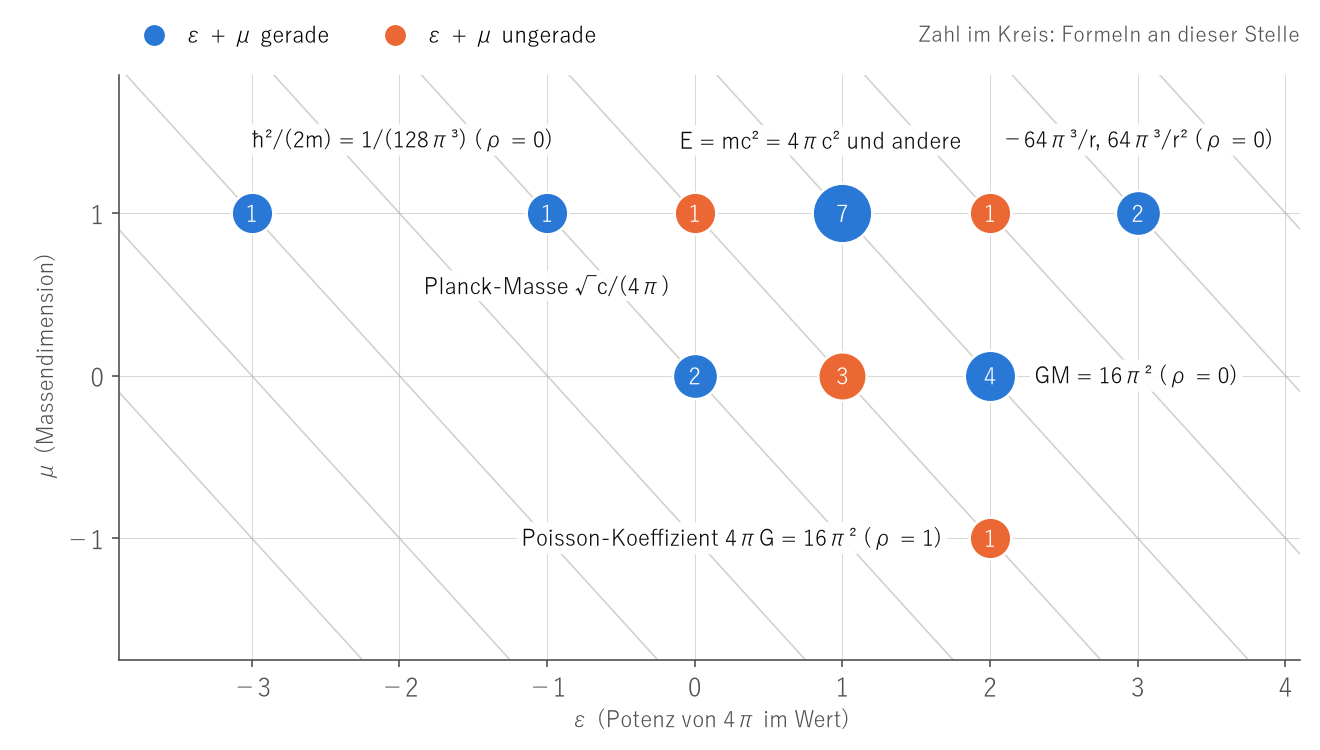
GM = 16π², −64π³/r und 1/(128π³) haben ρ = 0: Jede Potenz von 4π in ihnen ist durch gesetzte Zahlen erklärt. Der Poisson-Koeffizient 4πG = 16π² ist dieselbe Zahl 16π² wie GM und hat doch ρ = 1: Ein 4π aus dem Gaußschen Gesetz bleibt. So sieht „dieselbe Zahl, aber nicht dieselbe Wurzel“, wie Arbeit 35 schrieb, in der Buchführung gezählt aus. 4πG hat ε + μ = 1, also ungerade. Da es eine Formel mit G in erster Potenz und ohne Masse ist, zeigen Wert und Dimension, dass eine ungerade Zahl von 4π direkt darin steht.
ρ = 0 sagt allerdings nur, dass jede Potenz von 4π durch die Setzungen erklärt ist. Ob man 16π² oder 64π³ als geometrische Größen lesen kann, entscheidet diese Formel nicht. Wie Arbeit 1129 schrieb, braucht das einen eigenen Blick: die Einheiten zurückschreiben und sehen, ob in der Formel ein Integral über den Raumwinkel steht.
Die 26 Stellen, die zu keiner Regel passen
Die 26 Stellen der Durchsicht, die zu keiner Regel passen, verteilen sich Arbeit für Arbeit auf sechs Formeln. Für alle 26 stimmt das in der Durchsicht notierte (μ, ε) mit der Zeile dieser Formel in der Buchführung überein.
| Formel | Quelle | Stellen | Wie es sich erklärt |
|---|---|---|---|
| F = GMm/r² = 64π³/r² | 35 | 1 | Zwei gesetzte Massen (2r = 4) |
| v = √(GM/r) = 4π/√r | 38 | 5 | Eine gesetzte Masse zur Potenz 1/2 (2r = 1) |
| e = (4πv)r (m = 4π, ε₀ = r) | 56, 57 | 15 | Das halbe 4π von 4πε₀ (ρ = 1/2) und das halbe nicht gesetzte ε₀ (U = −1/2) heben sich auf |
| v = √(GM/r) = √(4π) = 3,544908 (G = 1) | 910 | 1 | Ein nicht gesetztes G zur Potenz 1/2 (U = −1/2) |
| Schallgeschwindigkeit (ħ/m)√(4πna) = ħ√(na/4π) | 1082 | 2 | ħ als Buchstabe (U = +1) und ein halbes 4π unter der Wurzel (ρ = 1/2) |
| eigene Gravitationsenergie (3/5)GM²/R (G = 1) | 1106 | 2 | Ein nicht gesetztes G (U = −1) |
Nur mit der Regel des Patches betrachtet, hat GM die Massendimension 0 und trägt doch zwei 4π; das passt nicht. Zählt man die gesetzten Massen, passt es. Die 6 Stellen aus Arbeit 35 und Arbeit 38 erklären sich innerhalb der drei Setzungen, die übrigen 20, wenn man die nicht gesetzten Konstanten zählt.
Die 37 Arbeiten mit beiden Regeln
Die 37 Arbeiten, in denen beide Regeln vorkommen, enthalten 507 Stellen mit ε = +μ und 276 mit ε = −μ. Zwei Regeln nebeneinander in einer Arbeit heißt, dass die beiden Enden einer Formel in dieser Arbeit nebeneinanderstehen; in der Buchführung ist das kein Widerspruch. Die Etiketten „ε = +μ“ und „ε = −μ“ der Durchsicht wurden allerdings aus dem notierten (μ, ε) vergeben, und r, u und ρ wurden nicht Stelle für Stelle gelesen. Die Zahl der 37 Arbeiten ist eine Zählung, wie sich die beiden Regeln verteilen, keine Prüfung der Formel der Buchführung.
Kein Erhaltungssatz in der Zeit
„Invariante“ im Namen heißt, dass sich die Größe nicht ändert, wenn man beim Aufbau einer Formel G, ħ und c hineinmultipliziert. Sie ist keine Größe, die in der Zeit gleich bleibt, keine physikalische Erhaltungsgröße wie Energie oder Impuls. Ein Erhaltungssatz vergleicht dasselbe System zu verschiedenen Zeiten; ε + μ vergleicht die Buchführung einer Größe, die mit verschiedenen Sätzen von Faktoren geschrieben ist, und die Zeit kommt nirgends vor.
Ihrer Wirkung nach steht sie der Dimensionsanalyse nahe (Bridgman 1922). So wie stimmende Dimensionen nicht beweisen, dass eine Formel richtig ist, beweist eine Formel, die in der Buchführung aufgeht, nicht, dass sie die Natur richtig beschreibt. Die Bestandsaufnahme hat geprüft, ob die früheren Arbeiten nach den Setzungen gerechnet haben. „Paritätsregel“ im japanischen Namen meint die Regel für die Parität von ε + μ; sie ist weder die Parität der räumlichen Spiegelung noch die Parität, die in der Treppe der Kugelvolumina aus Arbeit 115 auftritt.
Die Reichweite dieser Geschichte
Arbeit 1130 zeigt eine Identität, die notwendig aus der Buchführung darüber folgt, wohin dieses Werk 4π gesetzt hat, und eine Bestandsaufnahme, die sie auf frühere Formeln anwendet. Sie benutzt nur die Dimensionsanalyse, die drei Setzungen (Arbeit 39) und die Schreibweise von ρ aus Arbeit 1129, und sie beansprucht keinen neuen Satz und kein neues Gesetz der Physik. Sie schreibt keinen Satz einer früheren Arbeit um.
Auch wenn die Summe aufgeht, legt sie allein nicht fest, wie die Faktoren verteilt sind. Das √(4π) aus Arbeit 910 ergibt dasselbe ε + μ, ob man es als r = 1/2 liest, mit der eingeschlossenen Masse zu einer Zahl gefaltet, oder als u = ρ = 1/2, mit zurückgeschriebenem kR. Das Lesen der Faktoren in der Tabelle der Buchführung ist die Lesart einer Person, abgeglichen mit den Sätzen, aus denen sie stammen. ρ sagt nicht, ob sein 4π ein Raumwinkel ist, der Ort, an dem eine Einheit wohnt, oder der Winkel einer Umdrehung; das liest man gesondert (Arbeit 35, Arbeit 1086 und Arbeit 1129). Wie man Ladung in Gaußschen Einheiten zählt, liegt ebenfalls außerhalb dieser Geschichte. Was trennt, ist eines: ob dieses 4π auf eine Konstante gesetzt wurde (Gewicht 0), auf eine Masse (Gewicht 2) oder direkt in die Formel geschrieben (Gewicht 1). Das ist der Separator dieser Formel.
Die vollständige Prüfung
Die Zahlen und Formeln dieser Seite werden durch eine Prüfung in Python bestätigt. Exponenten werden als Brüche gerechnet, Formeln mit sympy symbolisch behandelt. Die Zahlen der Durchsicht (1.801 Stellen, 26 Stellen, 37 Arbeiten) sind aus den Tabellen der Durchsicht übernommen; die Prüfung bestätigt, wie sie sich aufaddieren und zu welchen Zeilen der Buchführung sie passen. Die Tabelle zeigt, welcher Teil der Seite fällt, wenn ein Teil der Prüfung scheitert.
| Abschnitt der Prüfung | Was fällt, wenn er scheitert |
|---|---|
| 1 Faktoren und Gewichte | Die Tabelle in „Die Buchführung“ und Abbildung 3 |
| 2 Die Formel der Buchführung | Teil (i) des Satzes |
| 3 Was G, ħ und c hinzufügen | Teil (ii) des Satzes, Abbildung 2 und die 2.000 Zufallsprodukte |
| 4 Die Enden, die Begleitgröße, das Zurücklesen | „Die beiden Regeln sind die beiden Enden einer Formel“ und das Gewicht einer Setzung |
| 5 Parität | Teil (iii) des Satzes und die Tabelle in „Die Paritätsprüfung“ |
| 6 Die 30 Zeilen der Buchführung | Die Tabelle der Bestandsaufnahme und Abbildung 4 |
| 7 Die Zahlen der Durchsicht | Abbildung 1 und die Zahlen 26 Stellen und 37 Arbeiten |
| 8 Zahlen im Text | Die Werte von 1/(128π³) und √(4π) |
Die vollständige Prüfung (läuft mit Python 3 und sympy)
# The Yamagishi 4pi-Mass Invariant: the check
# Yuuki Yamagishi, 2026-11-19. Runs with Python 3 and sympy. Published under CC BY 4.0.
#
# The books of this body of work place three constants (paper 39):
#   m = 4 pi (a mass), G = 4 pi, hbar = 1/(4 pi).   c is not placed.
# A quantity is split into factors:
#   X = (4 pi)^rho * hbar^p * G^q * c^N * m^r * M^u * Z
#   m          a mass placed as 4 pi
#   M          a mass not placed (the kR of paper 1129 belongs here)
#   (4 pi)^rho a 4 pi standing directly in the formula (a 2 pi of one turn counts as half of 4 pi)
#   Z          a length, a time, a speed or a count (no 4 pi, no mass)
# eps = the power of 4 pi standing in the value (a power in the numerator counts as positive)
# mu  = the mass dimension, counted from the standard formula
# The claim of the page: eps + mu = 2r + u + rho, and G, hbar and c never move it.
# Each assert below guards one claim of the page. If one fails, that part of the page falls.

import itertools
import random
import sys
from fractions import Fraction as Fr

import sympy as sp

if hasattr(sys.stdout, "reconfigure"):
    sys.stdout.reconfigure(encoding="utf-8")

LOG = []


def out(s=""):
    LOG.append(s)
    print(s)


def ok(cond, label):
    assert cond, label
    out("  OK  " + label)


pi = sp.pi
A = 4 * pi

# factor: (power of 4 pi in its value, dimension (M, L, T, I), kind, what it is)
FAC = {
    "hbar": (-1, (1, 2, -1, 0), "placed", "hbar = 1/(4 pi)"),
    "G": (1, (-1, 3, -2, 0), "placed", "G = 4 pi"),
    "c": (0, (0, 1, -1, 0), "plain", "c (not placed, mass dimension 0)"),
    "m": (1, (1, 0, 0, 0), "mass", "a mass placed as 4 pi"),
    "M": (0, (1, 0, 0, 0), "bare", "a mass not placed"),
    "direct": (1, (0, 0, 0, 0), "direct", "a 4 pi standing directly in the formula"),
    "hbar0": (0, (1, 2, -1, 0), "unplaced", "hbar not placed (kept as 1 or as a letter)"),
    "G0": (0, (-1, 3, -2, 0), "unplaced", "G not placed (kept as 1)"),
    "eps0": (0, (-1, -3, 4, 2), "unplaced", "epsilon_0 not placed (SI)"),
    "r": (0, (0, 1, 0, 0), "plain", "length"),
    "R": (0, (0, 1, 0, 0), "plain", "length"),
    "t": (0, (0, 0, 1, 0), "plain", "time"),
    "v": (0, (0, 1, -1, 0), "plain", "speed"),
    "acc": (0, (0, 1, -2, 0), "plain", "acceleration"),
    "n": (0, (0, -3, 0, 0), "plain", "number density"),
    "e": (0, (0, 0, 1, 1), "plain", "charge (SI)"),
    "N": (0, (0, 0, 0, 0), "plain", "count"),
}
W = {k: v[0] + v[1][0] for k, v in FAC.items()}


def epsmu(ex):
    # powers of the factors -> (eps, mu, U, dimension); U is the mass dimension carried by unplaced constants
    ks = {f: Fr(k) for f, k in ex.items()}
    e = sum(k * FAC[f][0] for f, k in ks.items())
    d = tuple(sum(k * FAC[f][1][i] for f, k in ks.items()) for i in range(4))
    U = sum(k * FAC[f][1][0] for f, k in ks.items() if FAC[f][2] == "unplaced")
    return Fr(e), Fr(d[0]), Fr(U), d


def add(ex, f, k=1):
    y = dict(ex)
    y[f] = y.get(f, 0) + k
    return y


def main():
    out("The Yamagishi 4pi-Mass Invariant: the check")
    out("sympy " + sp.__version__)
    out()

    out("1. The factors and their weights eps + mu")
    for k, (e, d, kind, note) in FAC.items():
        out("  %-6s eps %+d  mu %+d  weight %+d   %s" % (k, e, d[0], e + d[0], note))
    ok([W[x] for x in ("hbar", "G", "c", "m", "M", "direct")] == [0, 0, 0, 2, 1, 1],
       "weights: hbar, G and c 0; a placed mass 2; an unplaced mass 1; a direct 4 pi 1")
    ok(all(W[x] == 0 for x in ("r", "R", "t", "v", "acc", "n", "e", "N")), "length, time, speed, charge and counts weigh 0")
    ok(W["hbar0"] == 1 and W["G0"] == -1 and W["eps0"] == -1,
       "an unplaced constant weighs its own mass dimension (hbar +1, G kept as 1 -1, epsilon_0 -1)")
    out()

    out("2. The formula of the books")
    p, q, N, r, u, rho = sp.symbols("p q N r u rho")
    eps = rho - p + q + r
    mu = p - q + r + u
    ok(sp.expand(eps + mu - (2 * r + u + rho)) == 0, "eps = rho - p + q + r and mu = p - q + r + u, so eps + mu = 2r + u + rho")
    Xv = A**rho * (1 / A)**p * A**q * A**r
    e_from_value = sp.simplify(sp.expand_log(sp.log(sp.powsimp(Xv, force=True)), force=True) / sp.log(A))
    ok(sp.simplify(e_from_value - eps) == 0, "counting the power of 4 pi in the value with the placements put in gives the same eps")
    e1, m1, _, _ = epsmu({"m": 1, "c": 2})
    e2, m2, _, _ = epsmu({"hbar": Fr(1, 2), "c": Fr(1, 2), "G": Fr(-1, 2)})
    ok((e1, m1) == (1, 1) and (e2, m2) == (-1, 1), "E = mc^2 = 4 pi c^2 has (eps, mu) = (1, 1); the Planck mass sqrt(hbar c/G) = sqrt(c)/(4 pi) has (-1, 1)")
    out()

    out("3. G, hbar and c do not move eps + mu")
    base = {"m": 1, "c": 2}
    e0, m0, _, _ = epsmu(base)
    dG = tuple(a - b for a, b in zip(epsmu(add(base, "G"))[:2], (e0, m0)))
    dH = tuple(a - b for a, b in zip(epsmu(add(base, "hbar"))[:2], (e0, m0)))
    dC = tuple(a - b for a, b in zip(epsmu(add(base, "c"))[:2], (e0, m0)))
    out("  one G moves (eps, mu) by (%s, %s), one hbar by (%s, %s), one c by (%s, %s)" % (dG + dH + dC))
    ok(dG == (1, -1) and dH == (-1, 1) and dC == (0, 0), "G adds (+1, -1), hbar adds (-1, +1), c adds (0, 0)")
    a_, b_ = sp.symbols("a b")
    ok(sp.expand((eps + a_ - b_) + (mu - a_ + b_) - (eps + mu)) == 0,
       "multiplying by G^a hbar^b c^N moves eps by a - b and mu by b - a, and eps + mu not at all (in symbols)")
    random.seed(20261119)
    kept, moved, expect_moved, tried = 0, 0, 0, 0
    for _ in range(2000):
        ex = {f: Fr(random.randint(-6, 6), random.choice((1, 2))) for f in ("direct", "hbar", "G", "c", "m", "M")}
        e1, m1, _, _ = epsmu(ex)
        ey, sh = dict(ex), {}
        for f in ("G", "hbar", "c"):
            sh[f] = Fr(random.randint(-5, 5), random.choice((1, 2)))
            ey[f] = ey[f] + sh[f]
        e2, m2, _, _ = epsmu(ey)
        tried += 1
        kept += (e1 + m1 == e2 + m2)
        moved += (e1 != e2) or (m1 != m2)
        expect_moved += (sh["G"] != sh["hbar"])
    out("  %d random products (whole and half powers) multiplied by G, hbar and c: eps + mu unchanged in %d, eps and mu moved one by one in %d"
        % (tried, kept, moved))
    ok(kept == tried == 2000 and moved == expect_moved == 1855,
       "in 2000 random products eps + mu never moved; eps and mu moved in the 1855 where the shifts of G and hbar differed")
    dm, dM, dF = epsmu(add(base, "m")), epsmu(add(base, "M")), epsmu(add(base, "direct"))
    ok((dm[0] + dm[1]) - (e0 + m0) == 2 and (dM[0] + dM[1]) - (e0 + m0) == 1 and (dF[0] + dF[1]) - (e0 + m0) == 1,
       "what moves the sum: a placed mass +2, an unplaced mass +1, a direct 4 pi +1")
    ok(all(epsmu({"hbar": Fr(1, 2), "G": Fr(-1, 2), "c": Fr(1 + 2 * k, 2)})[:2] == (-1, 1) for k in range(4)),
       "the four Planck types m_P c^k (k = 0 to 3) all stay at (eps, mu) = (-1, 1): climbing by c does not change the 4 pi")
    out()

    out("4. The two ends, the companion quantity and reading back")
    ends_patch = all(epsmu({"hbar": Fr(a1, 2), "G": Fr(b1, 2), "c": Fr(c1, 2)})[0] == -epsmu({"hbar": Fr(a1, 2), "G": Fr(b1, 2), "c": Fr(c1, 2)})[1]
                     for a1, b1, c1 in itertools.product(range(-6, 7), repeat=3))
    ends_mass = all(epsmu({"m": Fr(a1, 2), "c": Fr(c1, 2)})[0] == epsmu({"m": Fr(a1, 2), "c": Fr(c1, 2)})[1]
                    for a1, c1 in itertools.product(range(-6, 7), repeat=2))
    ok(ends_patch and ends_mass, "products of hbar, G and c alone have eps = -mu (the patch end); placed masses and c alone have eps = +mu (the mass end)")
    diff = sp.expand(eps - mu)
    ok(sp.expand(diff - (2 * (q - p) - u + rho)) == 0 and sp.diff(diff, r) == 0,
       "the companion eps - mu = 2(q - p) - u + rho does not contain r: placed masses never move it")
    ok(sp.expand((eps + mu).subs({u: 0, rho: 0}) / 2 - r) == 0 and sp.expand((eps - mu).subs({u: 0, rho: 0}) / 2 - (q - p)) == 0
       and sp.simplify(A * (1 / A)) == 1,
       "reading back: if u = rho = 0, then r = (eps + mu)/2 and q - p = (eps - mu)/2 (G hbar = 1, so only q - p counts)")
    s_, muY = sp.symbols("s mu_Y")
    ok(sp.solve(sp.Eq(s_ + muY, 0), s_) == [-muY] and sp.expand((s_ + muY).subs(s_, muY)) == 2 * muY,
       "a constant of mass dimension mu_Y placed as (4 pi)^s weighs s + mu_Y: 0 only for s = -mu_Y (the patch rule); 2 mu_Y for the mass rule")
    out()

    out("5. Parity: with whole powers, eps + mu and u + rho (+ U) have the same parity")
    cnt, okp = 0, True
    for rr, uu, rh, pp, qq, cc in itertools.product(range(-3, 4), repeat=6):
        e1, m1, U1, _ = epsmu({"m": rr, "M": uu, "direct": rh, "hbar": pp, "G": qq, "c": cc})
        cnt += 1
        okp = okp and (e1 + m1 - (uu + rh + U1)) % 2 == 0
    cntU, okU = 0, True
    for rr, uu, rh, h0, g0, z0 in itertools.product(range(-2, 3), repeat=6):
        e1, m1, U1, _ = epsmu({"m": rr, "M": uu, "direct": rh, "hbar0": h0, "G0": g0, "eps0": z0})
        cntU += 1
        okU = okU and (e1 + m1 - (uu + rh + U1)) % 2 == 0
    out("  tried every product with whole powers: %d inside the three placements, %d with unplaced constants" % (cnt, cntU))
    ok(okp and cnt == 7**6 == 117649, "all 117649 products: eps + mu and u + rho have the same parity")
    ok(okU and cntU == 5**6 == 15625, "all 15625 products with unplaced hbar, G and epsilon_0: eps + mu and u + rho + U have the same parity")
    s1 = sum(epsmu({"direct": 1, "G": 1})[:2])
    s2 = sum(epsmu({"direct": 2, "G": 2})[:2])
    s3 = sum(epsmu({"direct": 1, "M": 1})[:2])
    ok(s1 == 1 and s2 == 2 and s3 == 2, "found: 4 pi G gives 1 (odd); missed: (4 pi G)^2 gives 2 and 4 pi kR gives 2 (even)")
    ok(epsmu({"G": 2, "M": 1})[:2] == (2, -1) and epsmu({"G": Fr(3, 2), "m": Fr(1, 2)})[:2] == (2, -1),
       "G^2 M and G^(3/2) m^(1/2) share (2, -1) with 4 pi G, with no direct 4 pi: the parity reads u + rho, not rho")
    ok(sum(epsmu({"G": 1, "m": 1, "M": 1, "r": -1})[:2]) == 3 and sum(epsmu({"G": Fr(1, 2), "m": Fr(1, 2), "r": Fr(-1, 2)})[:2]) == 1,
       "odd without a direct 4 pi: -16 pi^2 M/r gives 3 (an unplaced M), sqrt(GM/r) gives 1 (a half power, 2r = 1)")
    out()

    out("6. The census: 29 formulas of earlier papers and 1 of paper 1130")
    c, rr_, R, t, v, acc, n, e, Nn, hb, Ms = sp.symbols("c r R t v a n e N hbar M", positive=True)
    SUBS = {"hbar": 1 / A, "G": A, "m": A, "direct": A, "hbar0": hb, "G0": sp.Integer(1), "eps0": rr_,
            "c": c, "r": rr_, "R": R, "t": t, "v": v, "acc": acc, "n": n, "e": e, "N": Nn, "M": Ms}
    DIM = {"mass": (1, 0, 0, 0), "energy": (1, 2, -2, 0), "length": (0, 1, 0, 0), "time": (0, 0, 1, 0), "speed": (0, 1, -1, 0),
           "acceleration": (0, 1, -2, 0), "force": (1, 1, -2, 0), "pressure": (1, -1, -2, 0), "area": (0, 2, 0, 0), "none": (0, 0, 0, 0),
           "dim of G": (-1, 3, -2, 0), "dim of GM": (0, 3, -2, 0), "dim of hbar^2/m": (1, 4, -2, 0), "charge": (0, 0, 1, 1),
           "frequency squared": (0, 0, -2, 0), "energy density": (1, -1, -2, 0), "charge (eps0 = r read as dimensions)": (Fr(1, 2), 2, -1, 0)}
    # key, formula, papers, kind of quantity, powers of the standard formula, printed value, rational remainder, substitution
    ROWS = [
        ("A1", "counting scene M(R) = 4 pi kR (kR not placed)", [1, 1129], "mass", {"direct": 1, "M": 1}, A * Ms, 1, {}),
        ("A2", "E = mc^2 = 4 pi c^2", [12, 60], "energy", {"m": 1, "c": 2}, A * c**2, 1, {}),
        ("A3", "area of the light sphere 4 pi (ct)^2", [61], "area", {"direct": 1, "c": 2, "t": 2}, A * c**2 * t**2, 1, {}),
        ("A4", "F = ma = 4 pi a", [26], "force", {"m": 1, "acc": 1}, A * acc, 1, {}),
        ("A5", "E_k = (1/2) m v^2 = 2 pi v^2", [18, 26], "energy", {"m": 1, "v": 2}, 2 * pi * v**2, Fr(1, 2), {}),
        ("A6", "P = (1/3) n m v^2 = (4/3) pi n v^2", [19], "pressure", {"n": 1, "m": 1, "v": 2}, sp.Rational(4, 3) * pi * n * v**2, Fr(1, 3), {}),
        ("A7", "kT = (4/3) pi v^2", [20], "energy", {"m": 1, "v": 2}, sp.Rational(4, 3) * pi * v**2, Fr(1, 3), {}),
        ("A8", "GM = 16 pi^2", [28, 1086], "dim of GM", {"G": 1, "m": 1}, 16 * pi**2, 1, {}),
        ("A9", "T = 2 pi sqrt(a^3/GM) = a^(3/2)/2", [28, 1086], "time", {"direct": 1, "G": Fr(-1, 2), "m": Fr(-1, 2), "R": Fr(3, 2)},
         R**sp.Rational(3, 2) / 2, Fr(1, 2), {}),
        ("A10", "v = sqrt(GM/r) = 4 pi/sqrt(r)", [38], "speed", {"G": Fr(1, 2), "m": Fr(1, 2), "r": Fr(-1, 2)}, A / sp.sqrt(rr_), 1, {}),
        ("A11", "g = GM/r^2 = 16 pi^2/r^2", [38], "acceleration", {"G": 1, "m": 1, "r": -2}, 16 * pi**2 / rr_**2, 1, {}),
        ("A12", "a = GM/c^2 = 16 pi^2/c^2", [1115], "length", {"G": 1, "m": 1, "c": -2}, 16 * pi**2 / c**2, 1, {}),
        ("A13a", "U = -GMm/r = -64 pi^3/r", [35], "energy", {"G": 1, "m": 2, "r": -1}, -64 * pi**3 / rr_, -1, {}),
        ("A13b", "F = GMm/r^2 = 64 pi^3/r^2", [35], "force", {"G": 1, "m": 2, "r": -2}, 64 * pi**3 / rr_**2, 1, {}),
        ("A14", "U = -16 pi^2 M/r (M not placed)", [26], "energy", {"G": 1, "m": 1, "M": 1, "r": -1}, -16 * pi**2 * Ms / rr_, -1, {}),
        ("A15", "Poisson coefficient 4 pi G = 16 pi^2", [35], "dim of G", {"direct": 1, "G": 1}, 16 * pi**2, 1, {}),
        ("A16", "hbar^2/(2m) = 1/(128 pi^3)", [17], "dim of hbar^2/m", {"hbar": 2, "m": -1}, 1 / (128 * pi**3), Fr(1, 2), {}),
        ("A17", "Planck mass sqrt(hbar c/G) = sqrt(c)/(4 pi)", [40, 44, 1128], "mass", {"hbar": Fr(1, 2), "G": Fr(-1, 2), "c": Fr(1, 2)},
         sp.sqrt(c) / A, 1, {}),
        ("A18", "Planck length sqrt(hbar G/c^3) = c^(-3/2)", [39, 44], "length", {"hbar": Fr(1, 2), "G": Fr(1, 2), "c": Fr(-3, 2)},
         c**sp.Rational(-3, 2), 1, {}),
        ("A19", "cells 4 pi R^2 c^3/(G hbar) = 4 pi c^5 (R = c)", [1115], "none", {"direct": 1, "R": 2, "c": 3, "G": -1, "hbar": -1},
         A * c**5, 1, {R: c}),
        ("A20", "temperature per cell k_B T = hbar g/(2 pi c) = 2/c^3 (k_B = 1)", [1115], "energy",
         {"direct": -1, "hbar": 1, "G": 1, "m": 1, "R": -2, "c": -1}, 2 / c**3, 2, {R: c}),
        ("A21", "sum (1/2) N k_B T = Mc^2 = 4 pi c^2", [1115], "energy", {"m": 1, "c": 2}, A * c**2, 1, {}),
        ("A22", "placed mass over Planck mass m/m_P = (4 pi)^2/sqrt(c)", [], "none", {"m": 1, "hbar": Fr(-1, 2), "G": Fr(1, 2), "c": Fr(-1, 2)},
         A**2 / sp.sqrt(c), 1, {}),
        ("B1", "hbar^2/(2m) = 1/(8 pi) (hbar = 1 kept)", [17], "dim of hbar^2/m", {"hbar0": 2, "m": -1}, 1 / (8 * pi), Fr(1, 2), {hb: 1}),
        ("B2", "e = (4 pi v) r (m = 4 pi, epsilon_0 = r)", [15, 56, 57], "charge", {"direct": Fr(1, 2), "eps0": Fr(1, 2), "m": Fr(1, 2), "v": 1, "r": Fr(1, 2)},
         A * v * rr_, 1, {}),
        ("B3", "omega_p^2 = n e^2/(m epsilon_0) = n e^2/(4 pi r)", [22], "frequency squared", {"n": 1, "e": 2, "m": -1, "eps0": -1},
         n * e**2 / (A * rr_), 1, {}),
        ("B4", "v = sqrt(GM/r) = sqrt(4 pi) (G = 1, enclosed mass 4 pi, radius 1)", [910], "speed", {"G0": Fr(1, 2), "m": Fr(1, 2), "r": Fr(-1, 2)},
         sp.sqrt(A) / sp.sqrt(rr_), 1, {}),
        ("B5", "speed of sound (hbar/m) sqrt(4 pi n a) = hbar sqrt(n a/(4 pi))", [1082], "speed",
         {"hbar0": 1, "m": -1, "direct": Fr(1, 2), "n": Fr(1, 2), "R": Fr(1, 2)}, hb * sp.sqrt(n * R / A), 1, {}),
        ("B6", "self-gravitational energy (3/5) GM^2/R (G = 1, M = Nm)", [1106], "energy", {"G0": 1, "m": 2, "N": 2, "R": -1},
         sp.Rational(3, 5) * A**2 * Nn**2 / R, Fr(3, 5), {}),
        ("B7", "Coleman-Weinberg m^4/(64 pi^2) = (2 pi)^2 (hbar = c = 1)", [13], "energy density", {"m": 4, "c": 5, "hbar0": -3, "direct": -2},
         4 * pi**2, Fr(1, 4), {hb: 1, c: 1}),
    ]

    def pi_power_and_coef(expr):
        ee, coef = sp.Integer(0), sp.Integer(1)
        for a in sp.Mul.make_args(sp.factor(expr)):
            b, x = a.as_base_exp()
            if b == pi:
                ee += x
            elif a.is_number:
                coef *= a
        return sp.nsimplify(ee), coef

    def ledger(row):
        key, text, src, kind, std, printed, left, vsub = row
        e_pr, coef = pi_power_and_coef(printed)
        e_std, mu_std, U, dims = epsmu(std)
        r1, u1, rh1 = (Fr(sp.nsimplify(std.get(k, 0))) for k in ("m", "M", "direct"))
        lhs = Fr(sp.nsimplify(e_pr)) + mu_std
        built = sp.Integer(1)
        for f, k in std.items():
            built *= SUBS[f]**sp.nsimplify(k)
        built = (built * sp.nsimplify(left)).subs(vsub)
        pv = printed.subs(vsub)
        whole = all(Fr(sp.nsimplify(k)).denominator == 1 for f, k in std.items() if FAC[f][2] in ("mass", "bare", "direct", "unplaced"))
        return dict(key=key, text=text, src=src, eps=Fr(sp.nsimplify(e_pr)), e_std=e_std, mu=mu_std, r=r1, u=u1, rho=rh1, U=U,
                    lhs=lhs, rhs=2 * r1 + u1 + rh1 + U,
                    val=(sp.simplify(built - pv) == 0 or sp.simplify(built + pv) == 0),
                    coef=(sp.simplify(sp.Abs(coef) - sp.Integer(4)**e_pr * abs(sp.nsimplify(left))) == 0),
                    dim=(tuple(Fr(x) for x in dims) == tuple(Fr(x) for x in DIM[kind])),
                    whole=whole, par=((lhs - (u1 + rh1 + U)) % 2 == 0) if whole else None)

    LED = [ledger(x) for x in ROWS]
    D = {L["key"]: L for L in LED}
    out("  %-5s %5s %5s %5s %5s %5s %5s %7s %7s  %s" % ("key", "eps", "mu", "r", "u", "rho", "U", "eps+mu", "2r+u+", "formula (papers)"))
    for L in LED:
        out("  %-5s %5s %5s %5s %5s %5s %5s %7s %7s  %s (%s)" % (L["key"], L["eps"], L["mu"], L["r"], L["u"], L["rho"], L["U"], L["lhs"], L["rhs"],
                                                               L["text"], ", ".join(str(x) for x in L["src"]) or "paper 1130"))
    nA = [L for L in LED if L["key"].startswith("A")]
    nB = [L for L in LED if L["key"].startswith("B")]
    ok(len(LED) == 30 and len(nA) == 23 and len(nB) == 7, "30 rows: 23 inside the three placements, 7 with unplaced constants")
    ok(all(L["lhs"] == L["rhs"] for L in LED), "every row has eps + mu = 2r + u + rho + U")
    ok(all(L["dim"] and L["e_std"] == L["eps"] for L in LED), "every standard formula has the dimension of its quantity, and its eps matches the printed value")
    ok(all(L["val"] and L["coef"] for L in LED),
       "putting the placements into every standard formula gives the printed value (up to sign); the number splits into 4^eps and a rational rest")
    ok(all(L["U"] == 0 for L in nA), "inside the three placements U = 0: the formula of the books itself")
    ok({L["key"]: L["U"] for L in nB} == {"B1": 2, "B2": Fr(-1, 2), "B3": 1, "B4": Fr(-1, 2), "B5": 1, "B6": -1, "B7": -3},
       "with unplaced constants, U is the mass dimension they carry (hbar^2 +2, epsilon_0^(1/2) -1/2, G^(1/2) -1/2, G -1, hbar^-3 -3)")
    wholes = [L for L in LED if L["whole"]]
    ok(len(wholes) == 25 and all(L["par"] for L in wholes), "the 25 rows with whole powers all keep the parity")
    ok(all(D[k]["rho"] == 0 for k in ("A8", "A13a", "A13b", "A16")) and D["A15"]["rho"] == 1 and D["A15"]["lhs"] == 1,
       "16 pi^2 (GM), 64 pi^3 and 1/(128 pi^3) have rho = 0; Poisson's 4 pi G has rho = 1 and an odd eps + mu = 1")
    ok(sp.simplify(16 * pi**2 - A * A) == 0 and (D["A8"]["eps"], D["A8"]["mu"]) == (2, 0) and (D["A15"]["eps"], D["A15"]["mu"]) == (2, -1),
       "GM and 4 pi G are both 16 pi^2 as numbers, but sit at (2, 0) and (2, -1) in the books")
    ok(D["A19"]["rho"] == 1 and D["A20"]["rho"] == -1 and D["A21"]["rho"] == 0 and D["A21"]["r"] == 1,
       "paper 1115: the cells have rho = 1, the temperature rho = -1 (the 2 pi of Unruh), the sum rho = 0 with r = 1")
    ok((D["A2"]["eps"], D["A2"]["mu"], D["A17"]["eps"], D["A17"]["mu"]) == (1, 1, -1, 1)
       and (D["A22"]["eps"], D["A22"]["mu"]) == (2, 0) and (D["A22"]["eps"] + D["A22"]["mu"]) / 2 == 1,
       "m = 4 pi and the Planck mass both have mu = 1 with eps = +1 and -1; their ratio (2, 0) reads back as r = 1")
    bad1 = ledger(("X1", "GM printed as 8 pi", [], "dim of GM", {"G": 1, "m": 1}, 8 * pi, 1, {}))
    bad2 = ledger(("X2", "M placed too, but printed as -16 pi^2/r", [], "energy", {"G": 1, "m": 2, "r": -1}, -16 * pi**2 / rr_, -1, {}))
    bad3 = ledger(("X3", "G kept as 1 but counted as G = 4 pi", [], "speed", {"G": Fr(1, 2), "m": Fr(1, 2), "r": Fr(-1, 2)}, sp.sqrt(A) / sp.sqrt(rr_), 1, {}))
    ok(all(b["lhs"] != b["rhs"] for b in (bad1, bad2, bad3)),
       "self-test: a printed value off the placements fails (GM as 8 pi; -16 pi^2/r with M placed; sqrt(4 pi) counted with G = 4 pi)")
    alt = ledger(("X4", "paper 910 read with kR written back", [910], "speed", {"G0": Fr(1, 2), "M": Fr(1, 2), "direct": Fr(1, 2), "r": Fr(-1, 2)},
                  sp.sqrt(A) * sp.sqrt(Ms) / sp.sqrt(rr_), 1, {}))
    ok(alt["lhs"] == alt["rhs"] == D["B4"]["lhs"] == Fr(1, 2),
       "the sqrt(4 pi) of paper 910 gives 1/2 read as r = 1/2 or as u = rho = 1/2: the sum does not fix how the factors are assigned")
    out()

    out("7. The census numbers of the scan of 19 November 2026 (copied from the scan; this checks how they add up)")
    SCAN = {"eps = +mu (rule of m = 4 pi)": 1063, "eps = -mu (rule of the patch)": 513, "could not be written": 193,
            "fits neither": 26, "mu = 0 and power 0": 6}
    for k, x in SCAN.items():
        out("  %-32s %5d" % (k, x))
    ok(sum(SCAN.values()) == 1801, "1063 + 513 + 193 + 26 + 6 = 1801 places that contain the 4 pi of mass")
    # the places that fit neither: paper -> (number of places, (mu, eps) written by the readers of the scan, row of the books)
    NEITHER = {35: (1, (1, 3), "A13b"), 38: (5, (0, 1), "A10"), 56: (11, (0, 1), "B2"), 57: (4, (0, 1), "B2"),
               910: (1, (0, Fr(1, 2)), "B4"), 1082: (2, (0, Fr(-1, 2)), "B5"), 1106: (2, (1, 2), "B6")}
    ok(sum(x[0] for x in NEITHER.values()) == 26 and len(set(x[2] for x in NEITHER.values())) == 6,
       "the 26 places that fit neither rule fall into six formulas")
    ok(all((D[k]["mu"], D[k]["eps"]) == mue and D[k]["lhs"] == D[k]["rhs"] for _, mue, k in NEITHER.values()),
       "for all 26, the (mu, eps) written in the scan is that of a row of the books, and that row keeps the formula")
    inside = sum(x[0] for x in NEITHER.values() if x[2].startswith("A"))
    outside = sum(x[0] for x in NEITHER.values() if x[2].startswith("B"))
    out("  explained inside the three placements: %d places (papers 35 and 38); explained by unplaced constants: %d places" % (inside, outside))
    ok(inside == 6 and outside == 20, "6 places are explained by the placements and 20 by counting the unplaced constants")
    BOTH = [(5, 3, 3, 0), (14, 2, 4, 0), (15, 21, 4, 0), (16, 23, 3, 0), (17, 34, 12, 0), (21, 33, 4, 0), (22, 17, 1, 0), (26, 44, 7, 0),
            (28, 5, 9, 0), (29, 1, 1, 0), (30, 17, 1, 0), (32, 8, 1, 0), (35, 8, 37, 1), (38, 14, 11, 5), (39, 2, 38, 0), (56, 8, 13, 11),
            (57, 4, 5, 4), (60, 43, 3, 0), (61, 13, 1, 0), (63, 22, 1, 0), (74, 1, 12, 0), (116, 2, 26, 0), (124, 3, 1, 0), (128, 9, 1, 0),
            (134, 10, 1, 0), (147, 6, 1, 0), (249, 1, 2, 0), (306, 1, 2, 0), (316, 5, 1, 0), (1002, 1, 1, 0), (1067, 6, 1, 0),
            (1083, 43, 3, 0), (1085, 4, 3, 0), (1086, 3, 7, 0), (1092, 7, 3, 0), (1115, 53, 10, 0), (1128, 30, 42, 0)]
    plus, minus, nei = (sum(x[i] for x in BOTH) for i in (1, 2, 3))
    out("  papers with both rules: %d; places in them: eps = +mu %d, eps = -mu %d, neither %d" % (len(BOTH), plus, minus, nei))
    ok(len(BOTH) == 37 and all(x[1] > 0 and x[2] > 0 for x in BOTH) and (plus, minus, nei) == (507, 276, 21),
       "37 papers carry both rules: 507 places with eps = +mu and 276 with eps = -mu stand in the same papers")
    ok({x[0]: x[3] for x in BOTH if x[3]} == {35: 1, 38: 5, 56: 11, 57: 4} and 26 - nei == 5,
       "21 of the 26 places that fit neither are inside the 37 papers (35, 38, 56, 57); the other 5 (910, 1082, 1106) are outside")
    SAME = {"truly in one sentence: a value": 16, "truly: a lead-in to the next formula": 2, "truly: stating the placements": 17,
            "only the name Yamagishi patch for m = 4 pi": 15, "m = 4 pi and epsilon_0 = r in one word": 3}
    ok(sum(SAME.values()) == 53 and 16 + 2 + 17 == 35, "53 places where m = 4 pi and the patch appear in one sentence: 35 truly together, 15 by name, 3 bundled")
    out()

    out("8. Numbers written on the page")
    for k, x in (("4 pi", A), ("sqrt(4 pi)", sp.sqrt(A)), ("16 pi^2", 16 * pi**2), ("64 pi^3", 64 * pi**3), ("(4 pi)^2", A**2)):
        out("  %-12s = %.6f" % (k, float(x)))
    out("  %-12s = %.10f" % ("1/(128 pi^3)", float(1 / (128 * pi**3))))
    ok(abs(float(1 / (128 * pi**3)) - 0.0002519651) < 5e-11 and abs(float(sp.sqrt(A)) - 3.544908) < 5e-7,
       "1/(128 pi^3) = 0.0002519651 (paper 17) and sqrt(4 pi) = 3.544908 (paper 910)")
    out()
    out("All checks passed. If any assert fails, the matching part of the page falls.")


if __name__ == "__main__":
    main()
    if "--write" in sys.argv:          # --write OUTPUT_FILE : also save what was printed
        with open(sys.argv[sys.argv.index("--write") + 1], "w", encoding="utf-8", newline="") as f:
            f.write(chr(10).join(LOG) + chr(10))
Ausgabe der Prüfung
The Yamagishi 4pi-Mass Invariant: the check
sympy 1.14.0

1. The factors and their weights eps + mu
  hbar   eps -1  mu +1  weight +0   hbar = 1/(4 pi)
  G      eps +1  mu -1  weight +0   G = 4 pi
  c      eps +0  mu +0  weight +0   c (not placed, mass dimension 0)
  m      eps +1  mu +1  weight +2   a mass placed as 4 pi
  M      eps +0  mu +1  weight +1   a mass not placed
  direct eps +1  mu +0  weight +1   a 4 pi standing directly in the formula
  hbar0  eps +0  mu +1  weight +1   hbar not placed (kept as 1 or as a letter)
  G0     eps +0  mu -1  weight -1   G not placed (kept as 1)
  eps0   eps +0  mu -1  weight -1   epsilon_0 not placed (SI)
  r      eps +0  mu +0  weight +0   length
  R      eps +0  mu +0  weight +0   length
  t      eps +0  mu +0  weight +0   time
  v      eps +0  mu +0  weight +0   speed
  acc    eps +0  mu +0  weight +0   acceleration
  n      eps +0  mu +0  weight +0   number density
  e      eps +0  mu +0  weight +0   charge (SI)
  N      eps +0  mu +0  weight +0   count
  OK  weights: hbar, G and c 0; a placed mass 2; an unplaced mass 1; a direct 4 pi 1
  OK  length, time, speed, charge and counts weigh 0
  OK  an unplaced constant weighs its own mass dimension (hbar +1, G kept as 1 -1, epsilon_0 -1)

2. The formula of the books
  OK  eps = rho - p + q + r and mu = p - q + r + u, so eps + mu = 2r + u + rho
  OK  counting the power of 4 pi in the value with the placements put in gives the same eps
  OK  E = mc^2 = 4 pi c^2 has (eps, mu) = (1, 1); the Planck mass sqrt(hbar c/G) = sqrt(c)/(4 pi) has (-1, 1)

3. G, hbar and c do not move eps + mu
  one G moves (eps, mu) by (1, -1), one hbar by (-1, 1), one c by (0, 0)
  OK  G adds (+1, -1), hbar adds (-1, +1), c adds (0, 0)
  OK  multiplying by G^a hbar^b c^N moves eps by a - b and mu by b - a, and eps + mu not at all (in symbols)
  2000 random products (whole and half powers) multiplied by G, hbar and c: eps + mu unchanged in 2000, eps and mu moved one by one in 1855
  OK  in 2000 random products eps + mu never moved; eps and mu moved in the 1855 where the shifts of G and hbar differed
  OK  what moves the sum: a placed mass +2, an unplaced mass +1, a direct 4 pi +1
  OK  the four Planck types m_P c^k (k = 0 to 3) all stay at (eps, mu) = (-1, 1): climbing by c does not change the 4 pi

4. The two ends, the companion quantity and reading back
  OK  products of hbar, G and c alone have eps = -mu (the patch end); placed masses and c alone have eps = +mu (the mass end)
  OK  the companion eps - mu = 2(q - p) - u + rho does not contain r: placed masses never move it
  OK  reading back: if u = rho = 0, then r = (eps + mu)/2 and q - p = (eps - mu)/2 (G hbar = 1, so only q - p counts)
  OK  a constant of mass dimension mu_Y placed as (4 pi)^s weighs s + mu_Y: 0 only for s = -mu_Y (the patch rule); 2 mu_Y for the mass rule

5. Parity: with whole powers, eps + mu and u + rho (+ U) have the same parity
  tried every product with whole powers: 117649 inside the three placements, 15625 with unplaced constants
  OK  all 117649 products: eps + mu and u + rho have the same parity
  OK  all 15625 products with unplaced hbar, G and epsilon_0: eps + mu and u + rho + U have the same parity
  OK  found: 4 pi G gives 1 (odd); missed: (4 pi G)^2 gives 2 and 4 pi kR gives 2 (even)
  OK  G^2 M and G^(3/2) m^(1/2) share (2, -1) with 4 pi G, with no direct 4 pi: the parity reads u + rho, not rho
  OK  odd without a direct 4 pi: -16 pi^2 M/r gives 3 (an unplaced M), sqrt(GM/r) gives 1 (a half power, 2r = 1)

6. The census: 29 formulas of earlier papers and 1 of paper 1130
  key     eps    mu     r     u   rho     U  eps+mu   2r+u+  formula (papers)
  A1        1     1     0     1     1     0       2       2  counting scene M(R) = 4 pi kR (kR not placed) (1, 1129)
  A2        1     1     1     0     0     0       2       2  E = mc^2 = 4 pi c^2 (12, 60)
  A3        1     0     0     0     1     0       1       1  area of the light sphere 4 pi (ct)^2 (61)
  A4        1     1     1     0     0     0       2       2  F = ma = 4 pi a (26)
  A5        1     1     1     0     0     0       2       2  E_k = (1/2) m v^2 = 2 pi v^2 (18, 26)
  A6        1     1     1     0     0     0       2       2  P = (1/3) n m v^2 = (4/3) pi n v^2 (19)
  A7        1     1     1     0     0     0       2       2  kT = (4/3) pi v^2 (20)
  A8        2     0     1     0     0     0       2       2  GM = 16 pi^2 (28, 1086)
  A9        0     0  -1/2     0     1     0       0       0  T = 2 pi sqrt(a^3/GM) = a^(3/2)/2 (28, 1086)
  A10       1     0   1/2     0     0     0       1       1  v = sqrt(GM/r) = 4 pi/sqrt(r) (38)
  A11       2     0     1     0     0     0       2       2  g = GM/r^2 = 16 pi^2/r^2 (38)
  A12       2     0     1     0     0     0       2       2  a = GM/c^2 = 16 pi^2/c^2 (1115)
  A13a      3     1     2     0     0     0       4       4  U = -GMm/r = -64 pi^3/r (35)
  A13b      3     1     2     0     0     0       4       4  F = GMm/r^2 = 64 pi^3/r^2 (35)
  A14       2     1     1     1     0     0       3       3  U = -16 pi^2 M/r (M not placed) (26)
  A15       2    -1     0     0     1     0       1       1  Poisson coefficient 4 pi G = 16 pi^2 (35)
  A16      -3     1    -1     0     0     0      -2      -2  hbar^2/(2m) = 1/(128 pi^3) (17)
  A17      -1     1     0     0     0     0       0       0  Planck mass sqrt(hbar c/G) = sqrt(c)/(4 pi) (40, 44, 1128)
  A18       0     0     0     0     0     0       0       0  Planck length sqrt(hbar G/c^3) = c^(-3/2) (39, 44)
  A19       1     0     0     0     1     0       1       1  cells 4 pi R^2 c^3/(G hbar) = 4 pi c^5 (R = c) (1115)
  A20       0     1     1     0    -1     0       1       1  temperature per cell k_B T = hbar g/(2 pi c) = 2/c^3 (k_B = 1) (1115)
  A21       1     1     1     0     0     0       2       2  sum (1/2) N k_B T = Mc^2 = 4 pi c^2 (1115)
  A22       2     0     1     0     0     0       2       2  placed mass over Planck mass m/m_P = (4 pi)^2/sqrt(c) (paper 1130)
  B1       -1     1    -1     0     0     2       0       0  hbar^2/(2m) = 1/(8 pi) (hbar = 1 kept) (17)
  B2        1     0   1/2     0   1/2  -1/2       1       1  e = (4 pi v) r (m = 4 pi, epsilon_0 = r) (15, 56, 57)
  B3       -1     0    -1     0     0     1      -1      -1  omega_p^2 = n e^2/(m epsilon_0) = n e^2/(4 pi r) (22)
  B4      1/2     0   1/2     0     0  -1/2     1/2     1/2  v = sqrt(GM/r) = sqrt(4 pi) (G = 1, enclosed mass 4 pi, radius 1) (910)
  B5     -1/2     0    -1     0   1/2     1    -1/2    -1/2  speed of sound (hbar/m) sqrt(4 pi n a) = hbar sqrt(n a/(4 pi)) (1082)
  B6        2     1     2     0     0    -1       3       3  self-gravitational energy (3/5) GM^2/R (G = 1, M = Nm) (1106)
  B7        2     1     4     0    -2    -3       3       3  Coleman-Weinberg m^4/(64 pi^2) = (2 pi)^2 (hbar = c = 1) (13)
  OK  30 rows: 23 inside the three placements, 7 with unplaced constants
  OK  every row has eps + mu = 2r + u + rho + U
  OK  every standard formula has the dimension of its quantity, and its eps matches the printed value
  OK  putting the placements into every standard formula gives the printed value (up to sign); the number splits into 4^eps and a rational rest
  OK  inside the three placements U = 0: the formula of the books itself
  OK  with unplaced constants, U is the mass dimension they carry (hbar^2 +2, epsilon_0^(1/2) -1/2, G^(1/2) -1/2, G -1, hbar^-3 -3)
  OK  the 25 rows with whole powers all keep the parity
  OK  16 pi^2 (GM), 64 pi^3 and 1/(128 pi^3) have rho = 0; Poisson's 4 pi G has rho = 1 and an odd eps + mu = 1
  OK  GM and 4 pi G are both 16 pi^2 as numbers, but sit at (2, 0) and (2, -1) in the books
  OK  paper 1115: the cells have rho = 1, the temperature rho = -1 (the 2 pi of Unruh), the sum rho = 0 with r = 1
  OK  m = 4 pi and the Planck mass both have mu = 1 with eps = +1 and -1; their ratio (2, 0) reads back as r = 1
  OK  self-test: a printed value off the placements fails (GM as 8 pi; -16 pi^2/r with M placed; sqrt(4 pi) counted with G = 4 pi)
  OK  the sqrt(4 pi) of paper 910 gives 1/2 read as r = 1/2 or as u = rho = 1/2: the sum does not fix how the factors are assigned

7. The census numbers of the scan of 19 November 2026 (copied from the scan; this checks how they add up)
  eps = +mu (rule of m = 4 pi)      1063
  eps = -mu (rule of the patch)      513
  could not be written               193
  fits neither                        26
  mu = 0 and power 0                   6
  OK  1063 + 513 + 193 + 26 + 6 = 1801 places that contain the 4 pi of mass
  OK  the 26 places that fit neither rule fall into six formulas
  OK  for all 26, the (mu, eps) written in the scan is that of a row of the books, and that row keeps the formula
  explained inside the three placements: 6 places (papers 35 and 38); explained by unplaced constants: 20 places
  OK  6 places are explained by the placements and 20 by counting the unplaced constants
  papers with both rules: 37; places in them: eps = +mu 507, eps = -mu 276, neither 21
  OK  37 papers carry both rules: 507 places with eps = +mu and 276 with eps = -mu stand in the same papers
  OK  21 of the 26 places that fit neither are inside the 37 papers (35, 38, 56, 57); the other 5 (910, 1082, 1106) are outside
  OK  53 places where m = 4 pi and the patch appear in one sentence: 35 truly together, 15 by name, 3 bundled

8. Numbers written on the page
  4 pi         = 12.566371
  sqrt(4 pi)   = 3.544908
  16 pi^2      = 157.913670
  64 pi^3      = 1984.401708
  (4 pi)^2     = 157.913670
  1/(128 pi^3) = 0.0002519651
  OK  1/(128 pi^3) = 0.0002519651 (paper 17) and sqrt(4 pi) = 3.544908 (paper 910)

All checks passed. If any assert fails, the matching part of the page falls.
Arbeiten und Literatur
Alle Arbeiten sind unter CC BY 4.0 veröffentlicht. Die Prüfung auf dieser Seite kann zu denselben Bedingungen verwendet werden.
- Arbeit 1130 „Under the Yamagishi Patch, the Power of 4π Plus the Mass Dimension Is Unchanged by Multiplying In G, ħ and c, and Only Masses and an Explicit 4π Move It“: die Arbeit, auf der diese Seite beruht.
- Arbeit 44 „The Power of 4π Is the Mass Dimension“: Unter dem Patch ist die Potenz von 4π der Planck-Größen ihre Massendimension.
- Arbeit 1129 „The 4π of m = 4π Is a Solid Angle Only While the Mass Inside the Inverse-Square Ball Is Being Counted“: benutzte die Formel der Buchführung als Werkzeug ohne Namen und schrieb ρ auf zwei Weisen.
- Arbeit 1128 „Multiplying by a Speed Once Raises at Once the Ladder of Point, Line, Skin and Flesh Types and the Geometric Sequence of Planck Quantities with Ratio c“: Eine Stufe der Geschwindigkeit bewegt μ nicht.
- Arbeit 39 „The Yamagishi Planck Length Unpacking Theory (l_p=c^-3/2)“: die drei Setzungen.
- Arbeit 40 „The Four Planck Quantities Are Four Instances of One Rule“: Das 4π der Planck-Masse ist das 4π von G, quadriert und unter eine Wurzel zurückgebracht.
- Arbeit 116 „What Does the Exponent of c Count?“: eine Größe unter dem Patch mit einer Potenz von a und einer Potenz von c schreiben.
- Arbeit 35 „The Yamagishi Gravitational Constant Unpacking Theory“: 64π³ und das 4πG der Poisson-Gleichung.
- Arbeit 1086 „The π in the Formulas of Gravity Appears with Density and Vanishes with Mass; What Remains Is the Angle of a Revolution“: das 2π in Keplers Periode.
- Arbeit 1115 „E = 4πc² Reads as Energy Shared Out over the Cells of the Light Sphere, and Its Total Is the Same on Every Skin Only for a Massless Field“: die Zellen, die Temperatur pro Zelle und ihre Summe.
- Arbeit 12 „From Boundary Energy to Volume Energy“: E = 4πc².
- Arbeit 17 „The 8π Is an Artefact of the Units“: ħ²/(2m) = 1/(128π³).
- Arbeit 28 „The Yamagishi-Kepler Equation“: GM = 16π² und Keplers Periode.
- Arbeit 910 „A Flat Rotation Curve Fixes the Density There and Imposes Only the Enclosed Mass on the Inside“: √(4π) = 3,544908.
- Arbeit 115 „Two Staircases“: eine andere Parität, in der Treppe der Kugelvolumina.
- Bridgman, P. W. (1922). Dimensional Analysis. Yale University Press.