質量を m=4π と置くと、E=mc² は 4πc² になり、質量の 1 乗に 4π が一回掛かります。ところが、G=4π・ħ=1/(4π) と置く山岸パッチの下では、プランク質量 √(ħc/G) が √c/(4π) になり、質量の 1 乗が 4π で一回割られます。同じ質量の 1 乗なのに、4π の冪の符号が逆です。
この二つの規則を一つの式に書いたのが、論文1130の「山岸の 4π-質量次元パリティ則(Yamagishi 4π-Mass Invariant)」です。値に立つ 4π の冪と、量の質量次元を足すと、その和は G・ħ・c をいくら掛けても変わりません。和を動かすのは、質量と、式にじかに書かれた 4π だけです。このページでは、その帳簿の付け方を図でたどり、体系の式 30 本に点呼をかけた結果を、終わりに全文を載せた Python の検算とともに紹介します。
この文章の計算は、このページのために新しく行ったものと、査読を経ていない、著者自身による公開(プレプリント)の論文によります。
要点
- m=4π は質量の 1 乗に 4π を一回掛け、山岸パッチ G=4π・ħ=1/(4π) は一回割ります。同じ質量の 1 乗で、4π の冪の符号が逆です。
- 値に立つ 4π の冪 ε と質量次元 μ について、ε+μ=2r+u+ρ が成り立ちます。r は 4π と置いた質量、u は置かない質量、ρ は式にじかに立つ 4π の数です。
- G は (ε, μ) を (+1, −1)、ħ は (−1, +1)、c は (0, 0) 動かすので、ε+μ は G・ħ・c を何度掛けても変わりません。
- 二つの規則は、この式の両端です。パッチだけの量は ε=−μ、置いた質量だけの量は ε=+μ になります。
- 整数乗なら ε+μ と u+ρ は偶奇が同じです。じかの 4π が奇数個あれば知らせ、二つあると見落とします。
- 体系の式 30 本と、どちらの規則にも合わなかった 26 か所は、どれも帳簿の式どおりでした。既刊の計算の点検であって、新しい物理の法則ではありません。
問い:あちこちの 4π は、同じ 4π か
山岸の論文には、4π がいたる所に出てきます。E=4πc²(論文12)、GM=16π²(論文28)、ポアソン方程式の係数 4πG(論文35)、シュレーディンガー方程式の係数 ħ²/(2m)=1/(128π³)(論文17)、プランク質量 √c/(4π)(論文40)。どれも、置き方で入れた 4π と、式にもともと立っていた 4π が混ざっています。
2026 年 11 月 19 日に、体系の日本語版の原稿から、質量の 4π を含む所を拾い出す走査をしました。所ごとに、量と、その質量次元 μ と、値に立つ 4π の冪 ε を書き出しました。1,801 か所のうち、ε=+μ(m=4π の規則)が 1,063 か所、ε=−μ(パッチの規則)が 513 か所です。二つの規則が同じ論文に出るのは 37 本、どちらにも合わない所が 26 か所ありました。
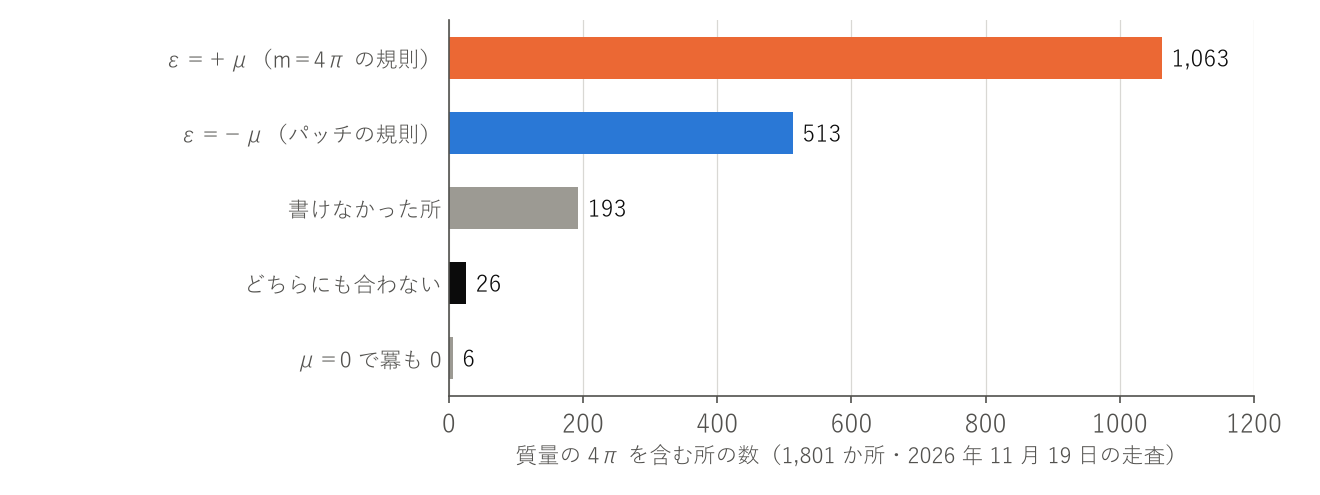
二つの規則は食い違っているのか。どちらにも合わない 26 か所は、計算の誤りなのか。論文1130 の答えは、どちらも「いいえ」です。二つの規則は一つの式の両端で、26 か所もその式どおりでした。式は、4π をどこに置いたかを記した帳簿から出てきます。
帳簿の付け方:ε と μ の二つの欄
量 X を、4π と質量の持ち方で因子に分けます。
X=(4π)ρ ħp Gq cN mr Mu Z
m は 4π と置いた質量、M は置かない質量、(4π)ρ は式にじかに立つ 4π、Z は長さ・時間・速さ・個数のように、4π も質量も持たない量です。冪は整数でも、平方根の 1/2 でもかまいません。
この量に、二つの欄で数を付けます。ε は、置き方を入れた値に立つ 4π の冪で、分子にあれば正に数えます。μ は、標準の式の次元から数えた質量次元です。ρ は、積分の角度や単位の決め方から来て式にじかに立っている 4π の数で、置き方から来た 4π は数えません(論文1129の書き方)。論文1130 はこれに一つ足し、一周の角の 2π も、4π の半分として ρ に入れました。
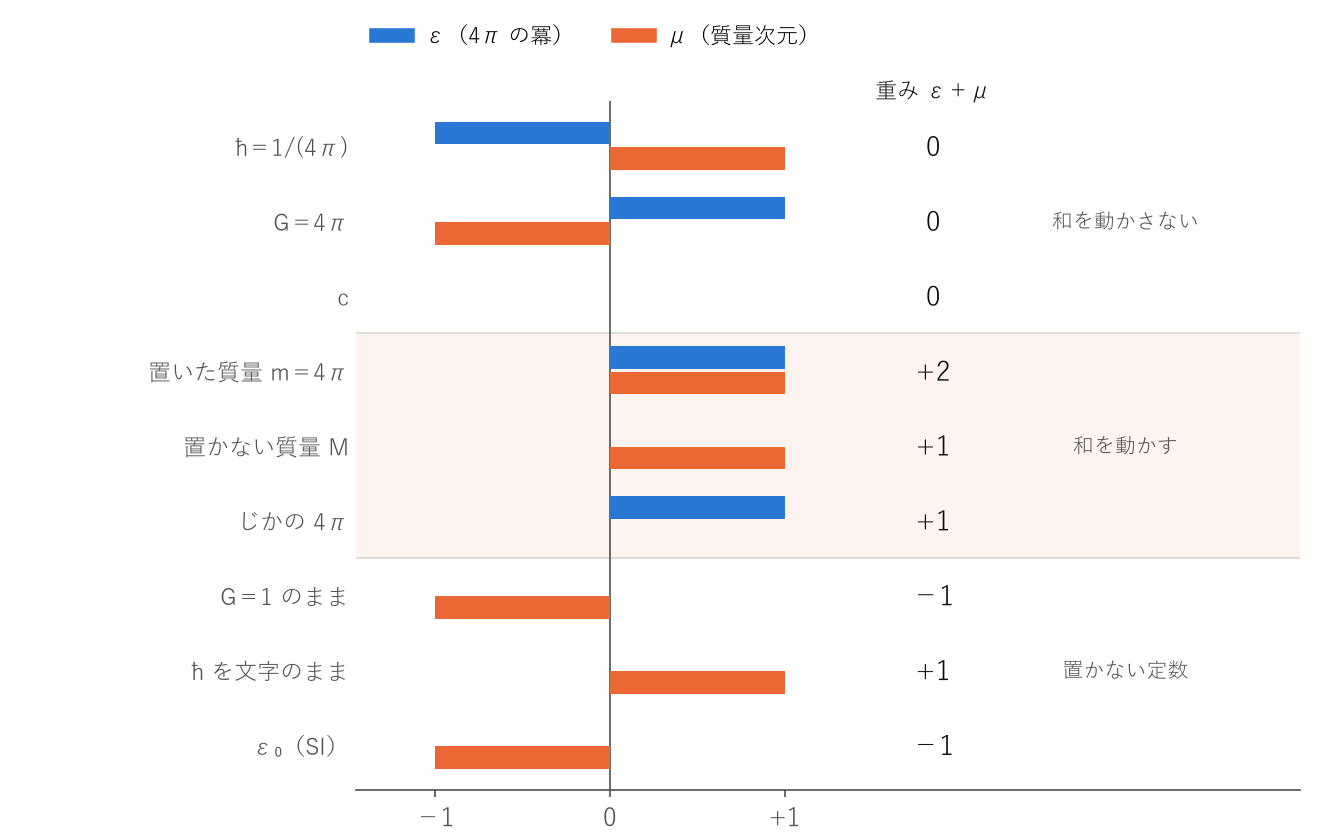
| 因子 | 置き方 | ε | μ | 重み ε+μ |
|---|---|---|---|---|
| ħ | 1/(4π) | −1 | +1 | 0 |
| G | 4π | +1 | −1 | 0 |
| c | 置かない(質量次元 0) | 0 | 0 | 0 |
| 置いた質量 m | 4π | +1 | +1 | 2 |
| 置かない質量 M | 置かない | 0 | +1 | 1 |
| じかの 4π | 式に立つ | +1 | 0 | 1 |
| 長さ・時間・速さ・個数 | なし | 0 | 0 | 0 |
量は因子の掛け算なので、値に立つ 4π の冪も、質量次元も、因子ごとの数に指数を掛けて足せば出ます。
ε=ρ−p+q+r μ=p−q+r+u
たとえば E=mc²=4πc² は、置いた質量が一つで (ε, μ)=(1, 1) です。プランク質量 √(ħc/G)=√c/(4π) は、ħ と c を 1/2 乗し、G を −1/2 乗した量で、(ε, μ)=(−1, 1) です。同じ μ=1 なのに、ε の符号が逆になります。
G・ħ・c は、和を動かさない
二つの式を足すと、p と q が消えます。論文1130 は、これを定理として書きました。
山岸の 4π-質量次元パリティ則 三つの置き方の下で、次の三つが成り立つ。
(一)帳簿の式:ε+μ=2r+u+ρ
(二)不変:G を一つ掛けると (ε, μ) は (+1, −1)、ħ は (−1, +1) 動き、c は動かさない。ε+μ を変えるのは、置いた質量(一つで 2)、置かない質量(1)、式にじかに立つ 4π(1)だけである。
(三)パリティ:r・u・ρ が整数なら、ε+μ と u+ρ は偶奇が同じである。
G を一つ掛けると q が 1 増え、ε が 1 増えて μ が 1 減ります。ħ はその逆で、c は ε にも μ にも入らない N を動かすだけです。帳簿にたとえれば、ε と μ は二つの欄で、G と ħ は片方の欄からもう片方への振替です。振替をいくら重ねても、二つの欄の合計は変わりません。
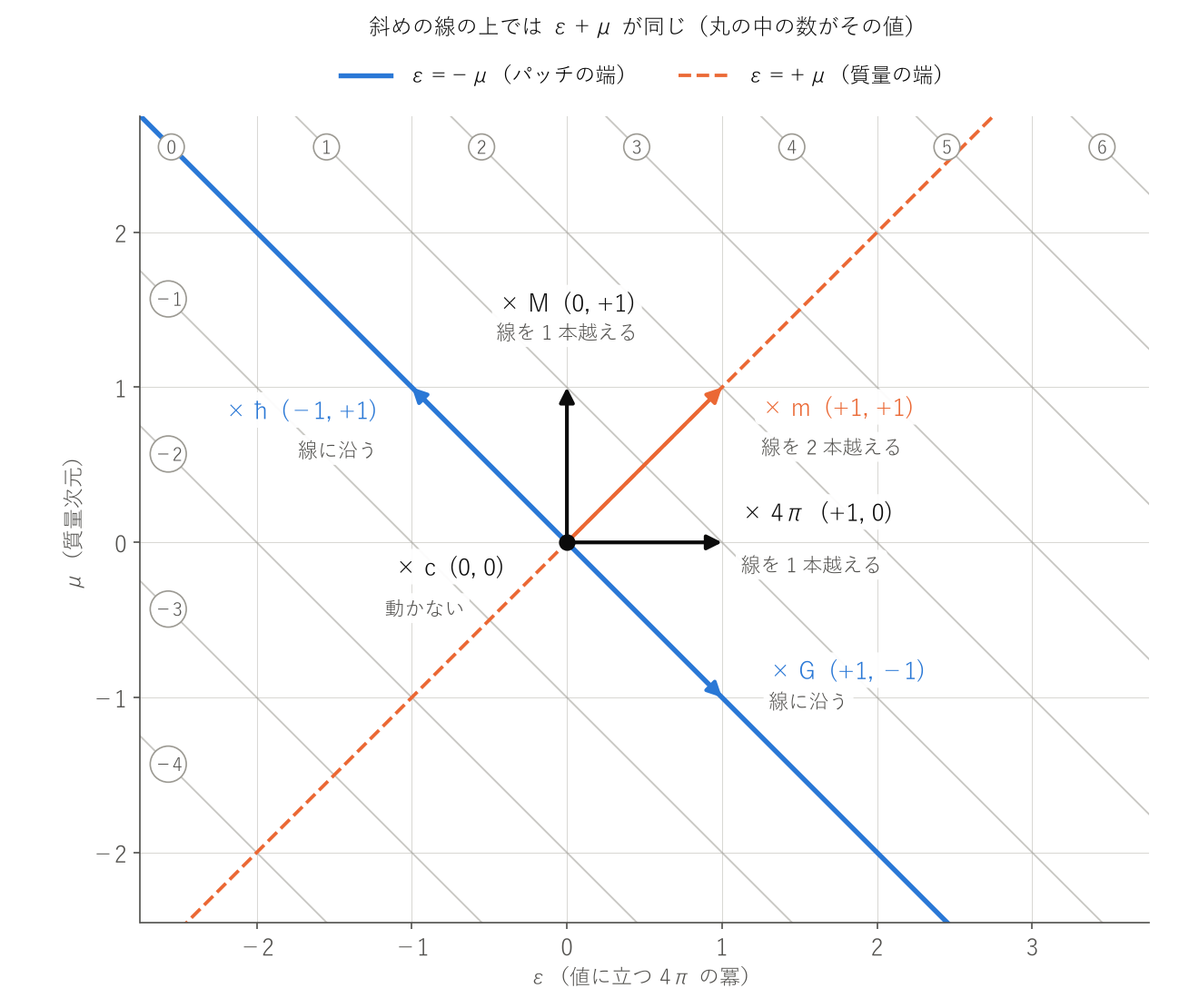
検算では、この式を記号のまま確かめたうえで、整数と半整数の冪を乱数で選んだ積 2,000 組に、G・ħ・c を掛けました。ε+μ が動いた組は一つもありません。ε と μ は、G と ħ の足し分が違う 1,855 組で、それぞれ動きました。
論文1128は、速さの段は μ を動かさないので、梯子を上っても 4π の数は変わらないと書きました。帳簿の言葉では、c が (0, 0) を足すことです。「ジュールをやめた世界」で見たプランクの量の四つの型 mPck は、どの段でも (ε, μ)=(−1, 1) のままで、4π は一回ずつ付いたままです。
和を動かすのは、質量と、じかの 4π だけ
ε+μ を動かすものは三つだけです。4π と置いた質量は、ε と μ の両方の欄に 1 ずつ書き込むので、一つで 2 動かします。置かない質量は μ の欄だけに、式にじかに立つ 4π は ε の欄だけに書き込むので、どちらも一つで 1 です。割れば、同じだけ減ります。
二つの規則は、一つの式の両端
パッチだけでできた量(r=u=ρ=0)では ε+μ=0、つまり ε=−μ です。論文40が、プランク質量とプランクエネルギーは質量次元が 1 なので 4π が一つ付くと書いたのは、この端の例です。置いた質量と c だけでできた量(p=q=u=ρ=0)では ε=r=μ、つまり ε=+μ で、E=mc²=4πc² はこの端にあります。図2 で原点を通る二本の線が、二つの端です。
対になる量 ε−μ=2(q−p)−u+ρ には、置いた質量の r が入りません。ε+μ には ħ・G・c が見えず、ε−μ には置いた質量が見えません。符号が逆の二つの規則は、この二つの見えなさの言い換えです。
二つを使うと、置かない質量もじかの 4π も無い(u=ρ=0)と分かっている式では、値と次元だけから因子の一部を読み戻せます。r=(ε+μ)/2、q−p=(ε−μ)/2 です。GM=16π² は (2, 0) で、r=1、q−p=1 と読めます。ħ²/(2m)=1/(128π³)=0.0002519651 は (−3, 1) で、r=−1、p−q=2 です。p と q が差でしか効かないのは、置き方の下では Għ=4π·1/(4π)=1 だからです。
置かない定数は、自分の質量次元を足す
体系には、G=1 のまま質量だけを 4π にした式や、ħ を文字のまま残した式、ε₀ の入る電磁の式もあります。こうした置かない定数は値に 4π を持ち込まず、自分の質量次元だけを運びます(G は 1 乗あたり −1、ħ は +1、ε₀ は −1)。帳簿の式は ε+μ=2r+u+ρ+U(U は置かない定数が運ぶ質量次元の和)に広がります。逆から見ると、質量次元 μY の定数を (4π)s と置いたときの重みは s+μY で、0 になるのは s=−μY、つまりパッチの規則のときだけです。G と ħ が ε+μ に見えないのはこのためで、質量の規則 s=+μY で置けば重みは 2μY になります。置いた質量の 2 は、その μY=1 の場合です。
偶奇の検査:じかの 4π が奇数個あれば知らせる
帳簿の式から、ε+μ−(u+ρ)=2r です。r が整数なら右辺は偶数なので、ε+μ と u+ρ は偶奇が同じになります。これがパリティ則です。検算では、三つの置き方の中の整数乗の積 117,649 個と、置かない定数を含む 15,625 個を総当たりして、偶奇の外れる積は一つもありませんでした。
使い道は、通信で一ビットの偶奇を添える検査に似ています。偶奇のビットは、一か所の誤りを知らせ、二か所の誤りは見落とします。帳簿でも同じで、三つの置き方の中で、質量が整数乗で入り、置かない質量が無い式なら、ε+μ が奇数のとき、式にじかに立つ 4π が奇数個あります。値に立つ 4π の冪と量の次元だけで、それが分かります。
| 式 | (ε, μ) | ε+μ | 偶奇の知らせ |
|---|---|---|---|
| ポアソンの係数 4πG=16π² | (2, −1) | 1 | じかの 4π が一つ。知らせる |
| 光の球の面積 4π(ct)² | (1, 0) | 1 | じかの 4π が一つ。知らせる |
| (4πG)² | (4, −2) | 2 | じかの 4π が二つ。見落とす |
| 数える場面 M(R)=4π·kR | (1, 1) | 2 | 置かない質量とじかの 4π が一つずつ。見落とす |
| U=−16π²M/r(M は置かない) | (2, 1) | 3 | じかの 4π は無い。置かない質量が奇数にする |
| v=√(GM/r)=4π/√r | (1, 0) | 1 | じかの 4π は無い。質量の 1/2 乗が奇数にする |
見落としは、じかの 4π があるのに偶数になる場合で、取り違えは、じかの 4π が無いのに奇数になる場合です。論文1115の和 4πc² のように、4π と 2π が打ち消し合う式も、偶奇には出ません。偶奇が言うのは u+ρ の偶奇までで、ρ そのものではありません。4πG と同じ (2, −1) を、置かない質量を含む G²M や、質量が 1/2 乗で入る G3/2m1/2 も持ちます。偶奇の検査は入口の見張りで、じかの 4π を全部数えるには、因子を読んで帳簿の式を使います。
体系の点呼:30 本・26 か所・37 本
帳簿の式は因子ごとの勘定から出るので、論文が置き方どおりに計算していれば、印字された値から数えた ε と、標準の式の次元から数えた μ の和は、必ず 2r+u+ρ(置かない定数があれば、それに U を足した値)に一致します。だから点呼は、既刊の計算の点検になります。落ちうるのは、標準の式に置き方を入れた値が、論文の印字と合うかどうかです。
既刊の式 29 本と論文1130 の 1 本、計 30 本(三つの置き方の中の 23 本と、置かない定数を含む 7 本)で確かめると、30 本とも帳簿の式どおりで、標準の式に置き方を入れた値はどれも論文の印字と一致しました(符号を除く)。落ちるはずの見本も三つ入れました(GM を 8π と印字した場合、M も置いたのに −16π²M/r の冪で印字した場合、G=1 のまま残したのに G=4π と数えた場合)。三つとも左辺と右辺が合いませんでした。
帳簿の表から 13 本を抜き出します。30 本の全部は、論文1130 と、下の検算の出力にあります。
| 式 | 出典 | ε | μ | r | u | ρ | ε+μ |
|---|---|---|---|---|---|---|---|
| 数える場面 M(R)=4π·kR | 01・1129 | 1 | 1 | 0 | 1 | 1 | 2 |
| E=mc²=4πc² | 12・60 | 1 | 1 | 1 | 0 | 0 | 2 |
| 光の球の面積 4π(ct)² | 61 | 1 | 0 | 0 | 0 | 1 | 1 |
| GM=16π² | 28・1086 | 2 | 0 | 1 | 0 | 0 | 2 |
| T=2π√(a³/GM)=a3/2/2 | 28・1086 | 0 | 0 | −1/2 | 0 | 1 | 0 |
| U=−GMm/r=−64π³/r | 35 | 3 | 1 | 2 | 0 | 0 | 4 |
| U=−16π²M/r(M は置かない) | 26 | 2 | 1 | 1 | 1 | 0 | 3 |
| ポアソンの係数 4πG=16π² | 35 | 2 | −1 | 0 | 0 | 1 | 1 |
| ħ²/(2m)=1/(128π³) | 17 | −3 | 1 | −1 | 0 | 0 | −2 |
| プランク質量 √(ħc/G)=√c/(4π) | 40・44・1128 | −1 | 1 | 0 | 0 | 0 | 0 |
| プランク長さ √(ħG/c³)=c−3/2 | 39・44 | 0 | 0 | 0 | 0 | 0 | 0 |
| 一マスの温度 kBT=ħg/(2πc)=2/c³ | 1115 | 0 | 1 | 1 | 0 | −1 | 1 |
| 置いた質量÷プランク質量 (4π)²/√c | 1130 | 2 | 0 | 1 | 0 | 0 | 2 |
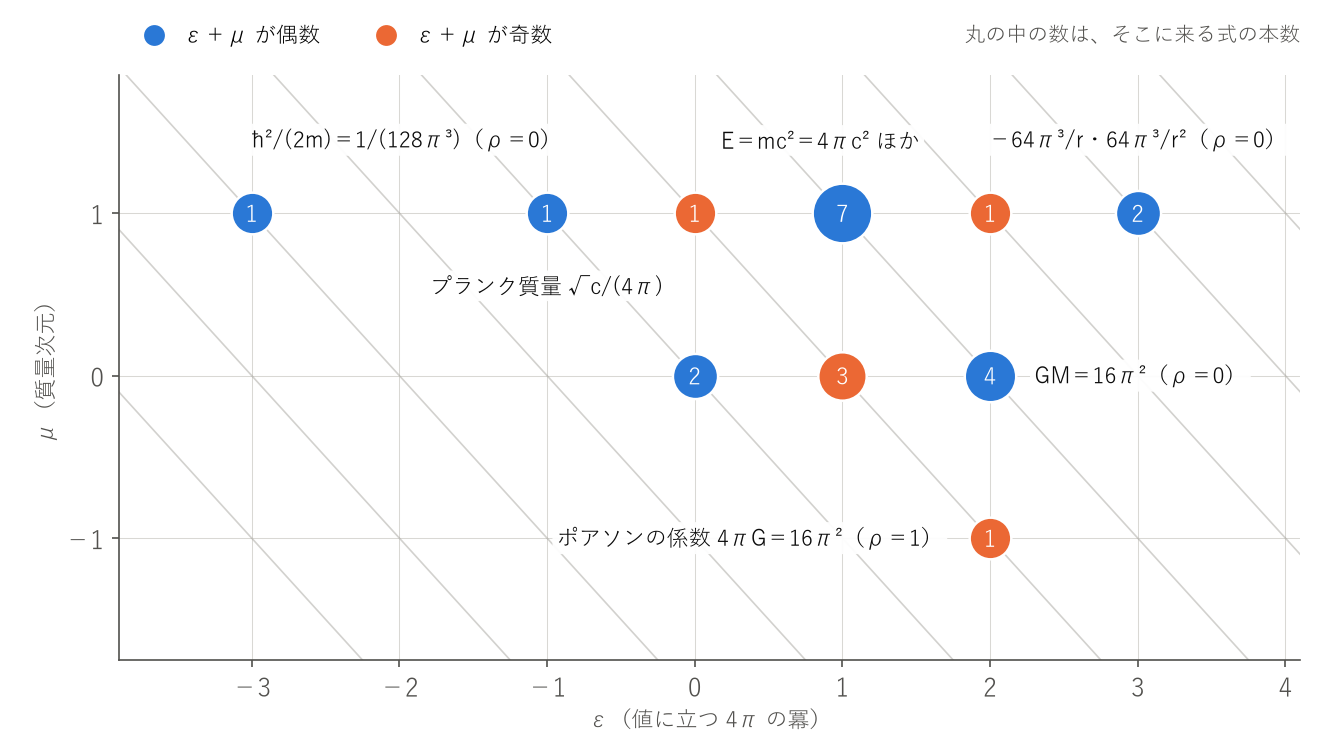
ケプラーの周期 T=2π√(a³/GM) では、一周の角の 2π が ρ=1 に入り、GM の平方根の r=−1/2 と合わせて ε+μ=0 になります。論文1086が、重力の式を質量で書いても残る π は一周の角だと書いたことを、帳簿で数えた形です。論文1115 の一マスの温度 2/c³ では、ウンルーの形の 2π が分母に一つあって ρ=−1 です。
同じ 16π² でも、帳簿は別
GM=16π²、−64π³/r、1/(128π³) は ρ=0 で、4π の冪は全部、置いた数で説明されます。ポアソンの係数 4πG=16π² は、数は GM と同じ 16π² なのに ρ=1 で、ガウスの法則の 4π が一つ残ります。論文35 が書いた「同じ数だが、同じ根ではない」を、帳簿で数えるとこうなります。4πG は ε+μ=1 で奇数です。質量の入らない G の 1 乗の式なので、値と次元から、じかの 4π が奇数個あると分かります。
ただし、ρ=0 が言うのは、4π の冪が全部置き方で説明されるということまでです。16π² や 64π³ を幾何の量として読めるかどうかは、この式では決まりません。論文1129 が書いたように、単位を書き戻して、式の中に立体角の積分が立つかを別に確かめることになります。
どちらの規則にも合わなかった 26 か所
走査でどちらの規則にも合わなかった 26 か所は、論文ごとに六つの式に分かれました。走査で書き出した (μ, ε) は、26 か所とも、その式の帳簿の行と一致します。
| 式 | 出典 | 所 | 説明のつき方 |
|---|---|---|---|
| F=GMm/r²=64π³/r² | 35 | 1 | 置いた質量が二つ(2r=4) |
| v=√(GM/r)=4π/√r | 38 | 5 | 置いた質量の 1/2 乗(2r=1) |
| e=(4πv)r(m=4π・ε₀=r) | 56・57 | 15 | 4πε₀ の 4π の半分(ρ=1/2)と、置かない ε₀ の半分(U=−1/2)が打ち消す |
| v=√(GM/r)=√(4π)=3.544908(G=1) | 910 | 1 | 置かない G の 1/2 乗(U=−1/2) |
| 音の速さ (ħ/m)√(4πna)=ħ√(na/4π) | 1082 | 2 | 文字のままの ħ(U=+1)と、平方根の中の 4π の半分(ρ=1/2) |
| 自分の重力のエネルギー (3/5)GM²/R(G=1) | 1106 | 2 | 置かない G(U=−1) |
パッチの規則だけで見ると、GM は質量次元が 0 なのに 4π が二つ付くので合いません。置いた質量を数えると合います。論文35 と論文38 の 6 か所は三つの置き方の中で、残る 20 か所は置かない定数を数えると、説明がつきます。
二つの規則が同居する 37 本
二つの規則が同じ論文に出る 37 本には、ε=+μ の所が 507、ε=−μ の所が 276 あります。同じ論文に二つの規則が並ぶのは、一つの式の両端が同じ論文に並んでいるということで、帳簿の上では食い違いではありません。ただ、走査の「ε=+μ」「ε=−μ」の札は書き出した (μ, ε) から付けたもので、所ごとの r・u・ρ までは読んでいません。37 本の数は、帳簿の式の点検ではなく、二つの規則の分かれ方の数えです。
時間の保存則とは違う
名の「不変量(Invariant)」は、式を組み立てるときに G・ħ・c を掛けても変わらない、という意味です。エネルギーや運動量のように、時間がたっても変わらない量(物理の保存量)ではありません。保存則は同じ系を時刻を変えて見比べますが、ε+μ が見比べるのは同じ量を別の因子の組で書いたときの帳簿で、時刻はどこにも出てきません。
働きとしては、次元の勘定(Bridgman 1922)に近いものです。次元がそろっていることが式の正しさの証明にならないのと同じく、帳簿の式が合うことも、式が自然を正しく言い当てていることの証明にはなりません。点呼が確かめたのは、既刊が置き方どおりに計算していたか、です。名の「パリティ則」は ε+μ の偶奇の規則を指し、空間の反転のパリティとも、論文115の球の体積の階段に出る偶奇とも、別のものです。
この話の射程
論文1130 が示したのは、体系が 4π をどこに置いたかの帳簿から必ず出る恒等式と、その式を既刊の式に当てた点呼です。使ったのは、次元の勘定と、三つの置き方(論文39)と、論文1129 の ρ の書き方だけで、新しい物理の定理も法則も主張していません。過去の論文の文も、一つも書き直していません。
和が合っても、因子の割り振りは和だけでは決まりません。論文910の √(4π) は、囲む質量を畳んだ数として r=1/2 と読んでも、kR を書き戻して u=ρ=1/2 と読んでも、ε+μ は同じです。帳簿の表の因子の読みは一人の目によるもので、出どころの文と照らして決めました。ρ は、その 4π が立体角か、単位の居場所か、一周の角かを言いません。それは別に読むことです(論文35・論文1086・論文1129)。ガウス単位での電荷の数え方も、この話の外にあります。分けるものは一つ、その 4π を定数に置いたか(重み 0)、質量に置いたか(重み 2)、式にじかに書いたか(重み 1)です。これが、この式の分離子です。
検算の全文
このページの数と式は、Python の検算で確かめています。指数は分数のまま計算し、式は sympy の記号で扱います。走査の数(1,801 か所・26 か所・37 本)は走査の表から写した数で、検算はその足し算と、帳簿の行との対応を確かめます。どの検算が落ちると、ページのどこが崩れるかを並べます。
| 検算の節 | 落ちたときに崩れる所 |
|---|---|
| 1 因子と重み | 「帳簿の付け方」の表と図3 |
| 2 帳簿の式 | 定理の(一) |
| 3 G・ħ・c の足し分 | 定理の(二)、図2、乱数 2,000 組の数 |
| 4 両端・対の量・読み戻し | 「二つの規則は、一つの式の両端」と、置き方の重み |
| 5 偶奇 | 定理の(三)と、「偶奇の検査」の表 |
| 6 帳簿の表 30 行 | 「体系の点呼」の表と図4 |
| 7 走査の数 | 図1 と、26 か所・37 本の数 |
| 8 本文の数 | 1/(128π³) と √(4π) の値 |
検算の全文(Python 3 と sympy で動きます)
# The Yamagishi 4pi-Mass Invariant: the check
# Yuuki Yamagishi, 2026-11-19. Runs with Python 3 and sympy. Published under CC BY 4.0.
#
# The books of this body of work place three constants (paper 39):
#   m = 4 pi (a mass), G = 4 pi, hbar = 1/(4 pi).   c is not placed.
# A quantity is split into factors:
#   X = (4 pi)^rho * hbar^p * G^q * c^N * m^r * M^u * Z
#   m          a mass placed as 4 pi
#   M          a mass not placed (the kR of paper 1129 belongs here)
#   (4 pi)^rho a 4 pi standing directly in the formula (a 2 pi of one turn counts as half of 4 pi)
#   Z          a length, a time, a speed or a count (no 4 pi, no mass)
# eps = the power of 4 pi standing in the value (a power in the numerator counts as positive)
# mu  = the mass dimension, counted from the standard formula
# The claim of the page: eps + mu = 2r + u + rho, and G, hbar and c never move it.
# Each assert below guards one claim of the page. If one fails, that part of the page falls.

import itertools
import random
import sys
from fractions import Fraction as Fr

import sympy as sp

if hasattr(sys.stdout, "reconfigure"):
    sys.stdout.reconfigure(encoding="utf-8")

LOG = []


def out(s=""):
    LOG.append(s)
    print(s)


def ok(cond, label):
    assert cond, label
    out("  OK  " + label)


pi = sp.pi
A = 4 * pi

# factor: (power of 4 pi in its value, dimension (M, L, T, I), kind, what it is)
FAC = {
    "hbar": (-1, (1, 2, -1, 0), "placed", "hbar = 1/(4 pi)"),
    "G": (1, (-1, 3, -2, 0), "placed", "G = 4 pi"),
    "c": (0, (0, 1, -1, 0), "plain", "c (not placed, mass dimension 0)"),
    "m": (1, (1, 0, 0, 0), "mass", "a mass placed as 4 pi"),
    "M": (0, (1, 0, 0, 0), "bare", "a mass not placed"),
    "direct": (1, (0, 0, 0, 0), "direct", "a 4 pi standing directly in the formula"),
    "hbar0": (0, (1, 2, -1, 0), "unplaced", "hbar not placed (kept as 1 or as a letter)"),
    "G0": (0, (-1, 3, -2, 0), "unplaced", "G not placed (kept as 1)"),
    "eps0": (0, (-1, -3, 4, 2), "unplaced", "epsilon_0 not placed (SI)"),
    "r": (0, (0, 1, 0, 0), "plain", "length"),
    "R": (0, (0, 1, 0, 0), "plain", "length"),
    "t": (0, (0, 0, 1, 0), "plain", "time"),
    "v": (0, (0, 1, -1, 0), "plain", "speed"),
    "acc": (0, (0, 1, -2, 0), "plain", "acceleration"),
    "n": (0, (0, -3, 0, 0), "plain", "number density"),
    "e": (0, (0, 0, 1, 1), "plain", "charge (SI)"),
    "N": (0, (0, 0, 0, 0), "plain", "count"),
}
W = {k: v[0] + v[1][0] for k, v in FAC.items()}


def epsmu(ex):
    # powers of the factors -> (eps, mu, U, dimension); U is the mass dimension carried by unplaced constants
    ks = {f: Fr(k) for f, k in ex.items()}
    e = sum(k * FAC[f][0] for f, k in ks.items())
    d = tuple(sum(k * FAC[f][1][i] for f, k in ks.items()) for i in range(4))
    U = sum(k * FAC[f][1][0] for f, k in ks.items() if FAC[f][2] == "unplaced")
    return Fr(e), Fr(d[0]), Fr(U), d


def add(ex, f, k=1):
    y = dict(ex)
    y[f] = y.get(f, 0) + k
    return y


def main():
    out("The Yamagishi 4pi-Mass Invariant: the check")
    out("sympy " + sp.__version__)
    out()

    out("1. The factors and their weights eps + mu")
    for k, (e, d, kind, note) in FAC.items():
        out("  %-6s eps %+d  mu %+d  weight %+d   %s" % (k, e, d[0], e + d[0], note))
    ok([W[x] for x in ("hbar", "G", "c", "m", "M", "direct")] == [0, 0, 0, 2, 1, 1],
       "weights: hbar, G and c 0; a placed mass 2; an unplaced mass 1; a direct 4 pi 1")
    ok(all(W[x] == 0 for x in ("r", "R", "t", "v", "acc", "n", "e", "N")), "length, time, speed, charge and counts weigh 0")
    ok(W["hbar0"] == 1 and W["G0"] == -1 and W["eps0"] == -1,
       "an unplaced constant weighs its own mass dimension (hbar +1, G kept as 1 -1, epsilon_0 -1)")
    out()

    out("2. The formula of the books")
    p, q, N, r, u, rho = sp.symbols("p q N r u rho")
    eps = rho - p + q + r
    mu = p - q + r + u
    ok(sp.expand(eps + mu - (2 * r + u + rho)) == 0, "eps = rho - p + q + r and mu = p - q + r + u, so eps + mu = 2r + u + rho")
    Xv = A**rho * (1 / A)**p * A**q * A**r
    e_from_value = sp.simplify(sp.expand_log(sp.log(sp.powsimp(Xv, force=True)), force=True) / sp.log(A))
    ok(sp.simplify(e_from_value - eps) == 0, "counting the power of 4 pi in the value with the placements put in gives the same eps")
    e1, m1, _, _ = epsmu({"m": 1, "c": 2})
    e2, m2, _, _ = epsmu({"hbar": Fr(1, 2), "c": Fr(1, 2), "G": Fr(-1, 2)})
    ok((e1, m1) == (1, 1) and (e2, m2) == (-1, 1), "E = mc^2 = 4 pi c^2 has (eps, mu) = (1, 1); the Planck mass sqrt(hbar c/G) = sqrt(c)/(4 pi) has (-1, 1)")
    out()

    out("3. G, hbar and c do not move eps + mu")
    base = {"m": 1, "c": 2}
    e0, m0, _, _ = epsmu(base)
    dG = tuple(a - b for a, b in zip(epsmu(add(base, "G"))[:2], (e0, m0)))
    dH = tuple(a - b for a, b in zip(epsmu(add(base, "hbar"))[:2], (e0, m0)))
    dC = tuple(a - b for a, b in zip(epsmu(add(base, "c"))[:2], (e0, m0)))
    out("  one G moves (eps, mu) by (%s, %s), one hbar by (%s, %s), one c by (%s, %s)" % (dG + dH + dC))
    ok(dG == (1, -1) and dH == (-1, 1) and dC == (0, 0), "G adds (+1, -1), hbar adds (-1, +1), c adds (0, 0)")
    a_, b_ = sp.symbols("a b")
    ok(sp.expand((eps + a_ - b_) + (mu - a_ + b_) - (eps + mu)) == 0,
       "multiplying by G^a hbar^b c^N moves eps by a - b and mu by b - a, and eps + mu not at all (in symbols)")
    random.seed(20261119)
    kept, moved, expect_moved, tried = 0, 0, 0, 0
    for _ in range(2000):
        ex = {f: Fr(random.randint(-6, 6), random.choice((1, 2))) for f in ("direct", "hbar", "G", "c", "m", "M")}
        e1, m1, _, _ = epsmu(ex)
        ey, sh = dict(ex), {}
        for f in ("G", "hbar", "c"):
            sh[f] = Fr(random.randint(-5, 5), random.choice((1, 2)))
            ey[f] = ey[f] + sh[f]
        e2, m2, _, _ = epsmu(ey)
        tried += 1
        kept += (e1 + m1 == e2 + m2)
        moved += (e1 != e2) or (m1 != m2)
        expect_moved += (sh["G"] != sh["hbar"])
    out("  %d random products (whole and half powers) multiplied by G, hbar and c: eps + mu unchanged in %d, eps and mu moved one by one in %d"
        % (tried, kept, moved))
    ok(kept == tried == 2000 and moved == expect_moved == 1855,
       "in 2000 random products eps + mu never moved; eps and mu moved in the 1855 where the shifts of G and hbar differed")
    dm, dM, dF = epsmu(add(base, "m")), epsmu(add(base, "M")), epsmu(add(base, "direct"))
    ok((dm[0] + dm[1]) - (e0 + m0) == 2 and (dM[0] + dM[1]) - (e0 + m0) == 1 and (dF[0] + dF[1]) - (e0 + m0) == 1,
       "what moves the sum: a placed mass +2, an unplaced mass +1, a direct 4 pi +1")
    ok(all(epsmu({"hbar": Fr(1, 2), "G": Fr(-1, 2), "c": Fr(1 + 2 * k, 2)})[:2] == (-1, 1) for k in range(4)),
       "the four Planck types m_P c^k (k = 0 to 3) all stay at (eps, mu) = (-1, 1): climbing by c does not change the 4 pi")
    out()

    out("4. The two ends, the companion quantity and reading back")
    ends_patch = all(epsmu({"hbar": Fr(a1, 2), "G": Fr(b1, 2), "c": Fr(c1, 2)})[0] == -epsmu({"hbar": Fr(a1, 2), "G": Fr(b1, 2), "c": Fr(c1, 2)})[1]
                     for a1, b1, c1 in itertools.product(range(-6, 7), repeat=3))
    ends_mass = all(epsmu({"m": Fr(a1, 2), "c": Fr(c1, 2)})[0] == epsmu({"m": Fr(a1, 2), "c": Fr(c1, 2)})[1]
                    for a1, c1 in itertools.product(range(-6, 7), repeat=2))
    ok(ends_patch and ends_mass, "products of hbar, G and c alone have eps = -mu (the patch end); placed masses and c alone have eps = +mu (the mass end)")
    diff = sp.expand(eps - mu)
    ok(sp.expand(diff - (2 * (q - p) - u + rho)) == 0 and sp.diff(diff, r) == 0,
       "the companion eps - mu = 2(q - p) - u + rho does not contain r: placed masses never move it")
    ok(sp.expand((eps + mu).subs({u: 0, rho: 0}) / 2 - r) == 0 and sp.expand((eps - mu).subs({u: 0, rho: 0}) / 2 - (q - p)) == 0
       and sp.simplify(A * (1 / A)) == 1,
       "reading back: if u = rho = 0, then r = (eps + mu)/2 and q - p = (eps - mu)/2 (G hbar = 1, so only q - p counts)")
    s_, muY = sp.symbols("s mu_Y")
    ok(sp.solve(sp.Eq(s_ + muY, 0), s_) == [-muY] and sp.expand((s_ + muY).subs(s_, muY)) == 2 * muY,
       "a constant of mass dimension mu_Y placed as (4 pi)^s weighs s + mu_Y: 0 only for s = -mu_Y (the patch rule); 2 mu_Y for the mass rule")
    out()

    out("5. Parity: with whole powers, eps + mu and u + rho (+ U) have the same parity")
    cnt, okp = 0, True
    for rr, uu, rh, pp, qq, cc in itertools.product(range(-3, 4), repeat=6):
        e1, m1, U1, _ = epsmu({"m": rr, "M": uu, "direct": rh, "hbar": pp, "G": qq, "c": cc})
        cnt += 1
        okp = okp and (e1 + m1 - (uu + rh + U1)) % 2 == 0
    cntU, okU = 0, True
    for rr, uu, rh, h0, g0, z0 in itertools.product(range(-2, 3), repeat=6):
        e1, m1, U1, _ = epsmu({"m": rr, "M": uu, "direct": rh, "hbar0": h0, "G0": g0, "eps0": z0})
        cntU += 1
        okU = okU and (e1 + m1 - (uu + rh + U1)) % 2 == 0
    out("  tried every product with whole powers: %d inside the three placements, %d with unplaced constants" % (cnt, cntU))
    ok(okp and cnt == 7**6 == 117649, "all 117649 products: eps + mu and u + rho have the same parity")
    ok(okU and cntU == 5**6 == 15625, "all 15625 products with unplaced hbar, G and epsilon_0: eps + mu and u + rho + U have the same parity")
    s1 = sum(epsmu({"direct": 1, "G": 1})[:2])
    s2 = sum(epsmu({"direct": 2, "G": 2})[:2])
    s3 = sum(epsmu({"direct": 1, "M": 1})[:2])
    ok(s1 == 1 and s2 == 2 and s3 == 2, "found: 4 pi G gives 1 (odd); missed: (4 pi G)^2 gives 2 and 4 pi kR gives 2 (even)")
    ok(epsmu({"G": 2, "M": 1})[:2] == (2, -1) and epsmu({"G": Fr(3, 2), "m": Fr(1, 2)})[:2] == (2, -1),
       "G^2 M and G^(3/2) m^(1/2) share (2, -1) with 4 pi G, with no direct 4 pi: the parity reads u + rho, not rho")
    ok(sum(epsmu({"G": 1, "m": 1, "M": 1, "r": -1})[:2]) == 3 and sum(epsmu({"G": Fr(1, 2), "m": Fr(1, 2), "r": Fr(-1, 2)})[:2]) == 1,
       "odd without a direct 4 pi: -16 pi^2 M/r gives 3 (an unplaced M), sqrt(GM/r) gives 1 (a half power, 2r = 1)")
    out()

    out("6. The census: 29 formulas of earlier papers and 1 of paper 1130")
    c, rr_, R, t, v, acc, n, e, Nn, hb, Ms = sp.symbols("c r R t v a n e N hbar M", positive=True)
    SUBS = {"hbar": 1 / A, "G": A, "m": A, "direct": A, "hbar0": hb, "G0": sp.Integer(1), "eps0": rr_,
            "c": c, "r": rr_, "R": R, "t": t, "v": v, "acc": acc, "n": n, "e": e, "N": Nn, "M": Ms}
    DIM = {"mass": (1, 0, 0, 0), "energy": (1, 2, -2, 0), "length": (0, 1, 0, 0), "time": (0, 0, 1, 0), "speed": (0, 1, -1, 0),
           "acceleration": (0, 1, -2, 0), "force": (1, 1, -2, 0), "pressure": (1, -1, -2, 0), "area": (0, 2, 0, 0), "none": (0, 0, 0, 0),
           "dim of G": (-1, 3, -2, 0), "dim of GM": (0, 3, -2, 0), "dim of hbar^2/m": (1, 4, -2, 0), "charge": (0, 0, 1, 1),
           "frequency squared": (0, 0, -2, 0), "energy density": (1, -1, -2, 0), "charge (eps0 = r read as dimensions)": (Fr(1, 2), 2, -1, 0)}
    # key, formula, papers, kind of quantity, powers of the standard formula, printed value, rational remainder, substitution
    ROWS = [
        ("A1", "counting scene M(R) = 4 pi kR (kR not placed)", [1, 1129], "mass", {"direct": 1, "M": 1}, A * Ms, 1, {}),
        ("A2", "E = mc^2 = 4 pi c^2", [12, 60], "energy", {"m": 1, "c": 2}, A * c**2, 1, {}),
        ("A3", "area of the light sphere 4 pi (ct)^2", [61], "area", {"direct": 1, "c": 2, "t": 2}, A * c**2 * t**2, 1, {}),
        ("A4", "F = ma = 4 pi a", [26], "force", {"m": 1, "acc": 1}, A * acc, 1, {}),
        ("A5", "E_k = (1/2) m v^2 = 2 pi v^2", [18, 26], "energy", {"m": 1, "v": 2}, 2 * pi * v**2, Fr(1, 2), {}),
        ("A6", "P = (1/3) n m v^2 = (4/3) pi n v^2", [19], "pressure", {"n": 1, "m": 1, "v": 2}, sp.Rational(4, 3) * pi * n * v**2, Fr(1, 3), {}),
        ("A7", "kT = (4/3) pi v^2", [20], "energy", {"m": 1, "v": 2}, sp.Rational(4, 3) * pi * v**2, Fr(1, 3), {}),
        ("A8", "GM = 16 pi^2", [28, 1086], "dim of GM", {"G": 1, "m": 1}, 16 * pi**2, 1, {}),
        ("A9", "T = 2 pi sqrt(a^3/GM) = a^(3/2)/2", [28, 1086], "time", {"direct": 1, "G": Fr(-1, 2), "m": Fr(-1, 2), "R": Fr(3, 2)},
         R**sp.Rational(3, 2) / 2, Fr(1, 2), {}),
        ("A10", "v = sqrt(GM/r) = 4 pi/sqrt(r)", [38], "speed", {"G": Fr(1, 2), "m": Fr(1, 2), "r": Fr(-1, 2)}, A / sp.sqrt(rr_), 1, {}),
        ("A11", "g = GM/r^2 = 16 pi^2/r^2", [38], "acceleration", {"G": 1, "m": 1, "r": -2}, 16 * pi**2 / rr_**2, 1, {}),
        ("A12", "a = GM/c^2 = 16 pi^2/c^2", [1115], "length", {"G": 1, "m": 1, "c": -2}, 16 * pi**2 / c**2, 1, {}),
        ("A13a", "U = -GMm/r = -64 pi^3/r", [35], "energy", {"G": 1, "m": 2, "r": -1}, -64 * pi**3 / rr_, -1, {}),
        ("A13b", "F = GMm/r^2 = 64 pi^3/r^2", [35], "force", {"G": 1, "m": 2, "r": -2}, 64 * pi**3 / rr_**2, 1, {}),
        ("A14", "U = -16 pi^2 M/r (M not placed)", [26], "energy", {"G": 1, "m": 1, "M": 1, "r": -1}, -16 * pi**2 * Ms / rr_, -1, {}),
        ("A15", "Poisson coefficient 4 pi G = 16 pi^2", [35], "dim of G", {"direct": 1, "G": 1}, 16 * pi**2, 1, {}),
        ("A16", "hbar^2/(2m) = 1/(128 pi^3)", [17], "dim of hbar^2/m", {"hbar": 2, "m": -1}, 1 / (128 * pi**3), Fr(1, 2), {}),
        ("A17", "Planck mass sqrt(hbar c/G) = sqrt(c)/(4 pi)", [40, 44, 1128], "mass", {"hbar": Fr(1, 2), "G": Fr(-1, 2), "c": Fr(1, 2)},
         sp.sqrt(c) / A, 1, {}),
        ("A18", "Planck length sqrt(hbar G/c^3) = c^(-3/2)", [39, 44], "length", {"hbar": Fr(1, 2), "G": Fr(1, 2), "c": Fr(-3, 2)},
         c**sp.Rational(-3, 2), 1, {}),
        ("A19", "cells 4 pi R^2 c^3/(G hbar) = 4 pi c^5 (R = c)", [1115], "none", {"direct": 1, "R": 2, "c": 3, "G": -1, "hbar": -1},
         A * c**5, 1, {R: c}),
        ("A20", "temperature per cell k_B T = hbar g/(2 pi c) = 2/c^3 (k_B = 1)", [1115], "energy",
         {"direct": -1, "hbar": 1, "G": 1, "m": 1, "R": -2, "c": -1}, 2 / c**3, 2, {R: c}),
        ("A21", "sum (1/2) N k_B T = Mc^2 = 4 pi c^2", [1115], "energy", {"m": 1, "c": 2}, A * c**2, 1, {}),
        ("A22", "placed mass over Planck mass m/m_P = (4 pi)^2/sqrt(c)", [], "none", {"m": 1, "hbar": Fr(-1, 2), "G": Fr(1, 2), "c": Fr(-1, 2)},
         A**2 / sp.sqrt(c), 1, {}),
        ("B1", "hbar^2/(2m) = 1/(8 pi) (hbar = 1 kept)", [17], "dim of hbar^2/m", {"hbar0": 2, "m": -1}, 1 / (8 * pi), Fr(1, 2), {hb: 1}),
        ("B2", "e = (4 pi v) r (m = 4 pi, epsilon_0 = r)", [15, 56, 57], "charge", {"direct": Fr(1, 2), "eps0": Fr(1, 2), "m": Fr(1, 2), "v": 1, "r": Fr(1, 2)},
         A * v * rr_, 1, {}),
        ("B3", "omega_p^2 = n e^2/(m epsilon_0) = n e^2/(4 pi r)", [22], "frequency squared", {"n": 1, "e": 2, "m": -1, "eps0": -1},
         n * e**2 / (A * rr_), 1, {}),
        ("B4", "v = sqrt(GM/r) = sqrt(4 pi) (G = 1, enclosed mass 4 pi, radius 1)", [910], "speed", {"G0": Fr(1, 2), "m": Fr(1, 2), "r": Fr(-1, 2)},
         sp.sqrt(A) / sp.sqrt(rr_), 1, {}),
        ("B5", "speed of sound (hbar/m) sqrt(4 pi n a) = hbar sqrt(n a/(4 pi))", [1082], "speed",
         {"hbar0": 1, "m": -1, "direct": Fr(1, 2), "n": Fr(1, 2), "R": Fr(1, 2)}, hb * sp.sqrt(n * R / A), 1, {}),
        ("B6", "self-gravitational energy (3/5) GM^2/R (G = 1, M = Nm)", [1106], "energy", {"G0": 1, "m": 2, "N": 2, "R": -1},
         sp.Rational(3, 5) * A**2 * Nn**2 / R, Fr(3, 5), {}),
        ("B7", "Coleman-Weinberg m^4/(64 pi^2) = (2 pi)^2 (hbar = c = 1)", [13], "energy density", {"m": 4, "c": 5, "hbar0": -3, "direct": -2},
         4 * pi**2, Fr(1, 4), {hb: 1, c: 1}),
    ]

    def pi_power_and_coef(expr):
        ee, coef = sp.Integer(0), sp.Integer(1)
        for a in sp.Mul.make_args(sp.factor(expr)):
            b, x = a.as_base_exp()
            if b == pi:
                ee += x
            elif a.is_number:
                coef *= a
        return sp.nsimplify(ee), coef

    def ledger(row):
        key, text, src, kind, std, printed, left, vsub = row
        e_pr, coef = pi_power_and_coef(printed)
        e_std, mu_std, U, dims = epsmu(std)
        r1, u1, rh1 = (Fr(sp.nsimplify(std.get(k, 0))) for k in ("m", "M", "direct"))
        lhs = Fr(sp.nsimplify(e_pr)) + mu_std
        built = sp.Integer(1)
        for f, k in std.items():
            built *= SUBS[f]**sp.nsimplify(k)
        built = (built * sp.nsimplify(left)).subs(vsub)
        pv = printed.subs(vsub)
        whole = all(Fr(sp.nsimplify(k)).denominator == 1 for f, k in std.items() if FAC[f][2] in ("mass", "bare", "direct", "unplaced"))
        return dict(key=key, text=text, src=src, eps=Fr(sp.nsimplify(e_pr)), e_std=e_std, mu=mu_std, r=r1, u=u1, rho=rh1, U=U,
                    lhs=lhs, rhs=2 * r1 + u1 + rh1 + U,
                    val=(sp.simplify(built - pv) == 0 or sp.simplify(built + pv) == 0),
                    coef=(sp.simplify(sp.Abs(coef) - sp.Integer(4)**e_pr * abs(sp.nsimplify(left))) == 0),
                    dim=(tuple(Fr(x) for x in dims) == tuple(Fr(x) for x in DIM[kind])),
                    whole=whole, par=((lhs - (u1 + rh1 + U)) % 2 == 0) if whole else None)

    LED = [ledger(x) for x in ROWS]
    D = {L["key"]: L for L in LED}
    out("  %-5s %5s %5s %5s %5s %5s %5s %7s %7s  %s" % ("key", "eps", "mu", "r", "u", "rho", "U", "eps+mu", "2r+u+", "formula (papers)"))
    for L in LED:
        out("  %-5s %5s %5s %5s %5s %5s %5s %7s %7s  %s (%s)" % (L["key"], L["eps"], L["mu"], L["r"], L["u"], L["rho"], L["U"], L["lhs"], L["rhs"],
                                                               L["text"], ", ".join(str(x) for x in L["src"]) or "paper 1130"))
    nA = [L for L in LED if L["key"].startswith("A")]
    nB = [L for L in LED if L["key"].startswith("B")]
    ok(len(LED) == 30 and len(nA) == 23 and len(nB) == 7, "30 rows: 23 inside the three placements, 7 with unplaced constants")
    ok(all(L["lhs"] == L["rhs"] for L in LED), "every row has eps + mu = 2r + u + rho + U")
    ok(all(L["dim"] and L["e_std"] == L["eps"] for L in LED), "every standard formula has the dimension of its quantity, and its eps matches the printed value")
    ok(all(L["val"] and L["coef"] for L in LED),
       "putting the placements into every standard formula gives the printed value (up to sign); the number splits into 4^eps and a rational rest")
    ok(all(L["U"] == 0 for L in nA), "inside the three placements U = 0: the formula of the books itself")
    ok({L["key"]: L["U"] for L in nB} == {"B1": 2, "B2": Fr(-1, 2), "B3": 1, "B4": Fr(-1, 2), "B5": 1, "B6": -1, "B7": -3},
       "with unplaced constants, U is the mass dimension they carry (hbar^2 +2, epsilon_0^(1/2) -1/2, G^(1/2) -1/2, G -1, hbar^-3 -3)")
    wholes = [L for L in LED if L["whole"]]
    ok(len(wholes) == 25 and all(L["par"] for L in wholes), "the 25 rows with whole powers all keep the parity")
    ok(all(D[k]["rho"] == 0 for k in ("A8", "A13a", "A13b", "A16")) and D["A15"]["rho"] == 1 and D["A15"]["lhs"] == 1,
       "16 pi^2 (GM), 64 pi^3 and 1/(128 pi^3) have rho = 0; Poisson's 4 pi G has rho = 1 and an odd eps + mu = 1")
    ok(sp.simplify(16 * pi**2 - A * A) == 0 and (D["A8"]["eps"], D["A8"]["mu"]) == (2, 0) and (D["A15"]["eps"], D["A15"]["mu"]) == (2, -1),
       "GM and 4 pi G are both 16 pi^2 as numbers, but sit at (2, 0) and (2, -1) in the books")
    ok(D["A19"]["rho"] == 1 and D["A20"]["rho"] == -1 and D["A21"]["rho"] == 0 and D["A21"]["r"] == 1,
       "paper 1115: the cells have rho = 1, the temperature rho = -1 (the 2 pi of Unruh), the sum rho = 0 with r = 1")
    ok((D["A2"]["eps"], D["A2"]["mu"], D["A17"]["eps"], D["A17"]["mu"]) == (1, 1, -1, 1)
       and (D["A22"]["eps"], D["A22"]["mu"]) == (2, 0) and (D["A22"]["eps"] + D["A22"]["mu"]) / 2 == 1,
       "m = 4 pi and the Planck mass both have mu = 1 with eps = +1 and -1; their ratio (2, 0) reads back as r = 1")
    bad1 = ledger(("X1", "GM printed as 8 pi", [], "dim of GM", {"G": 1, "m": 1}, 8 * pi, 1, {}))
    bad2 = ledger(("X2", "M placed too, but printed as -16 pi^2/r", [], "energy", {"G": 1, "m": 2, "r": -1}, -16 * pi**2 / rr_, -1, {}))
    bad3 = ledger(("X3", "G kept as 1 but counted as G = 4 pi", [], "speed", {"G": Fr(1, 2), "m": Fr(1, 2), "r": Fr(-1, 2)}, sp.sqrt(A) / sp.sqrt(rr_), 1, {}))
    ok(all(b["lhs"] != b["rhs"] for b in (bad1, bad2, bad3)),
       "self-test: a printed value off the placements fails (GM as 8 pi; -16 pi^2/r with M placed; sqrt(4 pi) counted with G = 4 pi)")
    alt = ledger(("X4", "paper 910 read with kR written back", [910], "speed", {"G0": Fr(1, 2), "M": Fr(1, 2), "direct": Fr(1, 2), "r": Fr(-1, 2)},
                  sp.sqrt(A) * sp.sqrt(Ms) / sp.sqrt(rr_), 1, {}))
    ok(alt["lhs"] == alt["rhs"] == D["B4"]["lhs"] == Fr(1, 2),
       "the sqrt(4 pi) of paper 910 gives 1/2 read as r = 1/2 or as u = rho = 1/2: the sum does not fix how the factors are assigned")
    out()

    out("7. The census numbers of the scan of 19 November 2026 (copied from the scan; this checks how they add up)")
    SCAN = {"eps = +mu (rule of m = 4 pi)": 1063, "eps = -mu (rule of the patch)": 513, "could not be written": 193,
            "fits neither": 26, "mu = 0 and power 0": 6}
    for k, x in SCAN.items():
        out("  %-32s %5d" % (k, x))
    ok(sum(SCAN.values()) == 1801, "1063 + 513 + 193 + 26 + 6 = 1801 places that contain the 4 pi of mass")
    # the places that fit neither: paper -> (number of places, (mu, eps) written by the readers of the scan, row of the books)
    NEITHER = {35: (1, (1, 3), "A13b"), 38: (5, (0, 1), "A10"), 56: (11, (0, 1), "B2"), 57: (4, (0, 1), "B2"),
               910: (1, (0, Fr(1, 2)), "B4"), 1082: (2, (0, Fr(-1, 2)), "B5"), 1106: (2, (1, 2), "B6")}
    ok(sum(x[0] for x in NEITHER.values()) == 26 and len(set(x[2] for x in NEITHER.values())) == 6,
       "the 26 places that fit neither rule fall into six formulas")
    ok(all((D[k]["mu"], D[k]["eps"]) == mue and D[k]["lhs"] == D[k]["rhs"] for _, mue, k in NEITHER.values()),
       "for all 26, the (mu, eps) written in the scan is that of a row of the books, and that row keeps the formula")
    inside = sum(x[0] for x in NEITHER.values() if x[2].startswith("A"))
    outside = sum(x[0] for x in NEITHER.values() if x[2].startswith("B"))
    out("  explained inside the three placements: %d places (papers 35 and 38); explained by unplaced constants: %d places" % (inside, outside))
    ok(inside == 6 and outside == 20, "6 places are explained by the placements and 20 by counting the unplaced constants")
    BOTH = [(5, 3, 3, 0), (14, 2, 4, 0), (15, 21, 4, 0), (16, 23, 3, 0), (17, 34, 12, 0), (21, 33, 4, 0), (22, 17, 1, 0), (26, 44, 7, 0),
            (28, 5, 9, 0), (29, 1, 1, 0), (30, 17, 1, 0), (32, 8, 1, 0), (35, 8, 37, 1), (38, 14, 11, 5), (39, 2, 38, 0), (56, 8, 13, 11),
            (57, 4, 5, 4), (60, 43, 3, 0), (61, 13, 1, 0), (63, 22, 1, 0), (74, 1, 12, 0), (116, 2, 26, 0), (124, 3, 1, 0), (128, 9, 1, 0),
            (134, 10, 1, 0), (147, 6, 1, 0), (249, 1, 2, 0), (306, 1, 2, 0), (316, 5, 1, 0), (1002, 1, 1, 0), (1067, 6, 1, 0),
            (1083, 43, 3, 0), (1085, 4, 3, 0), (1086, 3, 7, 0), (1092, 7, 3, 0), (1115, 53, 10, 0), (1128, 30, 42, 0)]
    plus, minus, nei = (sum(x[i] for x in BOTH) for i in (1, 2, 3))
    out("  papers with both rules: %d; places in them: eps = +mu %d, eps = -mu %d, neither %d" % (len(BOTH), plus, minus, nei))
    ok(len(BOTH) == 37 and all(x[1] > 0 and x[2] > 0 for x in BOTH) and (plus, minus, nei) == (507, 276, 21),
       "37 papers carry both rules: 507 places with eps = +mu and 276 with eps = -mu stand in the same papers")
    ok({x[0]: x[3] for x in BOTH if x[3]} == {35: 1, 38: 5, 56: 11, 57: 4} and 26 - nei == 5,
       "21 of the 26 places that fit neither are inside the 37 papers (35, 38, 56, 57); the other 5 (910, 1082, 1106) are outside")
    SAME = {"truly in one sentence: a value": 16, "truly: a lead-in to the next formula": 2, "truly: stating the placements": 17,
            "only the name Yamagishi patch for m = 4 pi": 15, "m = 4 pi and epsilon_0 = r in one word": 3}
    ok(sum(SAME.values()) == 53 and 16 + 2 + 17 == 35, "53 places where m = 4 pi and the patch appear in one sentence: 35 truly together, 15 by name, 3 bundled")
    out()

    out("8. Numbers written on the page")
    for k, x in (("4 pi", A), ("sqrt(4 pi)", sp.sqrt(A)), ("16 pi^2", 16 * pi**2), ("64 pi^3", 64 * pi**3), ("(4 pi)^2", A**2)):
        out("  %-12s = %.6f" % (k, float(x)))
    out("  %-12s = %.10f" % ("1/(128 pi^3)", float(1 / (128 * pi**3))))
    ok(abs(float(1 / (128 * pi**3)) - 0.0002519651) < 5e-11 and abs(float(sp.sqrt(A)) - 3.544908) < 5e-7,
       "1/(128 pi^3) = 0.0002519651 (paper 17) and sqrt(4 pi) = 3.544908 (paper 910)")
    out()
    out("All checks passed. If any assert fails, the matching part of the page falls.")


if __name__ == "__main__":
    main()
    if "--write" in sys.argv:          # --write OUTPUT_FILE : also save what was printed
        with open(sys.argv[sys.argv.index("--write") + 1], "w", encoding="utf-8", newline="") as f:
            f.write(chr(10).join(LOG) + chr(10))
検算の出力
The Yamagishi 4pi-Mass Invariant: the check
sympy 1.14.0

1. The factors and their weights eps + mu
  hbar   eps -1  mu +1  weight +0   hbar = 1/(4 pi)
  G      eps +1  mu -1  weight +0   G = 4 pi
  c      eps +0  mu +0  weight +0   c (not placed, mass dimension 0)
  m      eps +1  mu +1  weight +2   a mass placed as 4 pi
  M      eps +0  mu +1  weight +1   a mass not placed
  direct eps +1  mu +0  weight +1   a 4 pi standing directly in the formula
  hbar0  eps +0  mu +1  weight +1   hbar not placed (kept as 1 or as a letter)
  G0     eps +0  mu -1  weight -1   G not placed (kept as 1)
  eps0   eps +0  mu -1  weight -1   epsilon_0 not placed (SI)
  r      eps +0  mu +0  weight +0   length
  R      eps +0  mu +0  weight +0   length
  t      eps +0  mu +0  weight +0   time
  v      eps +0  mu +0  weight +0   speed
  acc    eps +0  mu +0  weight +0   acceleration
  n      eps +0  mu +0  weight +0   number density
  e      eps +0  mu +0  weight +0   charge (SI)
  N      eps +0  mu +0  weight +0   count
  OK  weights: hbar, G and c 0; a placed mass 2; an unplaced mass 1; a direct 4 pi 1
  OK  length, time, speed, charge and counts weigh 0
  OK  an unplaced constant weighs its own mass dimension (hbar +1, G kept as 1 -1, epsilon_0 -1)

2. The formula of the books
  OK  eps = rho - p + q + r and mu = p - q + r + u, so eps + mu = 2r + u + rho
  OK  counting the power of 4 pi in the value with the placements put in gives the same eps
  OK  E = mc^2 = 4 pi c^2 has (eps, mu) = (1, 1); the Planck mass sqrt(hbar c/G) = sqrt(c)/(4 pi) has (-1, 1)

3. G, hbar and c do not move eps + mu
  one G moves (eps, mu) by (1, -1), one hbar by (-1, 1), one c by (0, 0)
  OK  G adds (+1, -1), hbar adds (-1, +1), c adds (0, 0)
  OK  multiplying by G^a hbar^b c^N moves eps by a - b and mu by b - a, and eps + mu not at all (in symbols)
  2000 random products (whole and half powers) multiplied by G, hbar and c: eps + mu unchanged in 2000, eps and mu moved one by one in 1855
  OK  in 2000 random products eps + mu never moved; eps and mu moved in the 1855 where the shifts of G and hbar differed
  OK  what moves the sum: a placed mass +2, an unplaced mass +1, a direct 4 pi +1
  OK  the four Planck types m_P c^k (k = 0 to 3) all stay at (eps, mu) = (-1, 1): climbing by c does not change the 4 pi

4. The two ends, the companion quantity and reading back
  OK  products of hbar, G and c alone have eps = -mu (the patch end); placed masses and c alone have eps = +mu (the mass end)
  OK  the companion eps - mu = 2(q - p) - u + rho does not contain r: placed masses never move it
  OK  reading back: if u = rho = 0, then r = (eps + mu)/2 and q - p = (eps - mu)/2 (G hbar = 1, so only q - p counts)
  OK  a constant of mass dimension mu_Y placed as (4 pi)^s weighs s + mu_Y: 0 only for s = -mu_Y (the patch rule); 2 mu_Y for the mass rule

5. Parity: with whole powers, eps + mu and u + rho (+ U) have the same parity
  tried every product with whole powers: 117649 inside the three placements, 15625 with unplaced constants
  OK  all 117649 products: eps + mu and u + rho have the same parity
  OK  all 15625 products with unplaced hbar, G and epsilon_0: eps + mu and u + rho + U have the same parity
  OK  found: 4 pi G gives 1 (odd); missed: (4 pi G)^2 gives 2 and 4 pi kR gives 2 (even)
  OK  G^2 M and G^(3/2) m^(1/2) share (2, -1) with 4 pi G, with no direct 4 pi: the parity reads u + rho, not rho
  OK  odd without a direct 4 pi: -16 pi^2 M/r gives 3 (an unplaced M), sqrt(GM/r) gives 1 (a half power, 2r = 1)

6. The census: 29 formulas of earlier papers and 1 of paper 1130
  key     eps    mu     r     u   rho     U  eps+mu   2r+u+  formula (papers)
  A1        1     1     0     1     1     0       2       2  counting scene M(R) = 4 pi kR (kR not placed) (1, 1129)
  A2        1     1     1     0     0     0       2       2  E = mc^2 = 4 pi c^2 (12, 60)
  A3        1     0     0     0     1     0       1       1  area of the light sphere 4 pi (ct)^2 (61)
  A4        1     1     1     0     0     0       2       2  F = ma = 4 pi a (26)
  A5        1     1     1     0     0     0       2       2  E_k = (1/2) m v^2 = 2 pi v^2 (18, 26)
  A6        1     1     1     0     0     0       2       2  P = (1/3) n m v^2 = (4/3) pi n v^2 (19)
  A7        1     1     1     0     0     0       2       2  kT = (4/3) pi v^2 (20)
  A8        2     0     1     0     0     0       2       2  GM = 16 pi^2 (28, 1086)
  A9        0     0  -1/2     0     1     0       0       0  T = 2 pi sqrt(a^3/GM) = a^(3/2)/2 (28, 1086)
  A10       1     0   1/2     0     0     0       1       1  v = sqrt(GM/r) = 4 pi/sqrt(r) (38)
  A11       2     0     1     0     0     0       2       2  g = GM/r^2 = 16 pi^2/r^2 (38)
  A12       2     0     1     0     0     0       2       2  a = GM/c^2 = 16 pi^2/c^2 (1115)
  A13a      3     1     2     0     0     0       4       4  U = -GMm/r = -64 pi^3/r (35)
  A13b      3     1     2     0     0     0       4       4  F = GMm/r^2 = 64 pi^3/r^2 (35)
  A14       2     1     1     1     0     0       3       3  U = -16 pi^2 M/r (M not placed) (26)
  A15       2    -1     0     0     1     0       1       1  Poisson coefficient 4 pi G = 16 pi^2 (35)
  A16      -3     1    -1     0     0     0      -2      -2  hbar^2/(2m) = 1/(128 pi^3) (17)
  A17      -1     1     0     0     0     0       0       0  Planck mass sqrt(hbar c/G) = sqrt(c)/(4 pi) (40, 44, 1128)
  A18       0     0     0     0     0     0       0       0  Planck length sqrt(hbar G/c^3) = c^(-3/2) (39, 44)
  A19       1     0     0     0     1     0       1       1  cells 4 pi R^2 c^3/(G hbar) = 4 pi c^5 (R = c) (1115)
  A20       0     1     1     0    -1     0       1       1  temperature per cell k_B T = hbar g/(2 pi c) = 2/c^3 (k_B = 1) (1115)
  A21       1     1     1     0     0     0       2       2  sum (1/2) N k_B T = Mc^2 = 4 pi c^2 (1115)
  A22       2     0     1     0     0     0       2       2  placed mass over Planck mass m/m_P = (4 pi)^2/sqrt(c) (paper 1130)
  B1       -1     1    -1     0     0     2       0       0  hbar^2/(2m) = 1/(8 pi) (hbar = 1 kept) (17)
  B2        1     0   1/2     0   1/2  -1/2       1       1  e = (4 pi v) r (m = 4 pi, epsilon_0 = r) (15, 56, 57)
  B3       -1     0    -1     0     0     1      -1      -1  omega_p^2 = n e^2/(m epsilon_0) = n e^2/(4 pi r) (22)
  B4      1/2     0   1/2     0     0  -1/2     1/2     1/2  v = sqrt(GM/r) = sqrt(4 pi) (G = 1, enclosed mass 4 pi, radius 1) (910)
  B5     -1/2     0    -1     0   1/2     1    -1/2    -1/2  speed of sound (hbar/m) sqrt(4 pi n a) = hbar sqrt(n a/(4 pi)) (1082)
  B6        2     1     2     0     0    -1       3       3  self-gravitational energy (3/5) GM^2/R (G = 1, M = Nm) (1106)
  B7        2     1     4     0    -2    -3       3       3  Coleman-Weinberg m^4/(64 pi^2) = (2 pi)^2 (hbar = c = 1) (13)
  OK  30 rows: 23 inside the three placements, 7 with unplaced constants
  OK  every row has eps + mu = 2r + u + rho + U
  OK  every standard formula has the dimension of its quantity, and its eps matches the printed value
  OK  putting the placements into every standard formula gives the printed value (up to sign); the number splits into 4^eps and a rational rest
  OK  inside the three placements U = 0: the formula of the books itself
  OK  with unplaced constants, U is the mass dimension they carry (hbar^2 +2, epsilon_0^(1/2) -1/2, G^(1/2) -1/2, G -1, hbar^-3 -3)
  OK  the 25 rows with whole powers all keep the parity
  OK  16 pi^2 (GM), 64 pi^3 and 1/(128 pi^3) have rho = 0; Poisson's 4 pi G has rho = 1 and an odd eps + mu = 1
  OK  GM and 4 pi G are both 16 pi^2 as numbers, but sit at (2, 0) and (2, -1) in the books
  OK  paper 1115: the cells have rho = 1, the temperature rho = -1 (the 2 pi of Unruh), the sum rho = 0 with r = 1
  OK  m = 4 pi and the Planck mass both have mu = 1 with eps = +1 and -1; their ratio (2, 0) reads back as r = 1
  OK  self-test: a printed value off the placements fails (GM as 8 pi; -16 pi^2/r with M placed; sqrt(4 pi) counted with G = 4 pi)
  OK  the sqrt(4 pi) of paper 910 gives 1/2 read as r = 1/2 or as u = rho = 1/2: the sum does not fix how the factors are assigned

7. The census numbers of the scan of 19 November 2026 (copied from the scan; this checks how they add up)
  eps = +mu (rule of m = 4 pi)      1063
  eps = -mu (rule of the patch)      513
  could not be written               193
  fits neither                        26
  mu = 0 and power 0                   6
  OK  1063 + 513 + 193 + 26 + 6 = 1801 places that contain the 4 pi of mass
  OK  the 26 places that fit neither rule fall into six formulas
  OK  for all 26, the (mu, eps) written in the scan is that of a row of the books, and that row keeps the formula
  explained inside the three placements: 6 places (papers 35 and 38); explained by unplaced constants: 20 places
  OK  6 places are explained by the placements and 20 by counting the unplaced constants
  papers with both rules: 37; places in them: eps = +mu 507, eps = -mu 276, neither 21
  OK  37 papers carry both rules: 507 places with eps = +mu and 276 with eps = -mu stand in the same papers
  OK  21 of the 26 places that fit neither are inside the 37 papers (35, 38, 56, 57); the other 5 (910, 1082, 1106) are outside
  OK  53 places where m = 4 pi and the patch appear in one sentence: 35 truly together, 15 by name, 3 bundled

8. Numbers written on the page
  4 pi         = 12.566371
  sqrt(4 pi)   = 3.544908
  16 pi^2      = 157.913670
  64 pi^3      = 1984.401708
  (4 pi)^2     = 157.913670
  1/(128 pi^3) = 0.0002519651
  OK  1/(128 pi^3) = 0.0002519651 (paper 17) and sqrt(4 pi) = 3.544908 (paper 910)

All checks passed. If any assert fails, the matching part of the page falls.
論文と文献
論文はどれも CC BY 4.0 で公開しています。このページの検算も、同じ条件で使えます。
- 論文1130「山岸パッチの下では、4π の冪と質量次元の和は G・ħ・c を掛けても変わらず、動かすのは質量と式にじかに立つ 4π だけである」:このページの元の論文。
- 論文44「4π の冪は、質量次元である」:パッチの下でプランクの量に付く 4π の冪が、質量次元であること。
- 論文1129「m=4π の 4π が立体角なのは、逆二乗の球の中で重さを数えているあいだだけである」:帳簿の式を名を付けずに道具として使い、ρ を書き分けたこと。
- 論文1128「速さを一回掛けるという一つの操作で、点・線・皮・肉の型の梯子と、プランクの量の公比 c の等比列が同時に一段上がる」:速さの段は μ を動かさないこと。
- 論文39「山岸・プランク長 l_p = c^-3/2 幾何解凍理論」:三つの置き方。
- 論文40「四つのプランク量は、一つの規則の四つの実例である」:プランク質量の 4π は、G の 4π を二乗して平方根に戻したものであること。
- 論文116「c の冪は、何を数えているか」:パッチの下の量を a の冪と c の冪で書くこと。
- 論文35「山岸万有引力定数解凍理論」:64π³ と、ポアソン方程式の 4πG。
- 論文1086「重力の式の π は密度で書くと出て質量で書くと消え、残るのは一周の角の π である」:ケプラーの周期の 2π。
- 論文1115「E=4πc² は光の球のマス目に配ったエネルギーの和と読め、皮の大きさによらないのは場の質量が 0 のときだけである」:マス目・一マスの温度・その和。
- 論文12「境界エネルギーから体積エネルギーへ」:E=4πc²。
- 論文17「8π は単位の産物である」:ħ²/(2m)=1/(128π³)。
- 論文28「山岸・ケプラー方程式」:GM=16π² とケプラーの周期。
- 論文910「回転曲線が平らな区間は、そこの密度を決め、内側には囲む質量だけを課す」:√(4π)=3.544908。
- 論文115「二本の階段」:球の体積の階段に出る、別の偶奇。
- Bridgman, P. W. (1922). Dimensional Analysis. Yale University Press.