Set the mass to m = 4π, and E = mc² becomes 4πc²: each first power of mass is multiplied by 4π once. Under the Yamagishi patch, which sets G = 4π and ħ = 1/(4π), the Planck mass √(ħc/G) becomes √c/(4π): each first power of mass is divided by 4π once. The same first power of mass, and the power of 4π has opposite signs.
The Yamagishi 4π-Mass Invariant of Paper 1130 writes these two rules as one formula (its Japanese name means “the Yamagishi 4π-mass-dimension parity rule”). Add the power of 4π standing in a value to the mass dimension of the quantity, and the sum does not change however many G, ħ and c are multiplied in. Only masses, and a 4π written directly into the formula, move it. This page follows how the books are kept, with figures, and presents a census of 30 formulas of this body of work, together with a Python check printed in full at the end.
The calculations in this article were made for this page or come from papers that I published myself as preprints; they have not been peer reviewed.
Key points
- m = 4π multiplies each first power of mass by 4π once, and the Yamagishi patch G = 4π, ħ = 1/(4π) divides it once. The same first power of mass, with opposite signs in the power of 4π.
- For the power ε of 4π standing in a value and the mass dimension μ, ε + μ = 2r + u + ρ holds. r counts masses placed as 4π, u masses not placed, and ρ the 4π standing directly in the formula.
- G moves (ε, μ) by (+1, −1), ħ by (−1, +1) and c by (0, 0), so ε + μ does not change however many times G, ħ and c are multiplied in.
- The two rules are the two ends of this formula. A quantity of the patch alone has ε = −μ; a quantity of placed masses alone has ε = +μ.
- With whole powers, ε + μ and u + ρ have the same parity. It reports an odd number of direct 4π’s and misses two.
- The 30 formulas of this body of work and the 26 places that fit neither rule all follow the formula of the books. It is a check on the earlier calculations, not a new law of physics.
- The question
- Keeping the books
- G, ħ and c do not move it
- What moves the sum
- The parity check
- Census
- Not a conservation law
- The scope
- Check
- References
The question: is every 4π the same 4π?
4π turns up everywhere in my papers: E = 4πc² (Paper 12), GM = 16π² (Paper 28), the coefficient 4πG of Poisson’s equation (Paper 35), the coefficient ħ²/(2m) = 1/(128π³) of the Schrödinger equation (Paper 17), and the Planck mass √c/(4π) (Paper 40). In each of them, a 4π brought in by a placement is mixed with a 4π that stood in the formula from the start.
On 19 November 2026 I scanned the Japanese manuscripts of this body of work for every place that contains the 4π of mass. For each place, the quantity, its mass dimension μ and the power ε of 4π standing in its value were written down. Of the 1,801 places, 1,063 have ε = +μ (the rule of m = 4π) and 513 have ε = −μ (the rule of the patch). Thirty-seven papers contain both rules, and 26 places fit neither.
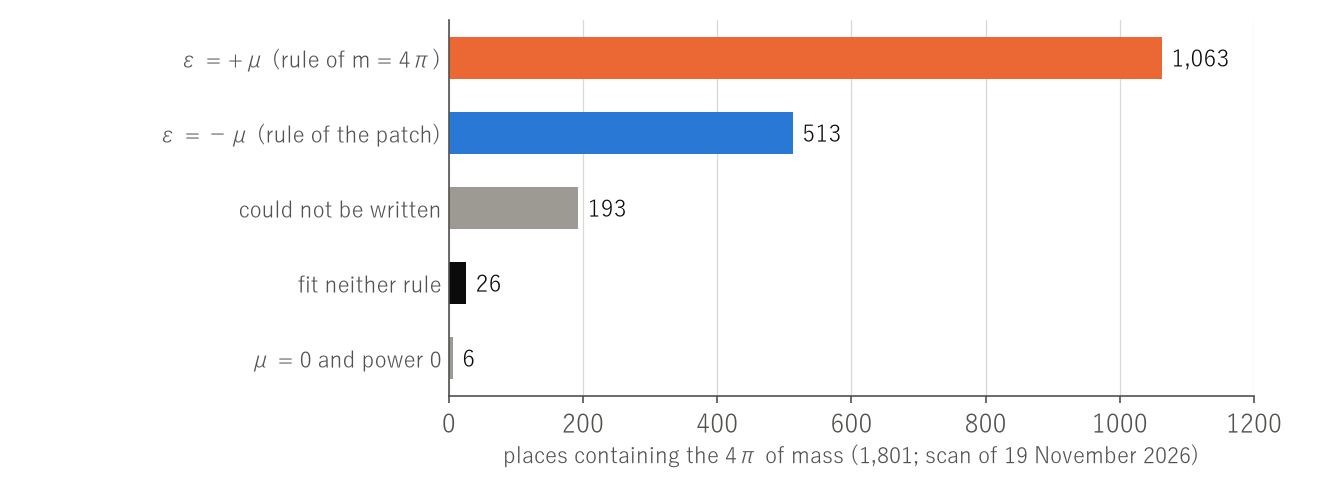
Do the two rules contradict each other? Are the 26 places that fit neither mistakes in calculation? Paper 1130 answers no to both. The two rules are the two ends of one formula, and the 26 places follow that formula too. The formula comes out of the books that record where the 4π was placed.
Keeping the books: two columns, ε and μ
Split a quantity X into factors by how it carries 4π and mass:
X = (4π)ρ ħp Gq cN mr Mu Z
Here m is a mass placed as 4π, M a mass not placed, (4π)ρ the 4π standing directly in the formula, and Z a quantity that carries neither 4π nor mass, such as a length, a time, a speed or a count. The powers may be whole numbers or the 1/2 of a square root.
The quantity gets a number in each of two columns. ε is the power of 4π standing in the value with the placements put in, counted as positive in the numerator. μ is the mass dimension, counted from the dimensions of the standard formula. ρ counts the 4π that stands directly in the formula, coming from an angular integral or from a choice of units; a 4π that comes from a placement is not counted (the way Paper 1129 writes it). Paper 1130 adds one thing: a 2π of the angle of one turn also enters ρ, as one half of 4π.
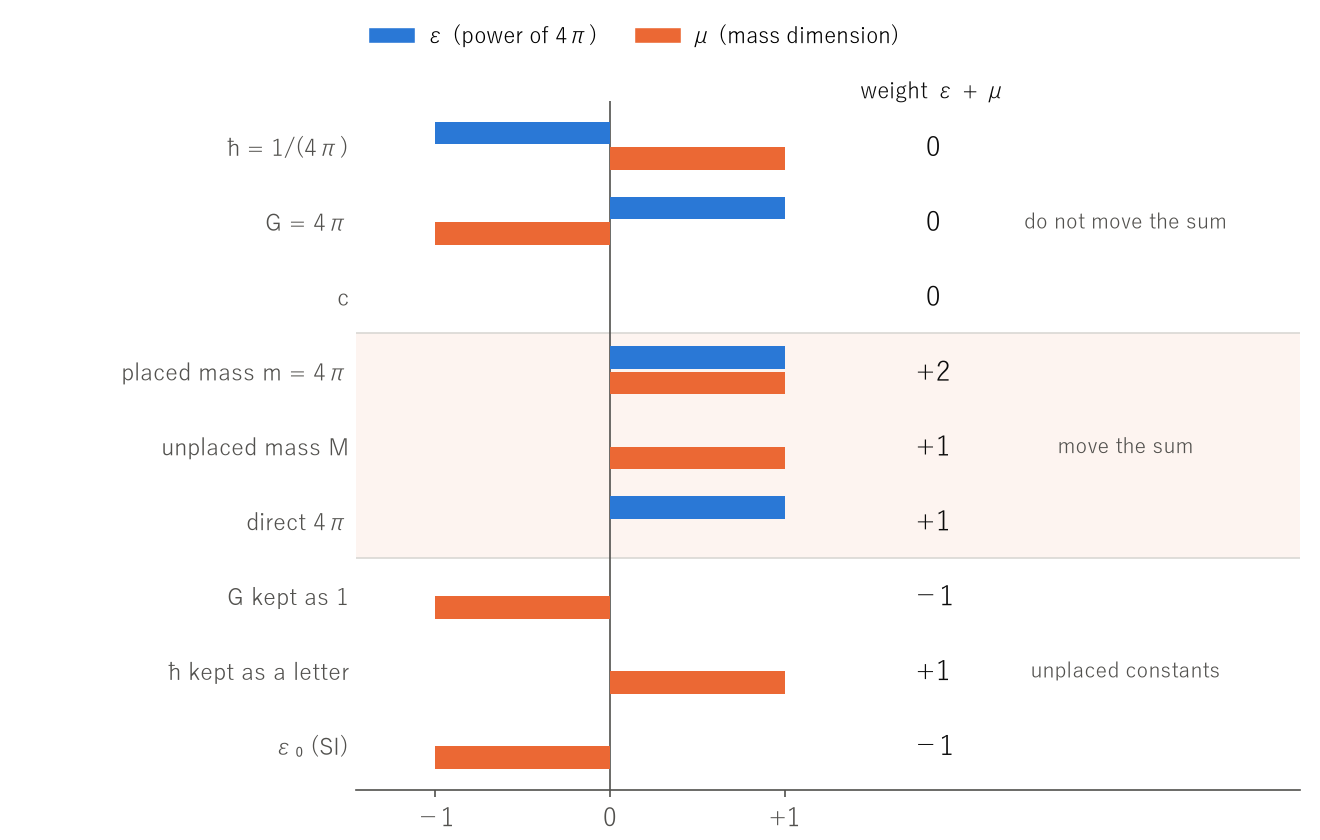
| Factor | Placement | ε | μ | Weight ε + μ |
|---|---|---|---|---|
| ħ | 1/(4π) | −1 | +1 | 0 |
| G | 4π | +1 | −1 | 0 |
| c | not placed (mass dimension 0) | 0 | 0 | 0 |
| placed mass m | 4π | +1 | +1 | 2 |
| unplaced mass M | not placed | 0 | +1 | 1 |
| direct 4π | stands in the formula | +1 | 0 | 1 |
| length, time, speed, count | none | 0 | 0 | 0 |
A quantity is a product of factors, so both the power of 4π in its value and its mass dimension come from multiplying each factor’s number by its exponent and adding:
ε = ρ − p + q + r μ = p − q + r + u
For example, E = mc² = 4πc² has one placed mass and (ε, μ) = (1, 1). The Planck mass √(ħc/G) = √c/(4π) takes ħ and c to the power 1/2 and G to the power −1/2, and has (ε, μ) = (−1, 1). The same μ = 1, with ε of opposite sign.
G, ħ and c do not move the sum
Add the two formulas, and p and q cancel. Paper 1130 states this as a theorem.
The Yamagishi 4π-Mass Invariant Under the three placements, the following three hold.
(i) The formula of the books: ε + μ = 2r + u + ρ
(ii) Invariance: one G moves (ε, μ) by (+1, −1), one ħ by (−1, +1), and c does not move it. What changes ε + μ is only a placed mass (2 for each), an unplaced mass (1) and a 4π standing directly in the formula (1).
(iii) Parity: if r, u and ρ are whole numbers, ε + μ and u + ρ have the same parity.
Multiplying by one G raises q by 1, so ε rises by 1 and μ falls by 1. ħ does the opposite, and c only moves N, which enters neither ε nor μ. In the language of bookkeeping, ε and μ are two columns, and G and ħ are transfers from one column to the other. However many transfers are made, the total of the two columns stays the same.
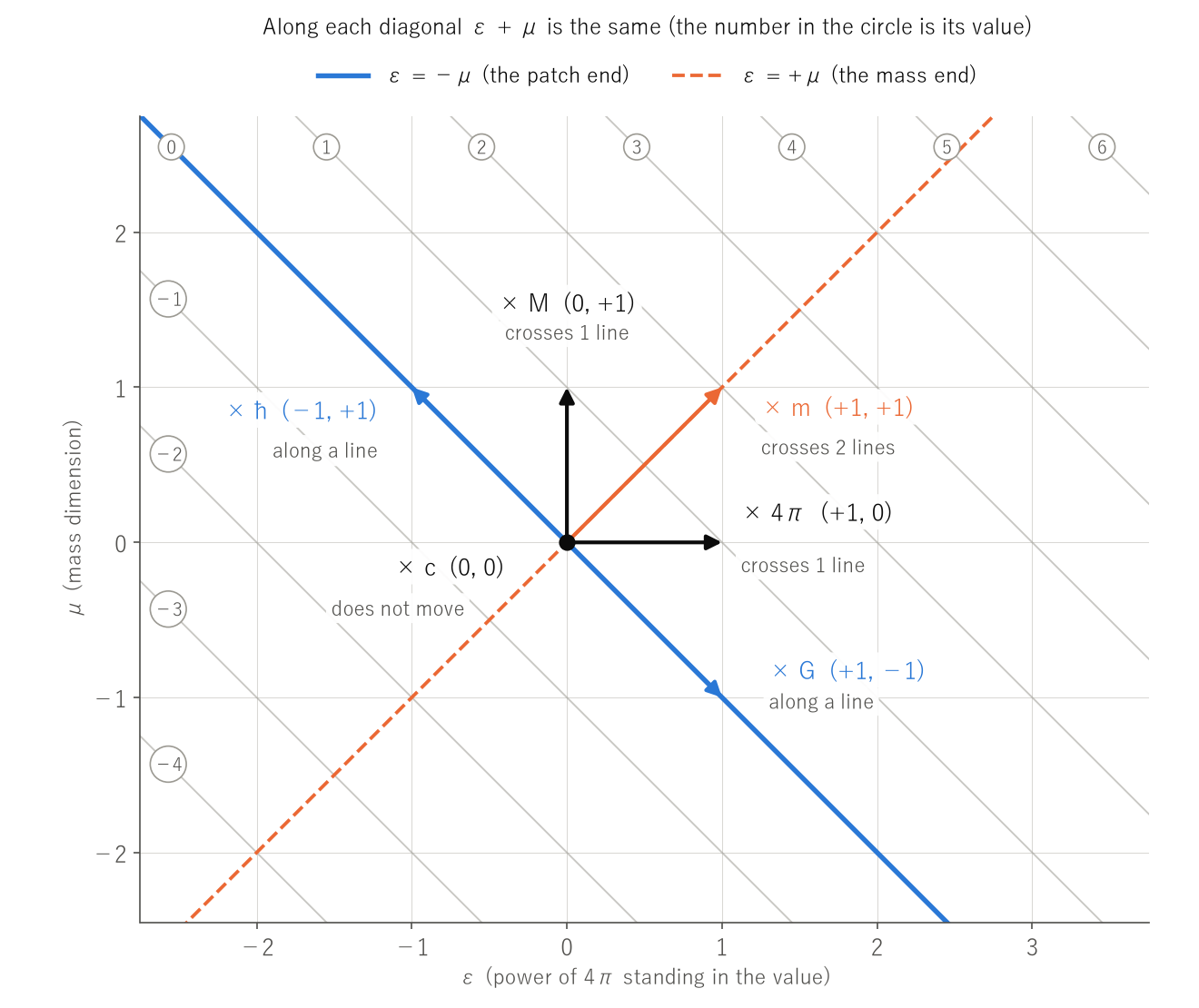
The check confirms the formula in symbols, then multiplies 2,000 random products, with whole and half powers, by G, ħ and c. In none of them did ε + μ move. ε and μ moved one by one in the 1,855 products in which the shifts of G and ħ differed.
Paper 1128 wrote that a rung of speed does not move μ, so the number of 4π’s does not change up the ladder. In the language of the books, c adds (0, 0). The four types mPck of the Planck quantities, seen in “A World Without Joules”, stay at (ε, μ) = (−1, 1) on every rung, each still carrying one 4π.
Only masses and a direct 4π move the sum
Only three things move ε + μ. A mass placed as 4π writes 1 into both columns, ε and μ, so each one moves the sum by 2. An unplaced mass writes only into the μ column and a 4π standing directly in the formula only into the ε column, so each moves it by 1. Dividing lowers the sum by the same amounts.
The two rules are the two ends of one formula
For a quantity made of the patch alone (r = u = ρ = 0), ε + μ = 0, that is, ε = −μ. When Paper 40 wrote that the Planck mass and the Planck energy have mass dimension 1 and therefore carry one 4π, that was an example of this end. For a quantity made of placed masses and c alone (p = q = u = ρ = 0), ε = r = μ, that is, ε = +μ, and E = mc² = 4πc² sits at this end. In Figure 2 the two lines through the origin are the two ends.
The companion quantity ε − μ = 2(q − p) − u + ρ does not contain r, the power of placed masses. ε + μ does not see ħ, G and c, and ε − μ does not see placed masses. The two rules of opposite sign are these two blind spots restated.
Using both, in a formula known to have no unplaced mass and no direct 4π (u = ρ = 0), part of the factors can be read back from value and dimension alone: r = (ε + μ)/2 and q − p = (ε − μ)/2. GM = 16π² has (2, 0) and reads back as r = 1, q − p = 1. ħ²/(2m) = 1/(128π³) = 0.0002519651 has (−3, 1) and reads back as r = −1, p − q = 2. p and q act only through their difference because, under the placements, Għ = 4π·1/(4π) = 1.
An unplaced constant adds its own mass dimension
This body of work also has formulas with G kept as 1 and only the mass set to 4π, with ħ kept as a letter, or with ε₀ in electromagnetism. Such unplaced constants bring no 4π into the value and carry only their own mass dimension (−1 per first power for G, +1 for ħ, −1 for ε₀). The formula of the books extends to ε + μ = 2r + u + ρ + U, where U is the sum of the mass dimensions carried by unplaced constants. Seen the other way round, placing a constant of mass dimension μY as (4π)s gives it the weight s + μY, which is 0 only when s = −μY, that is, under the patch rule. That is why G and ħ are invisible to ε + μ; placing by the rule of mass, s = +μY, gives the weight 2μY. The 2 of a placed mass is the case μY = 1.
The parity check: it reports an odd number of direct 4π’s
From the formula of the books, ε + μ − (u + ρ) = 2r. When r is a whole number the right-hand side is even, so ε + μ and u + ρ have the same parity. This is the parity rule. The check tried every one of the 117,649 products with whole powers inside the three placements, and the 15,625 that include unplaced constants, and found no product that breaks the parity.
Its use resembles the parity bit added in data transmission. A parity bit reports a single error and misses two. The books work the same way: inside the three placements, in a formula where masses enter with whole powers and no mass is left unplaced, an odd ε + μ means that an odd number of 4π’s stand directly in the formula. The power of 4π in the value and the dimension of the quantity are enough to tell.
| Formula | (ε, μ) | ε + μ | What the parity says |
|---|---|---|---|
| Poisson coefficient 4πG = 16π² | (2, −1) | 1 | One direct 4π. Reported |
| area of the light sphere 4π(ct)² | (1, 0) | 1 | One direct 4π. Reported |
| (4πG)² | (4, −2) | 2 | Two direct 4π’s. Missed |
| counting scene M(R) = 4π·kR | (1, 1) | 2 | One unplaced mass and one direct 4π. Missed |
| U = −16π²M/r (M not placed) | (2, 1) | 3 | No direct 4π. The unplaced mass makes it odd |
| v = √(GM/r) = 4π/√r | (1, 0) | 1 | No direct 4π. The mass to the power 1/2 makes it odd |
A miss is a case in which a direct 4π is present but the sum is even; a false alarm is a case in which there is no direct 4π but the sum is odd. A formula in which a 4π and a 2π cancel, such as the sum 4πc² of Paper 1115, does not show in the parity either. The parity speaks of the parity of u + ρ, not of ρ itself. G²M, with an unplaced mass, and G3/2m1/2, with a half power of mass, share the (2, −1) of 4πG. The parity check is a guard at the door; to count every direct 4π, read the factors and use the formula of the books.
A census of this body of work: 30 formulas, 26 places, 37 papers
Since the formula of the books follows from counting factor by factor, whenever a paper calculated according to the placements, the sum of ε counted from the printed value and μ counted from the dimensions of the standard formula must equal 2r + u + ρ (plus U if there are unplaced constants). The census is therefore a check on the calculations of the earlier papers. What can fail is whether putting the placements into the standard formula reproduces the value printed in the paper.
Checked for 29 formulas of earlier papers and 1 of Paper 1130, 30 in all (23 inside the three placements and 7 with unplaced constants), all 30 follow the formula of the books, and putting the placements into each standard formula reproduced the printed value (up to sign). Three examples that must fail were also included (GM printed as 8π; a value printed with the powers of −16π²M/r although M was also placed; G kept as 1 but counted as G = 4π). In all three the two sides disagreed.
Here are 13 rows taken from the table of the books. All 30 are in Paper 1130 and in the output of the check below.
| Formula | Source | ε | μ | r | u | ρ | ε + μ |
|---|---|---|---|---|---|---|---|
| counting scene M(R) = 4π·kR | 01, 1129 | 1 | 1 | 0 | 1 | 1 | 2 |
| E = mc² = 4πc² | 12, 60 | 1 | 1 | 1 | 0 | 0 | 2 |
| area of the light sphere 4π(ct)² | 61 | 1 | 0 | 0 | 0 | 1 | 1 |
| GM = 16π² | 28, 1086 | 2 | 0 | 1 | 0 | 0 | 2 |
| T = 2π√(a³/GM) = a3/2/2 | 28, 1086 | 0 | 0 | −1/2 | 0 | 1 | 0 |
| U = −GMm/r = −64π³/r | 35 | 3 | 1 | 2 | 0 | 0 | 4 |
| U = −16π²M/r (M not placed) | 26 | 2 | 1 | 1 | 1 | 0 | 3 |
| Poisson coefficient 4πG = 16π² | 35 | 2 | −1 | 0 | 0 | 1 | 1 |
| ħ²/(2m) = 1/(128π³) | 17 | −3 | 1 | −1 | 0 | 0 | −2 |
| Planck mass √(ħc/G) = √c/(4π) | 40, 44, 1128 | −1 | 1 | 0 | 0 | 0 | 0 |
| Planck length √(ħG/c³) = c−3/2 | 39, 44 | 0 | 0 | 0 | 0 | 0 | 0 |
| temperature per cell kBT = ħg/(2πc) = 2/c³ | 1115 | 0 | 1 | 1 | 0 | −1 | 1 |
| placed mass over Planck mass (4π)²/√c | 1130 | 2 | 0 | 1 | 0 | 0 | 2 |
In Kepler’s period T = 2π√(a³/GM), the 2π of one turn enters ρ = 1, and together with r = −1/2 from the square root of GM it gives ε + μ = 0. This is the books’ count of what Paper 1086 wrote: the π that remains when the formulas of gravity are written with mass is the angle of one turn. In the temperature per cell 2/c³ of Paper 1115, one 2π in the Unruh form sits in the denominator, so ρ = −1.
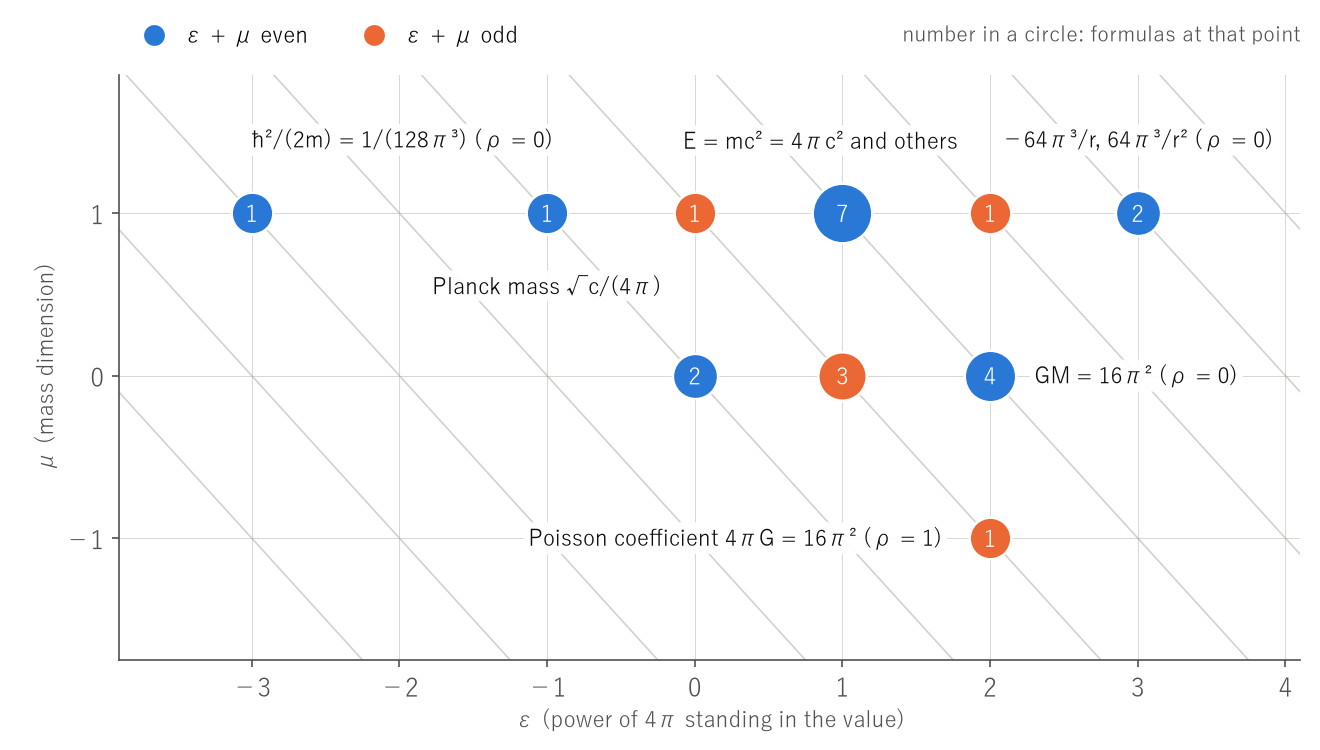
The same 16π², different books
GM = 16π², −64π³/r and 1/(128π³) have ρ = 0: every power of 4π in them is explained by placed numbers. The Poisson coefficient 4πG = 16π² is the same number 16π² as GM, yet it has ρ = 1: one 4π of Gauss’s law remains. This is what “the same number, but not the same root”, written in Paper 35, looks like when counted in the books. 4πG has ε + μ = 1, which is odd. Since it is a formula with G to the first power and no mass, its value and dimension show that an odd number of 4π’s stand directly in it.
ρ = 0, however, says only that every power of 4π is explained by the placements. Whether 16π² or 64π³ can be read as geometric quantities is not decided by this formula. As Paper 1129 wrote, that needs a separate look: write the units back and see whether an integral over the solid angle stands in the formula.
The 26 places that fit neither rule
The 26 places of the scan that fit neither rule fall, paper by paper, into six formulas. For all 26, the (μ, ε) written in the scan matches the row of that formula in the books.
| Formula | Source | Places | How it is explained |
|---|---|---|---|
| F = GMm/r² = 64π³/r² | 35 | 1 | Two placed masses (2r = 4) |
| v = √(GM/r) = 4π/√r | 38 | 5 | A placed mass to the power 1/2 (2r = 1) |
| e = (4πv)r (m = 4π, ε₀ = r) | 56, 57 | 15 | Half the 4π of 4πε₀ (ρ = 1/2) and half the unplaced ε₀ (U = −1/2) cancel |
| v = √(GM/r) = √(4π) = 3.544908 (G = 1) | 910 | 1 | An unplaced G to the power 1/2 (U = −1/2) |
| speed of sound (ħ/m)√(4πna) = ħ√(na/4π) | 1082 | 2 | ħ kept as a letter (U = +1) and half a 4π under the square root (ρ = 1/2) |
| self-gravitational energy (3/5)GM²/R (G = 1) | 1106 | 2 | An unplaced G (U = −1) |
Seen with the patch rule alone, GM has mass dimension 0 and yet carries two 4π’s, so it does not fit. Counting the placed masses makes it fit. The 6 places of Paper 35 and Paper 38 are explained inside the three placements, and the other 20 by counting the unplaced constants.
The 37 papers that carry both rules
The 37 papers in which both rules appear contain 507 places with ε = +μ and 276 with ε = −μ. Two rules side by side in one paper means that the two ends of one formula stand side by side in that paper, which in the books is no disagreement. The labels “ε = +μ” and “ε = −μ” of the scan, though, were attached from the (μ, ε) written down, and r, u and ρ were not read place by place. The count of 37 papers is a count of how the two rules split, not a check of the formula of the books.
Not a conservation law in time
“Invariant” in the name means that the quantity does not change when G, ħ and c are multiplied in while a formula is assembled. It is not a quantity that stays the same in time, a physical conserved quantity like energy or momentum. A conservation law compares the same system at different times; ε + μ compares the books of one quantity written with different sets of factors, and time appears nowhere.
In what it does, it is close to dimensional analysis (Bridgman 1922). Just as matching dimensions do not prove that a formula is right, a formula that balances in the books is no proof that it describes nature correctly. What the census checked is whether the earlier papers calculated according to the placements. “Parity rule” in the Japanese name refers to the rule for the parity of ε + μ; it is distinct both from the parity of spatial reflection and from the parity that appears in the staircase of ball volumes of Paper 115.
The scope of this story
What Paper 1130 shows is an identity that necessarily follows from the books recording where this body of work placed 4π, and a census applying it to earlier formulas. It uses only dimensional analysis, the three placements (Paper 39) and the way Paper 1129 writes ρ, and it claims no new theorem or law of physics. It rewrites no sentence of an earlier paper.
Even when the sum balances, the sum alone does not fix how the factors are assigned. The √(4π) of Paper 910 gives the same ε + μ whether it is read as r = 1/2, with the enclosed mass folded into a number, or as u = ρ = 1/2, with kR written back. The reading of the factors in the table of the books is one person’s reading, settled against the sentences they come from. ρ does not say whether its 4π is a solid angle, the place where a unit lives, or the angle of one turn; that is read separately (Paper 35, Paper 1086 and Paper 1129). How to count charge in Gaussian units also lies outside this story. What separates is one thing: whether that 4π was placed on a constant (weight 0), placed on a mass (weight 2) or written directly into the formula (weight 1). That is the separator of this formula.
The full check
The numbers and formulas of this page are confirmed by a Python check. Exponents are computed as fractions, and formulas are handled as symbols with sympy. The numbers of the scan (1,801 places, 26 places, 37 papers) are copied from the tables of the scan; the check confirms how they add up and how they match rows of the books. The table lists which part of the page falls if each part of the check fails.
| Section of the check | What falls if it fails |
|---|---|
| 1 Factors and weights | The table in “Keeping the books” and Figure 3 |
| 2 The formula of the books | Part (i) of the theorem |
| 3 What G, ħ and c add | Part (ii) of the theorem, Figure 2 and the 2,000 random products |
| 4 The ends, the companion, reading back | “The two rules are the two ends of one formula”, and the weight of a placement |
| 5 Parity | Part (iii) of the theorem and the table in “The parity check” |
| 6 The 30 rows of the books | The table of the census and Figure 4 |
| 7 The numbers of the scan | Figure 1 and the counts of 26 places and 37 papers |
| 8 Numbers in the text | The values of 1/(128π³) and √(4π) |
The full check (runs with Python 3 and sympy)
# The Yamagishi 4pi-Mass Invariant: the check
# Yuuki Yamagishi, 2026-11-19. Runs with Python 3 and sympy. Published under CC BY 4.0.
#
# The books of this body of work place three constants (paper 39):
#   m = 4 pi (a mass), G = 4 pi, hbar = 1/(4 pi).   c is not placed.
# A quantity is split into factors:
#   X = (4 pi)^rho * hbar^p * G^q * c^N * m^r * M^u * Z
#   m          a mass placed as 4 pi
#   M          a mass not placed (the kR of paper 1129 belongs here)
#   (4 pi)^rho a 4 pi standing directly in the formula (a 2 pi of one turn counts as half of 4 pi)
#   Z          a length, a time, a speed or a count (no 4 pi, no mass)
# eps = the power of 4 pi standing in the value (a power in the numerator counts as positive)
# mu  = the mass dimension, counted from the standard formula
# The claim of the page: eps + mu = 2r + u + rho, and G, hbar and c never move it.
# Each assert below guards one claim of the page. If one fails, that part of the page falls.

import itertools
import random
import sys
from fractions import Fraction as Fr

import sympy as sp

if hasattr(sys.stdout, "reconfigure"):
    sys.stdout.reconfigure(encoding="utf-8")

LOG = []


def out(s=""):
    LOG.append(s)
    print(s)


def ok(cond, label):
    assert cond, label
    out("  OK  " + label)


pi = sp.pi
A = 4 * pi

# factor: (power of 4 pi in its value, dimension (M, L, T, I), kind, what it is)
FAC = {
    "hbar": (-1, (1, 2, -1, 0), "placed", "hbar = 1/(4 pi)"),
    "G": (1, (-1, 3, -2, 0), "placed", "G = 4 pi"),
    "c": (0, (0, 1, -1, 0), "plain", "c (not placed, mass dimension 0)"),
    "m": (1, (1, 0, 0, 0), "mass", "a mass placed as 4 pi"),
    "M": (0, (1, 0, 0, 0), "bare", "a mass not placed"),
    "direct": (1, (0, 0, 0, 0), "direct", "a 4 pi standing directly in the formula"),
    "hbar0": (0, (1, 2, -1, 0), "unplaced", "hbar not placed (kept as 1 or as a letter)"),
    "G0": (0, (-1, 3, -2, 0), "unplaced", "G not placed (kept as 1)"),
    "eps0": (0, (-1, -3, 4, 2), "unplaced", "epsilon_0 not placed (SI)"),
    "r": (0, (0, 1, 0, 0), "plain", "length"),
    "R": (0, (0, 1, 0, 0), "plain", "length"),
    "t": (0, (0, 0, 1, 0), "plain", "time"),
    "v": (0, (0, 1, -1, 0), "plain", "speed"),
    "acc": (0, (0, 1, -2, 0), "plain", "acceleration"),
    "n": (0, (0, -3, 0, 0), "plain", "number density"),
    "e": (0, (0, 0, 1, 1), "plain", "charge (SI)"),
    "N": (0, (0, 0, 0, 0), "plain", "count"),
}
W = {k: v[0] + v[1][0] for k, v in FAC.items()}


def epsmu(ex):
    # powers of the factors -> (eps, mu, U, dimension); U is the mass dimension carried by unplaced constants
    ks = {f: Fr(k) for f, k in ex.items()}
    e = sum(k * FAC[f][0] for f, k in ks.items())
    d = tuple(sum(k * FAC[f][1][i] for f, k in ks.items()) for i in range(4))
    U = sum(k * FAC[f][1][0] for f, k in ks.items() if FAC[f][2] == "unplaced")
    return Fr(e), Fr(d[0]), Fr(U), d


def add(ex, f, k=1):
    y = dict(ex)
    y[f] = y.get(f, 0) + k
    return y


def main():
    out("The Yamagishi 4pi-Mass Invariant: the check")
    out("sympy " + sp.__version__)
    out()

    out("1. The factors and their weights eps + mu")
    for k, (e, d, kind, note) in FAC.items():
        out("  %-6s eps %+d  mu %+d  weight %+d   %s" % (k, e, d[0], e + d[0], note))
    ok([W[x] for x in ("hbar", "G", "c", "m", "M", "direct")] == [0, 0, 0, 2, 1, 1],
       "weights: hbar, G and c 0; a placed mass 2; an unplaced mass 1; a direct 4 pi 1")
    ok(all(W[x] == 0 for x in ("r", "R", "t", "v", "acc", "n", "e", "N")), "length, time, speed, charge and counts weigh 0")
    ok(W["hbar0"] == 1 and W["G0"] == -1 and W["eps0"] == -1,
       "an unplaced constant weighs its own mass dimension (hbar +1, G kept as 1 -1, epsilon_0 -1)")
    out()

    out("2. The formula of the books")
    p, q, N, r, u, rho = sp.symbols("p q N r u rho")
    eps = rho - p + q + r
    mu = p - q + r + u
    ok(sp.expand(eps + mu - (2 * r + u + rho)) == 0, "eps = rho - p + q + r and mu = p - q + r + u, so eps + mu = 2r + u + rho")
    Xv = A**rho * (1 / A)**p * A**q * A**r
    e_from_value = sp.simplify(sp.expand_log(sp.log(sp.powsimp(Xv, force=True)), force=True) / sp.log(A))
    ok(sp.simplify(e_from_value - eps) == 0, "counting the power of 4 pi in the value with the placements put in gives the same eps")
    e1, m1, _, _ = epsmu({"m": 1, "c": 2})
    e2, m2, _, _ = epsmu({"hbar": Fr(1, 2), "c": Fr(1, 2), "G": Fr(-1, 2)})
    ok((e1, m1) == (1, 1) and (e2, m2) == (-1, 1), "E = mc^2 = 4 pi c^2 has (eps, mu) = (1, 1); the Planck mass sqrt(hbar c/G) = sqrt(c)/(4 pi) has (-1, 1)")
    out()

    out("3. G, hbar and c do not move eps + mu")
    base = {"m": 1, "c": 2}
    e0, m0, _, _ = epsmu(base)
    dG = tuple(a - b for a, b in zip(epsmu(add(base, "G"))[:2], (e0, m0)))
    dH = tuple(a - b for a, b in zip(epsmu(add(base, "hbar"))[:2], (e0, m0)))
    dC = tuple(a - b for a, b in zip(epsmu(add(base, "c"))[:2], (e0, m0)))
    out("  one G moves (eps, mu) by (%s, %s), one hbar by (%s, %s), one c by (%s, %s)" % (dG + dH + dC))
    ok(dG == (1, -1) and dH == (-1, 1) and dC == (0, 0), "G adds (+1, -1), hbar adds (-1, +1), c adds (0, 0)")
    a_, b_ = sp.symbols("a b")
    ok(sp.expand((eps + a_ - b_) + (mu - a_ + b_) - (eps + mu)) == 0,
       "multiplying by G^a hbar^b c^N moves eps by a - b and mu by b - a, and eps + mu not at all (in symbols)")
    random.seed(20261119)
    kept, moved, expect_moved, tried = 0, 0, 0, 0
    for _ in range(2000):
        ex = {f: Fr(random.randint(-6, 6), random.choice((1, 2))) for f in ("direct", "hbar", "G", "c", "m", "M")}
        e1, m1, _, _ = epsmu(ex)
        ey, sh = dict(ex), {}
        for f in ("G", "hbar", "c"):
            sh[f] = Fr(random.randint(-5, 5), random.choice((1, 2)))
            ey[f] = ey[f] + sh[f]
        e2, m2, _, _ = epsmu(ey)
        tried += 1
        kept += (e1 + m1 == e2 + m2)
        moved += (e1 != e2) or (m1 != m2)
        expect_moved += (sh["G"] != sh["hbar"])
    out("  %d random products (whole and half powers) multiplied by G, hbar and c: eps + mu unchanged in %d, eps and mu moved one by one in %d"
        % (tried, kept, moved))
    ok(kept == tried == 2000 and moved == expect_moved == 1855,
       "in 2000 random products eps + mu never moved; eps and mu moved in the 1855 where the shifts of G and hbar differed")
    dm, dM, dF = epsmu(add(base, "m")), epsmu(add(base, "M")), epsmu(add(base, "direct"))
    ok((dm[0] + dm[1]) - (e0 + m0) == 2 and (dM[0] + dM[1]) - (e0 + m0) == 1 and (dF[0] + dF[1]) - (e0 + m0) == 1,
       "what moves the sum: a placed mass +2, an unplaced mass +1, a direct 4 pi +1")
    ok(all(epsmu({"hbar": Fr(1, 2), "G": Fr(-1, 2), "c": Fr(1 + 2 * k, 2)})[:2] == (-1, 1) for k in range(4)),
       "the four Planck types m_P c^k (k = 0 to 3) all stay at (eps, mu) = (-1, 1): climbing by c does not change the 4 pi")
    out()

    out("4. The two ends, the companion quantity and reading back")
    ends_patch = all(epsmu({"hbar": Fr(a1, 2), "G": Fr(b1, 2), "c": Fr(c1, 2)})[0] == -epsmu({"hbar": Fr(a1, 2), "G": Fr(b1, 2), "c": Fr(c1, 2)})[1]
                     for a1, b1, c1 in itertools.product(range(-6, 7), repeat=3))
    ends_mass = all(epsmu({"m": Fr(a1, 2), "c": Fr(c1, 2)})[0] == epsmu({"m": Fr(a1, 2), "c": Fr(c1, 2)})[1]
                    for a1, c1 in itertools.product(range(-6, 7), repeat=2))
    ok(ends_patch and ends_mass, "products of hbar, G and c alone have eps = -mu (the patch end); placed masses and c alone have eps = +mu (the mass end)")
    diff = sp.expand(eps - mu)
    ok(sp.expand(diff - (2 * (q - p) - u + rho)) == 0 and sp.diff(diff, r) == 0,
       "the companion eps - mu = 2(q - p) - u + rho does not contain r: placed masses never move it")
    ok(sp.expand((eps + mu).subs({u: 0, rho: 0}) / 2 - r) == 0 and sp.expand((eps - mu).subs({u: 0, rho: 0}) / 2 - (q - p)) == 0
       and sp.simplify(A * (1 / A)) == 1,
       "reading back: if u = rho = 0, then r = (eps + mu)/2 and q - p = (eps - mu)/2 (G hbar = 1, so only q - p counts)")
    s_, muY = sp.symbols("s mu_Y")
    ok(sp.solve(sp.Eq(s_ + muY, 0), s_) == [-muY] and sp.expand((s_ + muY).subs(s_, muY)) == 2 * muY,
       "a constant of mass dimension mu_Y placed as (4 pi)^s weighs s + mu_Y: 0 only for s = -mu_Y (the patch rule); 2 mu_Y for the mass rule")
    out()

    out("5. Parity: with whole powers, eps + mu and u + rho (+ U) have the same parity")
    cnt, okp = 0, True
    for rr, uu, rh, pp, qq, cc in itertools.product(range(-3, 4), repeat=6):
        e1, m1, U1, _ = epsmu({"m": rr, "M": uu, "direct": rh, "hbar": pp, "G": qq, "c": cc})
        cnt += 1
        okp = okp and (e1 + m1 - (uu + rh + U1)) % 2 == 0
    cntU, okU = 0, True
    for rr, uu, rh, h0, g0, z0 in itertools.product(range(-2, 3), repeat=6):
        e1, m1, U1, _ = epsmu({"m": rr, "M": uu, "direct": rh, "hbar0": h0, "G0": g0, "eps0": z0})
        cntU += 1
        okU = okU and (e1 + m1 - (uu + rh + U1)) % 2 == 0
    out("  tried every product with whole powers: %d inside the three placements, %d with unplaced constants" % (cnt, cntU))
    ok(okp and cnt == 7**6 == 117649, "all 117649 products: eps + mu and u + rho have the same parity")
    ok(okU and cntU == 5**6 == 15625, "all 15625 products with unplaced hbar, G and epsilon_0: eps + mu and u + rho + U have the same parity")
    s1 = sum(epsmu({"direct": 1, "G": 1})[:2])
    s2 = sum(epsmu({"direct": 2, "G": 2})[:2])
    s3 = sum(epsmu({"direct": 1, "M": 1})[:2])
    ok(s1 == 1 and s2 == 2 and s3 == 2, "found: 4 pi G gives 1 (odd); missed: (4 pi G)^2 gives 2 and 4 pi kR gives 2 (even)")
    ok(epsmu({"G": 2, "M": 1})[:2] == (2, -1) and epsmu({"G": Fr(3, 2), "m": Fr(1, 2)})[:2] == (2, -1),
       "G^2 M and G^(3/2) m^(1/2) share (2, -1) with 4 pi G, with no direct 4 pi: the parity reads u + rho, not rho")
    ok(sum(epsmu({"G": 1, "m": 1, "M": 1, "r": -1})[:2]) == 3 and sum(epsmu({"G": Fr(1, 2), "m": Fr(1, 2), "r": Fr(-1, 2)})[:2]) == 1,
       "odd without a direct 4 pi: -16 pi^2 M/r gives 3 (an unplaced M), sqrt(GM/r) gives 1 (a half power, 2r = 1)")
    out()

    out("6. The census: 29 formulas of earlier papers and 1 of paper 1130")
    c, rr_, R, t, v, acc, n, e, Nn, hb, Ms = sp.symbols("c r R t v a n e N hbar M", positive=True)
    SUBS = {"hbar": 1 / A, "G": A, "m": A, "direct": A, "hbar0": hb, "G0": sp.Integer(1), "eps0": rr_,
            "c": c, "r": rr_, "R": R, "t": t, "v": v, "acc": acc, "n": n, "e": e, "N": Nn, "M": Ms}
    DIM = {"mass": (1, 0, 0, 0), "energy": (1, 2, -2, 0), "length": (0, 1, 0, 0), "time": (0, 0, 1, 0), "speed": (0, 1, -1, 0),
           "acceleration": (0, 1, -2, 0), "force": (1, 1, -2, 0), "pressure": (1, -1, -2, 0), "area": (0, 2, 0, 0), "none": (0, 0, 0, 0),
           "dim of G": (-1, 3, -2, 0), "dim of GM": (0, 3, -2, 0), "dim of hbar^2/m": (1, 4, -2, 0), "charge": (0, 0, 1, 1),
           "frequency squared": (0, 0, -2, 0), "energy density": (1, -1, -2, 0), "charge (eps0 = r read as dimensions)": (Fr(1, 2), 2, -1, 0)}
    # key, formula, papers, kind of quantity, powers of the standard formula, printed value, rational remainder, substitution
    ROWS = [
        ("A1", "counting scene M(R) = 4 pi kR (kR not placed)", [1, 1129], "mass", {"direct": 1, "M": 1}, A * Ms, 1, {}),
        ("A2", "E = mc^2 = 4 pi c^2", [12, 60], "energy", {"m": 1, "c": 2}, A * c**2, 1, {}),
        ("A3", "area of the light sphere 4 pi (ct)^2", [61], "area", {"direct": 1, "c": 2, "t": 2}, A * c**2 * t**2, 1, {}),
        ("A4", "F = ma = 4 pi a", [26], "force", {"m": 1, "acc": 1}, A * acc, 1, {}),
        ("A5", "E_k = (1/2) m v^2 = 2 pi v^2", [18, 26], "energy", {"m": 1, "v": 2}, 2 * pi * v**2, Fr(1, 2), {}),
        ("A6", "P = (1/3) n m v^2 = (4/3) pi n v^2", [19], "pressure", {"n": 1, "m": 1, "v": 2}, sp.Rational(4, 3) * pi * n * v**2, Fr(1, 3), {}),
        ("A7", "kT = (4/3) pi v^2", [20], "energy", {"m": 1, "v": 2}, sp.Rational(4, 3) * pi * v**2, Fr(1, 3), {}),
        ("A8", "GM = 16 pi^2", [28, 1086], "dim of GM", {"G": 1, "m": 1}, 16 * pi**2, 1, {}),
        ("A9", "T = 2 pi sqrt(a^3/GM) = a^(3/2)/2", [28, 1086], "time", {"direct": 1, "G": Fr(-1, 2), "m": Fr(-1, 2), "R": Fr(3, 2)},
         R**sp.Rational(3, 2) / 2, Fr(1, 2), {}),
        ("A10", "v = sqrt(GM/r) = 4 pi/sqrt(r)", [38], "speed", {"G": Fr(1, 2), "m": Fr(1, 2), "r": Fr(-1, 2)}, A / sp.sqrt(rr_), 1, {}),
        ("A11", "g = GM/r^2 = 16 pi^2/r^2", [38], "acceleration", {"G": 1, "m": 1, "r": -2}, 16 * pi**2 / rr_**2, 1, {}),
        ("A12", "a = GM/c^2 = 16 pi^2/c^2", [1115], "length", {"G": 1, "m": 1, "c": -2}, 16 * pi**2 / c**2, 1, {}),
        ("A13a", "U = -GMm/r = -64 pi^3/r", [35], "energy", {"G": 1, "m": 2, "r": -1}, -64 * pi**3 / rr_, -1, {}),
        ("A13b", "F = GMm/r^2 = 64 pi^3/r^2", [35], "force", {"G": 1, "m": 2, "r": -2}, 64 * pi**3 / rr_**2, 1, {}),
        ("A14", "U = -16 pi^2 M/r (M not placed)", [26], "energy", {"G": 1, "m": 1, "M": 1, "r": -1}, -16 * pi**2 * Ms / rr_, -1, {}),
        ("A15", "Poisson coefficient 4 pi G = 16 pi^2", [35], "dim of G", {"direct": 1, "G": 1}, 16 * pi**2, 1, {}),
        ("A16", "hbar^2/(2m) = 1/(128 pi^3)", [17], "dim of hbar^2/m", {"hbar": 2, "m": -1}, 1 / (128 * pi**3), Fr(1, 2), {}),
        ("A17", "Planck mass sqrt(hbar c/G) = sqrt(c)/(4 pi)", [40, 44, 1128], "mass", {"hbar": Fr(1, 2), "G": Fr(-1, 2), "c": Fr(1, 2)},
         sp.sqrt(c) / A, 1, {}),
        ("A18", "Planck length sqrt(hbar G/c^3) = c^(-3/2)", [39, 44], "length", {"hbar": Fr(1, 2), "G": Fr(1, 2), "c": Fr(-3, 2)},
         c**sp.Rational(-3, 2), 1, {}),
        ("A19", "cells 4 pi R^2 c^3/(G hbar) = 4 pi c^5 (R = c)", [1115], "none", {"direct": 1, "R": 2, "c": 3, "G": -1, "hbar": -1},
         A * c**5, 1, {R: c}),
        ("A20", "temperature per cell k_B T = hbar g/(2 pi c) = 2/c^3 (k_B = 1)", [1115], "energy",
         {"direct": -1, "hbar": 1, "G": 1, "m": 1, "R": -2, "c": -1}, 2 / c**3, 2, {R: c}),
        ("A21", "sum (1/2) N k_B T = Mc^2 = 4 pi c^2", [1115], "energy", {"m": 1, "c": 2}, A * c**2, 1, {}),
        ("A22", "placed mass over Planck mass m/m_P = (4 pi)^2/sqrt(c)", [], "none", {"m": 1, "hbar": Fr(-1, 2), "G": Fr(1, 2), "c": Fr(-1, 2)},
         A**2 / sp.sqrt(c), 1, {}),
        ("B1", "hbar^2/(2m) = 1/(8 pi) (hbar = 1 kept)", [17], "dim of hbar^2/m", {"hbar0": 2, "m": -1}, 1 / (8 * pi), Fr(1, 2), {hb: 1}),
        ("B2", "e = (4 pi v) r (m = 4 pi, epsilon_0 = r)", [15, 56, 57], "charge", {"direct": Fr(1, 2), "eps0": Fr(1, 2), "m": Fr(1, 2), "v": 1, "r": Fr(1, 2)},
         A * v * rr_, 1, {}),
        ("B3", "omega_p^2 = n e^2/(m epsilon_0) = n e^2/(4 pi r)", [22], "frequency squared", {"n": 1, "e": 2, "m": -1, "eps0": -1},
         n * e**2 / (A * rr_), 1, {}),
        ("B4", "v = sqrt(GM/r) = sqrt(4 pi) (G = 1, enclosed mass 4 pi, radius 1)", [910], "speed", {"G0": Fr(1, 2), "m": Fr(1, 2), "r": Fr(-1, 2)},
         sp.sqrt(A) / sp.sqrt(rr_), 1, {}),
        ("B5", "speed of sound (hbar/m) sqrt(4 pi n a) = hbar sqrt(n a/(4 pi))", [1082], "speed",
         {"hbar0": 1, "m": -1, "direct": Fr(1, 2), "n": Fr(1, 2), "R": Fr(1, 2)}, hb * sp.sqrt(n * R / A), 1, {}),
        ("B6", "self-gravitational energy (3/5) GM^2/R (G = 1, M = Nm)", [1106], "energy", {"G0": 1, "m": 2, "N": 2, "R": -1},
         sp.Rational(3, 5) * A**2 * Nn**2 / R, Fr(3, 5), {}),
        ("B7", "Coleman-Weinberg m^4/(64 pi^2) = (2 pi)^2 (hbar = c = 1)", [13], "energy density", {"m": 4, "c": 5, "hbar0": -3, "direct": -2},
         4 * pi**2, Fr(1, 4), {hb: 1, c: 1}),
    ]

    def pi_power_and_coef(expr):
        ee, coef = sp.Integer(0), sp.Integer(1)
        for a in sp.Mul.make_args(sp.factor(expr)):
            b, x = a.as_base_exp()
            if b == pi:
                ee += x
            elif a.is_number:
                coef *= a
        return sp.nsimplify(ee), coef

    def ledger(row):
        key, text, src, kind, std, printed, left, vsub = row
        e_pr, coef = pi_power_and_coef(printed)
        e_std, mu_std, U, dims = epsmu(std)
        r1, u1, rh1 = (Fr(sp.nsimplify(std.get(k, 0))) for k in ("m", "M", "direct"))
        lhs = Fr(sp.nsimplify(e_pr)) + mu_std
        built = sp.Integer(1)
        for f, k in std.items():
            built *= SUBS[f]**sp.nsimplify(k)
        built = (built * sp.nsimplify(left)).subs(vsub)
        pv = printed.subs(vsub)
        whole = all(Fr(sp.nsimplify(k)).denominator == 1 for f, k in std.items() if FAC[f][2] in ("mass", "bare", "direct", "unplaced"))
        return dict(key=key, text=text, src=src, eps=Fr(sp.nsimplify(e_pr)), e_std=e_std, mu=mu_std, r=r1, u=u1, rho=rh1, U=U,
                    lhs=lhs, rhs=2 * r1 + u1 + rh1 + U,
                    val=(sp.simplify(built - pv) == 0 or sp.simplify(built + pv) == 0),
                    coef=(sp.simplify(sp.Abs(coef) - sp.Integer(4)**e_pr * abs(sp.nsimplify(left))) == 0),
                    dim=(tuple(Fr(x) for x in dims) == tuple(Fr(x) for x in DIM[kind])),
                    whole=whole, par=((lhs - (u1 + rh1 + U)) % 2 == 0) if whole else None)

    LED = [ledger(x) for x in ROWS]
    D = {L["key"]: L for L in LED}
    out("  %-5s %5s %5s %5s %5s %5s %5s %7s %7s  %s" % ("key", "eps", "mu", "r", "u", "rho", "U", "eps+mu", "2r+u+", "formula (papers)"))
    for L in LED:
        out("  %-5s %5s %5s %5s %5s %5s %5s %7s %7s  %s (%s)" % (L["key"], L["eps"], L["mu"], L["r"], L["u"], L["rho"], L["U"], L["lhs"], L["rhs"],
                                                               L["text"], ", ".join(str(x) for x in L["src"]) or "paper 1130"))
    nA = [L for L in LED if L["key"].startswith("A")]
    nB = [L for L in LED if L["key"].startswith("B")]
    ok(len(LED) == 30 and len(nA) == 23 and len(nB) == 7, "30 rows: 23 inside the three placements, 7 with unplaced constants")
    ok(all(L["lhs"] == L["rhs"] for L in LED), "every row has eps + mu = 2r + u + rho + U")
    ok(all(L["dim"] and L["e_std"] == L["eps"] for L in LED), "every standard formula has the dimension of its quantity, and its eps matches the printed value")
    ok(all(L["val"] and L["coef"] for L in LED),
       "putting the placements into every standard formula gives the printed value (up to sign); the number splits into 4^eps and a rational rest")
    ok(all(L["U"] == 0 for L in nA), "inside the three placements U = 0: the formula of the books itself")
    ok({L["key"]: L["U"] for L in nB} == {"B1": 2, "B2": Fr(-1, 2), "B3": 1, "B4": Fr(-1, 2), "B5": 1, "B6": -1, "B7": -3},
       "with unplaced constants, U is the mass dimension they carry (hbar^2 +2, epsilon_0^(1/2) -1/2, G^(1/2) -1/2, G -1, hbar^-3 -3)")
    wholes = [L for L in LED if L["whole"]]
    ok(len(wholes) == 25 and all(L["par"] for L in wholes), "the 25 rows with whole powers all keep the parity")
    ok(all(D[k]["rho"] == 0 for k in ("A8", "A13a", "A13b", "A16")) and D["A15"]["rho"] == 1 and D["A15"]["lhs"] == 1,
       "16 pi^2 (GM), 64 pi^3 and 1/(128 pi^3) have rho = 0; Poisson's 4 pi G has rho = 1 and an odd eps + mu = 1")
    ok(sp.simplify(16 * pi**2 - A * A) == 0 and (D["A8"]["eps"], D["A8"]["mu"]) == (2, 0) and (D["A15"]["eps"], D["A15"]["mu"]) == (2, -1),
       "GM and 4 pi G are both 16 pi^2 as numbers, but sit at (2, 0) and (2, -1) in the books")
    ok(D["A19"]["rho"] == 1 and D["A20"]["rho"] == -1 and D["A21"]["rho"] == 0 and D["A21"]["r"] == 1,
       "paper 1115: the cells have rho = 1, the temperature rho = -1 (the 2 pi of Unruh), the sum rho = 0 with r = 1")
    ok((D["A2"]["eps"], D["A2"]["mu"], D["A17"]["eps"], D["A17"]["mu"]) == (1, 1, -1, 1)
       and (D["A22"]["eps"], D["A22"]["mu"]) == (2, 0) and (D["A22"]["eps"] + D["A22"]["mu"]) / 2 == 1,
       "m = 4 pi and the Planck mass both have mu = 1 with eps = +1 and -1; their ratio (2, 0) reads back as r = 1")
    bad1 = ledger(("X1", "GM printed as 8 pi", [], "dim of GM", {"G": 1, "m": 1}, 8 * pi, 1, {}))
    bad2 = ledger(("X2", "M placed too, but printed as -16 pi^2/r", [], "energy", {"G": 1, "m": 2, "r": -1}, -16 * pi**2 / rr_, -1, {}))
    bad3 = ledger(("X3", "G kept as 1 but counted as G = 4 pi", [], "speed", {"G": Fr(1, 2), "m": Fr(1, 2), "r": Fr(-1, 2)}, sp.sqrt(A) / sp.sqrt(rr_), 1, {}))
    ok(all(b["lhs"] != b["rhs"] for b in (bad1, bad2, bad3)),
       "self-test: a printed value off the placements fails (GM as 8 pi; -16 pi^2/r with M placed; sqrt(4 pi) counted with G = 4 pi)")
    alt = ledger(("X4", "paper 910 read with kR written back", [910], "speed", {"G0": Fr(1, 2), "M": Fr(1, 2), "direct": Fr(1, 2), "r": Fr(-1, 2)},
                  sp.sqrt(A) * sp.sqrt(Ms) / sp.sqrt(rr_), 1, {}))
    ok(alt["lhs"] == alt["rhs"] == D["B4"]["lhs"] == Fr(1, 2),
       "the sqrt(4 pi) of paper 910 gives 1/2 read as r = 1/2 or as u = rho = 1/2: the sum does not fix how the factors are assigned")
    out()

    out("7. The census numbers of the scan of 19 November 2026 (copied from the scan; this checks how they add up)")
    SCAN = {"eps = +mu (rule of m = 4 pi)": 1063, "eps = -mu (rule of the patch)": 513, "could not be written": 193,
            "fits neither": 26, "mu = 0 and power 0": 6}
    for k, x in SCAN.items():
        out("  %-32s %5d" % (k, x))
    ok(sum(SCAN.values()) == 1801, "1063 + 513 + 193 + 26 + 6 = 1801 places that contain the 4 pi of mass")
    # the places that fit neither: paper -> (number of places, (mu, eps) written by the readers of the scan, row of the books)
    NEITHER = {35: (1, (1, 3), "A13b"), 38: (5, (0, 1), "A10"), 56: (11, (0, 1), "B2"), 57: (4, (0, 1), "B2"),
               910: (1, (0, Fr(1, 2)), "B4"), 1082: (2, (0, Fr(-1, 2)), "B5"), 1106: (2, (1, 2), "B6")}
    ok(sum(x[0] for x in NEITHER.values()) == 26 and len(set(x[2] for x in NEITHER.values())) == 6,
       "the 26 places that fit neither rule fall into six formulas")
    ok(all((D[k]["mu"], D[k]["eps"]) == mue and D[k]["lhs"] == D[k]["rhs"] for _, mue, k in NEITHER.values()),
       "for all 26, the (mu, eps) written in the scan is that of a row of the books, and that row keeps the formula")
    inside = sum(x[0] for x in NEITHER.values() if x[2].startswith("A"))
    outside = sum(x[0] for x in NEITHER.values() if x[2].startswith("B"))
    out("  explained inside the three placements: %d places (papers 35 and 38); explained by unplaced constants: %d places" % (inside, outside))
    ok(inside == 6 and outside == 20, "6 places are explained by the placements and 20 by counting the unplaced constants")
    BOTH = [(5, 3, 3, 0), (14, 2, 4, 0), (15, 21, 4, 0), (16, 23, 3, 0), (17, 34, 12, 0), (21, 33, 4, 0), (22, 17, 1, 0), (26, 44, 7, 0),
            (28, 5, 9, 0), (29, 1, 1, 0), (30, 17, 1, 0), (32, 8, 1, 0), (35, 8, 37, 1), (38, 14, 11, 5), (39, 2, 38, 0), (56, 8, 13, 11),
            (57, 4, 5, 4), (60, 43, 3, 0), (61, 13, 1, 0), (63, 22, 1, 0), (74, 1, 12, 0), (116, 2, 26, 0), (124, 3, 1, 0), (128, 9, 1, 0),
            (134, 10, 1, 0), (147, 6, 1, 0), (249, 1, 2, 0), (306, 1, 2, 0), (316, 5, 1, 0), (1002, 1, 1, 0), (1067, 6, 1, 0),
            (1083, 43, 3, 0), (1085, 4, 3, 0), (1086, 3, 7, 0), (1092, 7, 3, 0), (1115, 53, 10, 0), (1128, 30, 42, 0)]
    plus, minus, nei = (sum(x[i] for x in BOTH) for i in (1, 2, 3))
    out("  papers with both rules: %d; places in them: eps = +mu %d, eps = -mu %d, neither %d" % (len(BOTH), plus, minus, nei))
    ok(len(BOTH) == 37 and all(x[1] > 0 and x[2] > 0 for x in BOTH) and (plus, minus, nei) == (507, 276, 21),
       "37 papers carry both rules: 507 places with eps = +mu and 276 with eps = -mu stand in the same papers")
    ok({x[0]: x[3] for x in BOTH if x[3]} == {35: 1, 38: 5, 56: 11, 57: 4} and 26 - nei == 5,
       "21 of the 26 places that fit neither are inside the 37 papers (35, 38, 56, 57); the other 5 (910, 1082, 1106) are outside")
    SAME = {"truly in one sentence: a value": 16, "truly: a lead-in to the next formula": 2, "truly: stating the placements": 17,
            "only the name Yamagishi patch for m = 4 pi": 15, "m = 4 pi and epsilon_0 = r in one word": 3}
    ok(sum(SAME.values()) == 53 and 16 + 2 + 17 == 35, "53 places where m = 4 pi and the patch appear in one sentence: 35 truly together, 15 by name, 3 bundled")
    out()

    out("8. Numbers written on the page")
    for k, x in (("4 pi", A), ("sqrt(4 pi)", sp.sqrt(A)), ("16 pi^2", 16 * pi**2), ("64 pi^3", 64 * pi**3), ("(4 pi)^2", A**2)):
        out("  %-12s = %.6f" % (k, float(x)))
    out("  %-12s = %.10f" % ("1/(128 pi^3)", float(1 / (128 * pi**3))))
    ok(abs(float(1 / (128 * pi**3)) - 0.0002519651) < 5e-11 and abs(float(sp.sqrt(A)) - 3.544908) < 5e-7,
       "1/(128 pi^3) = 0.0002519651 (paper 17) and sqrt(4 pi) = 3.544908 (paper 910)")
    out()
    out("All checks passed. If any assert fails, the matching part of the page falls.")


if __name__ == "__main__":
    main()
    if "--write" in sys.argv:          # --write OUTPUT_FILE : also save what was printed
        with open(sys.argv[sys.argv.index("--write") + 1], "w", encoding="utf-8", newline="") as f:
            f.write(chr(10).join(LOG) + chr(10))
Output of the check
The Yamagishi 4pi-Mass Invariant: the check
sympy 1.14.0

1. The factors and their weights eps + mu
  hbar   eps -1  mu +1  weight +0   hbar = 1/(4 pi)
  G      eps +1  mu -1  weight +0   G = 4 pi
  c      eps +0  mu +0  weight +0   c (not placed, mass dimension 0)
  m      eps +1  mu +1  weight +2   a mass placed as 4 pi
  M      eps +0  mu +1  weight +1   a mass not placed
  direct eps +1  mu +0  weight +1   a 4 pi standing directly in the formula
  hbar0  eps +0  mu +1  weight +1   hbar not placed (kept as 1 or as a letter)
  G0     eps +0  mu -1  weight -1   G not placed (kept as 1)
  eps0   eps +0  mu -1  weight -1   epsilon_0 not placed (SI)
  r      eps +0  mu +0  weight +0   length
  R      eps +0  mu +0  weight +0   length
  t      eps +0  mu +0  weight +0   time
  v      eps +0  mu +0  weight +0   speed
  acc    eps +0  mu +0  weight +0   acceleration
  n      eps +0  mu +0  weight +0   number density
  e      eps +0  mu +0  weight +0   charge (SI)
  N      eps +0  mu +0  weight +0   count
  OK  weights: hbar, G and c 0; a placed mass 2; an unplaced mass 1; a direct 4 pi 1
  OK  length, time, speed, charge and counts weigh 0
  OK  an unplaced constant weighs its own mass dimension (hbar +1, G kept as 1 -1, epsilon_0 -1)

2. The formula of the books
  OK  eps = rho - p + q + r and mu = p - q + r + u, so eps + mu = 2r + u + rho
  OK  counting the power of 4 pi in the value with the placements put in gives the same eps
  OK  E = mc^2 = 4 pi c^2 has (eps, mu) = (1, 1); the Planck mass sqrt(hbar c/G) = sqrt(c)/(4 pi) has (-1, 1)

3. G, hbar and c do not move eps + mu
  one G moves (eps, mu) by (1, -1), one hbar by (-1, 1), one c by (0, 0)
  OK  G adds (+1, -1), hbar adds (-1, +1), c adds (0, 0)
  OK  multiplying by G^a hbar^b c^N moves eps by a - b and mu by b - a, and eps + mu not at all (in symbols)
  2000 random products (whole and half powers) multiplied by G, hbar and c: eps + mu unchanged in 2000, eps and mu moved one by one in 1855
  OK  in 2000 random products eps + mu never moved; eps and mu moved in the 1855 where the shifts of G and hbar differed
  OK  what moves the sum: a placed mass +2, an unplaced mass +1, a direct 4 pi +1
  OK  the four Planck types m_P c^k (k = 0 to 3) all stay at (eps, mu) = (-1, 1): climbing by c does not change the 4 pi

4. The two ends, the companion quantity and reading back
  OK  products of hbar, G and c alone have eps = -mu (the patch end); placed masses and c alone have eps = +mu (the mass end)
  OK  the companion eps - mu = 2(q - p) - u + rho does not contain r: placed masses never move it
  OK  reading back: if u = rho = 0, then r = (eps + mu)/2 and q - p = (eps - mu)/2 (G hbar = 1, so only q - p counts)
  OK  a constant of mass dimension mu_Y placed as (4 pi)^s weighs s + mu_Y: 0 only for s = -mu_Y (the patch rule); 2 mu_Y for the mass rule

5. Parity: with whole powers, eps + mu and u + rho (+ U) have the same parity
  tried every product with whole powers: 117649 inside the three placements, 15625 with unplaced constants
  OK  all 117649 products: eps + mu and u + rho have the same parity
  OK  all 15625 products with unplaced hbar, G and epsilon_0: eps + mu and u + rho + U have the same parity
  OK  found: 4 pi G gives 1 (odd); missed: (4 pi G)^2 gives 2 and 4 pi kR gives 2 (even)
  OK  G^2 M and G^(3/2) m^(1/2) share (2, -1) with 4 pi G, with no direct 4 pi: the parity reads u + rho, not rho
  OK  odd without a direct 4 pi: -16 pi^2 M/r gives 3 (an unplaced M), sqrt(GM/r) gives 1 (a half power, 2r = 1)

6. The census: 29 formulas of earlier papers and 1 of paper 1130
  key     eps    mu     r     u   rho     U  eps+mu   2r+u+  formula (papers)
  A1        1     1     0     1     1     0       2       2  counting scene M(R) = 4 pi kR (kR not placed) (1, 1129)
  A2        1     1     1     0     0     0       2       2  E = mc^2 = 4 pi c^2 (12, 60)
  A3        1     0     0     0     1     0       1       1  area of the light sphere 4 pi (ct)^2 (61)
  A4        1     1     1     0     0     0       2       2  F = ma = 4 pi a (26)
  A5        1     1     1     0     0     0       2       2  E_k = (1/2) m v^2 = 2 pi v^2 (18, 26)
  A6        1     1     1     0     0     0       2       2  P = (1/3) n m v^2 = (4/3) pi n v^2 (19)
  A7        1     1     1     0     0     0       2       2  kT = (4/3) pi v^2 (20)
  A8        2     0     1     0     0     0       2       2  GM = 16 pi^2 (28, 1086)
  A9        0     0  -1/2     0     1     0       0       0  T = 2 pi sqrt(a^3/GM) = a^(3/2)/2 (28, 1086)
  A10       1     0   1/2     0     0     0       1       1  v = sqrt(GM/r) = 4 pi/sqrt(r) (38)
  A11       2     0     1     0     0     0       2       2  g = GM/r^2 = 16 pi^2/r^2 (38)
  A12       2     0     1     0     0     0       2       2  a = GM/c^2 = 16 pi^2/c^2 (1115)
  A13a      3     1     2     0     0     0       4       4  U = -GMm/r = -64 pi^3/r (35)
  A13b      3     1     2     0     0     0       4       4  F = GMm/r^2 = 64 pi^3/r^2 (35)
  A14       2     1     1     1     0     0       3       3  U = -16 pi^2 M/r (M not placed) (26)
  A15       2    -1     0     0     1     0       1       1  Poisson coefficient 4 pi G = 16 pi^2 (35)
  A16      -3     1    -1     0     0     0      -2      -2  hbar^2/(2m) = 1/(128 pi^3) (17)
  A17      -1     1     0     0     0     0       0       0  Planck mass sqrt(hbar c/G) = sqrt(c)/(4 pi) (40, 44, 1128)
  A18       0     0     0     0     0     0       0       0  Planck length sqrt(hbar G/c^3) = c^(-3/2) (39, 44)
  A19       1     0     0     0     1     0       1       1  cells 4 pi R^2 c^3/(G hbar) = 4 pi c^5 (R = c) (1115)
  A20       0     1     1     0    -1     0       1       1  temperature per cell k_B T = hbar g/(2 pi c) = 2/c^3 (k_B = 1) (1115)
  A21       1     1     1     0     0     0       2       2  sum (1/2) N k_B T = Mc^2 = 4 pi c^2 (1115)
  A22       2     0     1     0     0     0       2       2  placed mass over Planck mass m/m_P = (4 pi)^2/sqrt(c) (paper 1130)
  B1       -1     1    -1     0     0     2       0       0  hbar^2/(2m) = 1/(8 pi) (hbar = 1 kept) (17)
  B2        1     0   1/2     0   1/2  -1/2       1       1  e = (4 pi v) r (m = 4 pi, epsilon_0 = r) (15, 56, 57)
  B3       -1     0    -1     0     0     1      -1      -1  omega_p^2 = n e^2/(m epsilon_0) = n e^2/(4 pi r) (22)
  B4      1/2     0   1/2     0     0  -1/2     1/2     1/2  v = sqrt(GM/r) = sqrt(4 pi) (G = 1, enclosed mass 4 pi, radius 1) (910)
  B5     -1/2     0    -1     0   1/2     1    -1/2    -1/2  speed of sound (hbar/m) sqrt(4 pi n a) = hbar sqrt(n a/(4 pi)) (1082)
  B6        2     1     2     0     0    -1       3       3  self-gravitational energy (3/5) GM^2/R (G = 1, M = Nm) (1106)
  B7        2     1     4     0    -2    -3       3       3  Coleman-Weinberg m^4/(64 pi^2) = (2 pi)^2 (hbar = c = 1) (13)
  OK  30 rows: 23 inside the three placements, 7 with unplaced constants
  OK  every row has eps + mu = 2r + u + rho + U
  OK  every standard formula has the dimension of its quantity, and its eps matches the printed value
  OK  putting the placements into every standard formula gives the printed value (up to sign); the number splits into 4^eps and a rational rest
  OK  inside the three placements U = 0: the formula of the books itself
  OK  with unplaced constants, U is the mass dimension they carry (hbar^2 +2, epsilon_0^(1/2) -1/2, G^(1/2) -1/2, G -1, hbar^-3 -3)
  OK  the 25 rows with whole powers all keep the parity
  OK  16 pi^2 (GM), 64 pi^3 and 1/(128 pi^3) have rho = 0; Poisson's 4 pi G has rho = 1 and an odd eps + mu = 1
  OK  GM and 4 pi G are both 16 pi^2 as numbers, but sit at (2, 0) and (2, -1) in the books
  OK  paper 1115: the cells have rho = 1, the temperature rho = -1 (the 2 pi of Unruh), the sum rho = 0 with r = 1
  OK  m = 4 pi and the Planck mass both have mu = 1 with eps = +1 and -1; their ratio (2, 0) reads back as r = 1
  OK  self-test: a printed value off the placements fails (GM as 8 pi; -16 pi^2/r with M placed; sqrt(4 pi) counted with G = 4 pi)
  OK  the sqrt(4 pi) of paper 910 gives 1/2 read as r = 1/2 or as u = rho = 1/2: the sum does not fix how the factors are assigned

7. The census numbers of the scan of 19 November 2026 (copied from the scan; this checks how they add up)
  eps = +mu (rule of m = 4 pi)      1063
  eps = -mu (rule of the patch)      513
  could not be written               193
  fits neither                        26
  mu = 0 and power 0                   6
  OK  1063 + 513 + 193 + 26 + 6 = 1801 places that contain the 4 pi of mass
  OK  the 26 places that fit neither rule fall into six formulas
  OK  for all 26, the (mu, eps) written in the scan is that of a row of the books, and that row keeps the formula
  explained inside the three placements: 6 places (papers 35 and 38); explained by unplaced constants: 20 places
  OK  6 places are explained by the placements and 20 by counting the unplaced constants
  papers with both rules: 37; places in them: eps = +mu 507, eps = -mu 276, neither 21
  OK  37 papers carry both rules: 507 places with eps = +mu and 276 with eps = -mu stand in the same papers
  OK  21 of the 26 places that fit neither are inside the 37 papers (35, 38, 56, 57); the other 5 (910, 1082, 1106) are outside
  OK  53 places where m = 4 pi and the patch appear in one sentence: 35 truly together, 15 by name, 3 bundled

8. Numbers written on the page
  4 pi         = 12.566371
  sqrt(4 pi)   = 3.544908
  16 pi^2      = 157.913670
  64 pi^3      = 1984.401708
  (4 pi)^2     = 157.913670
  1/(128 pi^3) = 0.0002519651
  OK  1/(128 pi^3) = 0.0002519651 (paper 17) and sqrt(4 pi) = 3.544908 (paper 910)

All checks passed. If any assert fails, the matching part of the page falls.
Papers and references
All the papers are published under CC BY 4.0. The check on this page can be used on the same terms.
- Paper 1130 “Under the Yamagishi Patch, the Power of 4π Plus the Mass Dimension Is Unchanged by Multiplying In G, ħ and c, and Only Masses and an Explicit 4π Move It”: the paper this page is based on.
- Paper 44 “The Power of 4π Is the Mass Dimension”: under the patch, the power of 4π carried by the Planck quantities is their mass dimension.
- Paper 1129 “The 4π of m = 4π Is a Solid Angle Only While the Mass Inside the Inverse-Square Ball Is Being Counted”: used the formula of the books as a tool without a name, and wrote ρ in two ways.
- Paper 1128 “Multiplying by a Speed Once Raises at Once the Ladder of Point, Line, Skin and Flesh Types and the Geometric Sequence of Planck Quantities with Ratio c”: a rung of speed does not move μ.
- Paper 39 “The Yamagishi Planck Length Unpacking Theory (l_p=c^-3/2)”: the three placements.
- Paper 40 “The Four Planck Quantities Are Four Instances of One Rule”: the 4π of the Planck mass is the 4π of G squared and returned under a square root.
- Paper 116 “What Does the Exponent of c Count?”: writing a quantity under the patch with a power of a and a power of c.
- Paper 35 “The Yamagishi Gravitational Constant Unpacking Theory”: 64π³, and the 4πG of Poisson’s equation.
- Paper 1086 “The π in the Formulas of Gravity Appears with Density and Vanishes with Mass; What Remains Is the Angle of a Revolution”: the 2π of Kepler’s period.
- Paper 1115 “E = 4πc² Reads as Energy Shared Out over the Cells of the Light Sphere, and Its Total Is the Same on Every Skin Only for a Massless Field”: the cells, the temperature per cell, and their sum.
- Paper 12 “From Boundary Energy to Volume Energy”: E = 4πc².
- Paper 17 “The 8π Is an Artefact of the Units”: ħ²/(2m) = 1/(128π³).
- Paper 28 “The Yamagishi-Kepler Equation”: GM = 16π² and Kepler’s period.
- Paper 910 “A Flat Rotation Curve Fixes the Density There and Imposes Only the Enclosed Mass on the Inside”: √(4π) = 3.544908.
- Paper 115 “Two Staircases”: a different parity, in the staircase of ball volumes.
- Bridgman, P. W. (1922). Dimensional Analysis. Yale University Press.