E(3D)=(4/3)πc³ is the formula obtained by stacking the surface-area shape 4πc², seen in the article “What Is E=4πc²?”, over the radius from 0 to c (Paper 12). Paper 12 calls this the volume restoration equation and writes its left-hand side as E(3D). The right-hand side has the same shape as the volume of a ball of radius c.
It carries the letter E in its name, but counting the units shows that it is not an energy: stacking multiplies by a width of radius, so one more unit is added. In this article I call it the volume shape.
Even so, what fills a ball of radius c really exists in physics: the region that light reaches in a unit of time, and the set of all possible velocities. And the set of velocities shows a completely different volume depending on the ruler used to measure it.
This article summarizes papers that I published myself as preprints; they have not been peer reviewed. Where a calculation in this article combines two papers, it says so.
Key points
- E(3D) is the area shape 4πr² summed over the radius from 0 to c (Paper 12). Because the sum starts at 0, no integration constant +C appears.
- Its unit is not energy but energy times speed. The E in the name shows the route that started from the energy equation E=4πc².
- Once a unit of time is chosen, the region that light reaches in it is a ball of radius c, and its volume is (4/3)πc³ (Paper 61).
- The set of all possible velocities is also a ball of radius c. With the ordinary ruler its volume is (4/3)πc³, but with the relativistic ruler the volume has no limit, and almost all of it sits just below the speed of light (a calculation in this article that combines Paper 60 and Paper 208).
- Of my 1,097 papers, 10 write (4/3)πc³ or “volume restoration” in their main text.
Where it comes from
The area of a sphere of radius r is 4πr². Stacking very thin shells from the centre out to radius c, the sum of the shell areas over the radius is the volume of the ball. In symbols, ∫₀ᶜ 4πr² dr = (4/3)πc³ (Paper 12). On a graph, the area under the curve of the shell area is the volume of the ball.
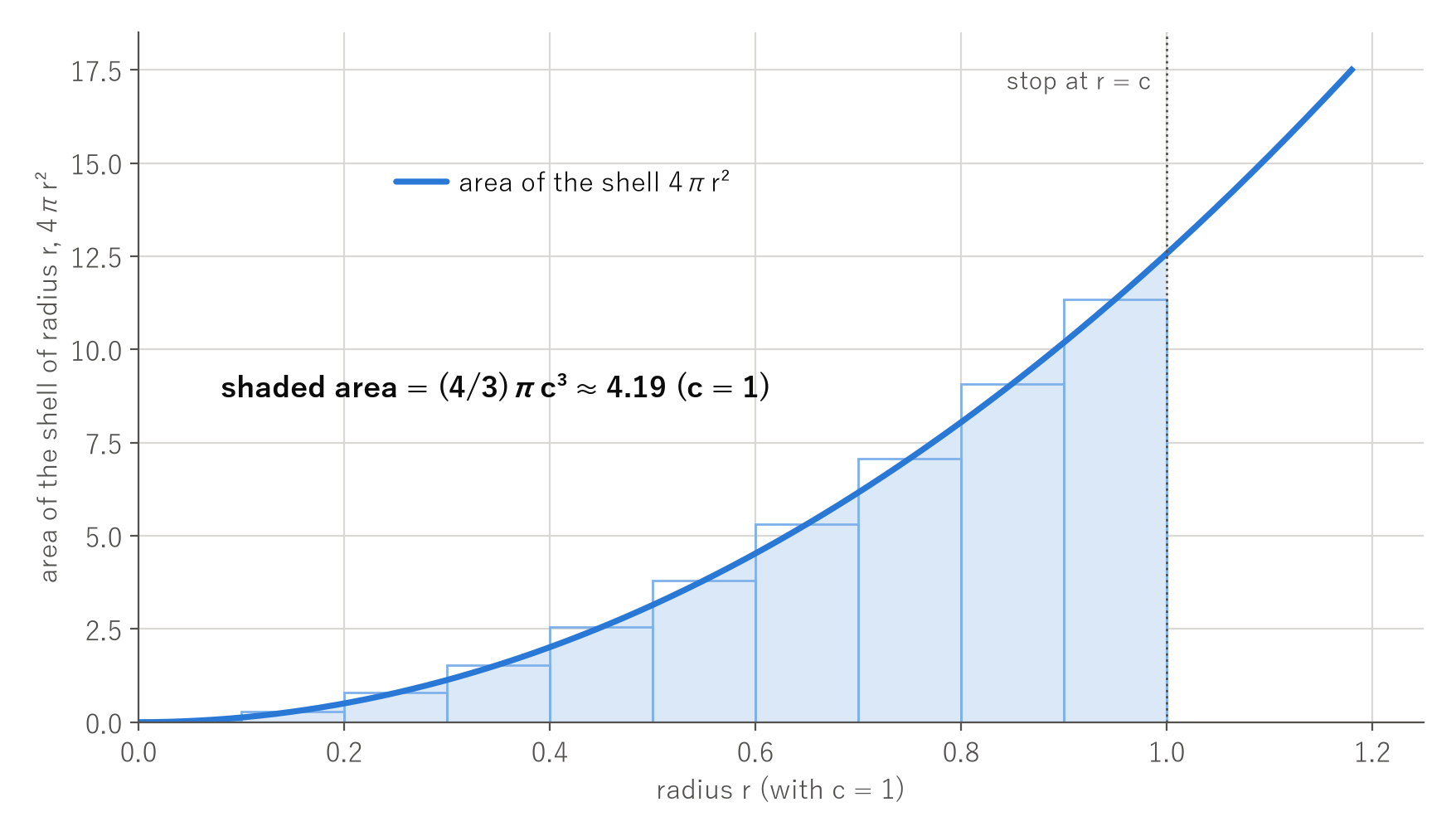
Because the sum runs from 0 to c, no integration constant +C appears. Written without fixing where the sum starts, a +C is attached, and some papers read it side by side with the cosmological constant (Papers 62 and 72). The conclusion of Paper 62, however, is that +C and the cosmological constant are not the same thing.
The name is E, the unit is on the volume side
The right-hand side of E=4πc², with m=4π, is a mass (kg) times a speed squared, with the unit of joules. Summing over the radius from 0 to c multiplies by a width of radius (here, a unit of speed), so the unit of (4/3)πc³ is kg times speed cubed, that is, joules times speed. So (4/3)πc³ is not itself an energy. The name E(3D) shows the route that started from the energy equation and extended its shape to the volume side.
What fills radius c really exists (1): the reach of light
Light leaving a point reaches, in time t, the inside of a ball of radius ct. Choosing a unit of time and setting t=1, the region reached is a ball of radius c, with volume (4/3)πc³ (Paper 61). Seen as thin shells of light stacked on one another, the region reached is the volume restoration integral itself (Paper 61).
The number (4/3)πc³ itself, however, changes with the choice of units, because the number for the speed of light depends on how the metre and the second are fixed. Paper 112 writes that what remains is not the number but the shape: the region reached is a ball, and its volume grows in proportion to (ct)³.
What fills radius c really exists (2): the velocity ball
Because the speed of anything has an upper limit c, gathering all possible velocities gives the inside of a ball of radius c (Papers 59 and 60). Measured with the ordinary ruler, the volume of this ball is exactly (4/3)πc³. The shape of E(3D) appears here as it is.
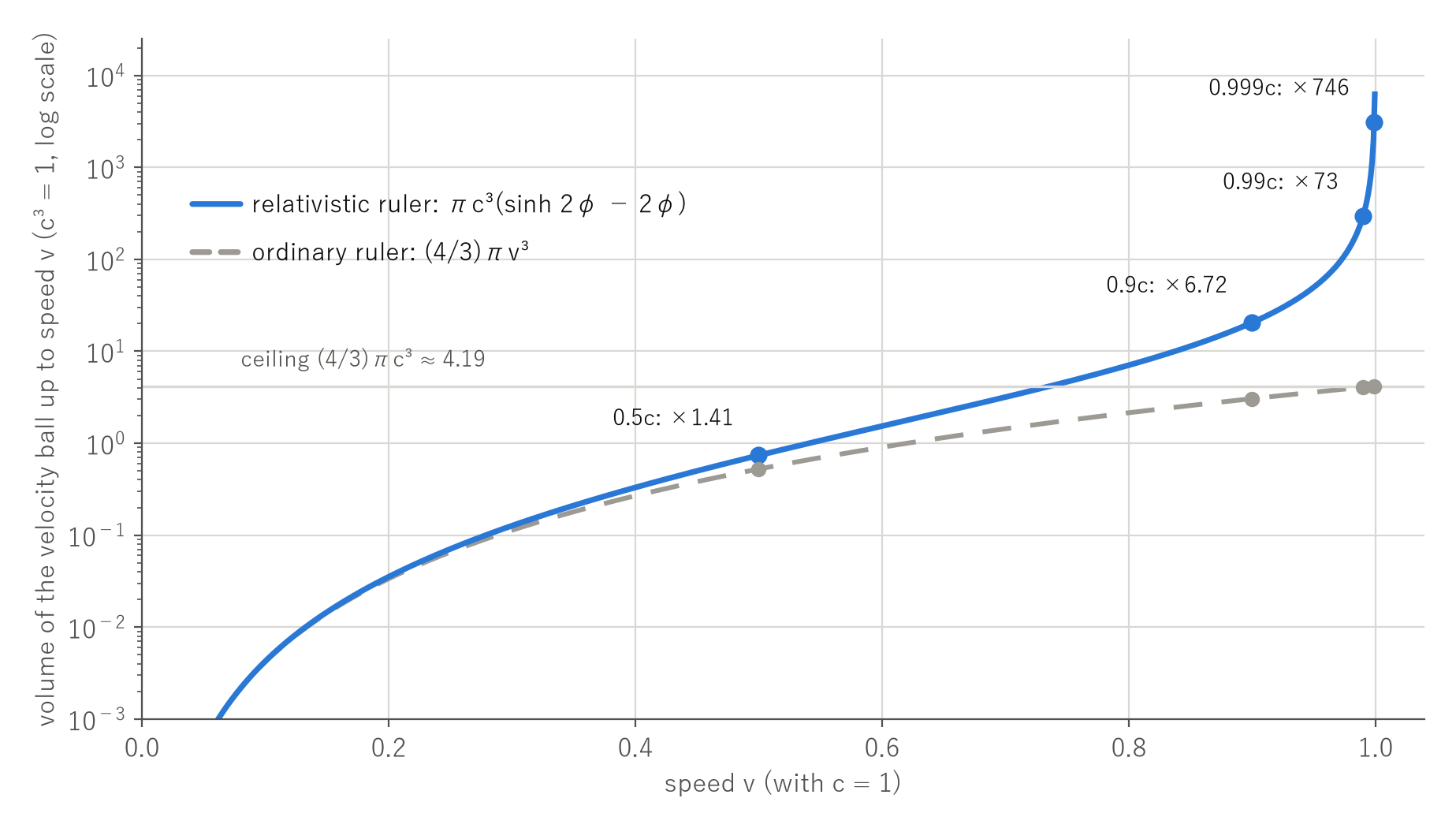
But relativity has its own ruler. Measuring the difference between two velocities by the rule of relativistic addition, the velocity ball becomes a hyperbolic space with curvature −1/c² (Paper 60). The volume of a ball in hyperbolic space has a closed formula (Paper 208); applied to the velocity ball, the volume up to speed v is πc³(sinh 2φ − 2φ), where φ is the inverse hyperbolic tangent of v/c, the relativistic distance divided by c. The numbers from here on are calculated in this article by combining Paper 60 and Paper 208.
The volume up to 0.5c is 1.41 times the value measured with the ordinary ruler; up to 0.9c, 6.72 times; up to 0.99c, 73 times; up to 0.999c, 746 times. With the ordinary ruler the volume of the velocity ball stops at (4/3)πc³, but with the relativistic ruler it grows without limit as the speed approaches that of light.
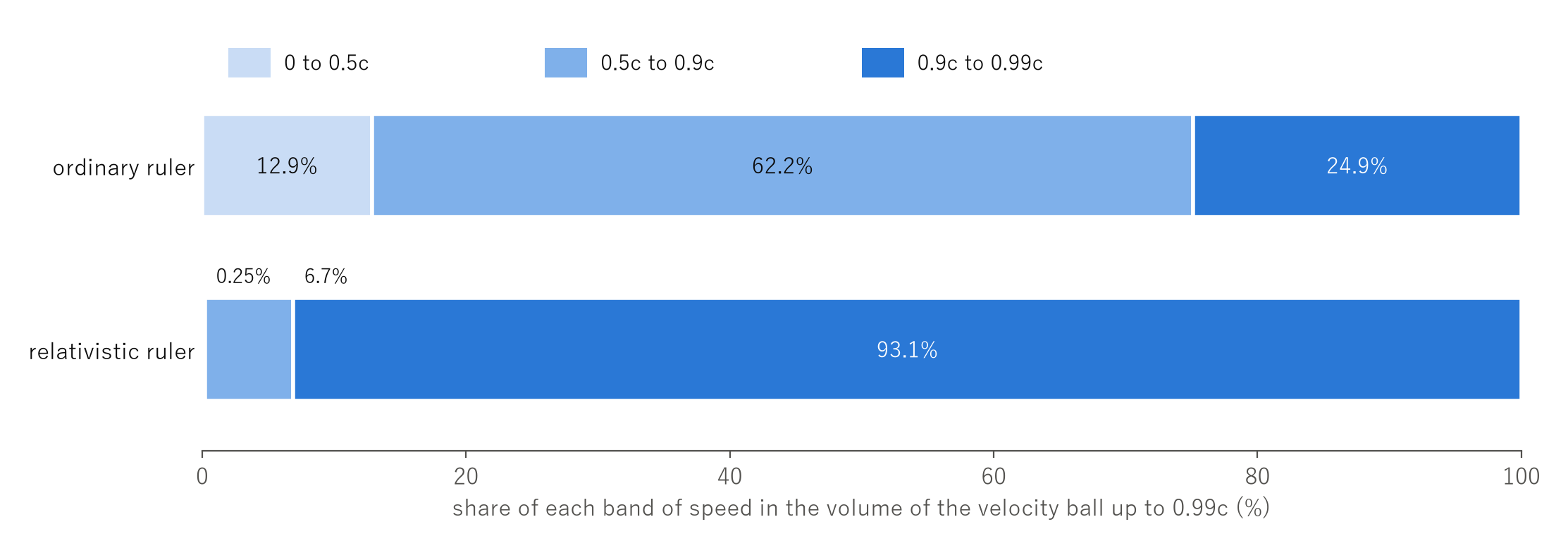
What is more, almost all of that volume lies just below the speed of light. In the ball up to 0.99c, the band from 0.9c to 0.99c holds 24.9% of the volume with the ordinary ruler, but 93.1% with the relativistic ruler.
Paper 208 showed that in hyperbolic space, however large a ball is made, 86% of its volume keeps living in the outer shell of thickness 1 (one radius of curvature). In the velocity ball this thickness corresponds to c in relativistic distance. For the ball up to 0.99c, the shell from 0.928c to 0.99c holds 89.2% of the volume. Measured with the ordinary ruler, the same shell of speeds holds 17.5%.
The balance between skin and content changes too. The surface area of the ball divided by its volume is 3/v with the ordinary ruler, and as the ball grows the content pulls away from the skin. With the relativistic ruler this ratio levels off at 2/c (2.09/c at 0.99c), and the content never pulls away from the skin (Paper 208). As the title of Paper 208 says, curvature does the same work as raising the dimension. To create the same crowding in flat space, the dimension would have to keep growing to twice the radius (Paper 208).
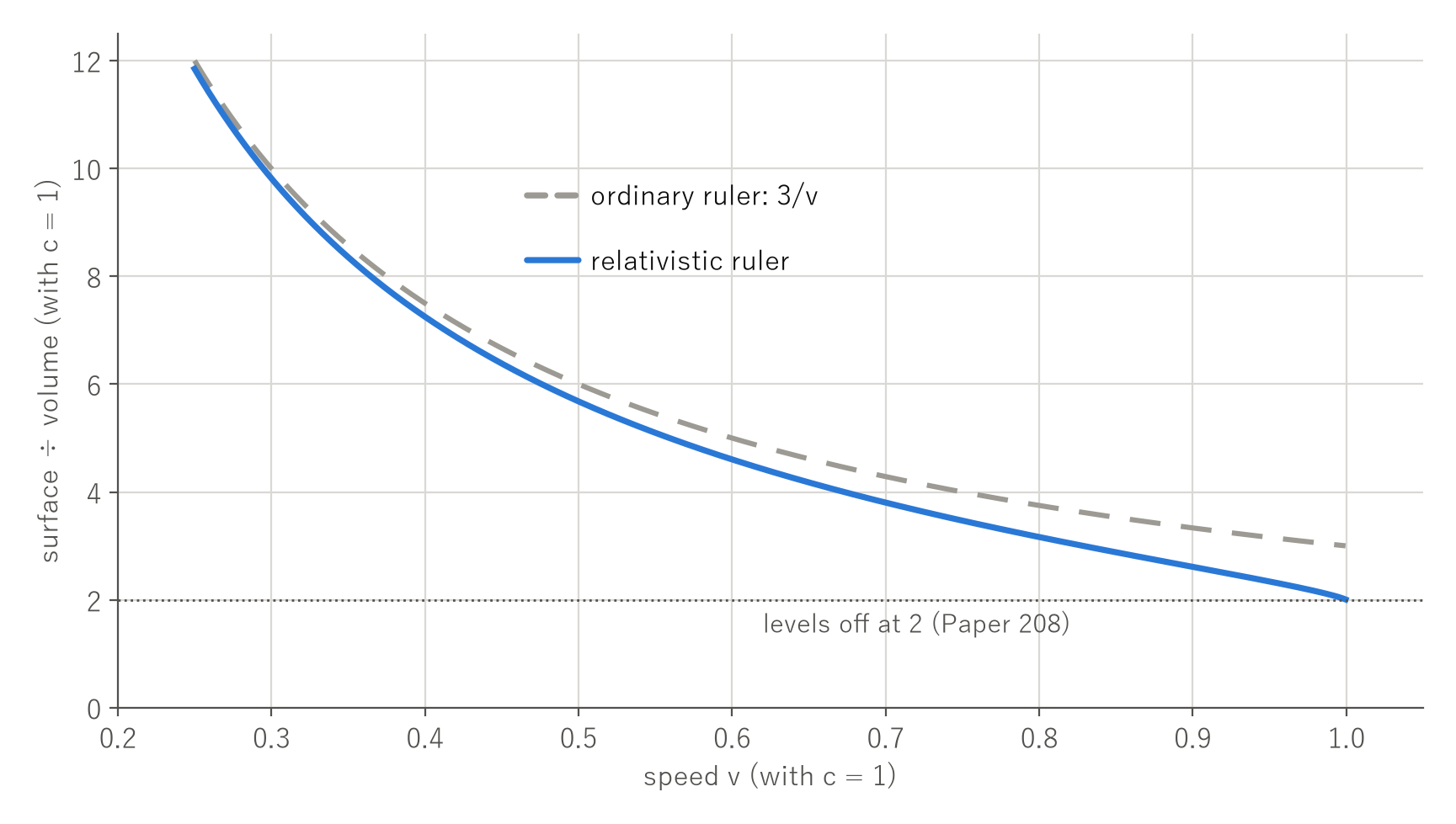
Both rulers are correct as geometry. What differs is the ruler, and unless one says which ruler was used, talk about the volume of the velocity ball does not mesh.
The same 4/3, different roots
The 4/3 of (4/3)πc³ is the 4/3 of the volume of a ball. The critical density, when the expansion of the universe is read with Newton’s shells, also contains 4π/3; it enters as the mass inside a shell (the volume of the ball times the density), so it is the same 4π/3 as the volume of the ball (Paper 907).
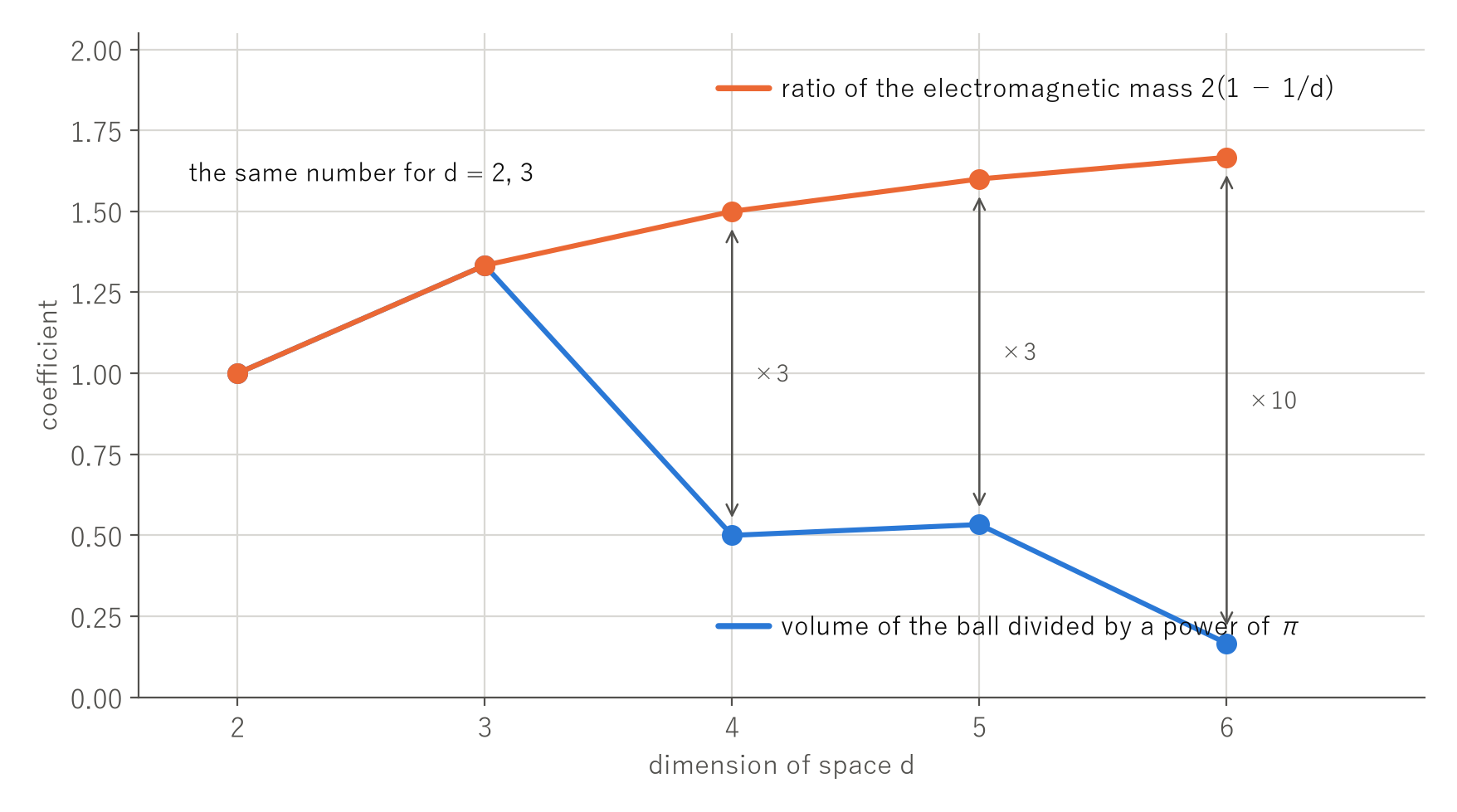
The electromagnetic mass of an electron seen as a small charged ball also shows a 4/3, but this one is twice the average 2/3 over the directions of the field, a root different from the volume of the ball (Paper 908). Moving the dimension d of space, the two give the same number only for d=2 and 3, and part at d=4.
Changing the dimension
Paper 12 carried out the same stacking in four dimensions and obtained (π²/2)c⁴. Paper 59 writes that the power of c matches the dimension of the volume of a ball of radius c, and that each stacking raises the dimension by one. Paper 1080 showed that the radius at which the volumes of the three- and four-dimensional balls are the same number is 8/(3π) = 0.849. With c set to 1, the four-dimensional 4.93 is larger than the three-dimensional 4.19, and which one is larger switches with the unit of speed.
Note that the 3 of c³ is the 3 of three dimensions because c was placed as the radius of the ball. The powers of c that appear in physics formulas do not count the dimension of space (Paper 116).
(4/3)πc³ in my papers: 10 papers
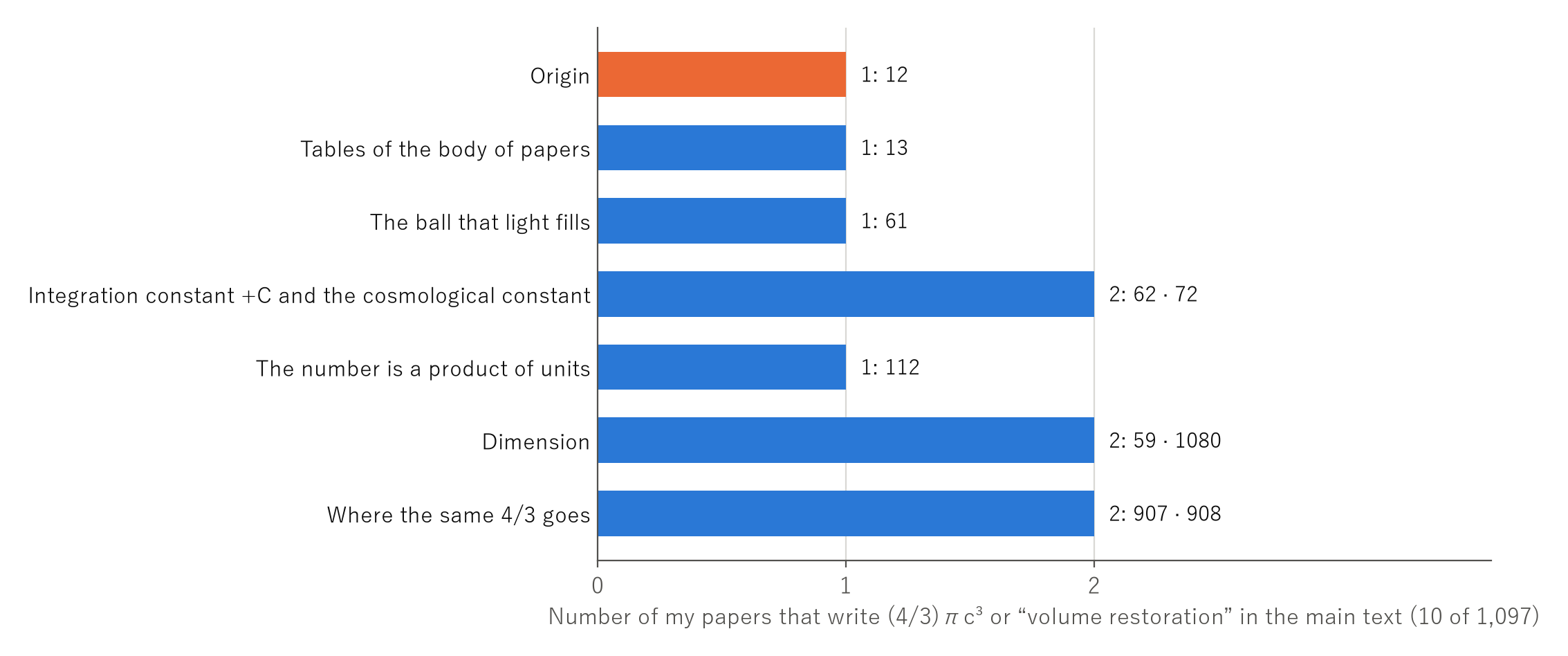
I counted the papers that write (4/3)πc³ or “volume restoration” in their main text (before the references). There are 10 of 1,097, and reading how each one uses it sorts them into seven ways.
| Way of use | Papers | What they do |
|---|---|---|
| Origin | 12 | Stacks the area shape 4πr² over the radius from 0 to c and obtains (4/3)πc³ (the volume restoration equation). In four dimensions, (π²/2)c⁴ |
| Tables of the body of papers | 13 | Lists it in a table of the body of papers as the formula of Paper 12 |
| The ball that light fills | 61 | Reads it as the volume of the region that light reaches in a unit of time |
| Integration constant +C and the cosmological constant | 62 · 72 | Sets the +C of the indefinite integral beside the cosmological constant (an integration constant in unimodular gravity): not the same, but dual |
| The number is a product of units | 112 | The number (4/3)πc³ itself is a product of units; what remains is the shape: the region reached is a ball whose volume grows as (ct)³ |
| Dimension | 59 · 1080 | The power of c and the dimension of the volume of a ball (59); the radius at which the volumes of the three- and four-dimensional balls are the same number (1080) |
| Where the same 4/3 goes | 907 · 908 | The 4π/3 of the critical density is the mass inside a shell, the same root as the volume of the ball (907). The 4/3 of the electromagnetic mass is an average over field directions, a different root (908) |
What E(3D) does not say
- It does not claim a new law of physics or a new energy.
- It does not say that (4/3)πc³ is an energy. Its unit is joules times speed.
- It does not say that +C is the cosmological constant itself. The conclusion of Paper 62 is that they are not the same.
- The number (4/3)πc³ itself changes with the choice of units (Papers 112 and 1080).
- The account of the volume of the velocity ball measured with the relativistic ruler is a calculation in geometry. It does not put forward a new physical quantity or prediction.
So what is it good for?
First, it serves as a ruler for telling skin from content. Setting the area shape and the volume shape side by side makes clear what is skin and what is content. I also used this view in Paper 1007, which counted the critical mass as a balance between what leaks out through the skin and what grows in the content.
Second, it shows that changing the ruler gives the same “ball of radius c” completely different contents. With the ordinary ruler the content stops at (4/3)πc³ and pulls away from the skin. With the relativistic ruler the content has no limit, almost all of it lies just inside the skin, and the ratio of skin to content approaches a constant.
And it is a practice ground for checking that the same number 4/3 can have different roots (Papers 907 and 908).
Frequently asked questions
Is E(3D) an energy?
No. Counting the units, it is an energy times a speed. The E in the name shows that it started from the energy equation E=4πc².
Is +C the cosmological constant?
They are not the same thing. Paper 62 sets +C beside the cosmological constant that appears as an integration constant in unimodular gravity, and concludes that they are not the same, but stand in dual positions with respect to the volume degree of freedom.
Is it true that the volume of the velocity ball has no limit?
Measured with the relativistic ruler (the distance measured by the addition of velocities), yes. Measured with the ordinary ruler, it is (4/3)πc³. Both are correct as geometry; what differs is the ruler. This point was calculated in this article by combining Paper 60 and Paper 208.
Why is the 3 of c³ the 3 of three dimensions?
Because c was placed as the radius of the ball. The volume of a three-dimensional ball of radius c is proportional to c³. The powers of c that appear in physics formulas do not directly count the dimension of space (Paper 116).
How does this relate to the article on E=4πc²?
The article “What Is E=4πc²?” covers the side of the area shape (the skin). This article covers the side of the volume shape obtained by stacking it (the content).
The original papers
- Paper 12: From Boundary Energy to Volume Energy
- Paper 59: The Volume of the Unit Ball Is Greatest in Five Dimensions
- Paper 60: c as the Ball of Velocity Space
- Paper 61: c as the Light Sphere
- Paper 62: +C and Λ: A Duality on the Volume Degree of Freedom
- Paper 112: The Allotted Region and the Freedom Within
- Paper 116: What Does the Exponent of c Count?
- Paper 208: Curvature Does the Same Work as Dimension
- Paper 908: The 4/3 of the Electromagnetic Mass Comes Not from a Ball’s Volume but from Averaging over Field Directions
- Paper 1080: The Radius Where the 3-Ball and 4-Ball Volumes Are the Same Number Is Where the Largest Dimension Changes
All papers are published under CC BY 4.0 (the pages are in Japanese, with the paper PDFs in Japanese and English).
The whole story in one book
E=4πc² and the volume shape (4/3)πc³ obtained by stacking it are explained step by step, with analogies and calculations, in the e-book “A Single Skin and What It Holds” (Amazon · Google Play Books).