E=4πc² is Einstein’s equation E=mc² with 4π put in for the mass m (Paper 12). The 4π is the mass counted inside radius 1 of a sphere whose density falls off as the inverse square of the distance (Paper 02; the article “What is m = 4π?”, in Japanese). The right-hand side has the same shape as the surface area of a sphere of radius c.
It is not a new law of physics but a well-known equation read in a different shape. Yet once it is read this way, two spheres of radius c turn up in physics for real: the sphere of all possible velocities, and the sphere over which light spreads (once a unit of time is chosen).
This article summarizes papers that I published myself as preprints; they have not been peer reviewed.
Key points
- E=4πc² is the ordinary E=mc² with m=4π put in. Nothing in the answer changes; what changes is how the equation looks.
- The right-hand side has the same shape as the area of a sphere of radius c (Paper 12). Same shape does not mean that energy has become an area.
- This 4π is not a solid angle but a mass: a number placed by a choice of mass units (a convention) (Papers 60 and 116).
- Even so, a sphere of radius c really exists. The set of all possible velocities is a ball of radius c with curvature −1/c², and this curvature is measured in experiments (Paper 60).
- Of my 1,097 papers, 22 write the formula E=4πc² in their main text. They use it in seven ways.
Where it comes from
In the calculation of Paper 02, the mass inside radius 1 of a sphere with density 1/r² comes out as 4π. Putting this in for m in E=mc² gives E=4πc². It is the formula for the area of a sphere, 4πr², with c in the place of r.
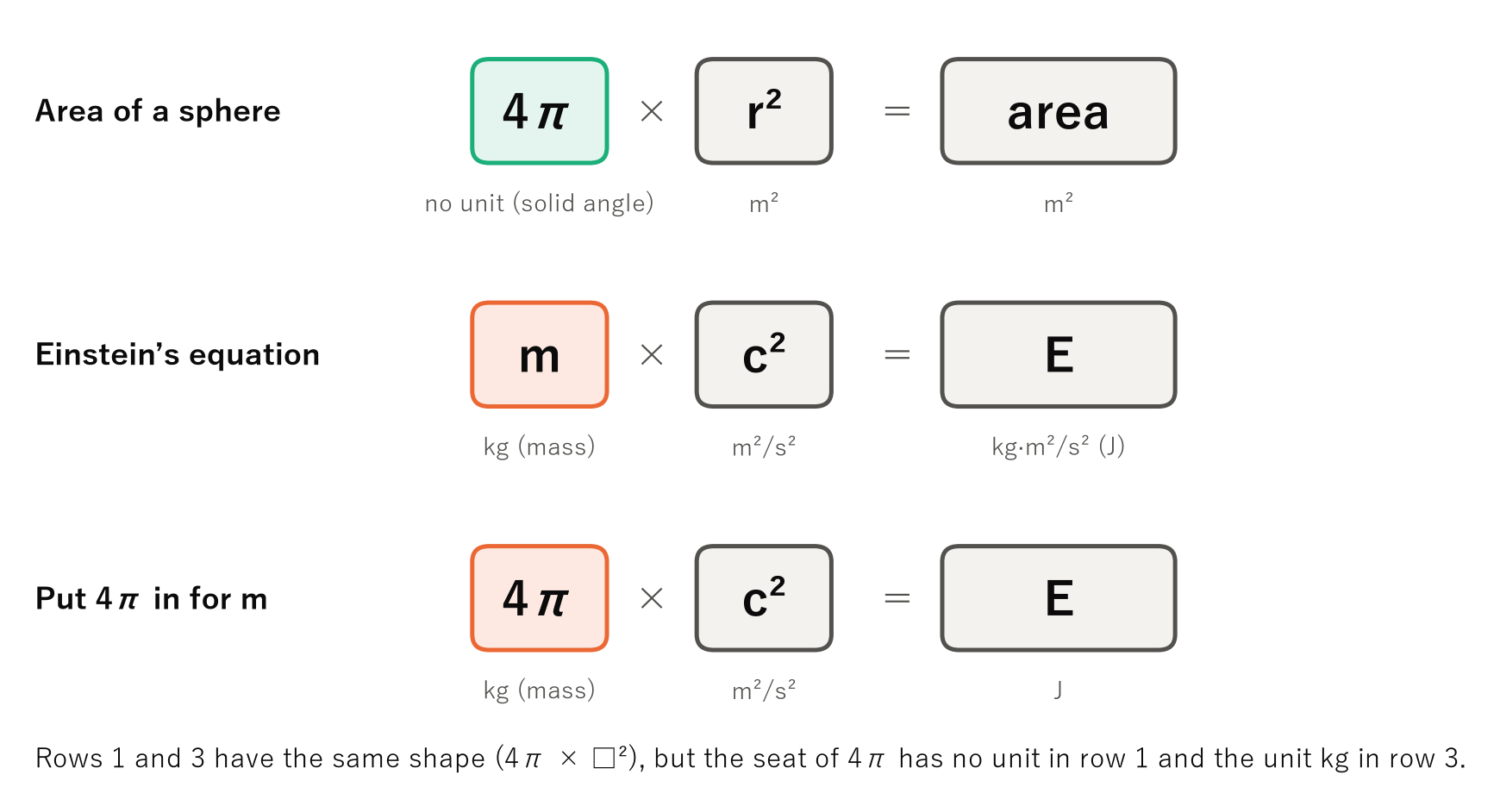
Check the units. E is measured in joules (kg·m²/s²), and c² in m²/s². For the two sides to match, the number multiplying c² must carry kg. A solid angle has no unit, so it cannot supply the kg. That is why the 4π in E=4πc² is not a solid angle but a mass (Paper 60).
There are three kinds of 4π in formulas
Paper 60 sorted the 4π that appears in physics formulas into three kinds.
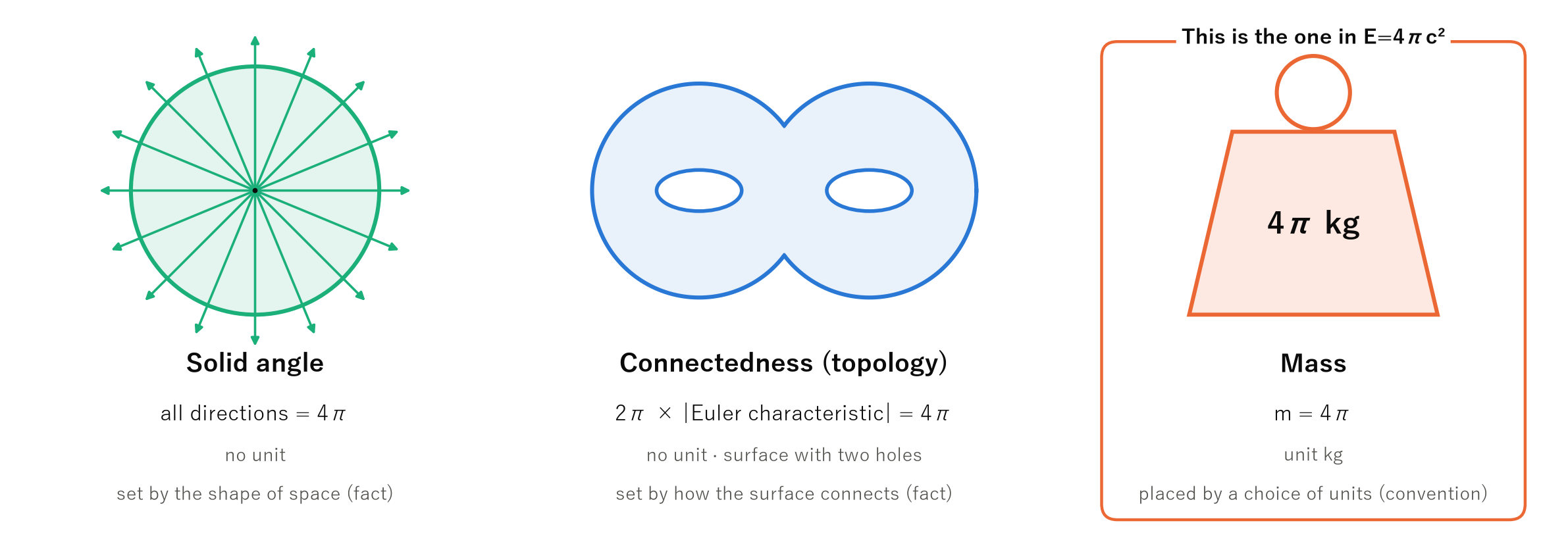
| 4π | Where it comes from | Unit | Status |
|---|---|---|---|
| Solid angle (all directions) | the shape of the sphere (Paper 01) | none | fact |
| 2π × |Euler characteristic| (a surface with two holes) | how the surface connects (Paper 67) | none | fact |
| Mass m=4π | the choice of mass units (Papers 56 and 116) | mass | convention |
Even when the number is the same, things that come from different roots are treated as different things; this is a rule in my papers (Papers 35 and 300). E=4πc² is where this distinction shows most clearly.
A sphere of radius c really exists (1): the sphere of velocities
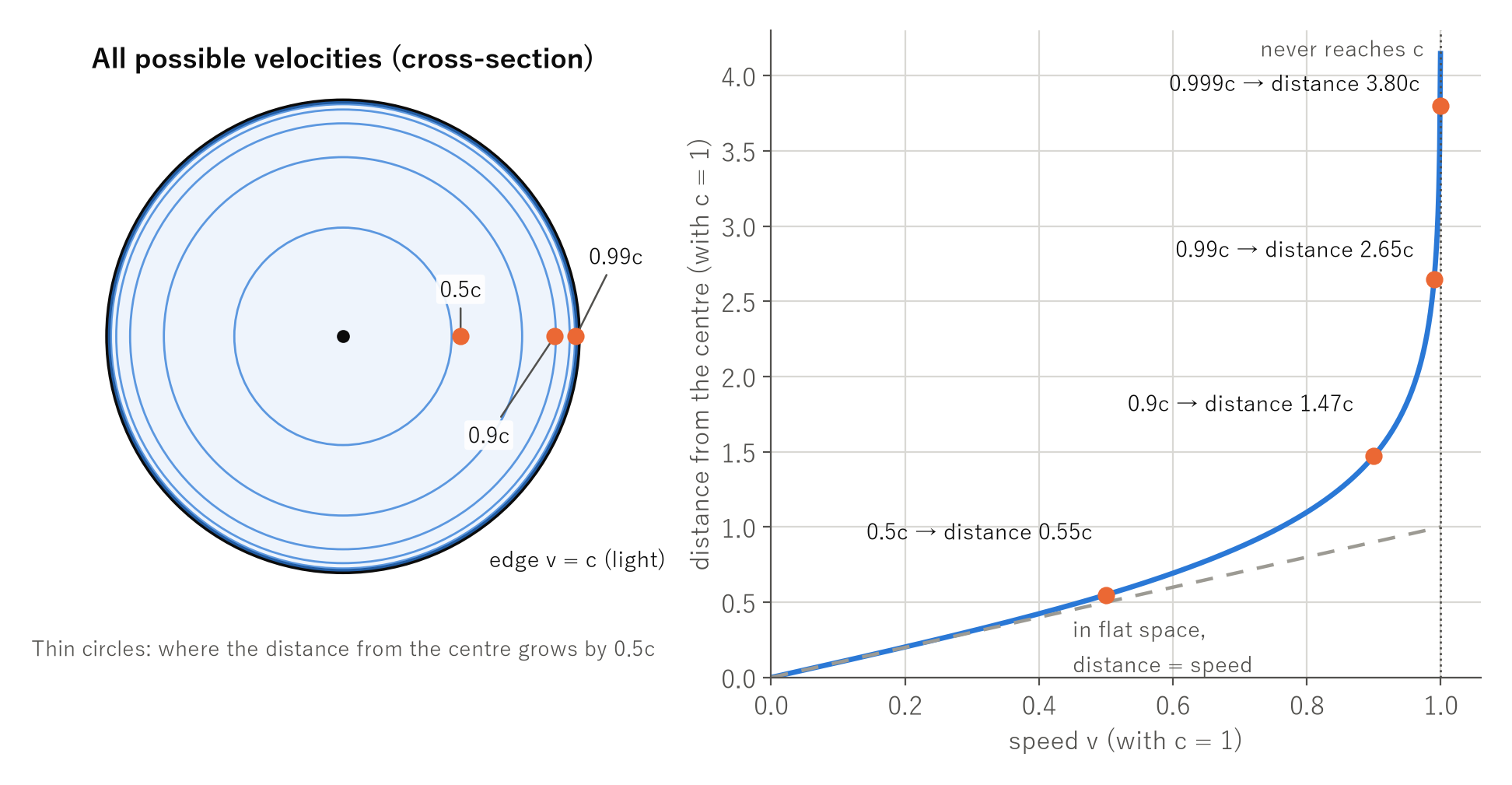
Every object has an upper limit c on its speed. Represent each velocity, with its direction and size, by a point, and gather the points of all possible velocities: they fill exactly the inside of a ball of radius c. Papers 59 and 60 state that for this ball, reading c as a radius holds literally, not as a figure of speech.
In relativity, velocities cannot simply be added, so the difference between two velocities is also measured by the rule of relativistic addition. Measured that way, the ball becomes a uniformly negatively curved space (a hyperbolic space) with curvature K=−1/c². Varičak showed this in 1910. The point for the speed 0.9c lies at distance 1.47c from the centre, 0.99c at 2.65c and 0.999c at 3.80c; however far you go, you never reach the edge c.
This curvature is not a picture but a measured quantity. Take a spinning object through a round of acceleration, change of direction and deceleration, and its orientation does not come back: it ends up slightly rotated. This rotation is called Thomas precession (1926), and the factor 1/2 in the spin–orbit interaction inside atoms is a sign of it (Paper 60).
Since the size of the curvature |K| is 1/c², c² can be replaced by 1/|K|. Then E=mc² becomes E=m/|K|, which reads: “the rest energy is inversely proportional to how much velocity space is curved”. No 4π is needed for this replacement, and it holds for any m. That is why Paper 60 sums up its own conclusion as “a result about c, not about 4π”.
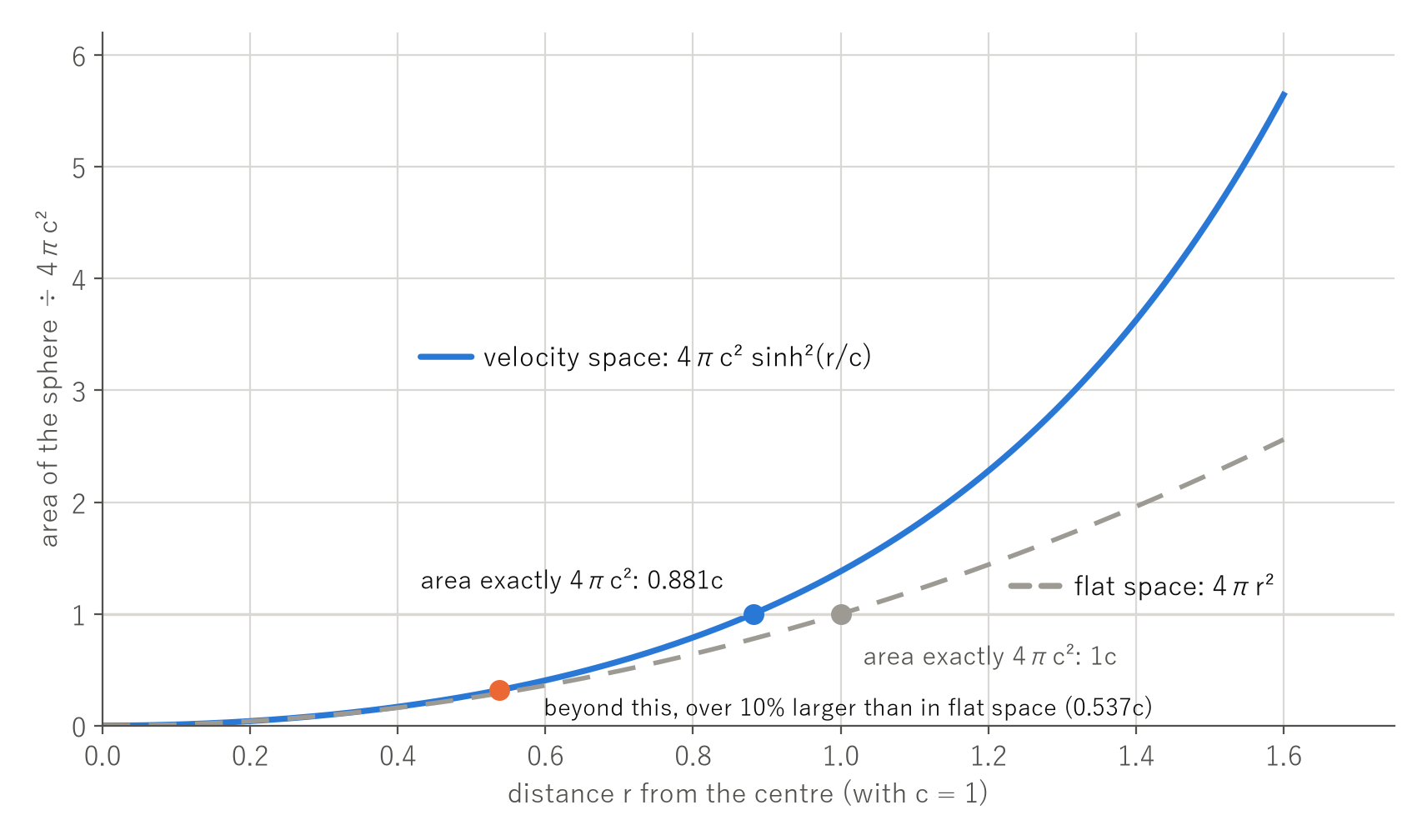
In velocity space, the area of a sphere at distance r from the centre is 4πc² sinh²(r/c) (Paper 60). While the radius is small it is almost the same as the flat 4πr², and beyond 0.537c it is more than 10% larger than in flat space. 4πc² is the scale of area at which the curvature of this space starts to matter. Note that the 4π in this area formula is the first kind, the solid angle, a different thing from the 4π (mass) of E=4πc².
A sphere of radius c really exists (2): the sphere of light
Light leaving a point spreads as the surface of a sphere of radius ct. Paper 61 calls this sphere the light sphere. If a unit of time is chosen and t=1, the light sphere has radius c and area 4πc². Then 4πc² is a genuine area, with the unit of a length squared.
But how long t=1 is, we decide. According to Paper 21, my body of papers has already used three choices of units: for mass (m=4π), for the gravitational constant (G=4π) and for the quantum constant (ħ=1/(4π)). Reading c as a length is a fourth choice, so the rule is to say so whenever it is used. And the 4π standing in the area of the light sphere is the first kind, the solid angle, a different thing from the 4π (mass) of E=4πc². The same string of symbols is an area on the light-sphere side and an energy on the E=4πc² side: two different kinds of quantity.
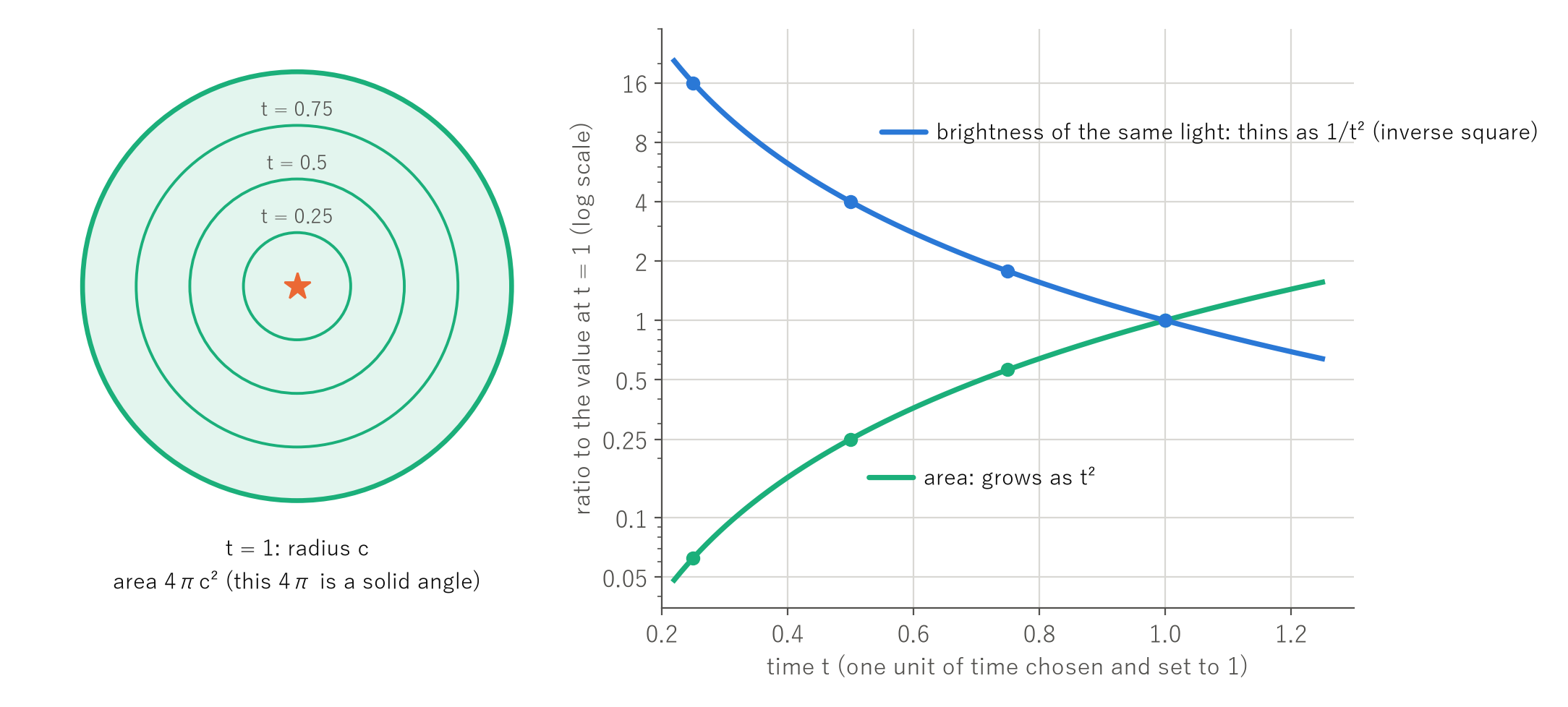
The light sphere can also be read as the origin of the inverse-square law. The same light spreads over the surface of radius ct, so its brightness thins as 1/(ct)² (Paper 61). And the light sphere corresponds to the edge v=c of the velocity sphere. The surface seen from the side of light and the interior seen from the side of velocities are two faces of the same c (Paper 61). Where else the inverse-square law appears is collected in the article “A Map of Inverse-Square Laws”.
E=4πc² in my papers: 22 papers, seven ways of use
I counted the papers that write the formula E=4πc² in their main text (before the references). Besides 4πc², I also counted the velocity-space form 4π/|K| and the area of the light sphere 4π(ct)². There are 22 of my 1,097 papers, and reading how each one uses it sorts them into seven ways.
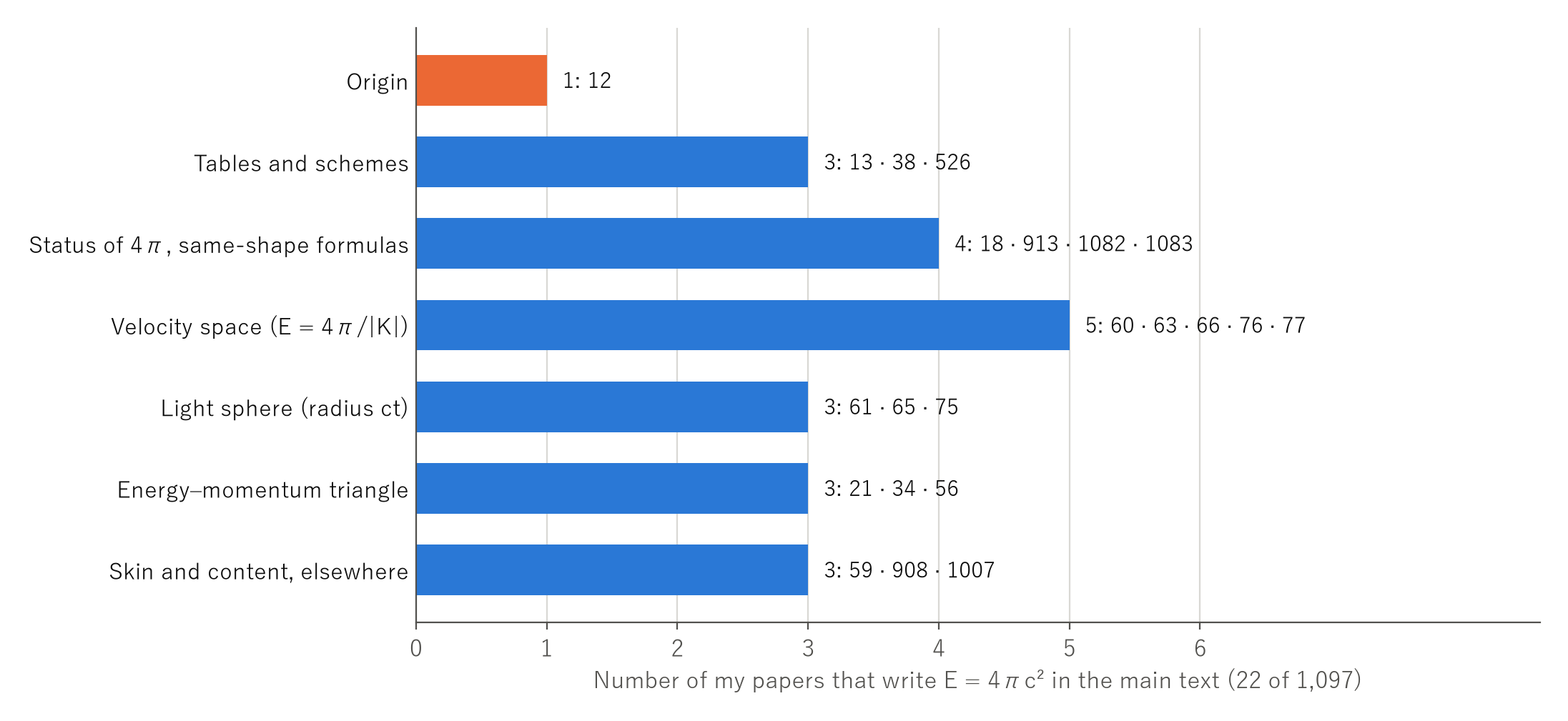
| Way of use | Papers | What they do |
|---|---|---|
| Origin | 12 | Puts m=4π into E=mc² and reads it as having the same shape as the area of a sphere of radius c. Stacking the area over the radius gives the volume shape (4/3)πc³ (the volume restoration equation) |
| Tables and schemes | 13 · 38 · 526 | Lists the formula of Paper 12 in tables and schemes of the body of papers |
| Status of 4π, same-shape formulas | 18 · 913 · 1082 · 1083 | Checks, with the same accounting, that the 4π put in for m is a choice of mass units: kinetic energy (18), the scattering-length formula (1082), h/m (1083). Also re-examines why the kinetic energy of a rolling ring takes the same shape 4πv² (913) |
| Velocity space (E=4π/|K|) | 60 · 63 · 66 · 76 · 77 | Rewrites it in terms of the set of all possible velocities (a ball of radius c with curvature −1/c²) and connects it to the curvature of spacetime (63), the gravitational redshift (66) and the space of positions and momenta (76, 77) |
| Light sphere (radius ct) | 61 · 65 · 75 | Reads it from the area 4π(ct)² of the sphere over which light spreads: the thinning of the inverse-square law (61), the entropy of the light sphere (65), the arrow of time (75) |
| Energy–momentum triangle | 21 · 34 · 56 | Uses it in the form E²=(pc)²+(4πc²)² |
| Skin and content, elsewhere | 59 · 908 · 1007 | From the area shape to the volume shape (59); the 4/3 of the electromagnetic mass comes not from the 4/3 of the ball’s volume but from an average over field directions (908); critical mass seen as a balance between skin and content (1007) |
The reading born in Paper 12 is still in use in Paper 1083. The largest group is velocity space, with 5 papers.
What E=4πc² does not say
- It does not claim a new law of physics or a new constant of nature.
- It does not say that energy is an area. E is measured in joules, not in units of area.
- It does not say that this 4π is a solid angle. It is a number placed by a choice of mass units.
- A choice of units does not change numbers without units. For example, the number for the weakness of gravity between two protons, Gm²/(ħc) (about 5.9×10⁻³⁹), does not move however the units are set (Paper 35).
- The velocity-space form E=4π/|K| does not explain the gravitational redshift, because the c of velocity space and the c read from coordinates in curved spacetime are different things (Paper 66).
So what is it good for?
First, it is a practice ground for telling kinds of 4π apart. The same 4π stands as a solid angle in one formula and as a mass in another. I used this distinction to check where the π in physics formulas comes from, and sorted out, one formula at a time, which π disappears in the scattering-length formula (Paper 1082) and in Planck’s constant divided by a mass (Paper 1083).
Second, it is an entrance to reading c as “the radius of the velocity sphere”. E=m/|K| is a reading that holds for any m, and the curvature behind it is measured as Thomas precession (Paper 60).
And stacking the area shape over the radius from 0 to c gives the volume shape (4/3)πc³. Paper 12 calls this the volume restoration equation. The volume side is the subject of the article “What Is E(3D)=(4/3)πc³?”.
Frequently asked questions
Is E=4πc² a standard physics equation?
No. The standard equation is E=mc². E=4πc² is how it is written when the mass units are chosen so that m=4π; the answer is the same as with E=mc².
So is energy an area?
No. The shape is the same, but the units differ. If a unit of time is chosen, 4πc² becomes the area of the light sphere, but then its 4π is a solid angle, a different thing from the 4π (mass) of E=4πc².
c is a speed. Why can it be called a radius?
Because the set of all possible velocities really is a ball of radius c (Papers 59 and 60). The light sphere, for its part, has radius c once a unit of time is chosen (Paper 61).
What is E=4π/|K|?
It is E=4πc² rewritten with the curvature K=−1/c² of velocity space. Without the 4π, E=m/|K| holds for any m (Paper 60).
How does this differ from the article on m=4π?
The article “What is m = 4π?” (in Japanese) explains where the mass number 4π comes from. This article explains how the equation obtained by putting that number into E=mc² is read and used in my papers.
The original papers
- Paper 02: The 4π Mass Cancellation Theorem
- Paper 12: From Boundary Energy to Volume Energy
- Paper 21: Zero-Tension Does Not Act on an Identity
- Paper 59: The Volume of the Unit Ball Is Greatest in Five Dimensions
- Paper 60: c as the Ball of Velocity Space
- Paper 61: c as the Light Sphere
- Paper 66: Velocity-Space Curvature and Gravitational Redshift
- Paper 116: What Does the Exponent of c Count?
All papers are published under CC BY 4.0 (the pages are in Japanese, with the paper PDFs in Japanese and English).
The whole story in one book
E=4πc² and the volume shape (4/3)πc³ obtained by stacking it are explained step by step, with analogies and calculations, in the e-book “A Single Skin and What It Holds” (Amazon · Google Play Books).