Radar, sonar, hospital ultrasound and bats all send out sound or radio waves and listen for what bounces back. Earlier, in “A Map of Inverse-Square Laws”, I wrote that when the point that sends and the point that receives are in the same place, the received strength weakens as the fourth power of the distance, because the wave passes twice, there and back, through skins that thin it as the square of the distance.
This time we separate the point that sends from the point that receives. This is the arrangement Kenjiro Kimura and colleagues at Kobe University use to image the inside with waves (the previous article, “An Invisible Rearrangement Becomes Visible When the Frequency Changes”). What about the echo changes then, and what does not? And why does an echo come back in the shape it was sent? The answer lay in the number three.
The calculations here were made new for this page, or come from the author’s own papers, released as preprints that have not been peer reviewed.
Key points
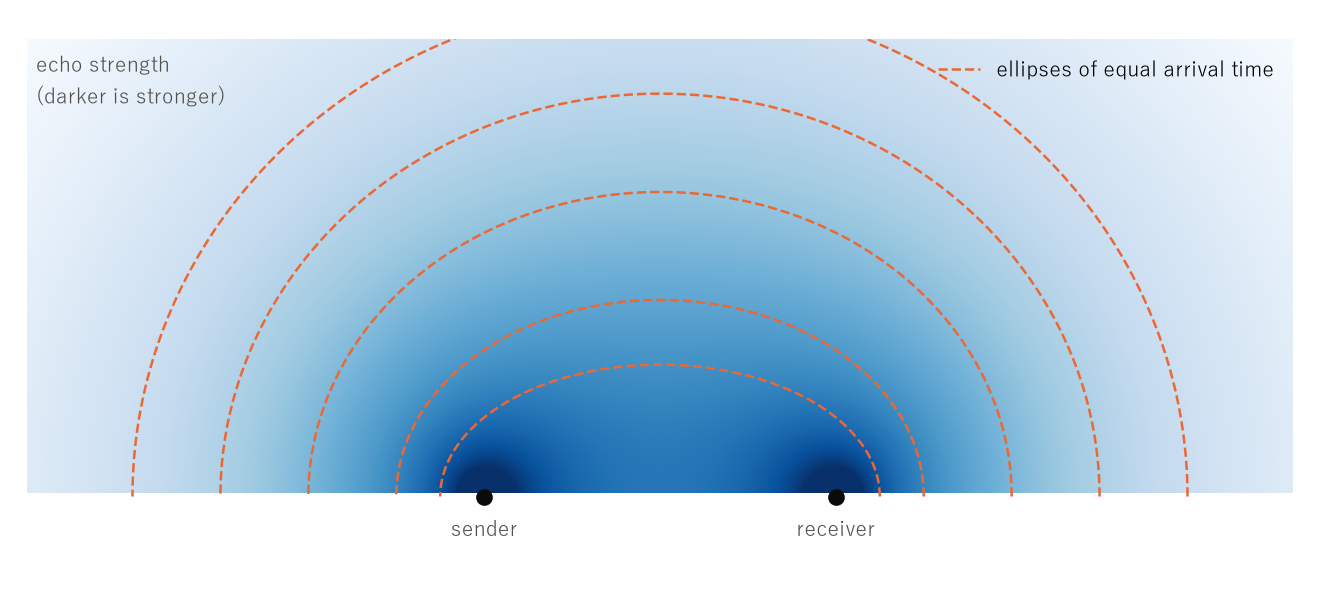
- When the point that sends and the point that receives are separated, an echo passes through two skins, one out and one back, and its strength is divided by the square of 4π and the product of the two distances. The arrival time is fixed by the sum of the paths, and the points whose echoes arrive at the same time lie on a spheroid (an ellipse in cross-section).
- Even on an ellipse of the same arrival time the strength differs. On the ellipse with path sum 4, the vertex and the co-vertex differ in strength by 1.333333 and in squared strength by 1.777778.
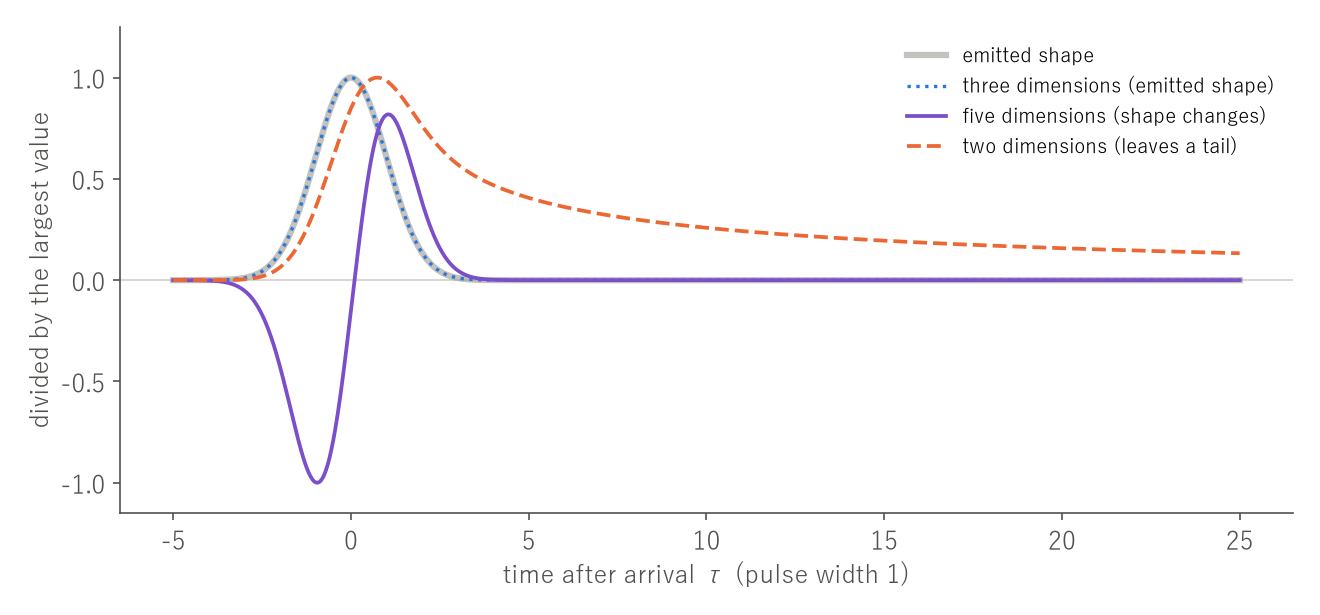
- In three dimensions an echo arrives, weakening, in the shape it was sent. In five dimensions the shape approaches its derivative, and in two dimensions it leaves a tail after it arrives.
- Only in three dimensions does a wave weaken and still arrive with its shape unchanged: there the exponent that keeps the flux, (d−1)/2, meets the exponent of the solution of Laplace’s equation, d−2 (in one dimension a plane wave keeps its shape without weakening).
Two skins, there and back
A wave leaving a centre spreads over spheres of radius r. Their area is 4πr², so for the flow through every sphere to be the same, the strength of the wave thins as the square of the distance and the amplitude is inversely proportional to the distance. This is the exponent 2 of my uniqueness theorem (Paper 01), and that conservation of the flow of a wave fixes the exponent uniquely I wrote in Paper 41 and Paper 53.
When a wave from the point that sends bounces once off a scatterer and reaches the point that receives, it passes through two skins. With the outgoing distance ρ1 and the returning distance ρ2, the strength of the echo is divided by (4π)²ρ1ρ2, and the arrival time is fixed by the sum of the paths ρ1 + ρ2. The points whose echoes arrive at the same time lie on a spheroid with the points that send and receive as foci. In cross-section it is an ellipse.
The sliders move the scatterer left and right, up and down. The gold dashed line is the ellipse on which echoes arrive at the same time.
- path sum (arrival time)
- product of distances ρ1ρ2
- strength relative to the co-vertex of the same ellipse
Compare on the ellipse with path sum 4. At the vertex (2, 0, 0), ρ1ρ2 = 3; at the co-vertex (0, √3, 0), ρ1ρ2 = 4. The two echoes arrive at the same time, but their strengths differ by 1.333333 and their squared strengths by 1.777778. The time fixes only the path sum. To divide the strength back by (4π)²ρ1ρ2 and take out the strength of the bounce, one also needs to know where on the ellipse the scatterer lies.
When the points that send and receive are in the same place, ρ1 = ρ2, and doubling the distance multiplies the squared strength by 0.062500 (one sixteenth). This is the round-trip power written in Paper 335, which did not treat separated points of sending and receiving. The present calculation (Paper 1111) counts that separated arrangement.
In three dimensions an echo arrives with its shape unchanged
A solution of the wave equation in three dimensions is the emitted shape delayed by the distance and multiplied by 1/(4πr). In Paper 1111 too, the echoes from a near scatterer (0, 0, 2) and a far one (0, 0, 4), aligned at their arrival times with their strengths restored and overlaid, coincided to within the digits of the computation; this checks in numbers what the formula says. In three dimensions an echo arrives in the shape it was sent, whatever the distance. This does not hold in every dimension. Change the dimension of space in the figure below.
The buttons choose the dimension of space, the slider the distance. Grey is the emitted shape (a pulse of width 1).
- agreement of shape (correlation in three and five dimensions; what remains at τ = 5 in two)
In five dimensions, the outgoing wave mixes in the derivative of the emitted shape. At distance 10 the best-aligned correlation is 0.688416, and far away it approaches 0.606531 (e^(−1/2)), as the shape turns into the derivative of the emitted shape. In two dimensions the wave leaves a tail after it arrives: at distance 10, 0.406428 of the peak remained at τ = 5 after arrival and 0.157827 at τ = 20. That in three dimensions no signal remains behind is known as Huygens’ principle (Paper 247), and it holds in odd dimensions from three up. But, as in five dimensions, the shape can change even without a tail. Only three dimensions keep the shape too.
Why three dimensions: two exponents meet
In d dimensions, ask as what power of the distance the amplitude of a wave leaving a centre should weaken. There are two conditions. One is that the flow through every sphere be the same. The extent of a sphere grows as the (d−1)-th power of the distance, so the strength thins as the (d−1)-th power and the amplitude weakens as the (d−1)/2-th power. This is the count of the skins of the uniqueness theorem applied to the strength of a wave.
The other is that the wave equation itself allow a solution without breaking the shape. For that, the way the amplitude weakens must be a spherically symmetric solution of Laplace’s equation (a constant, or inversely proportional to the (d−2)-th power of the distance). If both are not met, a remainder is left when the wave is put into the wave equation. The coefficient of the remainder is (d−1)(3−d)/4, which vanishes only for d = 1 and d = 3.
The slider moves the dimension of space d. The circled place is three dimensions, where the two exponents meet.
- flux-keeping exponent
- Laplace exponent
- remainder for arriving undistorted
The flux-keeping exponent (d−1)/2 and the Laplace exponent d−2 are both 1 in three dimensions, and meet there. One dimension is a plane wave whose amplitude does not weaken, with remainder 0, but a spherical wave that weakens with distance while keeping its shape exists only in three dimensions. This is a classical computation, also found among the exercises of textbooks on partial differential equations.
My papers contain several stories of two numbers that meet only in three dimensions. In the article on the uniqueness theorem, too, I wrote that moving the dimension splits the “2” into two, which meet only in three dimensions. The shape-keeping echo is one more member of that family.
Two roles of 1/r²
The 1/r² of gravity and electricity is a field with no source outside the inside, and the flux through a closed surface is 4π times the amount inside wherever the inside lies. That only one number per angular pattern can be read from outside a closed skin comes not from this 4π but from the field equation being of second order and local (Paper 1107). In this sense, the 1/r² field hides the inside from outside.
For waves, the same conservation of flow fixes the amplitude at 1/r, and in three dimensions that amplitude meets the Laplace solution, so the echo arrives with its shape unchanged. The time fixes the path sum, and once the position of the scatterer is known, the strength can be divided back by the 4π of two skins. Moving the dimension, the 1/r² of the static field and the 1/r² of the strength of a wave move together, so they share a root. Keeping the shape is a separate meeting, and a matter of three dimensions only. Still, what lets Professor Kimura and colleagues image the inside with separated points of sending and receiving is not so much that the echo keeps its shape as that what two points measure does not fit into one function on the skin.
Questions
Can echoes not be used in a two-dimensional world?
They can, but because the signal leaves a tail after it arrives, the path cannot be read directly from the arrival time. A calculation that subtracts the tail is needed.
Does Huygens’ principle not hold in five dimensions too?
It does. In five dimensions, too, the wave leaves no tail after it arrives. Even so, the arriving shape has the derivative of the emitted shape mixed in. Leaving no tail and keeping the shape are different things.
Are all echoes that arrive at the same time equally strong?
No. Even on the same ellipse the strength is set by the product of distances ρ1ρ2, and the vertex near the sending or receiving point is stronger. On the ellipse with path sum 4, the vertex is 1.333333 times as strong as the co-vertex.
Papers and references
All papers are published under CC BY 4.0.
- Paper 1111 “The Inverse Square Hides the Interior from a Static Field and Carries the Echo of a Wave Undistorted”: the source of the calculations on this page.
- Paper 1107 “When the Field Equation Is of Second Order, the Interior Can Be Read from Outside a Closed Skin Only as One Number per Angular Pattern”: that what goes outside is one number per pattern.
- Paper 335 “The Round Trip Changes the Exponent”: the round-trip power when the sending and receiving points are in the same place.
- Paper 247 “Splitting by Parity Is Not One Phenomenon”: Huygens’ principle and the parity of the dimension.
- Paper 01 “The Uniqueness Theorem of n = 2 for Spherically Symmetric Density Distributions”: the count of the skins.
- Paper 41 “The Fringes Do Not Remember the Exponent”: conservation of the flow of a spherical wave.
- Paper 53 “The Yamagishi Born-Rule Geometric Structure Theory”: the flow of an outgoing spherical wave.
- Paper 1092 “The “2” of the Inverse-Square Density Is Two 2s, and the 2 of the Shell Mass Meets the 2 of the Horizon Balance Only in Three Dimensions”: two numbers that meet in three dimensions.