Gravity, the electric force, the brightness of light, radio waves, sound. Physics has many quantities that weaken in inverse proportion to the square of the distance (inverse-square laws). Textbooks teach them one by one, in separate chapters. I line them up with a single ruler.
That ruler is "the weight per skin". Around the source, stack thin spherical skins like the layers of an onion, and look at how much of the quantity sits on one skin. This article is a map of inverse-square laws, drawn with that ruler.
The ruler: the weight per skin is flat only for the square
A spherical skin of radius r has area 4πr². When a density falls off as the n-th power of distance (1/rⁿ), one skin of thickness 1 weighs 4πr² × 1/rⁿ.
Only when n is 2 does the r² cancel, so that every skin weighs the same 4π. When n is smaller than 2, outer skins weigh more; when it is larger, inner skins weigh more. I showed this in Paper 01 as "the uniqueness theorem of n = 2". It also gives the result that the mass inside a sphere of radius 1 is exactly 4π, the solid angle of all directions.
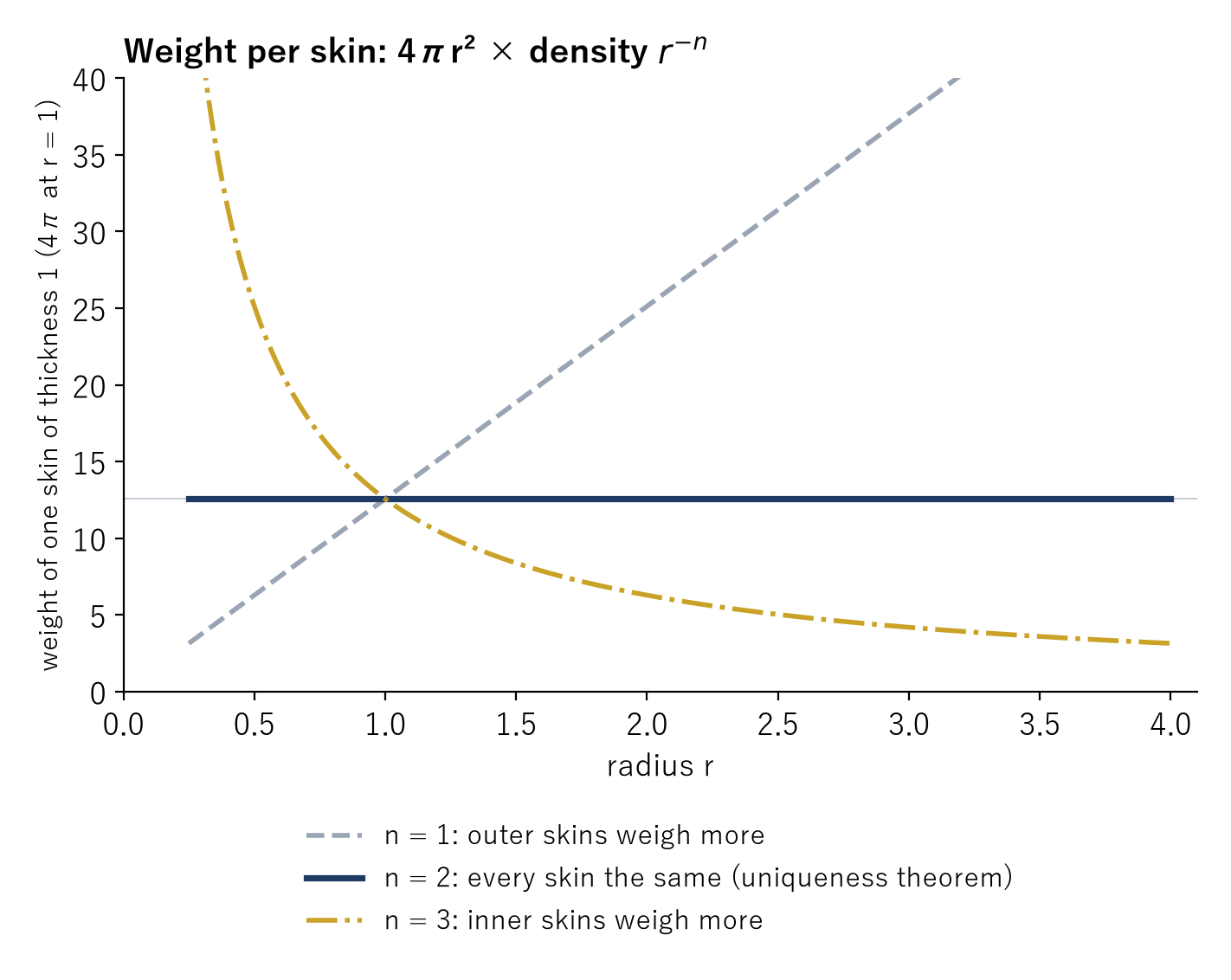
This "flatness" is what lies behind the many faces of the inverse-square law. Let me go through them one at a time.
1. Why is the night sky dark? (Paper 496)
Suppose stars are scattered evenly through space and go on forever. Distant stars look fainter (1/4πr²). But the farther the skin, the more stars it holds (4πr²). The two 4π and the r² cancel exactly, so the light arriving from the skin at radius 1 and from the skin at radius 1000 came out the same: 0.010000000.
Since every skin sends the same amount of light, adding up the skins makes the brightness grow in proportion to the radius (doubling the radius gives 2.000000000 times). The night sky is dark not because the stars are far and faint, but because the sum is cut off somewhere. This is the problem known as Olbers' paradox, and it is the "flatness" of the uniqueness theorem appearing directly in astronomy.
2. Four quantities are called "brightness" (Paper 214)
The word "brightness" actually refers to four different quantities. Of these, only the amount of light falling on a surface (irradiance) follows the inverse square. Moving from 1 m to 1000 m away from a source, the irradiance drops from 0.318 to 3.18×10⁻⁷, while the brightness of the source's surface (radiance) stays at 1013.211836.
That is why, however much a lens concentrates sunlight, it cannot make anything hotter than the surface of the Sun. The calculated upper limit was 5771.83 K, only 0.003% away from the Sun's surface temperature of 5772 K. What spreads out and thins over the skin is only "the amount falling on a surface".
3. One way or round trip changes the exponent (Paper 335)
In radio communication, the received strength goes as 1/r². A radar, however, sends a wave that reaches the target and bounces back. The thinning over the skin happens twice, so it becomes 1/r⁴.
To double the distance, communication needs 4 times the power, and radar needs 16 times. Doubling a radar's power extends its range by only 18.9207%. What sets the exponent is neither the frequency nor space, but "one way or round trip".
4. A point source or a line source (Paper 456)
Moving away from a point-like sound source, the sound spreads over spherical skins and drops by 6.0206 dB when the distance doubles. For a long source such as a road (a line source), the sound spreads over cylindrical skins instead of spherical ones, so it drops by only 3.0103 dB when the distance doubles.
To get the 10 dB that makes noise sound half as loud, you must move 3.1623 times farther away from a point source, but 10.0000 times farther from a line source. The shape of the spreading skin (sphere or cylinder) changes the exponent by one.
5. On a map, the "flat" exponent becomes 1 (Paper 1094)
There are models in which a shop attracts customers in inverse proportion to the square of the distance (Reilly's law, the Huff model). This 2 was borrowed from Newton's gravity. But people live on a map (two dimensions), not in spherical space.
On a map, the same number of customers comes from each ring when the exponent is 1. With the square, the number of customers keeps growing by 14.467569 each time the town is made 10 times wider. The same "2" plays different roles: "the same for every skin" in three-dimensional space, but "the border where the sum never stops" on a map.
6. For dipoles, the shape of the summation matters (Paper 1084)
The electric field of a pair of positive and negative charges (a dipole) weakens as 1/r³. In three dimensions this is exactly the "border" exponent. At the border, the result of the summation depends on the shape of the region you add over.
Added over a sphere, the electric field is -(4π/3)p. On the magnetic side it is +(8π/3)m. Adding 4π/3 and 8π/3 gives back 4π. The split into 1/3 and 2/3 holds only when the enclosing shape is round; with an elongated shape the split changes.
7. Change the dimension, and the two "2"s separate (Paper 1092)
When the dimension of space moves away from 3, the exponent that makes "every skin the same" becomes the dimension minus 1 (3 in four dimensions, 4 in five). The exponent of a density balanced against a black hole, on the other hand, stays at 2 in every dimension. The two "2"s coincide only in three dimensions.
The map: exponent and dimension decide the role
Putting all of this on one page gives the following. The horizontal axis is the exponent of distance; the vertical axis is the dimension of space.
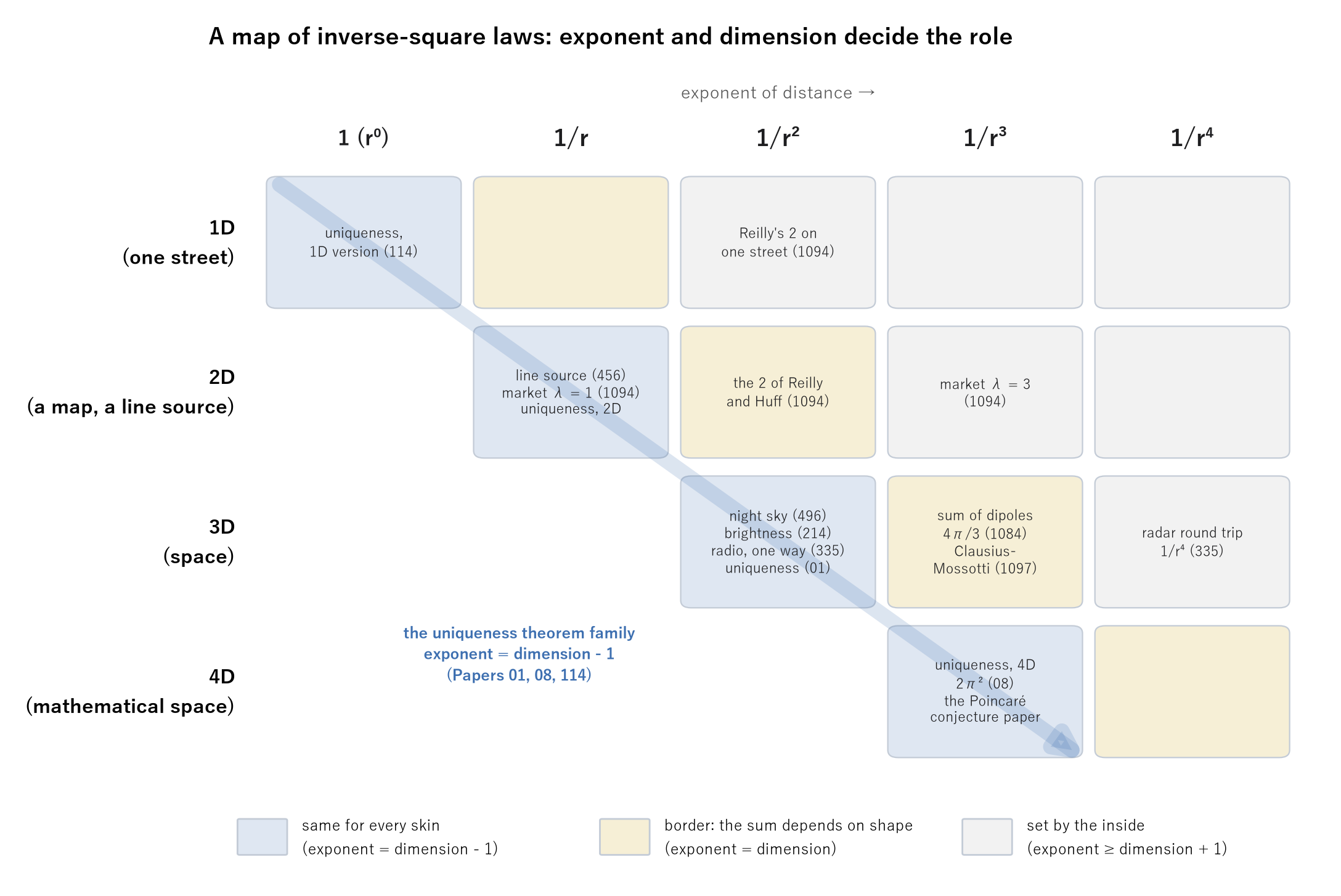
- Exponent = dimension - 1: the same for every skin. 1/r² in three dimensions (the night sky, light, one-way radio); 1/r in two dimensions (a line source, the market on a map).
- Exponent = dimension: the border, where the sum depends on the shape and size of the region. Dipoles in three dimensions; the 2 of Reilly and Huff on a map.
- Exponent = dimension + 1 or more: decided by the nearby inside. The 1/r⁴ of a radar's round trip.
Even under the same name, "inverse square", the role is entirely different depending on which dimension and which quantity you are talking about. In my papers I call such things, called by the same name but coming from different sources, distinct roots, and I always state what you have to move to turn one into the other (the separator). On this map, the separators are "the dimension" and "how far the exponent is from the dimension".
About this article
This article does not claim any new law. Each number comes from the numerical checks in the original papers. All the papers are preprints that have not been peer reviewed (the pages are in Japanese, with the paper PDFs in Japanese and English).
- Paper 01: The Uniqueness Theorem of n = 2 for Spherically Symmetric Density Distributions
- Paper 496: The 4π Appears Twice, Cancels, and Then the Sum Diverges
- Paper 214: A Lens Can Brighten and Cannot Increase Brightness
- Paper 335: The Round Trip Changes the Exponent
- Paper 456: Doubling the Distance Does Not Halve the Noise
- Paper 1094: The "Squared Distance" in Retail Gravity Models Is, on a Map, the Exponent at the Border Where the Total Number of Customers Stops Converging
- Paper 1084: 4π Splits into a Longitudinal 4π/3 and a Transverse 8π/3, and the 21 cm Line of Hydrogen Measures the Transverse Part
- Paper 1092: The "2" of the Inverse-Square Density Is Two 2s, and the 2 of the Shell Mass Meets the 2 of the Horizon Balance Only in Three Dimensions
- Paper 08: A Structural Interpretation of the 4D Poincaré Conjecture and Exotic Structures via the n=3 Uniqueness Theorem and Hopf Fibration
- Paper 114: Which Objects Know They Are in Four Dimensions?
- Paper 1097: A Lattice Sum of Dipole Fields Is Decided by the Shape of the Summation: 0 for a Sphere, 4π/3 for a Thin Needle, −8π/3 for a Thin Plate
What do you see when you read E=mc² with the ruler of a single skin? I wrote about that in a small book, A Single Skin and What It Holds.