In the previous piece, “Why Do Round Atoms Stick?”, we saw round atoms attract through fluctuations with no fixed direction. This time we look at the other side: the angles of bonds that do have directions.
Any two of methane’s four bonds open at 109.4712206 degrees. Water, at 104.4776 degrees, and ammonia, at 106.67 degrees, are a little narrower. How much of an angle is fixed by “just counting”, and where does another reason take over?
The calculations here were made for this page, and they rest on papers I published myself as preprints, which have not been peer reviewed.
Key points
- Place N directions of equal length at equal angles so that they sum to zero, and the cosine of the angle is fixed at −1/(N−1). At most four fit in three dimensions. Four give 109.4712206 degrees, the angle of methane.
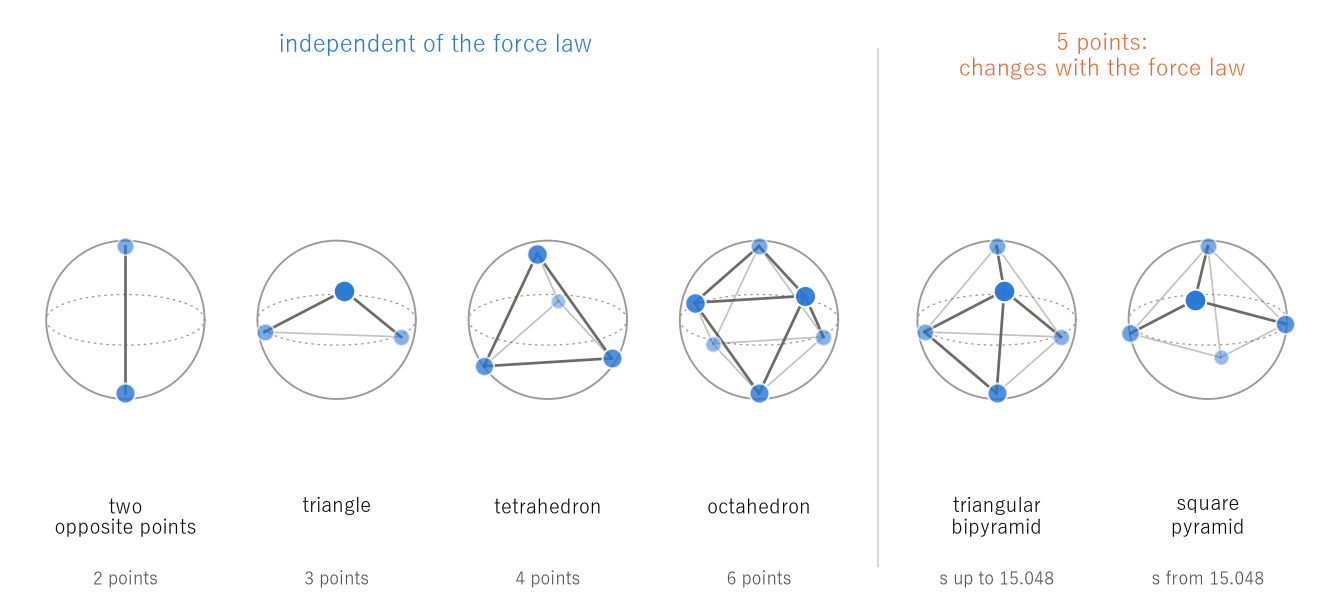
- When points on a sphere push each other apart, the shapes of 2, 3, 4, 6 and 12 points do not move however the force law is changed. Only 5 points change from a triangular bipyramid to a square pyramid once the power of the force exceeds s = 15.0481.
- Water and ammonia are narrower because their four neighbours (two rooms bonding to hydrogen and two that do not) are unequal. In a model of points, one ratio fitted to water put ammonia’s angle at 106.74 degrees, close to the measured 106.67.
- Water’s 104.4776 degrees is less than 0.0001 degrees from 104.4775122, the angle of the four-dimensional relative of the tetrahedron. Even so, it is not an angle of counting.
- Water being densest at 4 °C is not due to its angle either. In heavy water the temperature becomes a little above 11 °C, and pressure and salt also move it.
- Angles from counting
- Changing the force law
- Unequal neighbours
- Reading real angles
- 104.4776 and 104.4775
- Water at 4 °C
- Moving the dimension
- Questions
- References
Angles fixed by counting alone
Take N directions of length 1, place them so that any two meet at the same angle, and make them sum to zero. The squared length of the sum is N + N(N−1) × (cosine of the angle). Since this is zero, the cosine is −1/(N−1). Two directions give 180 degrees, three give 120 degrees, four give 109.4712206 degrees.
Five or more do not fit in three dimensions, because N directions need exactly N−1 dimensions. Lining up five at the equal angle of 104.4775122 degrees needs four dimensions or more.
The same counting appears in the rooms of an electron in an atom. There is one round s room and three p rooms with directions. Mixing them into four equal rooms, each room holds a quarter of s and three quarters of p. From the condition that two rooms are separate rooms, the cosine of the angle between them is −1/3, that is, 109.4712206 degrees. This 3 is the number of p rooms, which is the dimension of space (Paper 1110).
Changing the force law
If an angle is fixed by counting, changing the force law should not move it. Let us check. Place N points on a sphere and let every two of them push apart with an energy inversely proportional to the s-th power of the distance (s = 1 is the electric force; the force is inversely proportional to the (s+1)-th power). We look for the arrangement of lowest energy.
Choose the number of points and change the power s with the slider. The other slider turns the picture.
- number of points
- shape
- angles (pairs)
- when s moves
For 2, 3, 4, 6 and 12 points, not one angle moves when s is moved from 0.5 to 40. The energy of the icosahedron of 12 points equals the value I counted before (Paper 1014). Cohn and Kumar (2007) call an arrangement that is minimal for every force law of a wide family “universally optimal”, and showed that on the sphere 2, 3 and 4 points (regular simplices), 6 points (the octahedron) and 12 points (the icosahedron) are so, while 5 points are not.
Only 5 points change. Once s exceeds 15.048077, the square pyramid (one at the apex, four at the base) becomes lower than the triangular bipyramid (one at each pole, three on the equator). This agrees, to the digits shown, with the threshold S = 15.048... that Schwartz (2016) proved with the help of a computer. Five points cannot be placed at equal angles in three dimensions, so two kinds of seats appear, poles and equator, or apex and base. The force law decides which arrangement is lower.
Six and twelve points are not the counting of equal angles, but they are symmetric shapes in which every point stands alike, and they too do not depend on the force law. What fixes the angles that do not move lies outside the force law: counting, or symmetry.
When the four neighbours are unequal
Around the oxygen of water there are two rooms that bond to hydrogen and two that do not. The four are not equal. One reading says that the non-bonding rooms push harder (Gillespie and Nyholm, 1957). Let us try it with a model of points. Of four points, some carry charge q and the rest carry 1; we push them apart and measure the angle between the points of charge 1.
Change the charge ratio q with the slider. Choose the power s with the buttons, and “match water” finds the q that gives the water shape an angle of 104.4776 degrees. The large dots are the points of charge q.
- power s
- water shape: charges 1
- water shape: charges q
- product of distances ÷ square
- ammonia shape: charges 1
With equal charges, q = 1, both shapes give 109.4712 degrees, and changing s does not move them. When q exceeds 1 the angle narrows, and how far depends on both q and s. The force law enters the angle where the parts stop being equal.
Even so, one thing did not move. In the water shape, the product of the distances between like charges always equals the square of the distance between unlike charges (the cell “product of distances ÷ square” shows 1). Multiplying the two balance equations removes the charge, so for any power law it depends neither on s nor on the charge. The possible shapes are fixed on one path, and the charge and s decide where on it the shape stops.
Matched to water’s 104.4776 degrees, the charge ratio moves widely, from 1.245468 at s = 1 to 1.757134 at s = 12. Yet the angle between the points of charge q stays 114.6236 degrees for every s. With the same ratio in the ammonia shape, the angle is 106.7364 degrees (s = 1) to 106.8303 degrees (s = 12), only 0.07 to 0.16 degrees above the measured 106.67. This is a fact about a model of points; it does not say that electron pairs are point charges.
Reading how the rooms are mixed from real angles
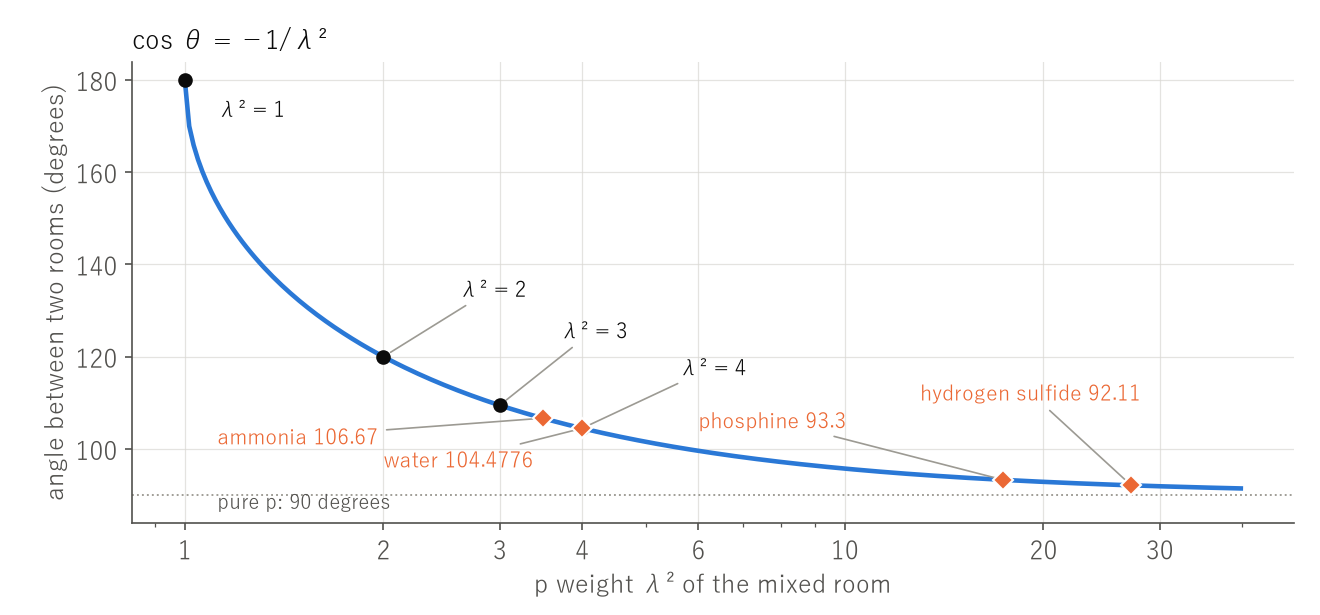
Used the other way, real angles tell how the rooms are mixed. From the condition that two rooms are separate, the p weight λ² of a bonding room is −1/cosθ, where θ is the angle. There is one s room’s worth of s in all, so the non-bonding rooms hold the rest. The angles are taken from the tables of NIST, the US National Institute of Standards and Technology.
| molecule | measured angle (degrees) | p weight λ² | s of one bonding room | total s of the non-bonding rooms |
|---|---|---|---|---|
| water | 104.4776 | 3.99998 | 0.2000 | 0.6000 |
| ammonia | 106.67 | 3.486 | 0.2229 | 0.3313 |
| phosphine | 93.3 | 17.37 | 0.0544 | 0.8367 |
| hydrogen sulfide | 92.11 | 27.16 | 0.0355 | 0.9290 |
The weights do not line up on integers. In hydrogen sulfide and phosphine almost no s enters the bonding rooms; they are nearly pure p, and the angle is close to 90 degrees. If the four were equal, as in methane, the weight would be exactly 3; when they are unequal, the weight takes whatever value the difference between the rooms gives.
104.4776 degrees and 104.4775 degrees
Water’s weight in the table, 3.99998, is almost 4. The angle for weight 4 is 104.4775122 degrees, the same as five equal directions lined up in four dimensions (the centre-to-vertex angle of the four-dimensional relative of the tetrahedron). It differs from water’s equilibrium angle of 104.4776 degrees by 0.0000878 degrees, inside the measurement uncertainty of 0.0019 degrees.
So is the angle of water the counting of four dimensions? It is not, for two reasons.
The first is the number of parts. The 104.4775122 degrees of counting is the angle when there are five equal directions and all ten pairs meet at the same angle. Water has four rooms in three dimensions, and the two bonding rooms are weighted differently from the two non-bonding ones. Water’s weight 4 is not a number of rooms but the ratio of s and p inside one room.
The second is the family. The weights of ammonia, phosphine and hydrogen sulfide, of the same family, are 3.486, 17.37 and 27.16, and they do not line up on integers. Nothing on the side of counting explains why water alone lands on an integer. Agreeing numbers do not always share a root. This is a good example of the test of “same root or separate roots” that I wrote before (Paper 300).
Is water densest at 4 °C because of its angle?
Water is densest at 4 °C, and ice floats on water. One sometimes reads that water’s angle of 104.5 degrees builds the cage of ice, and that this produces the peak at 4 °C. Are the angle and 4 °C really connected?
In ice, four partners line up around each oxygen in directions close to a regular tetrahedron, making an open network with many gaps. That is why ice is light, and the fact that four neighbours leave gaps belongs to the side of counting in the first half of this page. The peak at 4 °C, on the other hand, is a balance between shrinking as the water cools and swelling as the network starts to form. Its temperature moves while the angle of the molecule hardly changes.
- Heavy water: water with hydrogen replaced by heavy hydrogen. The angle of the molecule is almost the same as in water (in the approximation that the masses of the nuclei do not change the balanced shape), but the temperature of greatest density is a little above 11 °C. With the international equation for heavy water (Herrig and others, 2018) I get 11.598 °C, and the same method gives 3.978 °C for pure water. Data on the thermal expansion of heavy water are said to be strikingly inconsistent (Kell, 1977), so the decimals differ between sources, but it stays more than 7 °C away from 4 °C.
- Pressure: squeezing pure water lowers the temperature of greatest density. With the international equation for water (Wagner and Pruß, 2002), it is 2.981 °C at 5 MPa (about 50 atmospheres) and 1.932 °C at 10 MPa (about 100 atmospheres).
- Salt: the more salt, the lower the temperature of greatest density, until it falls below the freezing point. With the international equation for seawater (TEOS-10), the boundary is at a practical salinity of 23.73 (textbooks often quote 24.7). Ordinary seawater (practical salinity 35) keeps getting denser right down to freezing. Even so, sea ice floats.
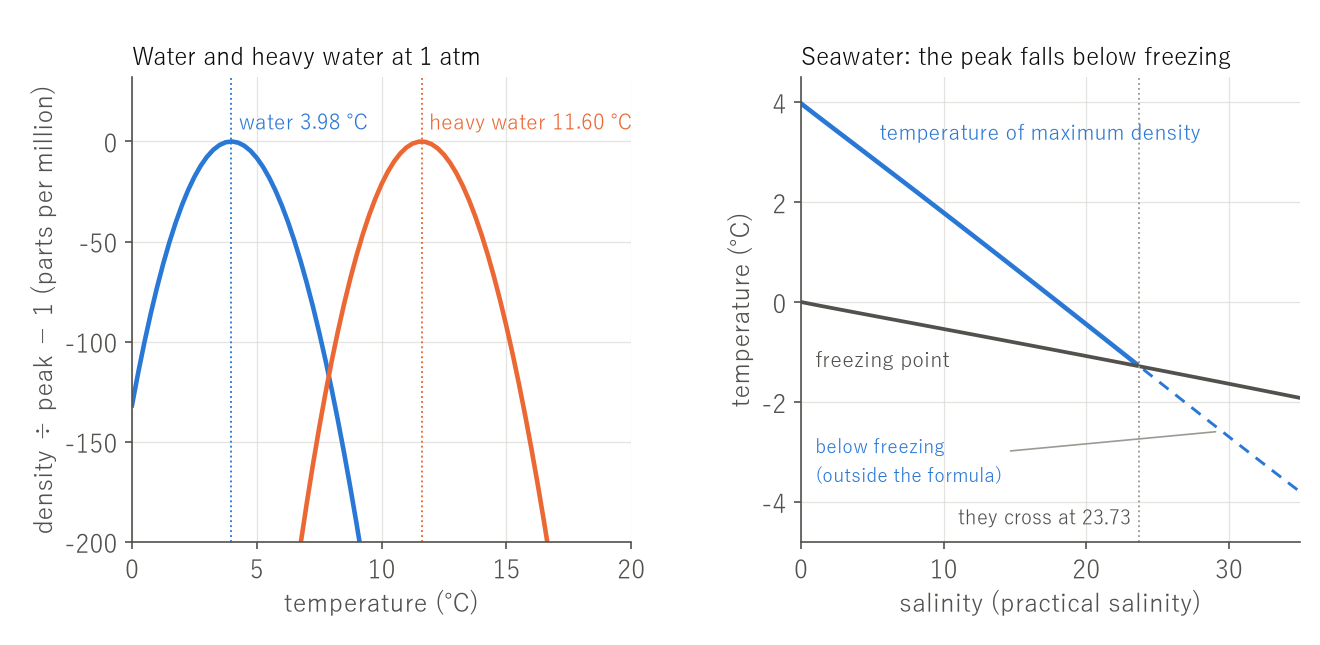
In short, the gaps (four neighbours) belong to the side of counting, while the temperature of 4 °C belongs to the side of energy, the balance between the strength of hydrogen bonds and thermal shaking. The angle of 104.4776 degrees does not set 4 °C.
Moving the dimension
What happens to an angle of counting when the dimension is moved? For the d-dimensional relative of the tetrahedron (the regular simplex), the centre-to-vertex angle has cosine −1/d: −1/3 in three dimensions, −1/4 in four. Mixing one s room and d p rooms gives the same formula.
In an earlier paper on soap films (Paper 1102), I wrote that the angle 109.4712206 degrees at which four borders of a film meet shares its root with the dihedral angle (the angle between faces) of the octahedron. Does that hold when the dimension is moved? The answer depends on which relatives the octahedron is extended into.
Change the dimension d with the slider. The buttons jump to set dimensions.
- centre angle of the simplex
- dihedral of the rectified simplex
- dihedral of the cross polytope
- difference from the cross polytope
The octahedron is both the shape that joins the midpoints of the edges of a tetrahedron (the rectified tetrahedron) and the shape that joins points on the coordinate axes (the cross polytope). Among the rectified relatives, the directions of adjacent faces are the direction from the centre of the tetrahedron to a vertex and the reversed direction of another vertex. So the dihedral angle equals the centre angle of the simplex in every dimension. Among the cross polytopes, the dihedral angle opens with the dimension, and the two coincide only in three dimensions.
So the “same root” survives in every dimension when read among the rectified relatives (Paper 1110). When checking by moving the dimension, the answer comes only after deciding what to keep while moving.
Questions
Is it known why water’s angle is 104.5 degrees?
This page does not compute it. The differences in energy between the four rooms are thought to decide how far the angle moves. What we checked here is only that the departure comes not from counting but from the difference between the rooms.
Is the “mixing” of rooms something that really happens?
Mixed rooms are one way of writing how the electrons sit. How to split the two non-bonding rooms is not fixed; only their total is. This page splits them equally.
How sure is the value of s where five points change shape?
Schwartz gave the threshold S = 15.048... in a computer-assisted proof. My calculation retraces it by comparing the energies of the bipyramid and the square pyramid, and agrees to the digits shown.
Papers and references
All the papers are published under CC BY 4.0.
- Paper 1110 “Methane’s 109.47 Degrees Is an Angle of Counting That Does Not Move When the Force Law Is Changed, and Water’s Angle Departs from It as Far as Its Four Neighbours Are Unequal”: the source of the calculations on this page.
- Paper 1109 “Atoms That Are Round on Average Still Attract, Their Fluctuating Lopsidedness Lining Up, in Inverse Proportion to the Sixth Power of the Distance”: attraction without direction.
- Paper 1102 “A Soap Film between Two Rings Breaks at a Gap of 1.3255 Radii, While a Chain of the Same Shape Always Hangs”: the 109.47 degrees of the film borders.
- Paper 1014 “The Optimal Arrangement in the Thomson Problem Is Unknown, but the Coordination Defects Always Sum to Twelve”: points on a sphere.
- Paper 300 “The Three Hundredth Census: Whether Two Things Share a Root Is Decidable”: agreeing numbers and roots.
- Pauling, L. (1931). The nature of the chemical bond. Application of results obtained from the quantum mechanics and from a theory of paramagnetic susceptibility to the structure of molecules. Journal of the American Chemical Society.
- Gillespie, R. J., and Nyholm, R. S. (1957). Inorganic stereochemistry. Quarterly Reviews, Chemical Society.
- Cohn, H., and Kumar, A. (2007). Universally optimal distribution of points on spheres. Journal of the American Mathematical Society.
- Schwartz, R. E. (2016). The phase transition in 5 point energy minimization. arXiv:1610.03303.
- Johnson, R. D. III (ed.) (2022). NIST Computational Chemistry Comparison and Benchmark Database. NIST Standard Reference Database Number 101, Release 22.
- Hoy, A. R., and Bunker, P. R. (1979). A precise solution of the rotation bending Schrödinger equation for a triatomic molecule with application to the water molecule. Journal of Molecular Spectroscopy.
- Wagner, W., and Pruß, A. (2002). The IAPWS Formulation 1995 for the Thermodynamic Properties of Ordinary Water Substance for General and Scientific Use. Journal of Physical and Chemical Reference Data.
- Herrig, S., Thol, M., Harvey, A. H., and Lemmon, E. W. (2018). A Reference Equation of State for Heavy Water. Journal of Physical and Chemical Reference Data.
- Kell, G. S. (1977). Effects of isotopic composition, temperature, pressure, and dissolved gases on the density of liquid water. Journal of Physical and Chemical Reference Data.
- IOC, SCOR and IAPSO (2010). The international thermodynamic equation of seawater - 2010: Calculation and use of thermodynamic properties. Intergovernmental Oceanographic Commission, Manuals and Guides No. 56, UNESCO.