Einstein’s E = mc² says that mass and energy are two faces of one thing. Choose the unit of mass well and set m to 4π, and the formula becomes E = 4πc². The number 4π is the same as the surface area of a sphere of radius 1, and it turns up all over my papers. How this formula has been used in my papers so far is collected in “What Is E=4πc²?”.
Physics has many places where a calculation produces an infinity and causes trouble: the energy of a body approaching the speed of light, the energy of a charge as small as a point, the energy of the vacuum. So, if m is set to 4π, do these infinities disappear?
The answer is no. Not a single one disappears. But following why they do not disappear makes it clear where an infinity comes from. What decides it is not the mass, but a comparison between how fast something thins out from the center and the dimension of space.
The calculations in this article were made for this page or come from papers that I published myself as preprints; they have not been peer reviewed.
Key points
- Whether the mass is set to 1, to 4π or to 1000, not one infinity disappears. The answers only grow by the same proportion.
- Whether something becomes infinite is decided by comparing how fast its density thins out away from the center (n) with the dimension of space (d).
- If n is larger than d it overflows at the center, if smaller it overflows outside, and if exactly equal it keeps growing slowly (as a logarithm) at both ends.
- The same infinity appears at the center when counted in distance and outside when counted in waves. What physics calls an ultraviolet divergence is one of these.
- Approaching light speed
- Where infinities come from
- Why the factor does not matter
- A map of famous infinities
- Distance or waves
- Moving the dimension
- When the mass becomes infinite
- What setting 4π showed
- Questions
- References
What happens if m is set to 4π and the speed approaches light speed?
Start with the most familiar infinity. The energy of a body moving at speed v is E = γmc², where γ is a number that grows without bound as v approaches the speed of light c.
Move the slider to the right to approach the speed of light. On the scale, 1 is 90% of the speed of light, 2 is 99% and 6 is 99.9999%.
- Speed (percent of light speed)
- γ
- Energy (m = 1)
- Energy (m = 4π)
- Ratio of the two
At 90% of the speed of light γ is 2.294, at 99% it is 7.089, and at 99.9999% it is 707.1. With m set to 4π the energy becomes 28.83, 89.08 and 8885.8. At every speed the ratio of the two stays at 4π = 12.566.
γ is fixed by the speed alone, and m only multiplies it from outside. Whatever is put for m, the energy grows without bound as the speed approaches light speed. The infinity is made on the side of γ, not on the side of m.
Where does an infinity come from?
Think a little more broadly. Suppose some quantity thins out as you move away from a center, like the energy of the electric field around a point charge, or the light of stars. When its density falls off as the inverse n-th power of the distance, count how much there is in total.
Picture an onion. From the center outward, add thin layers one at a time. The amount in one layer is the area of the layer times the density. In three dimensions the area of a layer is proportional to the square of the radius, and the density to the inverse n-th power of the radius, so the amount in one layer is proportional to the radius to the power (2−n). In d-dimensional space it is the power (d−1−n).
amount in one layer of radius r ∝ rd−1−n
The number of layers grows without limit, both toward the center and outward. Whether the total stays finite is decided by how the amount in one layer behaves at the center and outside.
- If n is smaller than d, the layers near the center are light, so the total settles at the center, while the outer layers are heavy, so it overflows outside.
- If n is larger than d it is the other way round: it overflows at the center and settles outside.
- If n and d are exactly equal, each time the layers are added 100 times more finely, the total grows by the same amount (4.605 each time). This is what “growing as a logarithm” means.
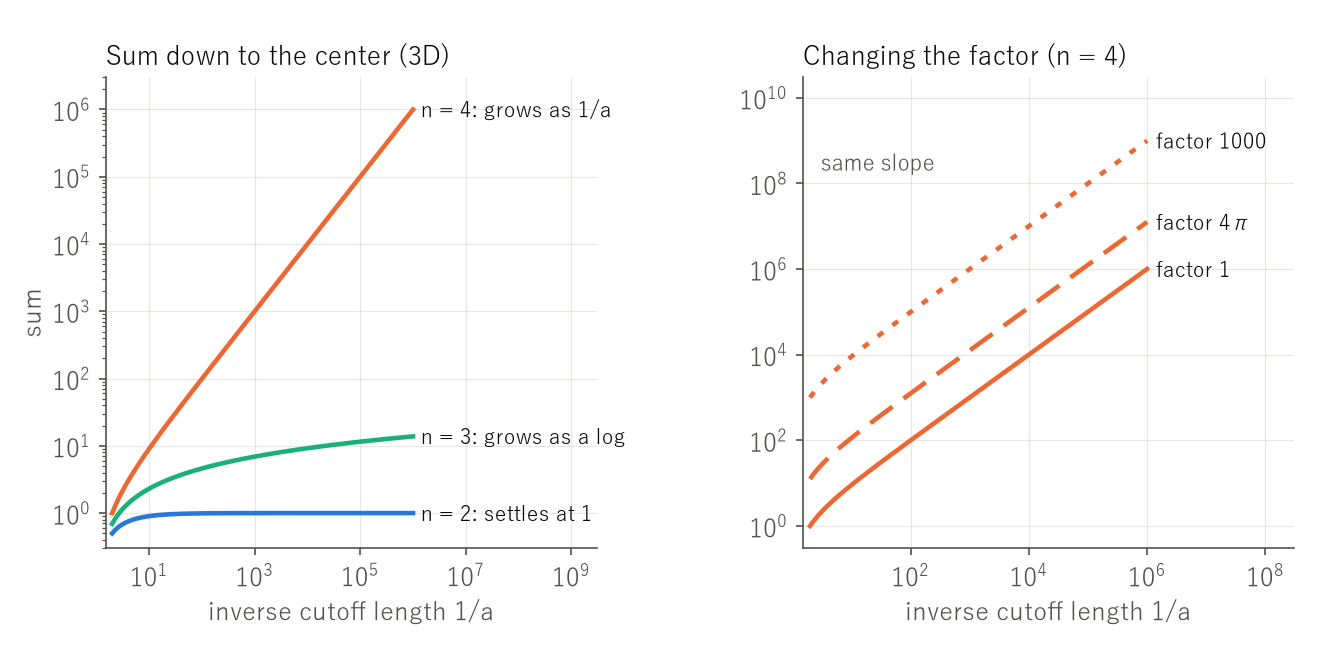
Move n and d with the sliders, or press one of the names below. Changing the factor shifts the lines up or down, but their slope does not change.
- Amount in one layer
- Center side
- Outer side
- When a is cut to 1/100
- When R is made 100 times larger
In three dimensions with n = 4, each time the length a that cuts near the center is cut to 1/100, the total grows a hundredfold: 99, 9999, 999999. With n = 2 it is 0.99, 0.9999, 0.999999 and settles at 1. n = 3 is the border, growing by the same step each time: 4.61, 9.21, 13.82.
Why does the factor not matter?
The amount in one layer carries one more number: the factor of the area of the layer (4π in three dimensions), and the overall size, such as a mass or a charge. Changing this “overall factor” from 1 to 4π or to 1000 only makes the total larger by the same proportion.
In three dimensions with n = 4, when a goes from one ten-thousandth to one millionth, the total grew by 100.0099 times whether the factor was 1, 4π or 1000. On a graph the lines only shift up or down; the slope does not change.
Setting the factor to 0 makes the total 0, but that erases the quantity itself; it does not make an infinity finite. The choice of units is a human convention, and whether something is finite or infinite is a fact that does not depend on units. A convention cannot move a fact.
The night sky is a good example. Suppose stars are spread evenly through space without end. In a farther layer the number of stars grows as the square of the radius, and the brightness of one star falls as the square of the radius. So the brightness of one layer is the same whether it is near or far. Adding it up without end, the night sky should be infinitely bright (Olbers’s paradox). In this calculation the 4π of the area of the sphere appears twice and cancels. Even so, the infinity remains (Paper 496). It remains when the factor disappears, and it remains when the factor becomes 4π. The real night sky is dark because the universe has a finite age, and light from far away has not reached us yet.
Placing famous infinities on one map
I placed famous infinities of physics on a map of the dimension d and the thinning speed n. The diagonal line is the border n = d; above it a sum overflows at the center, below it outside.
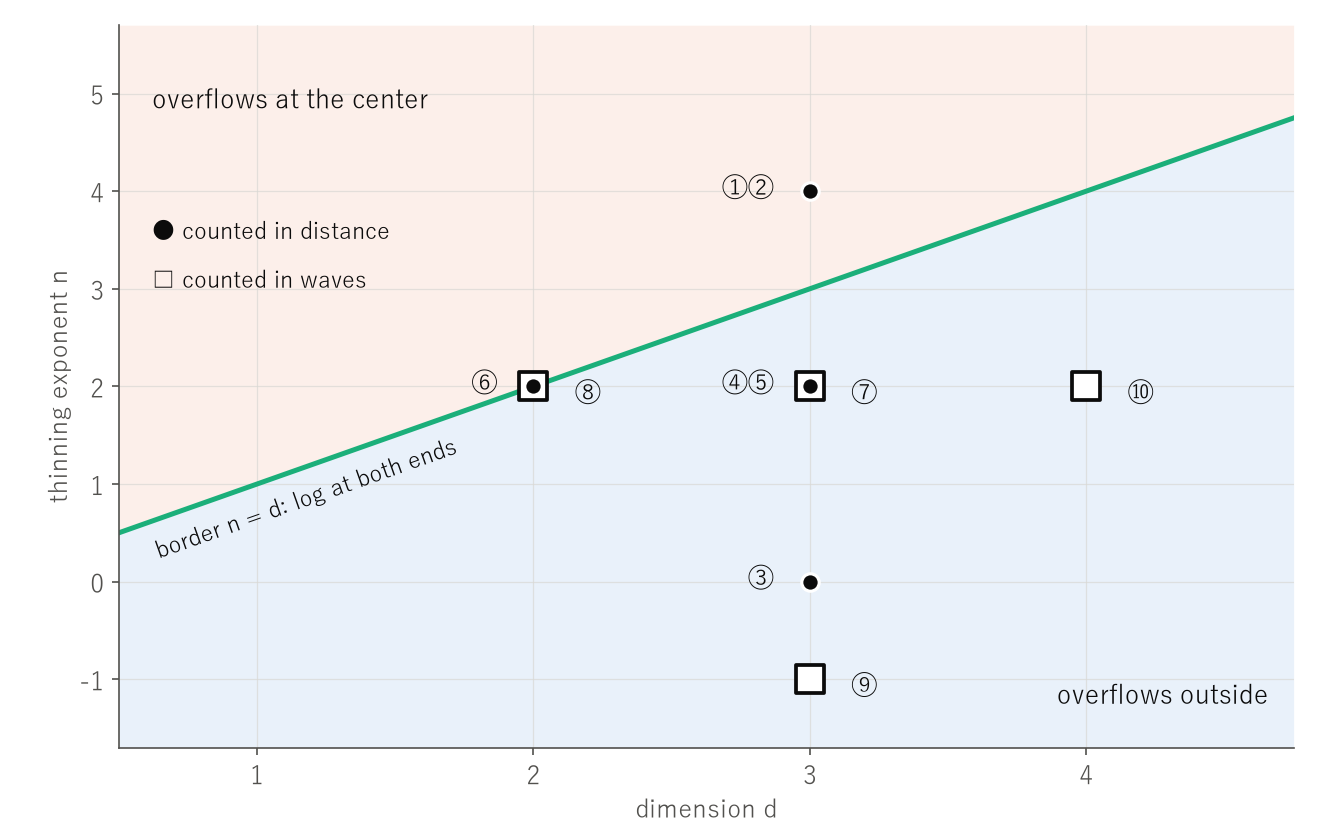
| No. | Infinity | Dimension d | Thinning speed n | Where it overflows | Growth |
|---|---|---|---|---|---|
| ① | energy of the electric field of a point charge | 3 | 4 | center | 1/a |
| ② | energy of the gravitational field of a point mass | 3 | 4 | center | 1/a |
| ③ | mass of a ball of uniform density | 3 | 0 | outside | R³ |
| ④ | mass in the outer part of a galaxy with a flat rotation curve (density 1/r²) | 3 | 2 | outside | R |
| ⑤ | brightness of evenly spread stars (night sky) | 3 | 2 | outside | R |
| ⑥ | field energy around a planar vortex or a straight wire | 2 | 2 | both ends | logarithm |
| ⑦ | uncondensed particles of a Bose gas (3D, counted in waves) | 3 | 2 | none | finite |
| ⑧ | uncondensed particles of a Bose gas (2D, counted in waves) | 2 | 2 | long distance | logarithm |
| ⑨ | zero-point energy of the vacuum (counted in waves) | 3 | −1 | short distance | Λ⁴ |
| ⑩ | correction to the Higgs mass (counted in waves) | 4 | 2 | short distance | Λ² |
a is the length that cuts near the center, R is the outer size, and Λ is the upper limit of the wavenumber. The position of every point is decided by the dimension and the thinning speed alone. The value of the mass appears nowhere on the map.
⑥, the vortex or wire, sits exactly on the border. Retail gravity models, which divide the pull of a shop by the square of the distance, also sit exactly on this border on the two-dimensional map where people live (Paper 1094). ⑧, the Bose gas, is related to the fact that condensation does not happen in two dimensions (Paper 482).
Counting in distance, or counting in waves
The energy of a point charge is denser closer to the center and overflows at the center. The same energy can also be counted by splitting it into waves of different lengths (a Fourier transform). Short distances correspond to fine waves, that is, to the side of large wavenumber.
Counted in waves, the same infinity overflows “outside in wavenumber”. What physics calls an ultraviolet divergence is the name it gets in this way of counting. On the map the point moves to the position reflected across the border. A point charge has n = 4 in distance and n = 2 in waves. The exponent in distance plus the exponent in waves always makes twice the dimension (6 in three dimensions).
Smear the charge into a small cloud of width σ, and the energy becomes finite. For σ = 1, 0.1 and 0.01 it is 0.282, 2.82 and 28.2, the same whether counted in distance or in waves. Each time σ is cut to 1/10 it grows tenfold, and with σ = 0 it is infinite. Smearing is one way of putting in where to cut, not a factor.
What happens when the dimension is moved?
Of the two coordinates of the map, n is decided by physics. But d can be moved in a calculation. Dimensional regularization, used in particle physics calculations, treats the dimension not as 3 or 4 but as a real number such as 1.9 or 2.5.
Summing 1/(k² + 1) over d dimensions gives a finite answer only when d is smaller than 2. At d = 1 it is 3.14159 (π), and at d = 1.9 it is 57.76. Continuing this finite answer as a formula in d up to 3 gives −19.739 (−2π²).
Move the dimension d with the slider. Set d to 3 and −2π² appears. Near 2 and 4 the value jumps.
- Dimension d
- Value
- In this dimension
The continued value is not the real total. In three dimensions, summing up to wavenumber Λ gives 1237.02 at Λ = 100, and it grows without bound with Λ. Subtracting 4πΛ leaves −19.6135, and at Λ = one million −19.7391962, approaching −2π². The value of dimensional regularization is the number that remains once it is decided not to count the part that grows in proportion to Λ. The infinity was not removed; it was put on the side that is not counted.
At d = 2 and d = 4 there are poles (places where the value jumps). Expanding 1/(k² + 1) for large k, the terms thin out at speeds 2, 4, 6, … The dimensions at which a term lies exactly on the border n = d are where the poles are.
What happens where the mass itself becomes infinite?
In the theory of elementary particles, the mass of the electron itself receives an infinite correction. The correction grows slowly, as the logarithm of the upper limit of the wavenumber, and its size is proportional to the mass of the electron. Here the mass really is the factor in front of an infinity.
This infinity is absorbed into the definition of the observed mass by a procedure called renormalization. The infinity goes into the mass. But it is not the value of the mass that removes it. With m set to 4π, the logarithmic growth as the upper limit is raised does not change.
Then what did setting 4π show?
Setting m to 4π does not remove an infinity. But trying it showed something: 4π is a factor that stands outside the infinity. The 4π of the area of a sphere is a number that multiplies the amount in one layer, and it has no say in whether the total is finite or infinite. Where the infinity sits and how fast it grows are decided by the rest, “the radius to which power”.
In Paper 02 I wrote the mass of a ball with density 1/rⁿ as m(n) = 4π/(3−n). In this formula too, 4π is the factor, and what decides where it becomes infinite is 3−n.
The energy of a point charge, the gravity of a point mass, the night sky, the energy of the vacuum and the Higgs all fit on one map. Each individual fact is written in physics textbooks. What I did was to line up ten infinities on one map and to check by calculation, and set out side by side, that changing the overall factor does not change the growth, that the exponent reflects across the border between distance and waves, and that dimensional regularization is a sideways move on the map (Paper 1106).
Questions
Does changing the units make an infinity disappear?
No. Changing the units only multiplies the answer by some number. A finite quantity stays finite, and an infinity stays an infinity.
Does renormalization remove the infinity?
It does not. It absorbs the infinity into the definition of the observed mass or charge. The finite part that remains changes with the choice of what is left uncounted (Paper 230).
If an infinity appears in a calculation, is the calculation wrong?
Not necessarily. Often it is telling you that a formula was summed beyond the range where it can be used. State how far the sum goes, and the answer is a finite number.
Papers and references
All the papers are published under CC BY 4.0.
- Paper 1106, “A Physical Infinity Is Set by How Fast Things Thin Out against the Dimension, Not by the Mass”: the source of the calculations on this page.
- Paper 02, “The 4π Mass Cancellation Theorem”: m(n) = 4π/(3−n).
- Paper 496, “The 4π Appears Twice, Cancels, and Then the Sum Diverges”: the night sky.
- Paper 482, “The Same Words ‘Critical Dimension’ Name Two Different Numbers, Above and Below”: the Bose gas.
- Paper 1094, “The ‘Squared Distance’ in Retail Gravity Models Is, on a Map, the Exponent at the Border Where the Total Number of Customers Stops Converging”: the border on a map.
- Paper 230, “There Are Seven Minus Signs, and One of Them Undoes No Addition”: ways of subtracting a divergence.
- Peskin, M. E., and Schroeder, D. V. (1995). An Introduction to Quantum Field Theory. Addison-Wesley.
- Bollini, C. G., and Giambiagi, J. J. (1972). Dimensional renormalization: The number of dimensions as a regularizing parameter. Il Nuovo Cimento B.
- 't Hooft, G., and Veltman, M. (1972). Regularization and renormalization of gauge fields. Nuclear Physics B.