“What Is a Separator?” was about the dividers in a tool box, and “The Manual for the Wrinkle-Removing Jig” was about a small case in the box. This page is the manual for the next case on the same shelf. Counting from the dividers, it is the third.
Equations and theorems are all written with the same “=”. Yet what that = says differs from one formula to the next. Some = signs were merely decided, some are forced by mathematics, and some were confirmed by experiment. In Paper 16 I called the roll of the six roots of the = sign. This tool turns that check into a procedure anyone can apply to a famous formula.
This text summarizes a paper that I published myself as a preprint, which has not been peer reviewed, together with trial runs done anew for this page.
Manual
- In a word
- Ask what would have to happen for this = to break.
- What it does
- Puts a tag on a formula. The tag has five fields: standpoint, root, grain, the one-sentence content, and the failure conditions.
- What you plug in
- A formula written with =, and at least two worlds whose inputs can be moved.
- When it fails
- When one formula cannot be taken out alone and broken. For proved theorems, use “remove an assumption” instead.
- Where it has crossed
- Electricity, springs, viscosity, light absorption, chemical reactions, money, heat, mechanics, cosmology, theorems.
Key points
- Define resistance R as voltage ÷ current, and the = in V = IR does not break, even for a diode. The content of the law lies in the sentence “R does not depend on the current”.
- Tags are put along two axes: why it holds (root) and how finely it holds (grain).
- The same formula gets a different tag depending on the theory you stand inside.
- A proved theorem has no weakness in its truth. For theorems, replace “break” with “remove an assumption”.
- A tag is a status, not a value judgement. A definition tag does not mean a weak formula.
- An equals sign that cannot break
- Procedure
- The two axes
- Looking at grain
- Standpoint
- Crossing record
- Theorems
- When it fails
- Try it in your own field
- Known work and mine
- References
An equals sign that cannot break
Look at V = IR. If resistance R is defined as the ratio of voltage V to current I, this = holds for any component. It holds even for a diode.
For an ideal diode at 300 K (saturation current 10⁻¹² A), the ratio V/I comes to 76270.4 Ω at 0.40 V and 1.21791 Ω at 0.70 V. The ratio moved by a factor of 62623.9. Even so, at every point V stays equal to I × R, because R was decided to be V/I.
What breaks is not the = but the sentence “R does not depend on the current”. The content of Ohm’s law is this sentence outside the = sign.
Try moving it. When the bend of the world is 0, the ratio is the same everywhere. Bend it, and the ratio moves, while the residual of the = stays at 0.
Pick a field and bend the world. Can you move the residual of the = away from 0?
- V
- R
- Residual of the =
- Spread of the ratio

The procedure, in verbs only
| Verb | What you do |
|---|---|
| Stand | Write which theory you are reading it inside |
| Measure apart | Write how to measure the left and right sides separately. If you cannot for one of them, it is a candidate for the definition tag |
| Break | Make one world where the = fails. If you cannot, it is a candidate for the identity tag |
| Move | Move the inputs and look for where it fails |
| Tag | Decide the root and the grain |
| Extract | Write the one sentence “it does not depend on what” |
| Fence | Write where it failed as the failure conditions |
The centre is “measure apart”. It asks whether the quantity on the right can be measured without using the left. If it cannot, the = is a definition. If it can, the = is saying something about the world.
The other key is “extract”. A definition tag does not end the story. Write the sentence “this does not depend on that”, and the content of the law comes out. If the separator asks what you must move to get something different, this sentence is its reverse side: it writes down what stays put however you move things. Paper 530 divided the status of proportionality constants into four, telling them apart by what you must move for the constant to move. It is the same question.
Tags are put along two axes
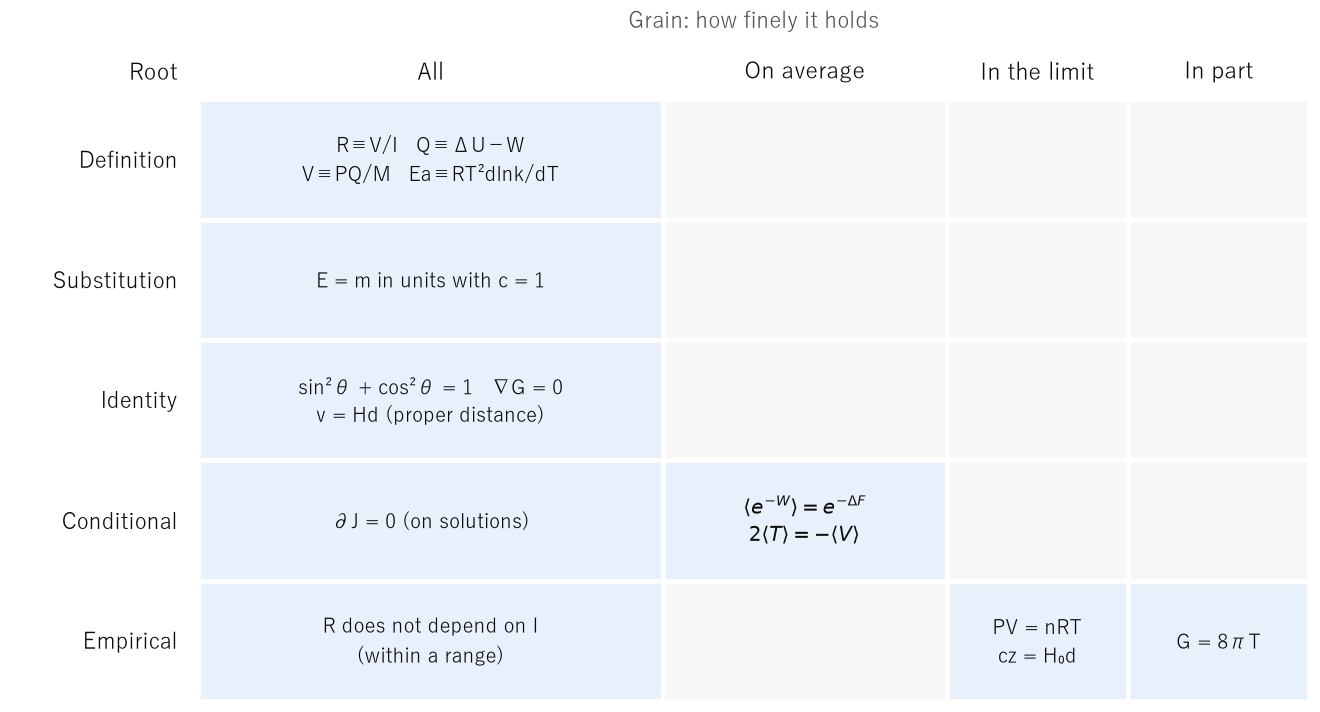
The first axis is the root. It asks why the formula holds. These are the six of Paper 16.
| Root | Question | Example |
|---|---|---|
| Definition | Is one side defined from the other? | R≡V/I |
| Consequence of substitution | Does it hold because a convention was chosen? | E = m in units with c = 1 |
| Identity | Does it fail in no world? | sin²θ + cos²θ = 1 |
| Conditional equation | Does it hold only on solutions? | Conservation of energy |
| Empirical law | Can a failing world be made, and has experiment confirmed it? | R does not depend on I (within a range) |
| Void | Do the dimensions of the two sides disagree? | length = time |
The second axis is the grain. It asks how finely the formula holds.
| Grain | Question | Example |
|---|---|---|
| All | Does it hold point by point, run by run? | ∇G = 0 |
| On average | Does it fail run by run and hold only on average? | The Jarzynski equality |
| In the limit | Does it hold only in a limit, failing on the way? | PV = nRT |
| In part | Does it tie together only part of a quantity? | G = 8πT |
The grain is not a seventh root. A formula that holds on average still has its own root for why it holds. That is why it sits on a separate axis.
Looking at grain
An equals sign that holds on average. Put a small particle in a harmonic trap and pull. With W the work done, the Jarzynski equality says ⟨e^(−W)⟩ = e^(−ΔF), with energy measured in units of the thermal energy. In this example ΔF = 0, so the right side is 1. It does not hold run by run.
Move the speed and the number of runs. W scatters run by run, but where does the average of e^(−W) head?
- Average of W
- Runs with negative W
- ⟨e^(−W)⟩
- Share of the top 1%
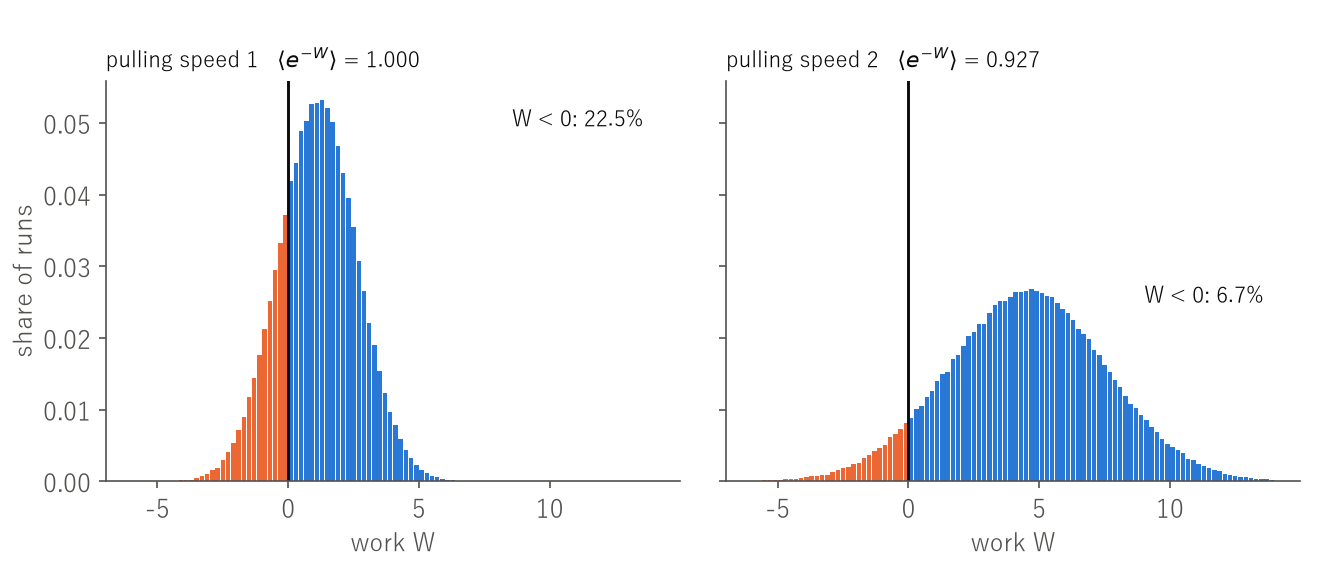
I computed the same model for 200,000 runs in time steps. The variance ÷ (2 × mean) of W is 0.998123, which fits this distribution closely. At speed 1, 22.5% of the paths have negative W, and ⟨e^(−W)⟩ is 1.000102±0.006315. At speed 2, the top 1% of runs hold 73.2% of the sum, and even with 200,000 runs the value is 0.926801±0.051570. The = is exact, but whether you can confirm it depends on the tail. That is the subject of Paper 136.
The virial theorem has the same grain. On an elliptical orbit of eccentricity 0.6, 2T/|V| moves from 0.400000 to 1.600000 moment by moment. Averaged over one orbit it is 1.000000. Averaged over only a quarter of the orbit’s angle it is 1.381972, which is not equality.
An equals sign that holds in the limit. PV = nRT is the formula of the limit where the pressure goes to 0. Computing Z = PV/(nRT) from the van der Waals equation at reduced temperature 1.5, for reduced volumes 10, 100, 1000 and 10000, gives 0.959483, 0.995844, 0.999583 and 0.999958, approaching 1. At the critical point it is 0.375000, exactly 3/8.
An equals sign that ties together only a part. What Einstein’s equation G = 8πT ties together is only the Ricci part of the curvature. Even if the right side is 0, spacetime need not be flat. In the Schwarzschild spacetime the Ricci curvature is 0 everywhere, while the size of the curvature RabcdRabcd is 48M²/r⁶. At M = 1, r = 3, a value of 0.065844 remains. What remains is the W part, the very “wrinkles” that the wrinkle-removing jig was weighing.
The tag changes with where you stand
A tag belongs not to the formula itself but to the pair of the formula and where you stand. In Paper 21 I wrote this about the formula of the mass shell.
| Formula | Standing here | Standing there |
|---|---|---|
| F = ma | With no force law written, the definition of F | Combined with F = −kx and the like, an empirical law that can fail |
| v = Hd | For proper distance, an identity of a uniform universe | Read with redshift and luminosity distance, an empirical law, with grain “in the limit” |
| e^(iπ) + 1 = 0 | With cos + i sin as the definition, a consequence of substitution | With the series as the definition, a theorem |
| E² = (pc)² + (mc²)² | Inside special relativity, an identity | Outside it, a null hypothesis that can be tested |
Look at v = Hd. For proper distance d = a(t)χ, ḋ = (ȧ/a)d holds for any a(t), whatever the universe contains. Written in observed quantities, things change. With d the luminosity distance, at redshift 1 the value of H₀d/c is 1.171573 in a dust universe and 1.500000 in a universe with no matter, unlike the 1.000000 of cz = H₀d. Paper 1039 wrote that Hubble’s law comes out exactly in a universe with no matter. The formula on the observational side changes with the contents of the universe, so it says something about the world.
For F = ma, both readings have their traditions. Most manuals of analytical mechanics follow the schools of Kirchhoff and Sommerfeld and read the second law as a definition of force, while Feynman is given as a representative of those who read it as a law (Stefanini and Reali). Neither is mistaken; they stand in different places.
Crossing record
I ran the same procedure in other fields. Many formulas define a constant by a ratio, so first comes the family of ratio laws.
| Field | What defines the = | The one sentence | Breaking world | Spread of the ratio |
|---|---|---|---|---|
| Electricity | R≡V/I | R does not depend on I | Diode | 10.779452 |
| Springs | k≡F/x | k does not depend on x | Softening spring | 0.462892 |
| Viscosity | μ≡τ/s (s is the shear rate) | μ does not depend on s | Shear thinning | 3.446621 |
| Light absorption | ε≡A/(cl) | ε does not depend on c | Solution forming dimers | 1.597254 |
| Reactions | Ea≡RT²dlnk/dT | Ea does not depend on T | k = AT²e^(−E/RT) | 0.086785 |
| Money | V≡PQ/M | V does not depend on M | World where V falls with M | 0.981862 |
In the worlds of the laws, the spread of the ratio was 0 (only for reactions, 9.30×10⁻¹¹ from the error of numerical differentiation). The residuals of the five = signs defined by a ratio are of the size of machine rounding even in the breaking worlds, at most 1.59×10⁻¹⁶.
The money formula was the clearest. The economist Humphrey writes that if V is defined as PQ/M, MV = PQ becomes an identity, and that if V is defined independently of the other quantities, it stops being one. This is the same thing as “measure apart” in the procedure.
For reactions, the definition stands in the glossary as it is. IUPAC defines the activation energy by Ea = RT²dlnk/dT and calls it an empirical parameter. In the world k = AT²e^(−E/RT), with E of 50000 J/mol, Ea moved from 54988.678 J/mol at 300 K to 59977.355 J/mol at 600 K.
The heat formula took the form of a loop. With W the work done from outside, define heat Q as ΔU − W, and the = of the first law does not break. The content is “adiabatic work does not depend on the path”. In a world made so that this fails, 0.200000 remained after one loop. It is the same form as the failure condition of the wrinkle-removing jig, but I have not judged whether it is the same root.
Even though the same form ran in six fields, I do not call it the same root. Defining by a ratio naturally gives the same form, and under the rule of the separator that is no verdict. All I can say is that the same procedure ran.
What did not cross. “Measure apart” did not cross to proved theorems, because both sides are fixed inside the same axioms. The ratio form does not apply to average or identity formulas. The breaking worlds for springs, absorption, money and heat were made up to show how the formula fails, and no real data were used.
For theorems, “remove an assumption”
“Break” cannot be used on a proved theorem. Because there is a proof, its truth has no weakness. What can be asked is which assumptions are needed and how far. Replace “break” with “remove an assumption”, and the procedure runs as it is.
| Theorem | Assumption removed | Result |
|---|---|---|
| Pythagorean theorem | A flat surface | For a right triangle with a = b = 1, c goes from 1.414214 on a flat surface to 1.274556 on a sphere of radius 1 |
| V − E + F = 2 for polyhedra | The shape of a sphere | From 2 for a cube to 0 for a grid on a torus |
| Cauchy’s integral theorem | No hole | ∮dz/z goes from 0 to an imaginary part of 6.283185 |
The side of theorems already has fine tools. The field of reverse mathematics measures which axioms are really needed to prove a theorem, and the relation between the parallel postulate and the Pythagorean theorem is an entry-level example. Lean, used to check proofs, has a command that lists the axioms a theorem depends on.
When it fails
| Condition | What happens | Repair |
|---|---|---|
| One formula cannot be taken out alone and broken | F = ma alone reads as a definition; combined with a force law it can be tested | Put the tag on the bundle |
| The range of worlds is not fixed | “It did not break” applies only inside the worlds tried | Write the worlds tried |
| Deciding the tag from a value | e^(iπ) + 1 has the same value under every definition | Write where the definition was placed |
| Using “break” on a proved theorem | There is a proof, so it does not break | Replace it with “remove an assumption” |
| Reading a tag as a value judgement | Reading a definition tag as “weak” is a mistake | Write that a tag is a status |
The first is the place Duhem pointed to. He wrote that a physical hypothesis cannot be tested alone, and that the whole theoretical scaffolding is put in doubt. In this case, put the tag on the bundle rather than on one formula. The pair F = ma and F = −kx fails on a damped path, with a residual of 0.172851.
The last matters. Definitions create ways of measuring and tools. A definition tag does not lower the value of a formula.
Try it in your own field
- Pick a formula that interests you, and write which theory you read it inside.
- Among its quantities, look for those defined from the others.
- If there are any, that = does not break. Write the sentence “that quantity does not depend on such-and-such”.
- Look for a world where the sentence fails. What you find is the failure condition.
- Check whether it holds run by run, on average, in a limit, or only in part.
- Write the tag down. The record of stopping helps the next person.
What is known, and what is my own work
What is known. The debate over reading the second law as a definition or a law, Duhem’s point that hypotheses cannot be tested alone, the fact that MV = PQ is an identity, and the definition of Ea are all known. Dirac wrote “equal only on the constraints” with a separate symbol, ≈. None of the results of the formulas here is new.
My own work. On the foundations of the six roots of the = sign (Paper 16), where one stands (Paper 21) and the status of proportionality constants (Paper 530), I assembled this into a procedure. I divided root and grain into two axes. I separated the = of definition from the content of the law, ran the same procedure in six fields, and wrote down even the parts that did not cross. I have not checked everything to see whether any literature contains an arrangement of the same form.
What this page does not do. It does not rank formulas. The made-up worlds are examples of shape, not claims about reality. I have not measured whether V depends on M. It is not investment advice.
Papers and references
All the papers are published under CC BY 4.0.
- Paper 16, “The Equals Sign Has Distinct Roots Too”: the six roots of the = sign.
- Paper 21, “Zero-Tension Does Not Act on an Identity”: where one stands.
- Paper 530, “One and the Same ‘Proportional To’ Carries Four Different Kinds of Constant”: what you must move for a constant to move.
- Paper 136, “The Equality Is Exact, and the Average Is Held by the Tail”: the = of an average and its tail.
- Paper 1039, “A Matter-Free Expanding Universe Is Flat Spacetime Resliced by Proper Time”: the slice on which Hubble’s law comes out exactly.
- Paper 300, “The Three Hundredth Census: Whether Two Things Share a Root Is Decidable”: the test of the separator.
- Humphrey, T. M. (1984). Algebraic quantity equations before Fisher and Pigou. Federal Reserve Bank of Richmond Economic Review.
- Stefanini, L. & Reali, G. (2015). Newton’s second law: not so elementary (as it may seem). arXiv:1502.04303.
- Ariew, R. Pierre Duhem. Stanford Encyclopedia of Philosophy.
- Reverse Mathematics. Stanford Encyclopedia of Philosophy.
- IUPAC Gold Book. activation energy (Arrhenius activation energy).