Put a rubber band on the skin of an apple. Wherever you put it, you can slide it over the skin and shrink it to a point. On the surface of a doughnut this fails. A band that runs around the hole cannot be shrunk, however you move it.
In 1904 Henri Poincaré asked this question one dimension up. If every loop in a closed three-dimensional space can be shrunk to a point, is that space the three-dimensional sphere? The answer came nearly a hundred years later. Richard Hamilton began the method of Ricci flow, and Grigori Perelman completed it in 2002 and 2003. The answer was yes.
The theorem of my first paper takes three lines. Divide a ball into shells of equal thickness: the only density that makes every shell weigh the same is 1/r² (the n = 2 uniqueness theorem). This 1/r² has a second name. The Gaussian curvature of a sphere of radius r, the measure of how much it bends, is exactly 1/r².
Read the density as the curvature of the shell, and the shell’s weight 4π becomes the total amount of its curvature. And this 4π is really at work, deep inside the proof by Perelman and others. On this page I follow that road while you move the figures with your own hands. I am not retracing the proof. I read, in the language of shells, where the number 3 takes effect inside it. The page goes on to the Poincaré conjecture in four dimensions.
This article summarizes papers that I published myself as preprints, which have not been peer reviewed, together with material calculated and arranged anew for this page. The interactive figures compute everything on the spot in your browser.
Key points
- The density 1/r² of the theorem is the same formula as the curvature of a sphere of radius r. The shell’s weight 4π is its total curvature, and it stays 4π however you deform the shell (the Gauss–Bonnet theorem).
- In every smooth three-dimensional space, the area of a small shell divided by r² starts from 4π. Curvature can be read as the shortfall from that value.
- The number of directions equals the number of planes only in three dimensions. That is why, in three dimensions, the shortfalls in each direction read off the whole of the curvature, exactly.
- In rotationally symmetric Ricci flow in three dimensions, the area of a cross-section shell obeys At = Ass − 8π. The extra term vanishes only when the shell is two-dimensional.
- The 4π in Perelman’s never-decreasing quantity W is the 4π of heat. The 4π of the shell lives elsewhere. It is the −4π that wears the width down in the step showing that the flow ends in finite time on a space where all loops shrink.
- The flow carries a shape to spaces that look the same from every point. What selects the sphere among them is the loop. The 3-sphere is the space in which a shell grows all the way without ever meeting itself.
- The shell of four-dimensional space is the 3-sphere, which has no number corresponding to total curvature. It has instead a bundle of circles, the Hopf fibration. The smooth Poincaré conjecture in four dimensions is still open.
- In four dimensions the number to fix first is the total of the space, 16π² on the round S⁴. Only the division between Q and W moves, and the most squashed shell sets the floor under the share of W (Paper 1105).
- The question
- Density and curvature
- The shortfall from 4π
- The flow
- Necks and surgery
- The quantities that never decrease
- Where the shell’s 4π works
- Loops select the sphere
- The shell in four dimensions
- Why four stays open
- The total and the share of W
- Perelman
- What is known, and my own work
- Within the corpus
- Questions
- Sources
The question: if every loop shrinks, is it a sphere?
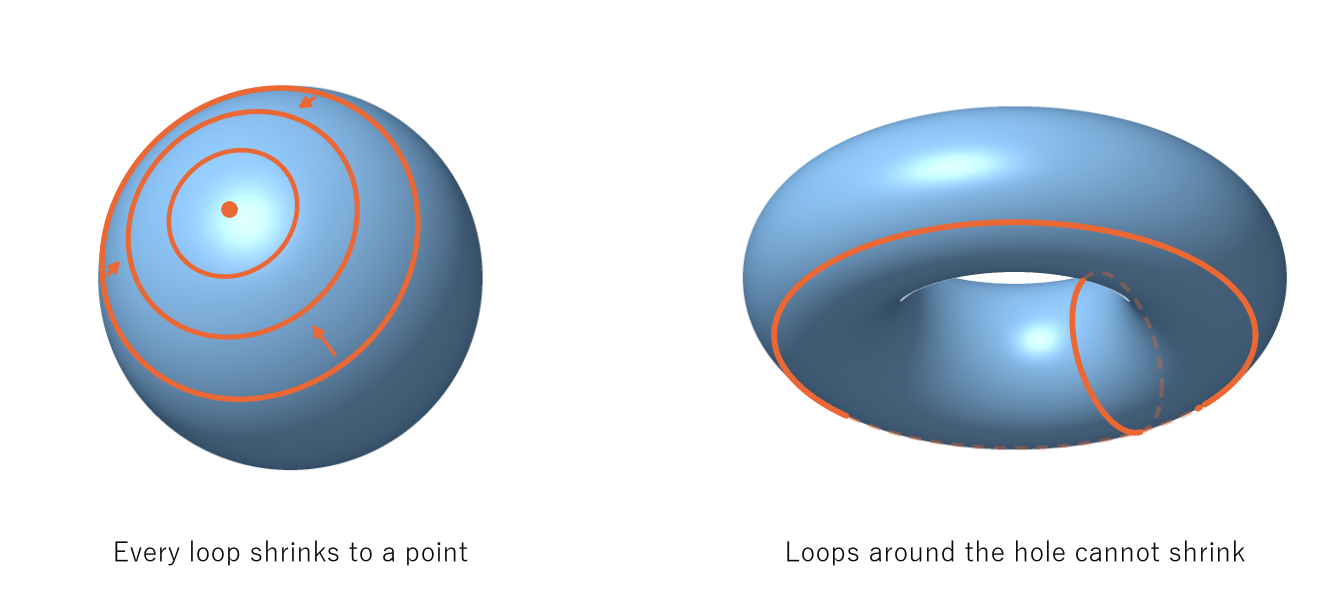
In two dimensions the answer has long been known. If every loop on a closed surface shrinks to a point, the surface is a sphere. Poincaré’s question is whether the same can be said in three dimensions.
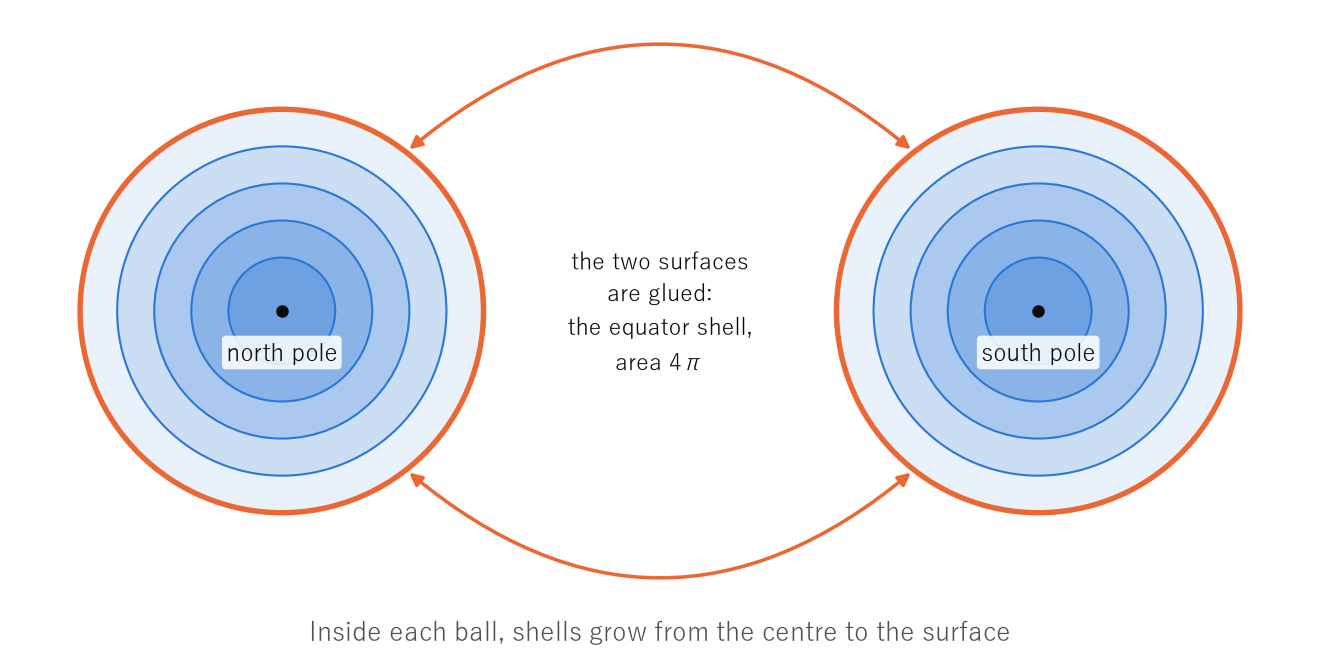
The three-dimensional sphere S³ is the set of points x² + y² + z² + w² = 1 in four-dimensional space. You cannot see it, but it is easy to build. Take two balls and glue their surfaces together. Travel through one ball and at the surface you pass into the other; go through its centre, and you come back into the first ball from the opposite side. There is no edge anywhere, and yet the size is finite.
A small incident came before the question. In 1900 Poincaré stated that a space with the same numbers of holes as a sphere (the Betti numbers) must be a sphere. Four years later, in 1904, he built a counterexample himself: a space with all the same hole numbers that is not a sphere. It contains a loop that cannot shrink. What numbers failed to separate, a loop separated. In my vocabulary, it was one of the first separators of topology. This space will return later, in the shape of a dodecahedron.
Now bring the theorem’s shells into this space. Choose a north pole and collect all the points at distance r from it. They form a two-dimensional sphere, a shell of S³. In the S³ of radius 1, the area of this shell is 4π sin²r. It is largest at the equator r = π/2, where it is exactly 4π.
Move the slider to change the distance r from the north pole.
- Shell area 4π sin²r
- Shell area ÷ r²
- Shortfall from 4π
- Value in flat space

Add up the shells from the north pole to the south pole and you get 2π², the volume of S³. A single sheet of shell can sweep the whole space from end to end. Keep this in mind: the act of sweeping comes back in the second half of this page, inside the proof.
The density of the theorem was the curvature of the shell
In three-dimensional space, the only density that makes every shell weigh the same is ρ(r) = 1/r². The shell weight then grows at the rate dm/dr = 4π.
The proof is on the page of the theorem. What I want to look at here is the other face of 1/r². A sphere of radius r has the curvature K = 1/r² measurable from within the surface (the Gaussian curvature), and its area is 4πr². Multiply them, and the radius disappears.
$$K=\frac{1}{r^{2}},\qquad K\times 4\pi r^{2}=4\pi$$This is the formula for the density of the theorem, letter for letter. Read the density as the curvature of the shell, and the weight 4π is the total amount of curvature of the whole shell, its total curvature. And for total curvature there is a long-known theorem.
$$\int_{S^{2}}K\,dA=2\pi\chi=4\pi$$This is the Gauss–Bonnet theorem. χ is the Euler number, which is 2 for a sphere. Dent the shell or stretch it, and as long as you do not open a hole, the total curvature stays 4π. On a round shell it was “4π at every radius”. Here it becomes “4π for every shape”.
Drag the round handles to change the shape of the shell, or choose a shape with the buttons.
- Shell area
- Average curvature

The same holds inside the S³ of Experiment 1. The shell at distance r is a round sphere of radius sin r, with curvature 1/sin²r and area 4π sin²r. Multiply them, and every shell gives 4π.
This agreement does, however, depend on the dimension. The theorem exists in every dimension: in d-dimensional space the density is 1/rd−1. The exponent of the shell’s curvature, by contrast, is 2 in every dimension, because curvature is the inverse square of a length. So the 2 in 1/r² is two different 2s: a 2 that moves and a 2 that does not.
| Dimension d of the space | Shell | Density of the theorem | Curvature of the shell | Curvature × shell area |
|---|---|---|---|---|
| 2 | circle S¹ | 1/r | not measurable from within | none |
| 3 | sphere S² | 1/r² | 1/r² | 4π (the radius disappears) |
| 4 | S³ | 1/r³ | 1/r² | 2π²r |
| 5 | S⁴ | 1/r⁴ | 1/r² | (8/3)π²r² |
The two 2s have distinct roots. Move the dimension and they come apart. They overlap only in dimension 3. Density and curvature become the same formula, the product loses its radius, and what is left is a 4π guaranteed by Gauss–Bonnet. This happens in exactly one dimension. That is what the title of this page means: only in dimension 3 does the curvature of a shell close at 4π.
“Close” here refers to the first power of curvature. The shell S⁴ of five-dimensional space has a number that closes when the square of curvature is integrated (the Gauss–Bonnet–Chern theorem). The first power closes only when the shell is two-dimensional.
Every space starts from 4π
The next step takes the theorem out of flat space. In a curved three-dimensional space, form the shell at distance r from a point and measure its area A(r). In every smooth space, A(r)/r² approaches 4π as r becomes small, because at a small enough scale every space looks flat. And the first term of the departure from 4π is curvature.
$$\frac{A(r)}{r^{2}}=4\pi\left(1-\frac{S}{18}\,r^{2}+\cdots\right)$$S is the scalar curvature, the total of the bending at that point (a different letter from the S in the spheres S² and S³). The 4π of the theorem is the starting point at every point of every space. Curvature is the shortfall from it. In the S³ of radius 1, S = 6, and the fractional shortfall starts as r²/3.
| r | S³ | flat space | hyperbolic space | fractional shortfall in S³ | r²/3 |
|---|---|---|---|---|---|
| 0.25 | 12.306743 | 12.566371 | 12.830361 | 0.020660 | 0.020833 |
| 0.50 | 11.553463 | 12.566371 | 13.649105 | 0.080605 | 0.083333 |
| 1.00 | 8.897913 | 12.566371 | 17.355387 | 0.291927 | 0.333333 |
The three middle columns are shell area ÷ r². With r down to 0.01, shortfall ÷ r² is 0.333329, approaching the 1/3 of the formula.
Direction by direction, it becomes clearer. Extend a thin tube from the centre in a direction v. In flat space with density 1/r², the content of the tube per unit length is constant; this is the theorem restated for each direction. In a curved space the tube narrows, and its content falls as follows.
$$\frac{dm}{dr\,d\Omega}=1-\frac{\mathrm{Ric}(v,v)}{6}\,r^{2}+\cdots$$Ric(v,v) is the Ricci curvature. The formula is in the textbooks. Read from the side of the theorem, though, it looks different: Ricci curvature is the number that measures how much the straight tube of n = 2 narrows in the direction v.
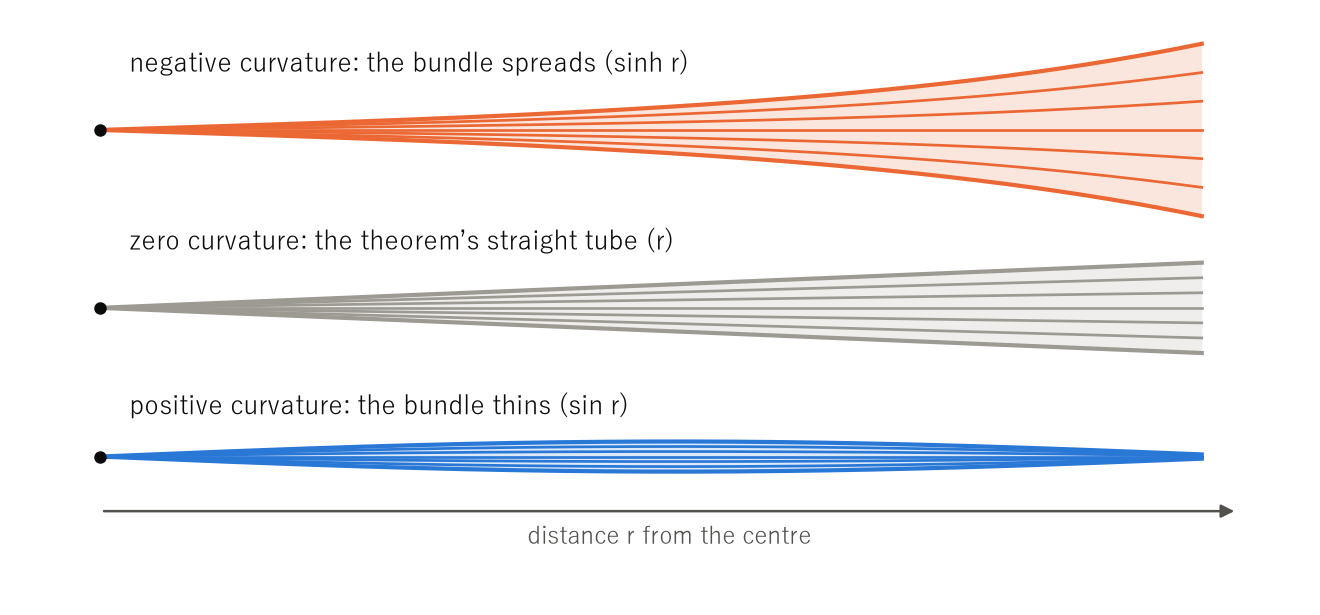
For example, in S²×ℝ, the space of a straight tube with spherical cross-section, the tube does not narrow along the axis. It narrows most in the directions of S². Shortfall ÷ r² measured at r = 0.01 was 0, 0.041667, 0.125000 and 0.166666 at angles of 0°, 30°, 60° and 90° from the axis, agreeing with Ric/6 to six digits (the formula gives 0.166667 at 90°).
The number of directions and the number of planes
Three-dimensional space has three perpendicular directions. It also has three perpendicular planes: the one spanned by directions 1 and 2, by 1 and 3, and by 2 and 3. The bending of a plane (its sectional curvature) can be computed from the shortfalls of the directions.
$$K_{12}=\frac{\mathrm{Ric}_{1}+\mathrm{Ric}_{2}-\mathrm{Ric}_{3}}{2}$$Measure the three shortfalls, and all three planes are determined. Nothing in the curvature is left that the shortfalls cannot measure. Moving the dimension shows how special this is.
| dimension d | directions | planes d(d−1)/2 | all of curvature (Riemann) | read by shortfalls (Ricci) | left over (Weyl) |
|---|---|---|---|---|---|
| 2 | 2 | 1 | 1 | 3 | 0 |
| 3 | 3 | 3 | 6 | 6 | 0 |
| 4 | 4 | 6 | 20 | 10 | 10 |
| 5 | 5 | 10 | 50 | 15 | 35 |
The numbers count independent components. In two dimensions curvature is a single number, and the three components of the Ricci curvature are all fixed by it.
Directions and planes are equal in number only in three dimensions. In two dimensions all of curvature can be read too, but there are 2 directions and 1 plane, so the counts differ. From four dimensions on, a Weyl curvature remains that the shortfalls cannot read. The only dimension in which the “narrowing of the theorem’s tube” reads the curvature with nothing missing and nothing extra is 3.
Experiment 3 lets you touch this 3 = 3. There is a family of shapes in which the 3-sphere stays a 3-sphere and the lengths of three directions can be changed separately: the left-invariant metrics whose curvature Milnor wrote down in 1976. Change the lengths, and the shortfalls of the directions and the bending of the planes move together.
Change the lengths of the three directions and press Flow. The flow is explained in the next section.
- Time
- Size (cube root of volume)
- Spread of the shortfalls

The flow: levelling the shortfall
In 1982 Richard Hamilton wrote an equation that moves a shape itself in time.
$$\frac{\partial g}{\partial t}=-2\,\mathrm{Ric}$$g is the way lengths are measured. The equation shrinks directions of positive curvature and stretches directions of negative curvature. Directions with a larger shortfall shrink faster, so the shortfalls level out. This is Ricci flow. The scalar curvature S obeys the following equation.
$$\frac{\partial S}{\partial t}=\Delta S+2\,|\mathrm{Ric}|^{2}$$The Δ term has the same form as in the heat equation and smooths out the bumps. The term 2|Ric|² increases curvature. Levelling and sharpening sit in the same equation.
In the same paper Hamilton showed that a closed three-dimensional space of positive Ricci curvature becomes round under this flow. The key to the calculation is that in three dimensions all of curvature can be written with the Ricci curvature: the 3 = 3 above. Press Flow in Experiment 3 to see a small version of this. Whatever starting lengths you choose, the shortfalls level out, even if some are negative. In a finer separate calculation, the shape starting from lengths 0.7, 1 and 1.3 vanished at time 0.246659, and with the other four initial values included, the final ratio of the shortfalls was 1.0002 or less in every case.
In the round S³, the square of the radius falls as 1 − 4t, and the sphere vanishes to a point at time 1/4. Take care with the unit of time here. Matching dimensions on both sides shows that the time of Ricci flow is not seconds but the square of a length (Paper 119). This matters shortly.
The trouble lies with shapes whose Ricci curvature is not positive. Wherever there is a waist, it may pinch off during the flow; curvature diverges, and the equation stops.
The neck: shell area falls at 8π
Take the simplest case: a three-dimensional shape with rotational symmetry about an axis. Its cross-sections are round spheres, that is, the shells of the theorem. Let s be the distance along the axis and ψ the radius of the shell there. Under Ricci flow, ψ obeys the following equation (in the form used by Angenent and Knopf).
$$\psi_{t}=\psi_{ss}-\frac{1-\psi_{s}^{2}}{\psi}$$This is an awkward equation with a division in it. But rewrite it for the shell area A = 4πψ², and the division and the ψs² term all disappear.
$$\boxed{\,A_{t}=A_{ss}-8\pi\,}$$The calculation takes two lines. (ψ²)t = 2ψψt = 2ψψss − 2 + 2ψs², and (ψ²)ss = 2ψψss + 2ψs². The difference leaves only −2. Multiply by 4π and you have −8π.
The shell area spreads to its neighbours like heat while falling at the constant rate 8π. The −8π is a constant. It depends on neither shape, nor place, nor time.
This equation closes only when the shell is two-dimensional. With an n-dimensional sphere as cross-section, u = ψ² obeys the following (checked by symbolic computation as well).
$$u_{t}=u_{ss}-2(n-1)+2(n-2)\,\psi_{s}^{2}$$The extra term vanishes only for n = 2, and only for n = 2 is the shell’s area proportional to ψ². For n = 1 the term −2(n−1) is 0. The cross-section of a two-dimensional shape is a circle, which has no curvature measurable from within, so nothing squeezes the neck. This is why necks do not pinch in two-dimensional Ricci flow.
Look at the units too. Area is the square of a length, and so is the time of Ricci flow. So area ÷ time is a pure number without units, and its value is 8π. Changing the unit of length does not move it.
What is 8π made of? Take the shell out as a surface and run two-dimensional Ricci flow on it. The area then falls at this rate.
$$\frac{dA}{dt}=-\int 2K\,dA=-2\times 4\pi=-8\pi$$Here too is 4π. A sphere of any shape loses area at the rate 8π, because the total curvature of the shell is 4π. The −8π of the neck is twice the total curvature of the shell.
Set the depth of the waist and press Flow. When the neck thins and the flow stops, press Surgery. Your browser is solving Ricci flow.
- Time
- Neck radius
- Area
- Rate of area loss
- Ratio to 8π
- Never-decreasing λ
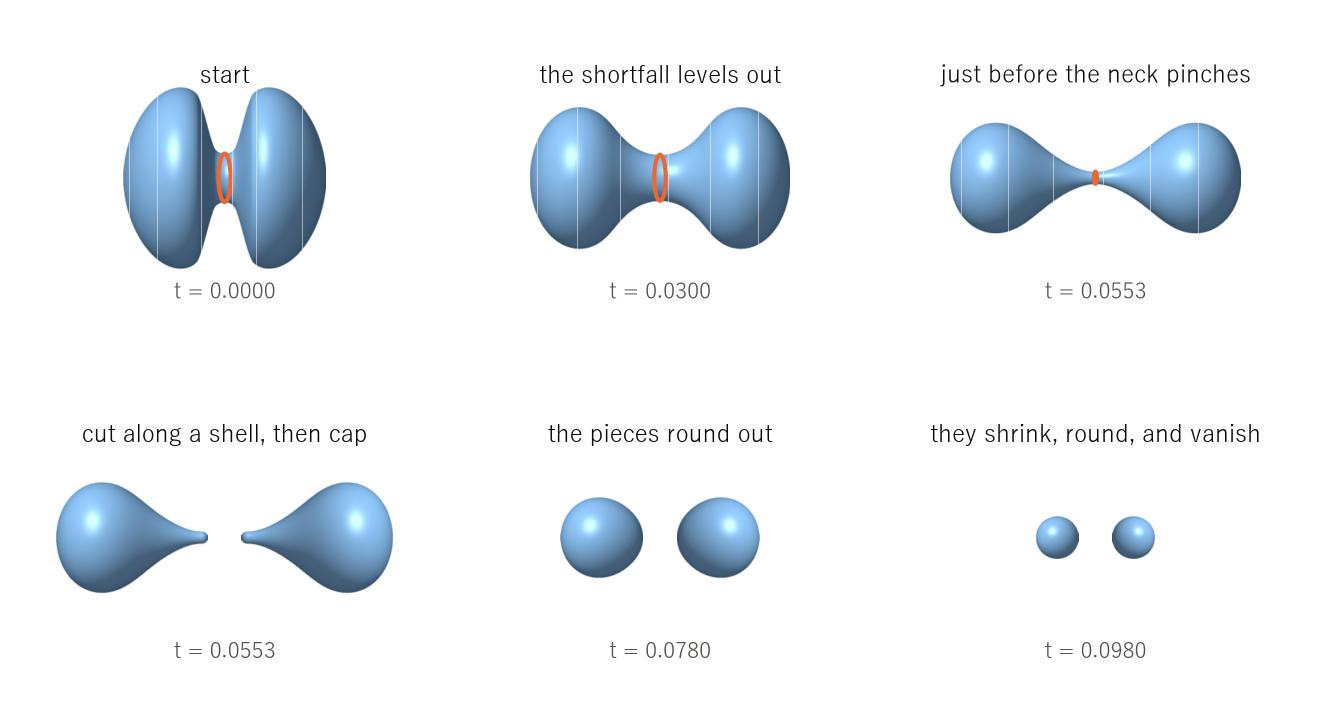
In the three-dimensional shape, a shallow waist disappears and the whole rounds out, while a deep one pinches. For this waist shape the boundary lies near a = 0.66. With grids of 200 and 300 points alike, a = 0.6563 rounded out and a = 0.6656 pinched. The times until pinching, or until rounding out and vanishing, are as follows.
| a | initial neck radius | outcome | time |
|---|---|---|---|
| 0.50 | 0.5000 | rounds out and vanishes | 0.1742 |
| 0.65 | 0.3500 | rounds out and vanishes | 0.1396 |
| 0.70 | 0.3000 | the neck pinches | 0.1185 |
| 0.80 | 0.2000 | the neck pinches | 0.0553 |
| 0.90 | 0.1000 | the neck pinches | 0.0092 |
The time is when the neck radius falls below 0.05, or, after the neck has gone, when the overall radius falls below 0.08. “Pinches” is judged by the neck becoming thinner than 0.3 times the widest part.
In the two-dimensional shape the neck does not pinch, however deep the waist. The rate of area loss was 25.13222, 25.13227 and 25.13208 for depths 0, 0.5 and 0.8, while 8π = 25.132741. The three values agree to the third decimal place and differ from 8π by less than 0.01%.
Now the neck shell in three dimensions. In the flow with a = 0.8, I counted the rate of area loss of the neck shell.
| neck radius | shell area | rate of loss | ratio to 8π |
|---|---|---|---|
| 0.200 | 0.5022 | 10.424 | 0.415 |
| 0.150 | 0.2833 | 16.372 | 0.651 |
| 0.100 | 0.1255 | 19.198 | 0.764 |
| 0.070 | 0.0617 | 20.461 | 0.814 |
| 0.051 | 0.0323 | 21.218 | 0.844 |
| 0.030 | 0.0111 | 21.991 | 0.875 |
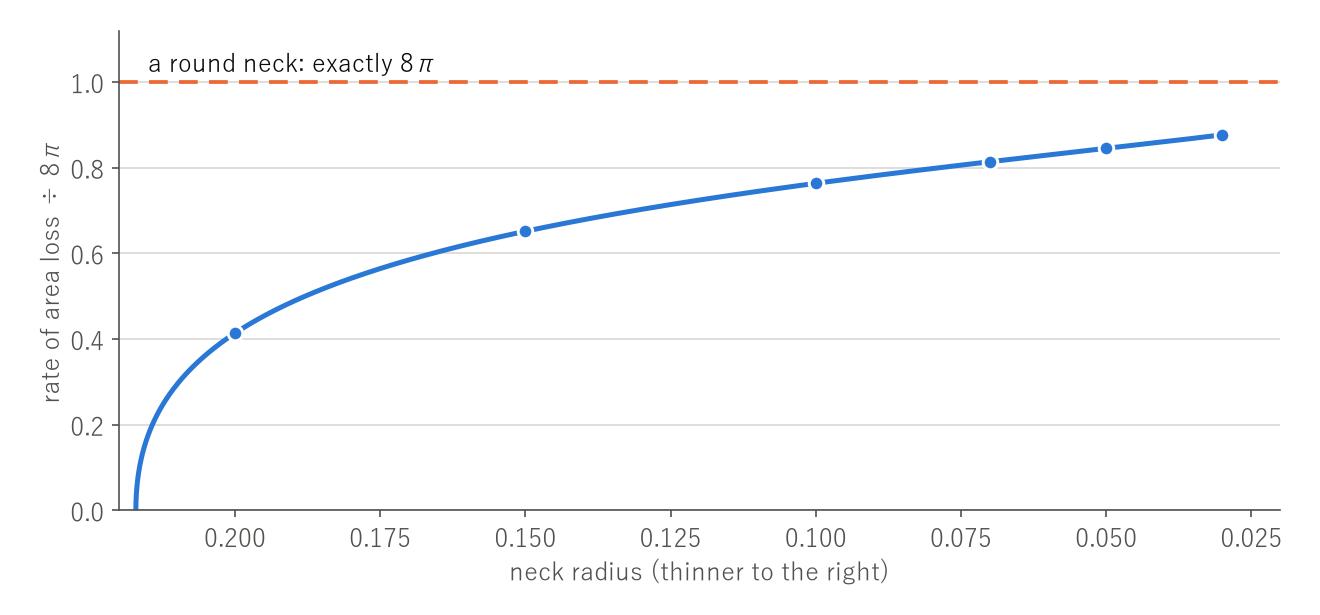
Something follows at once from the equation. At the thinnest point of the neck, Ass is 0 or more, so At cannot go below −8π. The neck shell cannot fall faster than 8π. A shell of area A needs at least the time A/(8π) to pinch off. For the neck shell, 8π is a speed limit. That is why the ratio in the table does not exceed 1.
Surgery: the cut is a shell
When a neck pinches, the equation stops. The method Hamilton conceived and Perelman completed is surgery. Cut the thinned neck, put round caps on the cuts, and continue the flow. The cut of a three-dimensional neck is S², the shell of the theorem. Space is cut along shells.
The surgery button of Experiment 4 cuts once the neck radius falls below 0.05. In a separate calculation, the shape with a = 0.8 was cut at time 0.05534. The two capped pieces had no neck, and both shrank roundly to radius 0.08 by time 0.10409, with a roundness (total length ÷ π ÷ widest part) of 1.0034. Across the surgery λ went from 29.259 to 29.301, so here too it did not fall.
This is, of course, the simplest case. The real proof has to show that a shape without rotational symmetry can be cut wherever a singularity forms, and that the number of cuts is finite in finite time. What made that possible is the next quantity.
Perelman’s quantities that never decrease
To continue the surgery, one has to foresee the shape of the regions where curvature grows. This is where Hamilton’s programme had stalled. In his 2002 paper Perelman showed quantities that never decrease along the flow.
One is λ, the lowest eigenvalue of the operator −4Δ + S, where S is the scalar curvature. Look at the graph of λ in Experiment 4. However the shape changes, the line never falls. Measured separately at higher precision, λ rose from 6.1827 to 29.7106 in the flow with a = 0.8, and in 167 measurements it fell 0 times. On the round S³ it comes to 6.000000, agreeing with the exact value 6.
The other is W.
$$\mathcal{W}(g,f,\tau)=\int\Bigl[\tau\bigl(S+|\nabla f|^{2}\bigr)+f-3\Bigr]\,(4\pi\tau)^{-3/2}\,e^{-f}\,dV$$A 4π is visible here. But this is not the 4π of the shell. (4πτ)−3/2 is the normalizing factor of a three-dimensional Gaussian, the reciprocal of three copies of the one-dimensional integral ∫e−x²/(4τ)dx = √(4πτ). It is the 4π of heat spreading out. In Paper 07 I wrote that this 4π and the 4π of the solid angle of a sphere are the same number at different addresses. Their derivations have no part in common.
On shapes that only shrink, W is a constant, and its value tells the shapes apart.
| shape | value of W | number | eW |
|---|---|---|---|
| flat ℝ³ | 0 | 0 | 1 |
| round S³ | log(2√π) − 3/2 | −0.234488 | 0.790976 |
| neck S²×ℝ | log 2 − 1 | −0.306853 | 0.735759 |
The neck’s value is the interesting one. The 2 in its log 2 comes from dividing the shell’s area 4π × 2τ by the 4πτ of heat. The 4π of the shell and the 4π of heat sit above and below the fraction line and cancel, leaving only 2. This is where the two numbers from different addresses meet. It is, however, a cancellation of numbers. It does not mean that the two have the same root.
With this quantity Perelman proved “no local collapsing”: seen at the scale of the curvature, the volume of a small ball does not vanish. This narrows down the shapes that appear when you magnify the neighbourhood of a singularity. In three dimensions the shapes that only shrink are ℝ³, the neck S²×ℝ and their relatives, and the round S³ and its relatives. A region of large curvature looks like a neck, a capped neck, or a piece that rounds out and vanishes. That is why the cut always has the shape of a shell.
One more thing matters here. That λ and W do not decrease is not limited to three dimensions. Perelman wrote in the abstract of his paper that this monotonic expression is “valid in all dimensions and without curvature assumptions”. The never-decreasing quantity does not know about 3. The 4π inside W, too, stays 4π when the dimension changes. Then where are the parts that do know about 3?
Vanishing in finite time: where the shell’s 4π works
If the flow simply went on forever after repeated surgery, nothing would follow. What the Poincaré conjecture needs is that on a space where all loops shrink, the flow vanishes entirely in finite time. Once it has vanished, the original space is known to be the pieces that vanished, joined together.
There are two roads to this step. The Gauss–Bonnet theorem appears on both.
One is Perelman’s 2003 paper. It looks at the area A of the smallest disk spanning a loop. Applying the Gauss–Bonnet theorem to the disk gives the following inequality, where Smin is the minimum of the scalar curvature over the whole space. The 2π is the same number as the total curvature of a hemisphere.
$$\frac{dA}{dt}\le-2\pi-\frac{1}{2}\,S_{\min}\,A$$The other is the method of Colding and Minicozzi, which uses the shells themselves. Sweep the space with two-dimensional shells, as in Experiment 1. A sweep starts from a point and ends at a point. There are countless ways to sweep. Each sweep has a largest shell, so look for the sweep that makes it as small as possible. That value is the width w of the space. Under Ricci flow, the width obeys the following inequality.
$$\frac{dw}{dt}\le-4\pi+\frac{3}{4\,(t+C)}\,w$$About the −4π on the right-hand side, the two authors write this in their paper.
“The 4π in (1.6) comes from the Gauss-Bonnet theorem.”
Colding & Minicozzi, Width and finite extinction time of Ricci flow (2008)
This is the total curvature of the shell. On the largest shell, the rate of area loss is as follows. The shell is a minimal surface, KΣ is its curvature, and |A|² is the size of its second fundamental form.
$$\frac{d}{dt}\,\mathrm{Area}(\Sigma)=-\int_{\Sigma}K_{\Sigma}\,dA-\frac{1}{2}\int_{\Sigma}\bigl(|A|^{2}+S\bigr)\,dA$$The first term is −4π, regardless of the shape of the shell or of the space, as you saw in Experiment 2. On round examples it divides up as follows.
| place | rate of area loss | number |
|---|---|---|
| equatorial shell of the round S³ | −16π = −4π − 12π | −50.265482 |
| shell of the round neck S²×ℝ | −8π = −4π − 4π | −25.132741 |
Every case contains −4π. The second term comes from the bending of the space, and even if the scalar curvature goes negative it is held down by the term 3/(4(t+C)) w. Integrating the inequality says that the width would become negative in finite time. A width cannot be negative. So the flow has to end before then.
Where is the condition on loops used? The two authors write that it is only in the fact that the width is greater than 0.
“This positivity is the only place where the assumption on the topology of M is used.”
The same paper
On a space where all loops shrink, a sweep by shells cannot be collapsed to a point, and the width cannot be 0. The logic of this step is no more than that. Loops keep the width positive, the shell’s 4π wears the width down, and because the two cannot both continue, the flow ends in finite time.
Divide a ball into shells, and the same 4π sits on every shell. The scene I chose as my starting point stands almost unchanged at the last push of a hundred-year question. Space is swept by shells, every shell carries 4π whatever its shape, and that 4π wears the width away.
Let me set down the addresses of the two 4πs.
| the 4π of the shell | the 4π of heat | |
|---|---|---|
| source | total curvature of a sphere (Gauss–Bonnet), area of a sphere | the Gaussian integral (spreading of heat) |
| place in the proof | the −4π of finite extinction, the −8π of the neck | (4πτ)−3/2 in W |
| when the dimension changes | gone for the shell in four dimensions | stays 4π, the exponent 3/2 becomes d/2 |
| dimensions where it works | three-dimensional space, with two-dimensional shells | all dimensions |
Sorting the parts of the proof by whether they know about 3 gives this table. It applies the yardstick of Paper 114 to the parts of the proof.
| part | dimensions where it works |
|---|---|
| the equation of Ricci flow | all dimensions |
| λ and W do not decrease | all dimensions |
| all of curvature can be written with Ricci curvature (3 = 3) | 3 (also readable in 2) |
| positive curvature wins where curvature is large (the Hamilton–Ivey estimate) | 3 |
| the neck’s cross-section is S², and shell area obeys a closed equation | 3 |
| the total curvature 4π of the shell wears the width down | 3 |
Perelman’s never-decreasing quantities work in every dimension. They could solve a three-dimensional question because the parts that know about 3 were separately in place. The last two of those parts come directly from the shell being two-dimensional.
Loops: what finally selects the sphere
Suppose the flow has vanished entirely. The pieces that vanish are the spaces of constant curvature S³/Γ and S²×S¹, and the original space is these joined together. S³/Γ is S³ folded up by a finite group Γ.
A space of constant curvature looks the same from every point. Measured from anywhere, the shell area follows the same formula 4π sin²r. To the eye of the theorem’s shells, none of them can be told apart from S³. Then what selects S³? Let the shell grow and you will see. In every space other than S³, the shell meets itself on the way.
Poincaré’s counterexample of 1904 comes back here. Take a dodecahedron and glue opposite faces with a twist of 36°, and you have that space (Weber and Seifert showed this form in 1933). In the same way one can glue a cube with a twist of 90° and an octahedron with a twist of 60°. All have constant curvature and are S³ filled with copies of one solid.
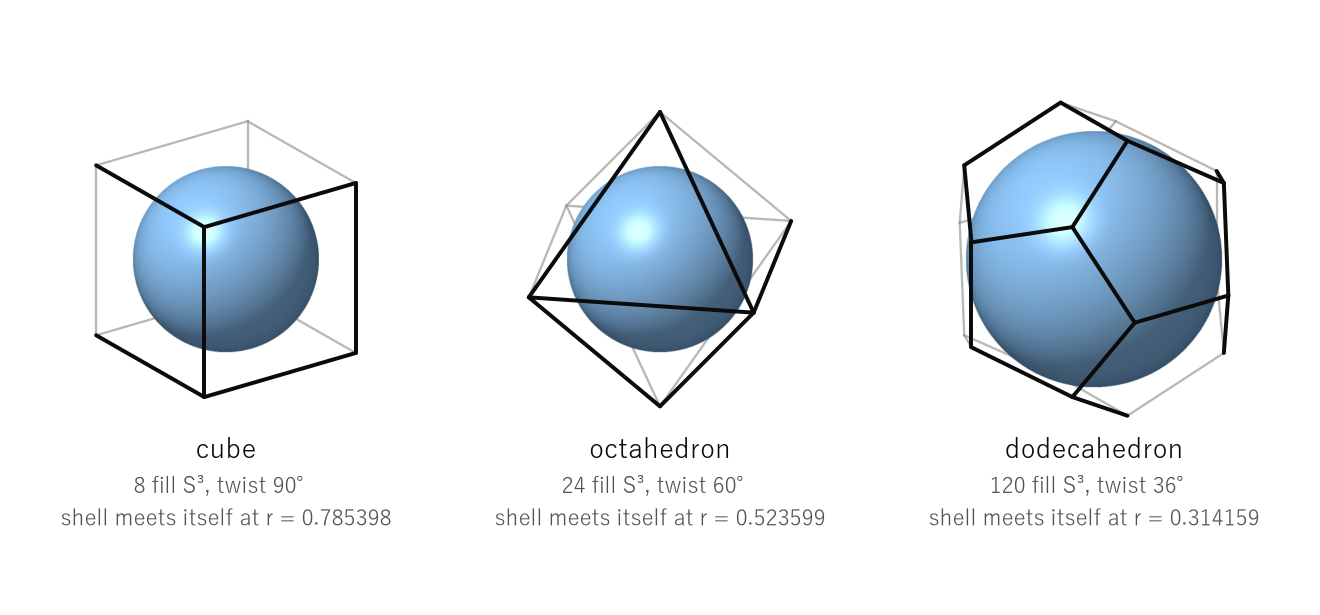
Choose a solid and widen the shell with the slider. Drag to turn the solid.
- Shell left
- Shell area
- Shell area in S³
- Volume of the space
- Shortest loop that cannot shrink
- Copies filling S³
| solid | faces | twist | copies filling S³ | radius where the shell meets itself | radius where the shell is gone | volume | shortest loop |
|---|---|---|---|---|---|---|---|
| cube | 6 | 90° | 8 | 0.785398 | 60° | 2.467401 | 1.570796 |
| octahedron | 8 | 60° | 24 | 0.523599 | 45° | 0.822467 | 1.047198 |
| dodecahedron | 12 | 36° | 120 | 0.314159 | 22.24° | 0.164493 | 0.628319 |
I built the finite quaternion groups (of orders 8, 24 and 120) and confirmed by calculation that they close as groups, that their nearest-point regions are these solids, that the volumes are 2π² ÷ order, and that the twists are the angles in the table. Radii are distances from the centre in radians. The “radius where the shell is gone” is the distance to a vertex, given in degrees. The 8 cubes are the surface of the tesseract, the 24 octahedra that of the 24-cell, and the 120 dodecahedra that of the 120-cell.
Compare two columns of the table. The radius where the shell meets itself is exactly half the length of the shortest loop that cannot shrink. A shell meets itself on the far side when two shortest paths from the centre join up into one closed loop. A shell meeting itself and a loop that cannot shrink are one fact said in two ways.
In S³ the shell never meets itself until it closes at the south pole at r = π. Among spaces of constant curvature, S³ alone lets the shell grow safely to the end. The theorem of Killing (1891) and Hopf (1926) is the reverse side of this: a closed space of constant curvature in which every loop shrinks can only be the sphere.
That closes the road. A space where all loops shrink cannot contain a piece with a loop that cannot shrink. S²×S¹ has such a loop, and so does every S³/Γ other than S³. The only piece left is S³, and joining copies of it gives S³.
Let me line up the road in the order of the shells. This is the order of the reading, not of the logic of the proof.
- The n = 2 uniqueness theoremThe only density that makes every shell weigh the same is 1/r², which in three dimensions is the same formula as the shell’s curvature
- The Gauss–Bonnet theoremThe total curvature of a shell is 4π for every shape
- The expansion of small shellsEvery space starts from 4π, and curvature is the shortfall from it
- HamiltonThe flow levels the shortfall. Because 3 = 3, nothing is left unlevelled
- Necks and surgeryThe neck shell cannot lose area faster than 8π, and space is cut along shells
- PerelmanThe never-decreasing quantities narrow down the shape of singularities
- Finite extinctionLoops keep the width positive and the shell’s 4π wears it down. The flow ends
- Killing and HopfThe pieces left have constant curvature, and loops select S³
Why the sphere?
If every loop shrinks, why is it the sphere? In the language of shells the answer has three steps.
- The flow carries the shape to spaces in which shells grow by the same formula from every point. The shortfalls can be levelled because in three dimensions they are the whole of the curvature.
- The shell’s total curvature 4π makes the pieces vanish in finite time. On a space where all loops shrink, the width cannot reach 0, so it is the flow that ends.
- Among the pieces left, S³ alone lets a shell grow all the way without meeting itself. In a space of constant curvature, “every loop shrinks” and “the shell does not meet itself” are the same thing.
The theorem says “the same on every shell”. S³ is the space in which that shell grows from the north pole to the south pole without once meeting itself. That the answer to Poincaré’s question is the sphere reads like this in the language of the theorem.
Four dimensions: the shell becomes a 3-sphere
Go up one dimension. The shell of four-dimensional space is S³. The answer to the three-dimensional Poincaré conjecture becomes, in four dimensions, a shell. The theorem exists in four dimensions too: the density that makes every shell weigh the same is 1/r³, and the shell’s weight is 2π² (Paper 08).
But this shell does not close. Curvature × area is 2π²r, and the radius remains. The Euler number of S³ is 0, and there is no number corresponding to total curvature at all; the Euler number of a closed odd-dimensional space is always 0. The 4π of the shell, which drove the proof in three dimensions, does not exist on the shell of four dimensions (the number that can be fixed in four dimensions comes in a later section).
Instead S³ has another structure, the Hopf fibration. The whole of S³ can be filled with circles that do not meet. Each circle corresponds to one point of a sphere of radius 1/2. In the S³ of radius R, the area of the base times the length of the circle is exactly the volume (Paper 08).
$$\pi R^{2}\times 2\pi R=2\pi^{2}R^{3}$$At radius 1 this is π × 2π = 2π². The base area is π, not 4π. At radius 2 both base and circle are 4π, and the volume splits as 4π × 4π = 16π². But this agreement compares an area with a length, so the radius at which it happens moves when the unit of length changes. What does not move is that doubling the radius multiplies the volume by 8.
Drag to turn. Move the radius, and choose the circles shown and the way of gluing.
- Base area
- Circle length
- Product
- Volume of the space
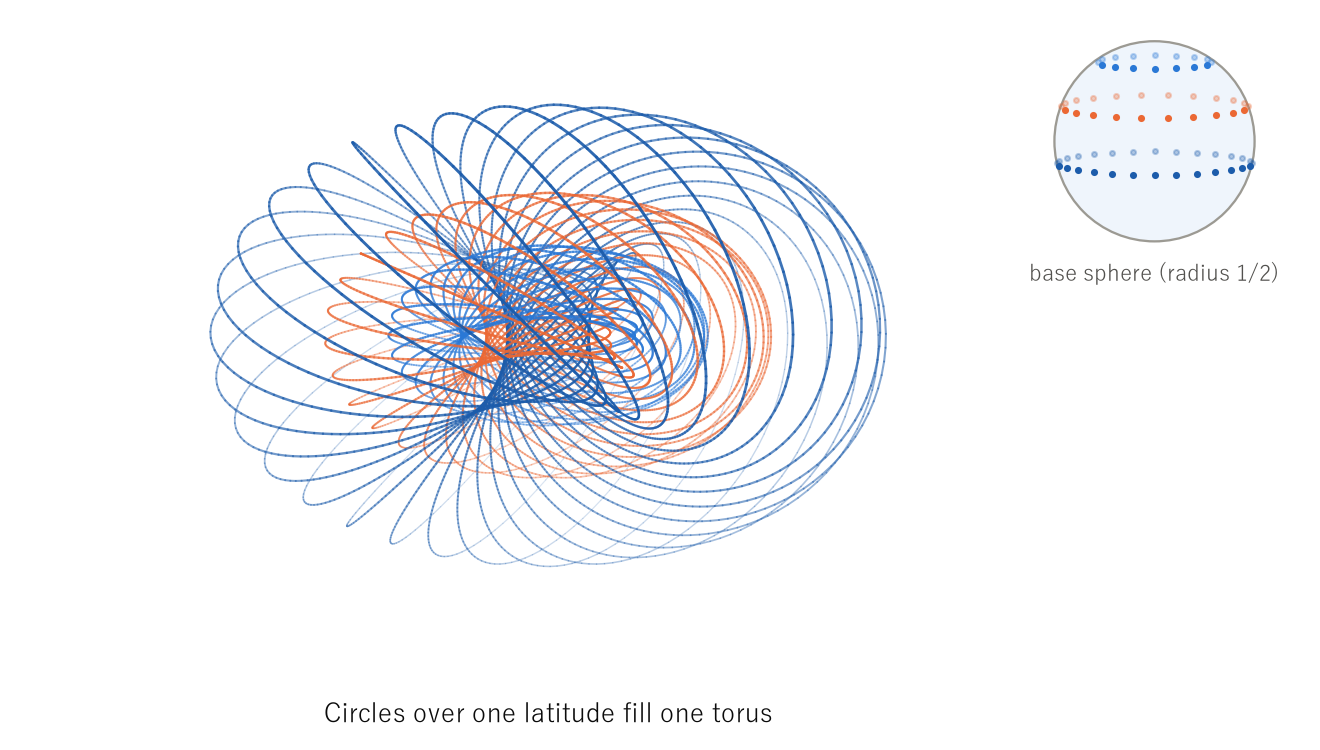
Any two circles link exactly once. Measured by the Gauss integral, the linking number was 1.000001. This linking separates the sphere from a mere product. As far as the product of volumes goes, dividing S³ in another way gives the same 19.739209. The product does not tell the fillings apart; the linking number does (Paper 1068). Here too, what numbers did not separate, loops separate.
Cut each circle into p equal parts and glue, and you get the lens space L(p,1). Its volume is 2π²/p, and the shell meets itself at radius π/p: 1.570796, 1.047198 and 0.628319 for p = 2, 3 and 5. The circle’s length becomes 2π/p, and that circle is a loop that cannot shrink. The gluing of the Hopf fibration and the spaces of Experiment 5 belong to the same family.
Why only dimension four stays open
The “Poincaré conjecture” is not one question for each dimension. It becomes different questions depending on whether “the same as a sphere” is read topologically or with smoothness included (Paper 1003).
| dimension | topological question | smooth question |
|---|---|---|
| 1, 2 | classical | classical |
| 3 | Perelman (2002–2003) | Perelman (in dimension 3 the two questions are the same) |
| 4 | Freedman (1982) | open |
| 5, 6 | Smale and others (1961–) | solved (one sphere) |
| 7 and up | Smale, Newman and others | many dimensions have several spheres (28 in dimension 7) |
Counting the smooth question in dimensions 1 to 139 gives 8 dimensions with one sphere, 1 undecided, and 130 with exotic spheres. The undecided one is dimension 4. What remains unsolved is not a high dimension but exactly dimension four.
Why four? One reason is addition. The heart of the proofs in five dimensions and up is the Whitney trick, which removes two intersection points by means of a two-dimensional disk. The disk being two-dimensional, in spaces of dimension five or more it does not meet itself in general position. In four dimensions it meets itself in exactly points, because 2 + 2 = 4. Two random triangles meet in ℝ⁴ with frequency 0.055670 and in ℝ⁵ with frequency 0 (Paper 1004). Freedman overcame this difficulty in the topological world. In the smooth world, Donaldson showed examples where the trick fails.
From the side of the shell, a second 4 comes into view. Curvature has the dimension of length to the −2. So when the first power of curvature is integrated over a two-dimensional surface, scale disappears: this was the 4π of Gauss–Bonnet. The square of curvature has the dimension of length to the −4, so scale disappears when it is integrated over four dimensions. That is the Yang–Mills ∫|F|², the foundation of Donaldson’s theory. The “first power of curvature on a two-dimensional shell” that supported the proof in three dimensions gives way, in four dimensions, to the “square of curvature on a four-dimensional space”.
Whether the 2 + 2 of the disk and the 2 × 2 of curvature are a 4 with one root, I have not established. They may be distinct roots that happen to overlap in one dimension. Paper 114, which sorted the objects of four dimensions, and Paper 254, on knots, look at the place of this dimension from other angles. ℝⁿ has more than one smooth structure only for n = 4, and then uncountably many.
From the side of Ricci flow, too, four dimensions is another world. The 10 components of Weyl curvature cannot be read by the shortfalls. When the neck’s cross-section becomes three-dimensional, the term 2ψs² remains in the equation above. And there is no total curvature of the shell. The never-decreasing W works in four dimensions, but the parts that knew about 3 do not carry over.
Move the slider to change the dimension d of the space. In each of the three panels, find where the two lines cross.
- Theorem exponent
- Directions / planes
- Shell area
- All curvature / Ricci
- Weyl components
- Power of r in curvature × shell area
- Poincaré conjecture

All three pairs cross at d = 3: the theorem exponent d − 1 and the curvature exponent 2, the numbers of directions and planes, the shell area and 4π. Even so, I do not gather the three into one root. Each stands at 3 for its own reason. Not calling things one root merely because numbers overlap has been my rule since Paper 300. That separate reasons all point at 3 is, however, itself a countable fact.
The number that can be fixed first in four dimensions: the total and the share of W
Up to here I have written that the shell of four dimensions has no number like 4π. Does that mean four dimensions has no number to fix first? It has one. The space itself holds it, not the shell. On a closed four-dimensional space, the integral of the curvature squared is fixed by the Euler number χ alone (the four-dimensional form of Chern’s theorem).
$$\int Q\,dV+\int\|W\|^{2}\,dV=8\pi^{2}\chi$$Q is built from the scalar curvature and the trace-free Ricci curvature, and W is the Weyl curvature. On the round S⁴, W is 0; multiplying Q = 6/r⁴ by the area 8π²r⁴/3 makes the radius disappear and leaves 16π², at radius 1 and at radius 3 alike. What happened with the 4π of the shell in three dimensions happens again one dimension up. This 16π² is not read as (4π)², though: nothing here makes 4π appear twice (Paper 48).
However the metric moves, the total does not. Only the division between Q and W moves. Write f for the fraction of the total held by W. It depends neither on scale nor on conformal changes.
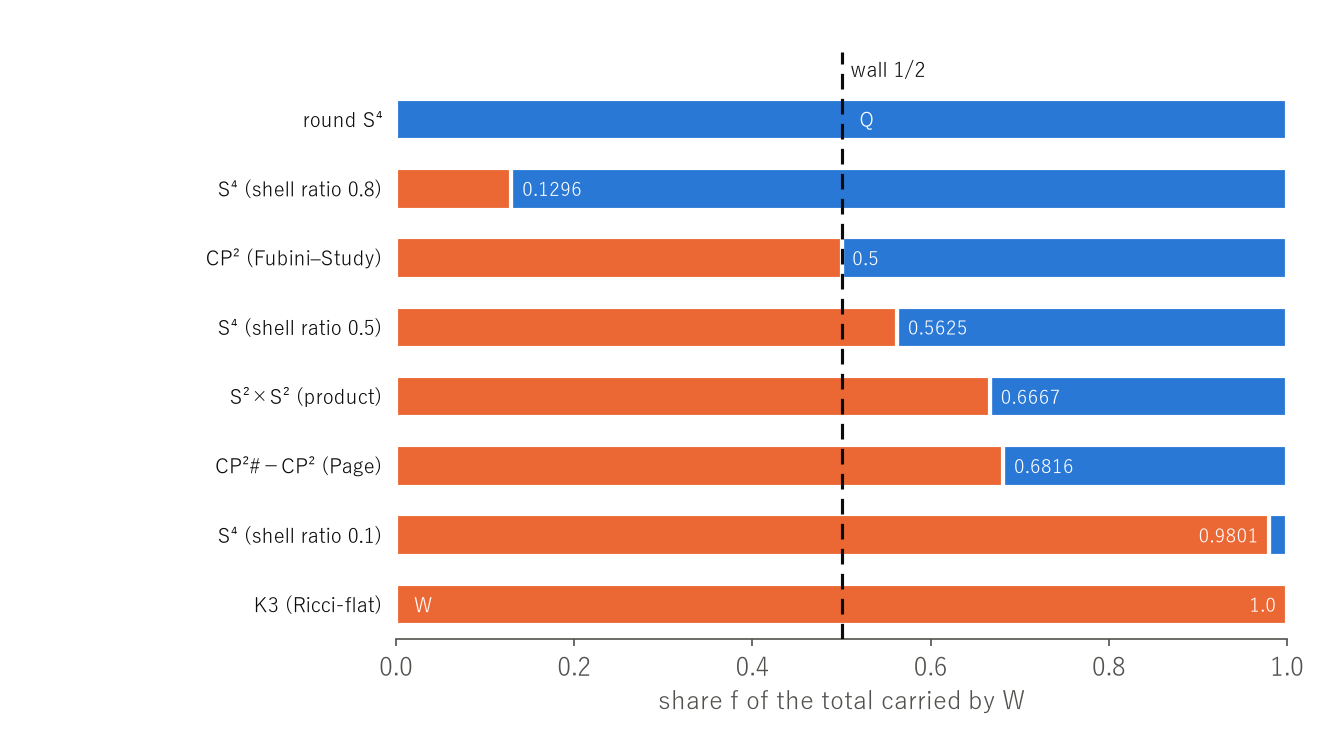
The theorem of Chang, Gursky and Yang (2003) is short when written with f. If the Yamabe constant is positive and Q beats W (f < 1/2), the space is S⁴ or RP⁴. There is a wall at one half. Its value is set by CP², which has exactly f = 1/2. Turned around: if an exotic S⁴ exists, then W holds more than half of the total for every metric with positive Yamabe constant.
Through Kuiper’s theorem, the smooth four-dimensional Poincaré conjecture is the same question as this one: does every space homeomorphic to S⁴ carry a metric with W = 0? On S⁴ the two chiralities of W hold equal amounts, so removing one half removes the other.
I computed this share on spaces made of stacked S³ shells (Paper 1105). Write v for the ratio of the thickness of the Hopf circle to the size of the base. Then W is written by v alone, and the size of the shell disappears from the formula. The total is decided by how the shells close. An end where the shell collapses to a point holds 8π², an end where only the circles collapse and a surface remains holds 16π², and a neck in between holds 0. S⁴ closes with two points, and that is where its 16π² comes from. In this family only S⁴ has no surface.
The difference of the two chiralities of W is an exact derivative. From this comes the following inequality for every shell, where t is the conformal time.
$$f\ \geq\ (1-v^{2})^{2}+2\Bigl(\frac{dv}{dt}\Bigr)^{2}$$The most squashed shell sets the floor under the share of W. The shell of four dimensions has no number for the total, but it has a number for its shape (the eta invariant), and that is the floor. This (1−v²)² agrees, with ratio at least 0.99996, with the value counted by another road from the eigenvalues Hitchin found in 1974. The space exactly on the floor at a turning shell has the shape of two balls of the Pedersen metric placed back to back.
Move the ratio v₀ of the most squashed shell and the length L of the neck inserted there.
- share f of W
- share of Q
- floor of the shell
- sign of the Yamabe constant
Beyond the wall, everything is still the true S⁴. f can exceed 1/2 with the scalar curvature positive everywhere, and with a long neck it exceeds 1 as well (shell ratio 0.5, neck length 6, f = 1.125). The wall says that on the near side there is a sphere; it does not say that beyond it there is not. The wall has only one side. The f of one metric does not tell what the space is. If anything can tell, it is the infimum of f on that space.
Lowering f, the metrics where it stops (Bach-flat metrics) are bound, when they have an end closing at a point, to have one chirality of W vanish. On S⁴ in this family the only metrics that stop are those conformal to the round one. Other stopping metrics exist only on spaces with ends closing on a surface, and the Page metric on CP²#−CP² (f = 0.68155171) is an example. On S²×S², Gursky’s theorem (1998) makes the f = 2/3 of the product metric the infimum.
This is neither a proof of the conjecture nor a way to solve it. Every space in this family is already known to be S⁴, CP² or the like, and no exotic S⁴ enters. What has been found is the accounts around the problem. The total is fixed by a number, so a difference, if there is one, lies on the side of the division.
Perelman
Grigori Perelman was born in Leningrad in 1966. On 11 November 2002, 10 March 2003 and 17 July 2003 he posted the papers of the proof as preprints on arXiv. A footnote on the first page of the first paper reads as follows.
“I was partially supported by personal savings accumulated during my visits to the Courant Institute in the Fall of 1992, to the SUNY at Stony Brook in the Spring of 1993, and to the UC at Berkeley as a Miller Fellow in 1993-95. I’d like to thank everyone who worked to make those opportunities available to me.”
Perelman (2002), footnote
The proof was checked in detail over several years by three groups: Kleiner and Lott, Morgan and Tian, and Cao and Zhu. Small gaps were found, and all could be filled by his own methods.
Perelman resigned from the Steklov Institute in December 2005, declined the Fields Medal in 2006, and in 2010 declined the Millennium Prize of the Clay Mathematics Institute. Among his reasons, he is reported to have said in effect that Hamilton’s contribution was as great as his own. Hamilton died on 29 September 2024.
I hold Perelman in very great respect. He found never-decreasing quantities where no one had looked, closed a hundred-year question in three preprints, mentioned only in a one-line footnote that he had lived on savings, and ended that line with thanks.
What is known, and where my own work begins
What is known. The proof of the Poincaré conjecture is Perelman’s work. Ricci flow is Hamilton’s work. The Gauss–Bonnet theorem, the expansion of small shells (Gray 1973 and others), Milnor’s curvature formulas, the equations of rotationally symmetric flow, the inequalities of finite extinction, the values of W, the Killing–Hopf theorem, the Hopf fibration and the results in four dimensions (including the four-dimensional form of Chern’s theorem and the results of Kuiper, Chang–Gursky–Yang, Gursky, Hitchin, Pedersen and Page) are all known.
What my papers added. The n = 2 uniqueness theorem and its family in each dimension (Paper 01, Paper 08). Separating the addresses of the 4π of W and the 4π of the solid angle (Paper 07). Noticing that the radius of agreement in the Hopf split moves with the unit while the volume ratio 8 does not (Paper 08). Counting the table of categories and the self-intersections of disks (Paper 1003, Paper 1004). Writing W by the ratio v alone on the family of S³ shells, and counting that the most squashed shell sets the floor under the share of W and that the wall has only one side (Paper 1105).
What this page arranges anew. None of this is in a paper yet. Reading the density of the theorem as the curvature of the shell. Reading curvature as the shortfall from 4π and connecting it to the equal numbers of directions and planes. The form At = Ass − 8π of the shell-area equation, and that the extra term vanishes only for n = 2. That the 2 in the neck’s W comes from dividing the two 4πs. The reading that links the 4π of finite extinction to the shells of the theorem. The table sorting the parts of the proof by whether they know about 3. The table of radii at which shells meet themselves. All of these are combinations of published formulas, and I have not searched exhaustively for literature with the same arrangement.
What this page does not do. It is neither a new proof nor a simplification. Without the uniqueness theorem the proof would not change by a single letter. The shell’s 4π works in the form of the Gauss–Bonnet theorem and is not derived from the uniqueness theorem. The position of Paper 07, that what drives the flow is Ricci flow and simple connectivity, stands unchanged. To the open question in four dimensions I have added nothing.
Within the corpus
The Poincaré conjecture is a place my papers return to again and again. Here is a suggested reading order.
- Paper 01, “The Uniqueness Theorem of n = 2 for Spherically Symmetric Density Distributions”: the shell theorem itself.
- Paper 02, “The 4π Mass Cancellation Theorem”: the same fact written from the side of the integral.
- Paper 07, “A Structural Interpretation of the 3D Poincaré Conjecture via the n=2 Uniqueness Theorem and Perelman’s Ricci Flow”: the place of three conditions, and the two 4πs.
- Paper 08, “A Structural Interpretation of the 4D Poincaré Conjecture and Exotic Structures via the n=3 Uniqueness Theorem and Hopf Fibration”: 2π² and the Hopf split.
- Paper 103, “Flowing Geometry to Canonical Form”: dynamical uniqueness.
- Paper 110, “Ricci Flow Is a Renormalization Group Flow”: a bridge to Friedan’s theorem.
- Paper 114, “Which Objects Know They Are in Four Dimensions?”: what selects a dimension and what does not.
- Paper 119, “The Fourth Clock”: the time of Ricci flow is the square of a length.
- Paper 174, “Whose Singularity Is It?”: how Hironaka’s resolution differs from surgery.
- Paper 254, “That Knots Come Undone in Four Dimensions Is Not One Phenomenon”.
- Paper 300, “The Three Hundredth Census: Whether Two Things Share a Root Is Decidable”: the test of the separator.
- Paper 1003, “The Poincaré Conjecture Is a Different Question in Each Category, and Only Dimension Four Stays Open in Both PL and Smooth”.
- Paper 1004, “The Disk That Cancels Intersections Avoids Itself from Dimension Five Up and Meets Itself in Points Only in Dimension Four”.
- Paper 1068, “Even When the Volume Product Is the Same, the Linking Number of the Fibres Tells the Bundle Apart”.
- Paper 1092, “The ‘2’ of the Inverse-Square Density Is Two 2s, and the 2 of the Shell Mass Meets the 2 of the Horizon Balance Only in Three Dimensions”.
- Paper 1104, “A Circle of Radius 1000 km Drawn on the Earth Falls 25.77 km Short of 2πr, While a Circle on a Cylinder of Rolled Paper Falls Short Not at All”: the two-dimensional version of the shortfall.
- Paper 1105, “On the Four-Sphere, Q and W Share 16π², and the Most Squashed Shell Sets a Floor under the Share of W”: the number that can be fixed first in four dimensions, and its division.
An article that measures the same shortfall on the Earth is “A Circle of Radius 1000 km on the Earth Falls 25.77 km Short”. The starting theorem is in “The n = 2 Uniqueness Theorem”, and the idea of distinct roots is in “What Is a Separator?”.
There is a book on the same subject, Reading the Poincaré Conjecture Through Spherical Shells (Google Play Books). The book keeps formulas to a minimum and explains, dimension by dimension, the numbers carried by a shell. The reading of curvature as a shortfall, the shell-area equation, the 4π of finite extinction and the radii at which shells meet themselves are not in the book. I wrote this page so that it will be new to readers of the book as well.
Questions
Is this another proof of the Poincaré conjecture?
No. The proof is Perelman’s. This page reads where the number 3 and the 4π take effect in that proof.
Are the 4π of the shell and the 4π of heat really different?
Yes. The 4π of the shell is the total curvature of a sphere and comes from the shell being two-dimensional. The 4π of heat comes from the Gaussian integral and is the same in every dimension. They are the same number only, and their derivations have no part in common. Their standing above and below the fraction line in the neck’s value of W is a cancellation of numbers.
Why is the condition on loops needed?
In the language of shells it is needed in two places. First, it keeps the width from reaching 0, which forces the flow to end in finite time. Second, it selects S³ from the pieces of constant curvature that are left: the shell does not meet itself because there is no loop that cannot shrink.
What does the 3-sphere look like?
Two balls with their surfaces glued together (Figure 2). Another view is a space filled with circles (Experiment 6). Both are the same S³.
Is the Poincaré conjecture in four dimensions unsolved?
The topological question was solved by Freedman in 1982. The smooth question is, as of 2026, unsolved. Unlike in dimensions 7 and up, it is not known how many spheres there are in dimension 4. The total is fixed by topology, so a difference, if there is one, lies in how Q and W divide it (the total and the share of W).
How far can the calculations in the figures be trusted?
The experiments are coarse calculations on a grid of 200 points, and the last digits move. The instant of surgery lies outside the equation of the flow, so the theorem that λ does not decrease gives no guarantee there. The numbers in the text and tables come from separate calculations, whose procedure was tested against the round solution of the flow to 8 digits (a difference of 8.69 × 10⁻⁹ in three dimensions on a grid of 200). The boundary a = 0.66 is a value for this waist shape, not a universal constant.
Papers and sources
All the papers are published under CC BY 4.0. The record of Paper 01 is on its YOI record page.
These are the main works I checked for this page.
- Poincaré, H. (1904). Cinquième complément à l’analysis situs. Rendiconti del Circolo Matematico di Palermo.
- Killing, W. (1891); Hopf, H. (1926). Zum Clifford-Kleinschen Raumproblem: spaces of constant curvature.
- Hopf, H. (1931). Über die Abbildungen der dreidimensionalen Sphäre auf die Kugelfläche.
- Weber, C. & Seifert, H. (1933). Die beiden Dodekaederräume.
- Smale, S. (1961); Freedman, M. (1982); Donaldson, S. (1983, 1987): high dimensions and four dimensions.
- Kuiper, N. H. (1949). On conformally-flat spaces in the large. Annals of Mathematics.
- Chang, S.-Y. A., Gursky, M. J. & Yang, P. C. (2003). A conformally invariant sphere theorem in four dimensions. Publications Mathématiques de l’IHÉS.
- Hitchin, N. J. (1974). Harmonic spinors. Advances in Mathematics; Hitchin, N. J. (1997). Einstein metrics and the eta-invariant.
- Pedersen, H. (1986). Einstein metrics, spinning top motions and monopoles. Mathematische Annalen; Page, D. N. (1978). A compact rotating gravitational instanton. Physics Letters B.
- Gursky, M. J. (1998). The Weyl functional, de Rham cohomology, and Kähler-Einstein metrics. Annals of Mathematics.
- Gray, A. (1973). The volume of a small geodesic ball of a Riemannian manifold. Michigan Mathematical Journal 20.
- Milnor, J. (1976). Curvatures of left invariant metrics on Lie groups.
- Hamilton, R. S. (1982). Three-manifolds with positive Ricci curvature. Journal of Differential Geometry 17.
- Hamilton, R. S. (1995). The formation of singularities in the Ricci flow; Ivey, T. (1993): the Hamilton–Ivey estimate.
- Perelman, G. (2002). The entropy formula for the Ricci flow and its geometric applications. arXiv:math/0211159.
- Perelman, G. (2003). Ricci flow with surgery on three-manifolds. arXiv:math/0303109.
- Perelman, G. (2003). Finite extinction time for the solutions to the Ricci flow on certain three-manifolds. arXiv:math/0307245.
- Cao, H.-D., Hamilton, R. S. & Ilmanen, T. (2004). Gaussian densities and stability for some Ricci solitons: the values of W.
- Colding, T. H. & Minicozzi, W. P. (2005). Estimates for the extinction time for the Ricci flow on certain 3-manifolds and a question of Perelman. Journal of the American Mathematical Society 18.
- Colding, T. H. & Minicozzi, W. P. (2008). Width and finite extinction time of Ricci flow. Geometry & Topology 12.
- Angenent, S., Isenberg, J. & Knopf, D. (arXiv:1011.4868, arXiv:1208.4312): the equations of rotationally symmetric flow.
- Kleiner, B. & Lott, J. (2008). Notes on Perelman’s papers; Morgan, J. & Tian, G. (2007). Ricci Flow and the Poincaré Conjecture; Cao, H.-D. & Zhu, X.-P. (2006): verification of the proof.
- Ni, L. & Wallach, N. (2008); Cao, H.-D., Chen, B.-L. & Zhu, X.-P. (2008): classification of the shapes that only shrink.