Mathematics and physics have a number of famous, rock-solid theorems, such as Noether’s theorem and the Gauss–Bonnet theorem. They all make strong statements, but each one holds only inside its assumptions. Looking at what breaks when an assumption is removed often makes it clearer what the theorem is really saying.
In my papers I always try to write down what you have to change to turn one thing into another (I call it the separator). So I chose 38 famous theorems, sorted them into seven groups, and set out for each one what it says, what it assumes, and what breaks without the assumptions. I also counted how many of my 1,097 papers name each theorem in their main text.
The theorems my papers use most
The most frequent are Euler’s polyhedron formula (the Euler characteristic) and the Gauss–Bonnet theorem, with 32 papers each. Next comes my own uniqueness theorem with 21 (65 papers cite that Paper 01 in their references). 166 papers, 15.1% of the total, name at least one of the 38 theorems.
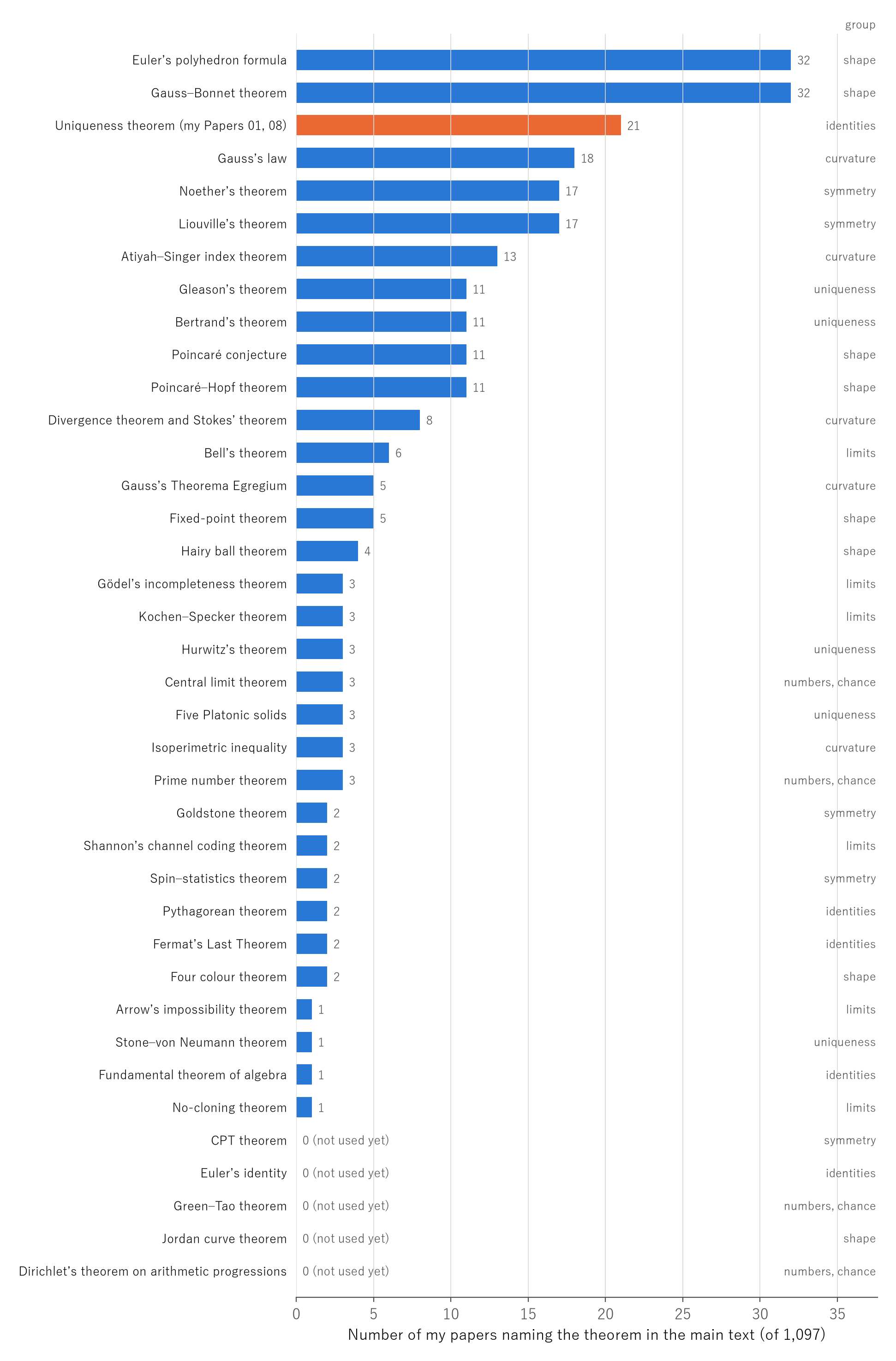
What I counted is the number of papers whose main text (before the references) mentions the theorem’s name, not how deeply they use it. Mentions of a different theorem with the same name (for example Hurwitz’s bound on approximation, Liouville’s theorem in complex analysis, or Bertrand’s paradox) were read and removed. Across the main texts there are 215 different names of the form “someone’s theorem, law, inequality or conjecture”.
1. Identities and counting: it must come out that way
Theorems saying that when you count numbers or shapes, the result is forced.
| Theorem (who, when) | What it says | Assumptions | Without the assumptions | My papers |
|---|---|---|---|---|
| Pythagorean theorem (ancient; proved in Euclid’s Elements) | In a right triangle, a² + b² = c² | a flat plane (Euclidean geometry) | On a sphere the hypotenuse gets shorter: c² is smaller than a² + b² | 2 (904 · 1016) |
| Euler’s identity (Euler, 1748) | eiπ + 1 = 0 | extending the exponential function to complex numbers (eiθ = cos θ + i sin θ) | With real numbers alone, ex is never negative | 0 |
| Fundamental theorem of algebra (Gauss, 1799) | An equation of degree n has n solutions among the complex numbers (counting repeats) | looking for solutions among the complex numbers | With real numbers alone, x² + 1 = 0 has no solution | 1 (520) |
| Fermat’s Last Theorem (Wiles, 1995) | For n of 3 or more, no positive whole numbers satisfy xⁿ + yⁿ = zⁿ | positive whole numbers, n at least 3 | For n = 2 there are infinitely many, such as 3² + 4² = 5² | 2 (642 · 1016) |
| Uniqueness theorem (my Papers 01 and 08) | In d dimensions, when a density falls off as the n-th power of the distance, every shell weighs the same only for n = d − 1 (2 in three dimensions, 3 in four) | spherical symmetry | If the shape is not a sphere, the weight of a shell changes with direction | 21 (1 · 8 · 1097) |
The last row is a theorem from my own papers, a preprint that has not been peer reviewed. I placed it here to measure it with the same ruler as the others (the assumptions, and what breaks without them).
2. Shape: unchanged by bending
Theorems about properties that do not change when a shape is bent or stretched like rubber (topology).
| Theorem (who, when) | What it says | Assumptions | Without the assumptions | My papers |
|---|---|---|---|---|
| Euler’s polyhedron formula (Euler, 1750) | For a polyhedron, vertices − edges + faces = 2 (this number is the Euler characteristic) | a shape without holes (the same shape as a sphere) | For a doughnut-shaped polyhedron it becomes 0 | 32 (128 · 224 · 1014) |
| Gauss–Bonnet theorem (Gauss, 1827; Bonnet, 1848) | Adding up the bending (Gaussian curvature) of a closed surface gives 2π × the Euler characteristic (4π for a sphere) | a smooth closed surface without an edge | If there is an edge, the bending of the edge must be added | 32 (91 · 316 · 1050) |
| Poincaré–Hopf theorem (Poincaré, 1880s; Hopf, 1926) | On a closed surface, the indices of the points where a flow (vector field) stops add up to the Euler characteristic | a closed surface without an edge, isolated stopping points | With an edge, a condition on the direction of the flow at the edge is needed | 11 (67 · 128 · 316) |
| Hairy ball theorem (Poincaré, 1885; Brouwer, 1912) | You cannot comb the hair on a ball flat without leaving a cowlick somewhere | a sphere of even dimension (such as the ordinary sphere) | On a doughnut surface, a circle or the three-dimensional sphere, it can be done | 4 (67 · 115 · 128) |
| Fixed-point theorem (Brouwer, 1911, and others) | A continuous map of a disc to itself always leaves some point unmoved | continuous, a closed shape without holes | On a ring (a shape with a hole) a simple rotation moves every point | 5 (161 · 622 · 1073) |
| Poincaré conjecture (posed in 1904; solved by Perelman, 2002–2003) | A closed three-dimensional shape in which every loop can be shrunk is the same shape as the three-dimensional sphere | closed, and every loop shrinks to a point | If some loop cannot shrink (as in the three-dimensional torus), the shape is different | 11 (7 · 8 · 1003) |
| Four colour theorem (Appel and Haken, 1976) | Four colours are enough to colour a map in the plane so that neighbours differ | the plane (or the sphere), each country in one piece | On a doughnut surface some maps need seven colours | 2 (303 · 538) |
| Jordan curve theorem (Jordan, 1887) | A closed curve in the plane that does not cross itself divides the plane into an inside and an outside | the plane | On a doughnut surface there are loops that do not divide it in two | 0 |
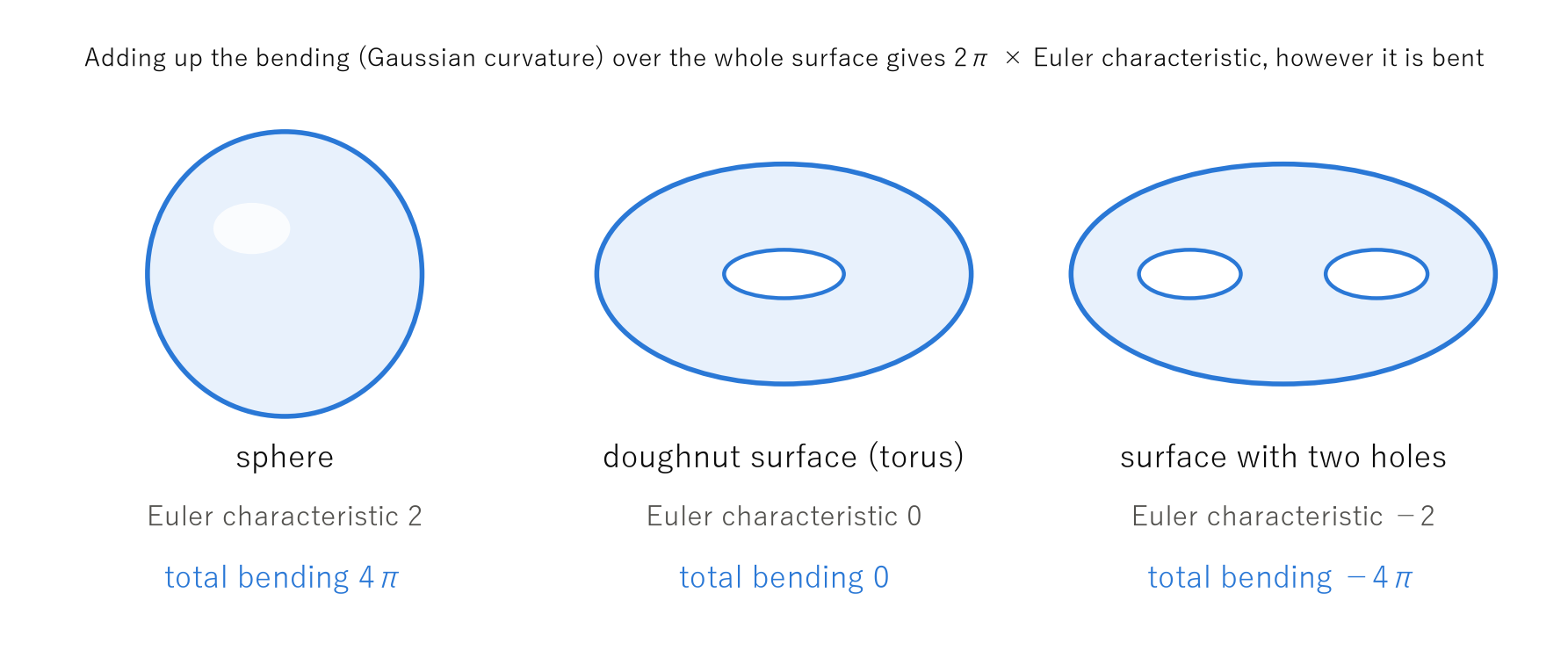
3. Curvature and integrals: measuring from inside, linking inside and edge
Theorems that measure the bending of a surface or space from within, and theorems that link what happens inside to what happens at the edge.
| Theorem (who, when) | What it says | Assumptions | Without the assumptions | My papers |
|---|---|---|---|---|
| Gauss’s Theorema Egregium (Gauss, 1827) | The Gaussian curvature of a surface is decided by measuring lengths within the surface alone (no need to look from outside) | Gaussian curvature (the product of the bendings in two directions) | The mean curvature cannot be decided without looking from outside; rolling up a sheet of paper leaves its Gaussian curvature at 0 | 5 (91 · 158 · 409) |
| Divergence theorem and Stokes’ theorem (Gauss, 1813; Ostrogradsky, 1826; Kelvin and Stokes, 1850–1854) | The total of what springs out inside equals the total that leaves through the edge | a smooth field and a region with an edge | If there is a singular point inside (such as a point charge), it must be counted separately | 8 (35 · 92 · 912) |
| Gauss’s law (Lagrange, 1773; Gauss, 1835) | The total electric field through a closed surface is proportional to the charge inside | a force falling off as the square of the distance (in three dimensions) | If not the square, the total changes with the size of the surface | 18 (1 · 2 · 1082) |
| Isoperimetric inequality (known since antiquity; rigorous proofs in the 19th century) | For the same perimeter, the circle encloses the largest area | a flat plane | On a curved surface the bound takes a different form | 3 (205 · 326 · 1007) |
| Atiyah–Singer index theorem (Atiyah and Singer, 1963) | The difference in the number of solutions counted with a differential equation is decided by the shape (topology) alone | an elliptic differential operator on a compact manifold | With an edge, a correction from the edge (the η invariant) is needed | 13 (70 · 128 · 1058) |
The “only for the square” of Gauss’s law is the same place as my uniqueness theorem (n = 2 in three dimensions), seen from another side. The Gauss–Bonnet theorem is contained in the Atiyah–Singer index theorem as a special case.
4. Symmetry and conservation: if nothing changes, something is kept
Theorems saying that when changing something leaves the laws the same (a symmetry), something is conserved.
| Theorem (who, when) | What it says | Assumptions | Without the assumptions | My papers |
|---|---|---|---|---|
| Noether’s theorem (Noether, 1918) | For each continuous symmetry that leaves the action unchanged, there is one conserved quantity | a system whose motion follows from an action (Lagrangian), a continuous symmetry | With friction nothing is conserved; for symmetries that differ from place to place (gauge), one gets identities instead of conservation laws (the second theorem) | 17 (80 · 107 · 310) |
| Liouville’s theorem (Liouville, 1838) | The volume in the space of positions and momenta (phase space) does not change with time | a system without friction (a Hamiltonian system) | With friction the volume shrinks | 17 (77 · 78 · 135) |
| Goldstone theorem (Nambu, 1960; Goldstone, 1961; general proof in 1962) | When a continuous symmetry breaks spontaneously, a massless wave (particle) appears | a symmetry that is the same everywhere (global) | With a gauge field the particle is absorbed and becomes heavy (the Higgs mechanism) | 2 (175 · 286) |
| Spin–statistics theorem (Fierz, 1939; Pauli, 1940) | Particles with half-integer spin cannot share a state (fermions); those with integer spin can gather (bosons) | relativistic quantum field theory, three-dimensional space | In a two-dimensional world, in-between particles (anyons) are possible | 2 (112 · 1087) |
| CPT theorem (Schwinger, 1951; Lüders, 1954; Pauli, 1955) | Swapping particles and antiparticles, mirroring space and running time backwards, all together, leaves the laws unchanged | local, relativistic quantum field theory | For theories that are not relativistic there is no such guarantee | 0 |
In Noether’s theorem, what can change while the laws stay the same corresponds to what is conserved:
| What can change while the laws stay the same (symmetry) | Conserved quantity |
|---|---|
| shifting time | energy |
| shifting place | momentum |
| turning the direction | angular momentum |
| turning the phase of a quantum wave | electric charge |
5. Uniqueness: under these conditions, only this
Theorems saying that once the conditions are set, the answer is fixed to one (or a few).
| Theorem (who, when) | What it says | Assumptions | Without the assumptions | My papers |
|---|---|---|---|---|
| Stone–von Neumann theorem (Stone, 1930; von Neumann, 1931) | There is essentially only one way to represent the quantum commutation relation of position and momentum | finitely many degrees of freedom, irreducible, strongly continuous (Weyl form) | With infinitely many degrees of freedom (quantum field theory) there are many representations that cannot be turned into one another | 1 (127) |
| Hurwitz’s theorem (Hurwitz, 1898) | Number systems in which you can multiply and divide while keeping lengths exist only in dimensions 1, 2, 4 and 8 (real numbers, complex numbers, quaternions, octonions) | division is possible and lengths multiply | In 16 dimensions (sedenions) two non-zero numbers can multiply to 0 | 3 (114 · 115 · 231) |
| Bertrand’s theorem (Bertrand, 1873) | The only central forces for which every orbit closes are the inverse-square attraction and the spring force | a force toward a centre, all bound orbits | For other forces the orbit slowly turns (precession) | 11 (15 · 28 · 1072) |
| Five Platonic solids (Euclid’s Elements) | In three dimensions there are only five regular polyhedra: tetrahedron, cube, octahedron, dodecahedron and icosahedron | three dimensions, no dents (convex) | In four dimensions there are six kinds; in five or more, three | 3 (114 · 209 · 224) |
| Gleason’s theorem (Gleason, 1957) | The only way to assign quantum probabilities is the square of the size of the wave (the Born rule) | three dimensions or more, an assignment that does not depend on how measurements are grouped | In two dimensions (one qubit) other assignments can be made | 11 (11 · 71 · 157) |
6. Patterns in numbers and chance: what appears when you gather many
Rules that appear when you gather many primes or many random fluctuations.
| Theorem (who, when) | What it says | Assumptions | Without the assumptions | My papers |
|---|---|---|---|---|
| Prime number theorem (Hadamard and de la Vallée Poussin, 1896) | The number of primes up to x is about x ÷ ln x | large x (the ratio approaches 1) | For small x the gap is noticeable | 3 (6 · 769 · 1018) |
| Dirichlet’s theorem on arithmetic progressions (Dirichlet, 1837) | If a and d have no common factor, a, a + d, a + 2d, … contains infinitely many primes | a and d have no common factor | With a common factor, at most one prime appears | 0 |
| Green–Tao theorem (Green and Tao, announced 2004, published 2008) | The primes contain arithmetic progressions as long as you like | finite length (as long as you like) | No arithmetic progression of primes goes on forever | 0 |
| Central limit theorem (from de Moivre, 1733, through Laplace, 1812, to Lyapunov, 1901) | Adding many unrelated fluctuations makes the distribution of the sum approach the normal (bell-shaped) distribution | independent, finite spread | For fluctuations with infinite spread (such as the Cauchy distribution) the result is not normal | 3 (187 · 190 · 655) |
7. What cannot be done: stating the limits
Theorems that say: however you try, this cannot be done. A clear limit also makes clear what can be done.
| Theorem (who, when) | What it says | Assumptions | Without the assumptions | My papers |
|---|---|---|---|---|
| Gödel’s incompleteness theorem (Gödel, 1931) | A consistent system that includes the arithmetic of whole numbers has statements it can neither prove nor refute | includes arithmetic, consistent, axioms listable by a machine | Some systems, such as the elementary geometry of the real numbers, settle every statement | 3 (189 · 259 · 525) |
| Arrow’s impossibility theorem (Arrow, 1951) | With three or more options, no way of combining votes satisfies a few simple fairness conditions all at once | three or more options, using rankings only | With two options, majority rule satisfies the conditions | 1 (184) |
| Bell’s theorem (Bell, 1964) | Schemes that fix the results in advance at each place (local hidden variables) cannot produce the quantum correlations (2√2 in the CHSH value; their limit is 2) | locality, free choice of measurement | Theories in which distant places are directly linked can reproduce them | 6 (160 · 227 · 1062) |
| Kochen–Specker theorem (Kochen and Specker, 1967) | One cannot assume that all quantities have values before measurement, independent of how measurements are grouped | three dimensions or more | In two dimensions one can | 3 (11 · 41 · 71) |
| No-cloning theorem (Wootters and Zurek; Dieks, 1982) | An unknown quantum state cannot be copied exactly | the state is not known in advance | A fixed set of orthogonal states can be copied | 1 (281) |
| Shannon’s channel coding theorem (Shannon, 1948) | Below the capacity of the channel, data can be sent with as few errors as you like; above it, not | long codes can be used | With short codes, errors remain | 2 (163 · 536) |
How the theorems connect
The seven groups are not separate. The Euler characteristic appears in both the Poincaré–Hopf theorem and the Gauss–Bonnet theorem, and Gauss–Bonnet widens further into the Atiyah–Singer index theorem. The hairy ball theorem follows from the Poincaré–Hopf theorem. Applying the divergence theorem to the electric field gives Gauss’s law, and its “only for the square” is where my uniqueness theorem sits.
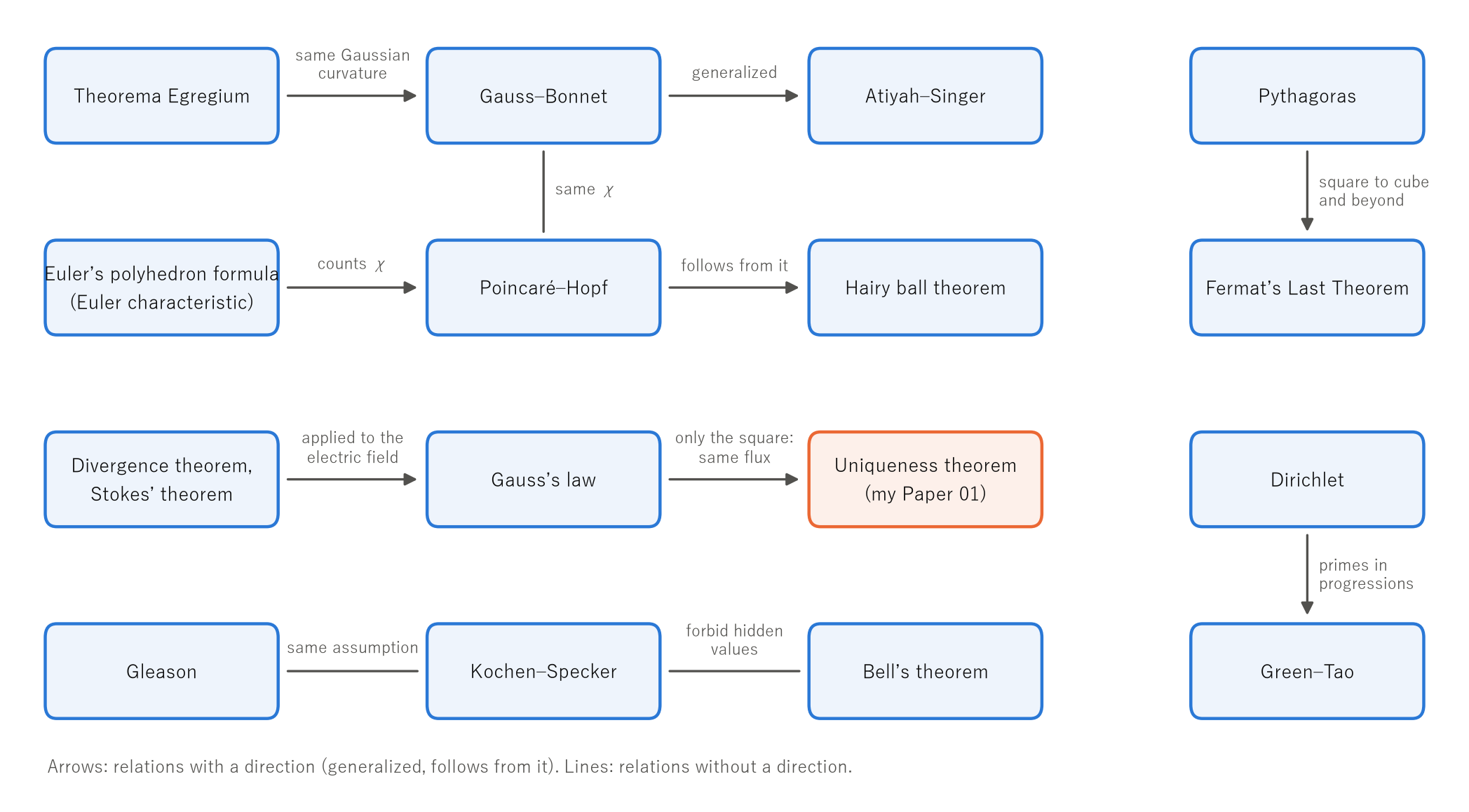
The two pairs in the right-hand column have the shape of a separator. Raise the square in the Pythagorean theorem to a cube or higher and, by Fermat’s Last Theorem, the solutions disappear. Dirichlet’s theorem says that an arithmetic progression contains infinitely many primes, but not that its terms are all prime; the Green–Tao theorem answers that progressions whose terms are all prime can be as long as you like, while keeping the assumption that they do not go on forever.
Timeline
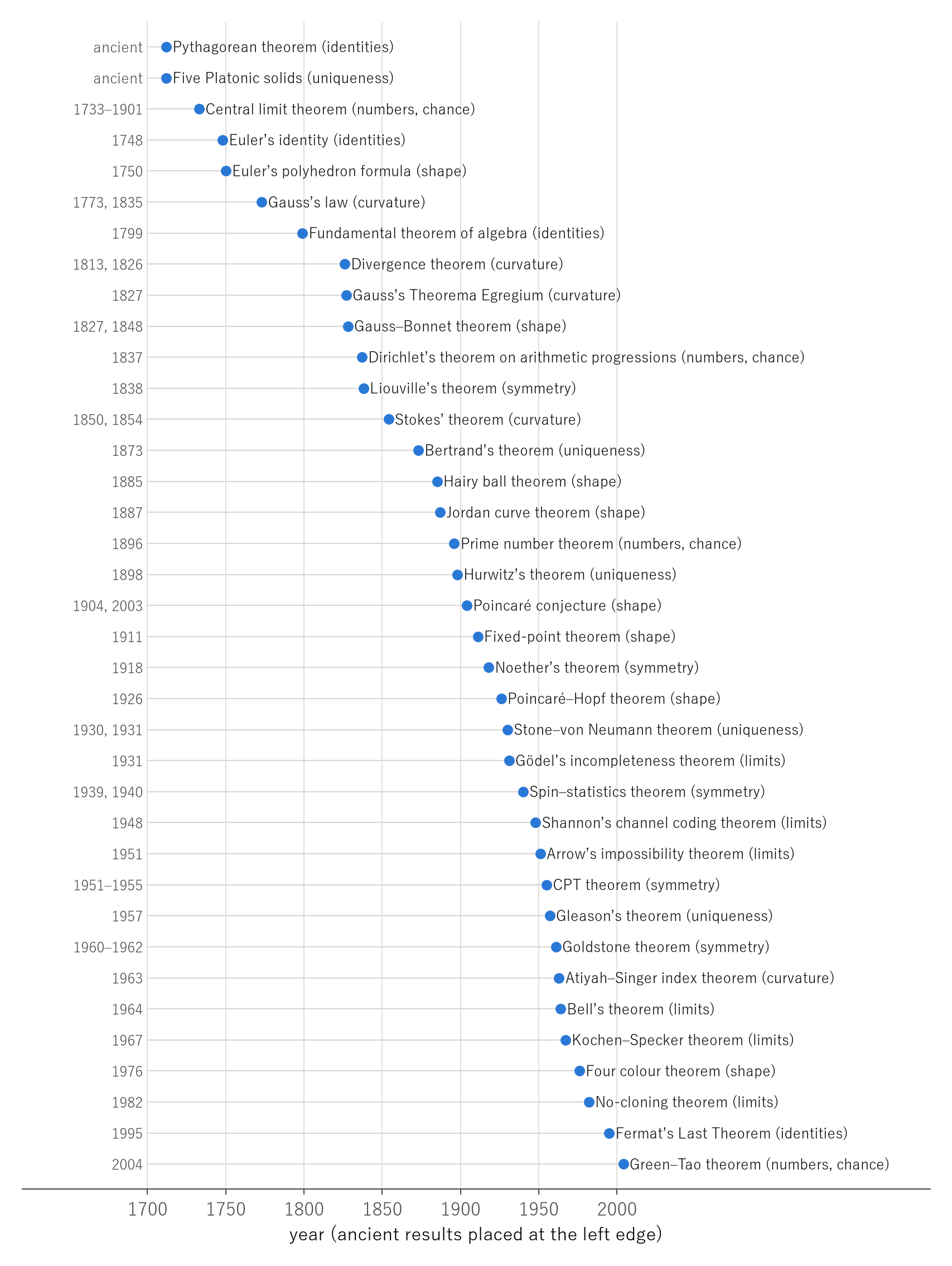
Many of the theorems on curvature and integrals date from the 19th century, and many of those on symmetry and the quantum world from the 20th. The newest, the Green–Tao theorem, was announced in 2004.
Famous theorems I have not used yet
Of the 38, five are not yet named in the main text of any of my papers: Euler’s identity, the Jordan curve theorem, the CPT theorem, Dirichlet’s theorem on arithmetic progressions and the Green–Tao theorem. Each makes it clear what breaks without its assumptions, so I am keeping them as seeds for future papers.
About this article
This article does not claim any new theorem. I shortened the statements of the theorems to make them easier to read, so please check their exact forms in the original sources or in textbooks. The names and years were checked against encyclopedias and the records of the original papers. The numbers of my papers were counted by machine over the main texts of 1,097 papers, removing by reading the mentions that refer to a different theorem with the same name. The uniqueness theorem is from my own papers, and all of my papers are preprints that have not been peer reviewed (the pages are in Japanese, with the paper PDFs in Japanese and English).
The earlier articles “A Map of Inverse-Square Laws” and “Add Up the Dots on Graph Paper, and the Answer Depends on the Shape” are written with the same ruler: what do you have to change to turn one thing into another?