Until now I have written many of my papers under the name “structural interpretation”. Rather than digging deep into one specialist field, my work mostly cuts across several fields and sets in order the physics and mathematics that already exist. Yet the n = 2 uniqueness of Paper 01 and the parity rule of Paper 1130 are not rereadings; they are statements with proofs. So how many papers in this body of work are not structural interpretations, and what does each of them say? This page is a ledger that answers that question.
I sort the papers into four standings: theorems of mathematics, laws that necessarily follow from the rules of placement, facts checked by calculation, and structural interpretations. Of the 122 papers read down to the theorems and proofs in the manuscripts, 13 are theorems of mathematics and 16 are laws that follow from the rules. For 13 of those 29, a computer has checked the proof line by line, as the manuscript states it, with the proof checker Lean, and the result is public in a repository on GitHub. The repository also holds 66 papers whose statements, shown in the manuscripts with numbers or tables, were recast as general theorems and proved (19 of them only in their core): 79 in all.
The papers on this page are preprints that I published myself; they have not been peer reviewed.
Key points
- Of the 1,131 papers with a Japanese manuscript, 110 call themselves a “structural interpretation” in the text. Of these, 92 are among Nos. 1 to 123; among the 1,009 papers from No. 124 on, only 18 do.
- There are four standings: A theorems of mathematics, B laws that necessarily follow from the rules of placement, C facts checked by calculation, D structural interpretations and readings of known theorems.
- Wording picked out 277 candidates, and 122 of them were read down to the theorems and proofs in the manuscripts and placed again. A has 13 papers (12 general theorems and 1 single identity), B has 16, C has 27 and D has 66.
- Of the 29 papers in A and B, a machine has checked the proofs of 13 in Lean, as the manuscripts state them. For the other 16, the proof in the manuscript has been read and checked.
- For another 66 papers, statements that the manuscripts show with numbers or tables were set up as general theorems and proved in Lean (19 only in their core). These are not theorems of the current versions of the manuscripts but material for raising them to theorems in the next versions.
- Having a proof and being a new statement are different things. By the reading, 11 of the 13 papers in A state things known from textbooks and elsewhere. What belongs to this body of work itself is the placement, m = 4π and the Yamagishi patch, and the series of books that counts 4π on top of it.
- Question
- Four standings
- How counted
- Ledger
- Checked by machine
- General form (66)
- Novelty is separate
- Scope
- References
The question: how far does “structural interpretation” reach?
On 21 November 2026 I scanned the wording of the 1,131 papers that have a Japanese manuscript (the medical papers are kept elsewhere and are not included). In the text, 110 papers call themselves a “structural interpretation”. Counted by bands of numbers, those papers cluster at the beginning.
| Numbers | Papers | Use the name |
|---|---|---|
| 1–11 | 11 | 9 |
| 12–60 | 48 | 28 |
| 61–123 | 63 | 55 |
| 124–300 | 177 | 2 |
| 301–600 | 300 | 3 |
| 601–900 | 300 | 0 |
| 901–1000 | 100 | 1 |
| 1001–1132 | 132 | 12 |
| Total | 1,131 | 110 |
“This body of work is made of structural interpretations” is true of roughly the first 120 papers. Around No. 124 the way of writing changes: most later papers set up one statement, such as “A is B and only B”, and lay it down after checking it by calculation. Most of the 18 later papers that use the name do so when citing earlier papers.
Not using the name, however, does not make a paper a proved theorem. The 1,021 papers without it mix theorems proved for every case, facts counted within the range examined, and papers that reread without saying so. Telling them apart needs a ruler for standings.
Four standings
| Standing | Says | Does not say | Examples |
|---|---|---|---|
| A theorems of mathematics | Shows by proof that something holds in every case | Whether it is right as physics, or whether it is new | Paper 01, Paper 1131 |
| B laws that follow from the rules | Derives formulas that necessarily hold under a chosen placement (m = 4π, G = 4π, ħ = 1/(4π) and so on). Accept the placement, and anyone who calculates gets the same formula | That the placement itself is a fact of nature | Paper 1130, Paper 1132 |
| C facts checked by calculation | Checks the numbers or shapes of particular cases by numerical or symbolic calculation | Anything outside the range examined. “Only” may mean only within the cases counted | Paper 1107, Paper 910 |
| D structural interpretations, readings of known theorems | Rereads known theories and theorems in the language of this body of work | Claims no new theorem | Paper 07, Paper 08 |
The border between A and C is the hardest to see. Even if a title says “only in three dimensions”, the paper is A if it shows this by algebra for every dimension, and C if it only counts a few dimensions. B can look like a kind of A, but its premises include a rule of placement, so it is kept apart. A formula in B is necessary once the rule is accepted; choosing the rule is a separate question.
How it was counted: from 1,131 papers to 122
The numbers were narrowed in three steps.
- A scan of wording. It picked up papers with theorem and proof environments (18), papers whose abstract says “prove” or “proved” (20), and papers that do not call themselves a structural interpretation but whose abstract says “only”, “the unique” or “necessary and sufficient” (241). Without overlaps these are 268 papers; with 9 added by hand, there were 277 candidates.
- Sorting by abstract. Only the abstracts of the 277 were read, and the papers were placed provisionally in the four standings.
- Placing again from the manuscripts. The 63 papers provisionally placed in A or B, 4 papers of concern and 55 papers whose second choice was A or B, 122 in all, were read down to the statements of the theorems and their proofs and placed again. The rule was “do not place generously; when in doubt, place lower”.
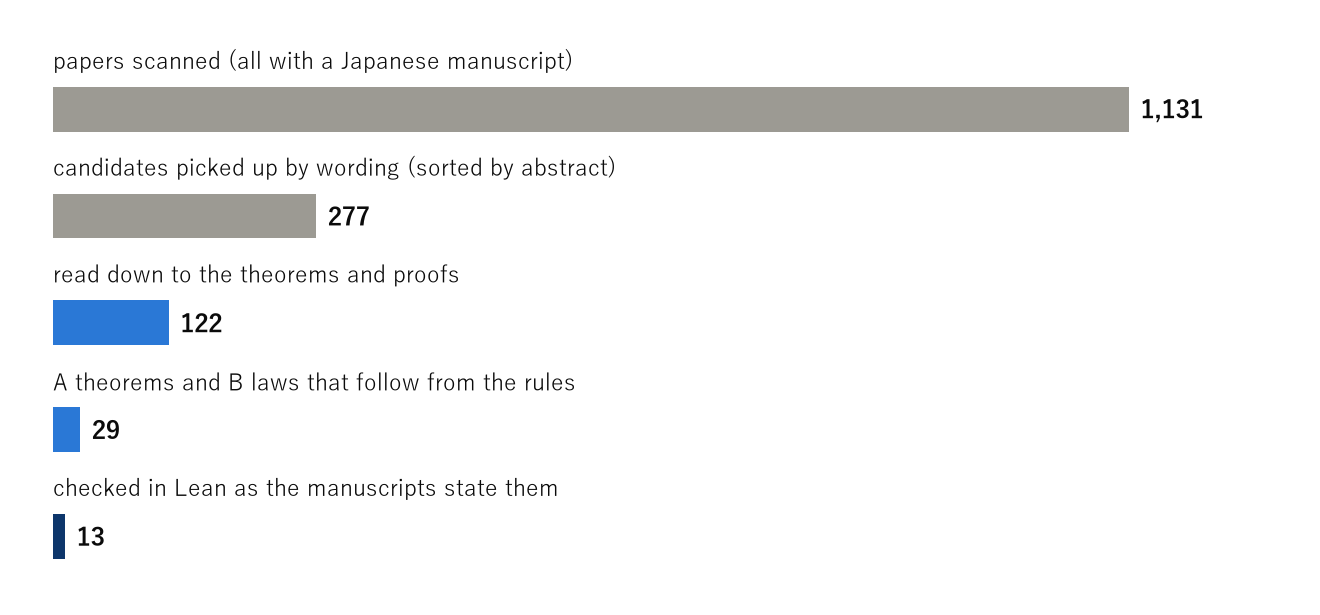
Reading the manuscripts moved many papers down a step. The table gives the numbers placed from the abstract only and after reading the manuscript.
| Standing | Abstract | Manuscript |
|---|---|---|
| A theorems of mathematics | 25 | 13 |
| B laws that follow from the rules | 38 | 16 |
| C facts checked by calculation | 15 | 27 |
| D structural interpretations, readings of known theorems | 43 | 66 |
| Other | 1 | 0 |
A statement that read as “every case” in an abstract turned out, in the manuscript, to be a count of a few cases, or a theorem-shaped text turned out to reread a known theorem. These 122 are the papers placed again in the four standings. Another 97 were read down to the manuscripts to see whether they could be recast as general theorems (see “The 66 papers in a more general form than the manuscripts” below). 912 papers remain that have not been read down to the contents of the manuscript, and papers that belong in A or B may remain among them. Some of the 97 also already state the general case in the manuscript, so placing them in the four standings could add to A or B.
The ledger: 13 theorems of mathematics and 16 laws from the rules
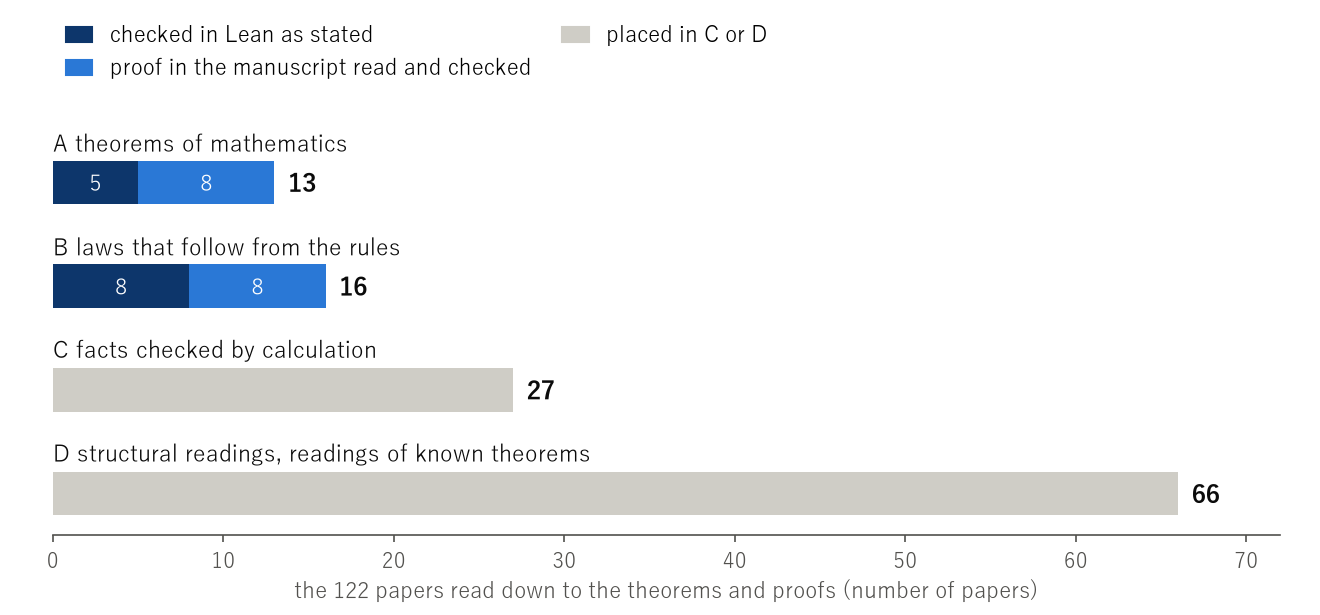
The statements in the tables shorten the statements of the theorems in the manuscripts without dropping conditions. Where a condition that matters is not written in the manuscript, the reading has added it. The line “Known?” under each statement is the judgement of the reading that made the ledger. Where the last column says “Lean”, it links to the paper’s Lean file. “General form” means that a statement more general than the manuscript’s was checked in Lean (see the section below).
A Theorems of mathematics (13 papers)
| Paper | Statement | Lean |
|---|---|---|
| 01 | For a spherically symmetric density ρ = r−n in three dimensions (n any real number), the rate of growth of shell mass dm/dr = 4πr2−n is independent of the radius only when n = 2. Known? known from textbooks and elsewhere | Lean |
| 02 | A single identity. The mass of the unit ball with density r−2 is 4π. As a calculation in the text, for n < 3 the mass is 4π/(3−n), and it is 4π only for n = 2. Known? known from textbooks and elsewhere | Lean |
| 53 | Under free-particle Schrödinger evolution, ∫|ψ|n d³x is conserved for every initial state only when n = 2. Known? known from textbooks and elsewhere | not yet |
| 116 | In d dimensions with d ≠ 1, the set of exponents that writes a quantity of dimension LλMμTτ as ħpGdqcN is unique, and the determinant of the system is 1 − d. As a corollary, under G = a, ħ = 1/a the power of a is −μ. Known? known from textbooks and elsewhere | Lean |
| 143 | In a linear Onsager system with two forces (X1 fixed, L22 > 0), the point where entropy production is stationary in X2 and the steady state J2 = 0 differ by (L21 − L12)X1/(2L22). The two coincide only when L12 = L21. Known? known from textbooks and elsewhere | not yet |
| 330 | For an m × n matrix A (m ≥ n) with linearly independent columns, the 2-norm condition numbers satisfy κ2(AᵀA) = κ2(A)² exactly. Known? known from textbooks and elsewhere | not yet |
| 503 | Extrapolate a liquid with a positive entropy of fusion at its melting point, taking the heat-capacity difference to be a positive constant. However small that difference, the entropy difference always crosses 0 at a finite positive temperature TK = Tm exp(−ΔSm/ΔCp). Known? known from textbooks and elsewhere | not yet |
| 751 | For every n and k, the fraction of binary strings of length n that a one-to-one map can shorten to length n − k or less is below 21−k. In particular, some string of length n is not shortened by any lossless compression. Known? known from textbooks and elsewhere | not yet |
| 905 | With the Coulomb force in d dimensions set to q²/rd−1, the monomials that give a power correspond one to one to the partitions of d − 1. Integrated over one period, the forms with two factors reduce, up to sign, to a single integral when d is odd, and vanish when d is even. Known? a rephrasing of a known theorem | Lean |
| 1066 | In flat d-dimensional spacetime, two points share a light ray only when their separation is null (spatial separation = time separation), and then they share exactly one. Known? known from textbooks and elsewhere | not yet |
| 1122 | Build the precision matrix Q = (κ²I + L)k (κ² ≥ 0) from the Laplacian L of a lattice that can be coloured with two colours. In every dimension and for every k, the non-zero entries of Q are exactly the pairs of points at path distance k or less, and the Markov blanket is k layers thick (on a periodic lattice, when each side is long enough). Known? known from textbooks and elsewhere | not yet |
| 1123 | For primary currents inside a bounded conductor of uniform conductivity with insulating surroundings (the outside taken to be connected), the set of currents invisible both to the surface potential and to the magnetic field outside does not depend on the shape of the conductor. Known? the author’s statement | not yet |
| 1131 | For positive integers n, n! = 2n only for n = 3 (and (n − 1)! = 2 also only for n = 3). Known? known from textbooks and elsewhere | Lean |
B Laws that follow from the rules of placement (16 papers)
| Paper | Statement | Lean |
|---|---|---|
| 19 | Putting m = 4π into the kinetic-theory pressure P = (1/3)nm⟨v²⟩ gives P = (4/3)πn⟨v²⟩ (v² is the mean square speed). Known? known from textbooks and elsewhere | not yet |
| 20 | Putting Ek = 2π⟨v²⟩, from m = 4π, into equipartition ⟨Ek⟩ = (3/2)kT gives kT = (4/3)π⟨v²⟩. Known? known from textbooks and elsewhere | not yet |
| 22 | Putting m = 4π and ε0 = r (r the Debye length; a formal correspondence of symbols) into the plasma frequency ωp² = ne²/(mε0) lets it be written ωp² = ne²/(4πr). Known? known from textbooks and elsewhere | not yet |
| 26 | Putting m = 4π for the test mass only, and G = 4π, into F = ma, p = mv, Ek = (1/2)mv² and U = −GMm/r gives F = 4πa, Ek = 2πv² and U = −16π²M/r, and the work-energy theorem is kept. Known? known from textbooks and elsewhere | not yet |
| 30 | Putting the mean density 4πn, from m = 4π, into the self-gravitational energy −3GM²/(5R) of a uniform ball gives −(256π⁴/15)Gn²R⁵. Known? known from textbooks and elsewhere | not yet |
| 39 | Under G = 4π, ħ = 1/(4π), ħG = 1 and the Planck length is c−3/2. The invariant factors of the dimension matrix of (ħ, G, c) are (1, 1, 2). Known? known from textbooks and elsewhere | Lean |
| 40 | Under G = a, ħ = 1/a (a > 0), the four Planck quantities lP, tP, mP and EP are cN or cN/a. lP/tP = c and EPtP = ħ do not depend on the values of ħ and G. Known? known from textbooks and elsewhere | Lean |
| 44 | Under G = a, ħ = 1/a (a > 0), the power of a on nine Planck quantities is fixed by the mass dimension, and each is cN or cN/a (for the temperature, when the Boltzmann constant is set to kB = 1). Known? the author’s statement | Lean |
| 65 | Putting ħG = 1 and the area A = 4πc² of the causal sphere at unit time t = 1 into S = A/(4lP²) gives S = πc⁵ (a substitution under three conventions, not an equation in SI). Known? a rephrasing of a known theorem | not yet |
| 912 | For an ideal gas in d dimensions, equipartition gives kT/⟨v²⟩ = m/d. Setting m to the area of the unit sphere in d dimensions makes this coefficient equal to the volume of the unit ball for every d (with m fixed at 4π, only for d = 3). Known? known from textbooks and elsewhere | Lean |
| 996 | In a model of rope skipping with the rope turned ω times a second and a fixed foot-contact time tc, the ratio of the jump heights for a double and a single is ((2 − ωtc)/(1 − ωtc))², and no jump is possible once tc exceeds 1/ω. Known? the author’s statement | Lean |
| 1082 | With the coupling g = 4πħ²a/m for scattering length a, setting m = 4π gives g = ħ²a, but 4π remains in the formulas that contain no mass. In d dimensions, setting m to the area of the unit sphere still leaves a factor d − 2, and nothing remains only in three dimensions (assuming the outer solution 1 − (a/r)d−2). Known? known from textbooks and elsewhere | not yet |
| 1093 | For the Tangherlini solution in d dimensions, with Newton’s G, the coefficient of the entropy equals the volume of the cross-section only for d = 3 and 4. With 8πG = 1, S = 2πA in every d. Known? known from textbooks and elsewhere | Lean (general form) |
| 1128 | The Planck quantity of the type mass times speed to the k is mPck = √(ħ/G)·ck+1/2, and the ratio of neighbours is c in every system of units. Under G = a, ħ = 1/a every type is c(2k+1)/2/a. Known? known from textbooks and elsewhere | Lean |
| 1130 | In the books of m = 4π, G = 4π, ħ = 1/(4π), split a quantity as (4π)ρħpGqcNmrMu. Then the power ε of 4π standing in the value and the mass dimension μ satisfy ε + μ = 2r + u + ρ. Multiplying or dividing by G, ħ and c never changes ε + μ, and if r, u and ρ are integers, ε + μ and u + ρ have the same parity. Known? the author’s statement | Lean |
| 1132 | Among rescalings of the units by positive factors, the one that keeps the number for c and moves the numbers for G and ħ from (1, 1) to (4π, 1/(4π)) is unique: it multiplies the unit of mass by 4π and leaves the units of length and time alone. Known? a rephrasing of a known theorem | Lean |
Most of B put a placement into known formulas (Paper 19, Paper 26 and others). These formulas necessarily come out once the placement is put in, and what is new is the placement. Paper 1130 and Paper 1132 are not the results of putting a placement into a formula; they are theorems about the books of the placement itself.
The 13 papers checked by machine
Lean repository: github.com/yamagishi-lab/yamagishi-math (Lean 4 and Mathlib; the code is under the Apache License 2.0)
Lean is a tool in which a computer checks the statement of a theorem and each step of its proof against fixed rules. For the 13 papers Nos. 01, 02, 39, 40, 44, 116, 905, 912, 996, 1128, 1130, 1131 and 1132, the mathematical content, as the manuscripts state it, was written in Lean 4 and Mathlib (a library of checked mathematics built up by mathematicians), and the proofs were confirmed to go through. No command that skips a step of a proof, and no axiom of my own, is used. Every theorem relies only on the three axioms of logic that ordinary mathematics uses without mention. Each time the repository changes, GitHub also rebuilds it and checks it automatically.
What the machine checks reaches as far as the statements written in Lean. Whether they say the same thing as the Japanese statements in the manuscripts is for a person to compare, and the correspondence table in the repository sets them side by side, one by one (in Japanese). Only the mathematical content (bookkeeping of exponents, integrals, inequalities, systems of equations) is formalized; physical readings such as “this 4π is a solid angle” or “this 4π is a convention” lie outside. Conventions of units and dimensions, such as the dimension of ħ or the placement G = a, ħ = 1/a, are given as tables in the input. Applying the results to published formulas, and comparing numerical values, are also outside the machine.
During the formalization, one place was found where a condition in a manuscript was missing. In the table of Paper 44, the mass dimension of temperature is 1 only when the Boltzmann constant is set to kB = 1. In Lean the proof went through with this condition added, and the statement in the table above includes it. The other 12 papers went through with the conditions of the manuscripts as they stand. For Paper 912, the same identity was proved by symmetry instead of by the one line with the divergence theorem in the manuscript (Mathlib does not yet have the divergence theorem for general domains).
Split into three steps of checking, the papers stand as follows.
| Step | Papers | Contents |
|---|---|---|
| (a) proof checked by machine as the manuscript states it | 13 | Nos. 01, 02, 116, 905, 1131 in A; Nos. 39, 40, 44, 912, 996, 1128, 1130, 1132 in B |
| (b) proof in the manuscript read and checked, not yet put through the machine | 16 | Nos. 53, 143, 330, 503, 751, 1066, 1122, 1123 in A; Nos. 19, 20, 22, 26, 30, 65, 1082, 1093 in B (for 1093, a form more general than the manuscript’s was checked in Lean) |
| (c) all others | 1,102 | 93 papers read down to the manuscripts and placed in C or D, 97 papers read down to the manuscripts to look at general forms, and 912 papers not read down to the manuscripts (65 of the 66 papers in general form are also here) |
The 66 papers in a more general form than the manuscripts
The GitHub repository also holds Lean files for 66 more papers. In each, the manuscript shows the statement with numbers, tables or a few cases. The statement was recast as a general theorem, for every n or every dimension, and proved in Lean. For 19 of them only the core of the statement is formalized (marked in the table). The repository holds 79 papers in all, but only the 13 above are checked as the manuscripts state them; the other 66 are in this general form.
These 66 are not what the current versions of the manuscripts prove. They are material for raising the manuscripts to theorems in their next versions. For that reason the numbers of the four standings (13 in A, 16 in B) are unchanged. Of the 66, Paper 1093 is among the 16 in B, and the other 65 lie outside A and B. Even in general form, most of them are elementary or already known.
They were picked up in two ways. 10 are papers among the 122 read down to the manuscripts that, on reading, looked as if a little work would make them general theorems. 56 come from the 854 papers not picked up as candidates: their abstracts were read, 97 that looked as if they could become general theorems were chosen and read down to the manuscripts, and these 56 were formalized from among them. With this, 219 papers in all have been read down to the manuscripts.
Making the statements general also turned up places where a condition is needed, or where a sentence of a manuscript does not hold as written. In Paper 156, “a radial harmonic function bounded near the origin is constant” needs the dimension to be at least 2 (in one dimension, f(r) = r is not constant). In Paper 710, “the ratio of sizes is set by the difference of the exponents alone” holds only when the revenue exponent is 1; in general the difference alone does not set it. In Paper 534, the logarithmic temperature scale is determined only when the Carnot work is required to be independent of temperature for every step; requiring it for the one-degree step alone does not determine the scale. Such places are written in the Lean files and in the records of the repository.
Open the list of the 66 papers (in order of number)
| Paper | General statement | Lean |
|---|---|---|
| 28 | For the force law r″ = −k‖r‖n−1r with any real n, the periods of similar orbits scale as a(1−n)/2, not only for circles, and the circular orbit is stable only when n > −3. | Lean |
| 36 | For d ≠ 1 the no-slip conditions fix the coefficients; with the strain and pressure on the sphere taken as input, the drag is d(d − 2)/(d − 1)·Sd−1·μUad−2 (6π at d = 3, 0 at d = 2). core only | Lean |
| 141 | With the scaling balance taken as an equality, M ∝ R(3Γ−4)/(Γ−2) for every Γ ≠ 2, and the exponent vanishes only for Γ = 4/3; by Lane–Emden homology the mass is independent of the central density only for n = 3. core only | Lean |
| 156 | For every real d, radial harmonic functions are A + Br2−d (A + B log r for d = 2), and bounded near the origin forces a constant; this needs d ≥ 2 (for d = 1, f(r) = r). | Lean |
| 202 | In any dimension, metric-compatible differences K correspond one to one to torsions; K leaves the geodesic equation unchanged only when K (and the torsion) is totally antisymmetric, and in d = 2 such K vanishes. core only | Lean |
| 205 | On the flat a × b torus (a ≤ b, ab = 1), among the three candidates disc, band and complement of a disc, the shortest enclosure is the disc for A ≤ a²/π, the band up to 1 − a²/π, then the complement. core only | Lean |
| 208 | In curvature −κ² and dimension n, V(r − t) ≤ e−(n−1)κtV(r) for every r ≥ t, so the outer shell of thickness t holds at least 1 − e−(n−1)κt of the volume at every radius. core only | Lean |
| 221 | Over any field, for every n ≥ 1 and ε, λ is an eigenvalue of the Jordan block with ε in the corner exactly when λn = ε; over ℂ all eigenvalues have modulus |ε|1/n. | Lean |
| 235 | For −u″ = λu with Robin conditions u′(0) = hu(0), u′(1) = −hu(1), h ≥ 0 gives λ ≥ 0, and for h < 0 there is an eigenfunction with eigenvalue −μ² ≤ 2h < 0. | Lean |
| 236 | J[y] = ∫0L (y′² − y²) with zero ends is ≥ 0 for all y only when L ≤ π; x² + 1 = 0 has 0 or 2 roots in a finite field of characteristic ≠ 2 and exactly 1 in characteristic 2. | Lean |
| 251 | In every dimension d, the inversion pull-back x1/‖x‖² is harmonic only for d = 2 (the Kelvin transform is harmonic in every d). | Lean |
| 298 | The doubling strategy has expectation 1 − (2(1 − p))k, which is 0 only for p = 1/2. | Lean |
| 340 | For two points on the same latitude, the great circle is no longer than the rhumb line (equal only on the equator), the rhumb line is shorter than π/2 times the great circle, and π/2 is the best constant. core only | Lean |
| 342 | The two-phase Voigt/Reuss ratio is 1 + u(1 − u)(√(a/b) − √(b/a))², largest only at u = 1/2; for many phases it is at most (A + B)²/(4AB) (Kantorovich). | Lean |
| 346 | For −dC/dt = kCn with any real n, the half-life is independent of the initial concentration only for n = 1. | Lean |
| 360 | For all n and 0 ≤ k ≤ n, the inclusion–exclusion sum Sk cut at k brackets Dn/n! alternately (equality only at k = n) with a gap of at most 1/(k + 1)!; truncation brackets in general (Bonferroni). | Lean |
| 373 | For all a, b, c, d > 0, V is conserved, and the ratio of the prey’s maximum to its minimum strictly increases with the level and takes every value above 1. core only | Lean |
| 385 | For every k > 0, cos²α(1 − e−k tan α) has a unique maximiser on (0°, 90°), below 45°, which strictly decreases as k grows. | Lean |
| 391 | The expected maximum of N independent Rayleigh waves equals exactly (√π/2) Σk=1N (−1)k+1 C(N, k)/√k. core only | Lean |
| 412 | E ≤ 3n − 6 gives an average degree ≤ 6 − 12/n < 6; for sites on one line, the Euclidean and taxicab nearest-site assignments coincide. core only | Lean |
| 457 | In the Q10 model, for any two temperatures the colder one wins on flavour exactly when q < Q, and they tie when q = Q. | Lean |
| 488 | For a curve with f′ = c/√y, the fall time is the same, cπ/√(2g), from every height. core only | Lean |
| 493 | As n → ∞ with m/n² → q, the Schwarz lantern area tends to 2πr√(h² + π⁴r²q²/4), which is the true area 2πrh only when q = 0. | Lean |
| 508 | In a simple graph with n vertices and at most n + 1 edges, all Hamiltonian cycles use the same edges (a cycle plus one chord keeps only the original cycle); n + 2 edges are not enough. | Lean |
| 511 | For R0 > 1 the final size z is unique, 1 + √(1 − z) < z/pc < 2, and the ratio decreases strictly in R0. | Lean |
| 534 | If the Carnot work for every step δ > 0 is independent of θ, the scale is θ = A ln(τ/273.15); requiring it only for the one-degree step does not determine the scale. | Lean |
| 579 | Two 2PL items with different discrimination cross at exactly one ability; with equal discrimination the order of correct-response rates is the same for every population. core only | Lean |
| 581 | For the Chapman–Richards curve (c > 1), the peak of the current increment t1 = ln c/k and the peak of the mean increment t2 satisfy t1 < t2 < 2t1. | Lean |
| 584 | The transmissibility is 1 at r = √2 for every damping; for r < √2 it decreases with ζ, and for r > √2 it increases with ζ. | Lean |
| 606 | For a symmetric matrix over any field, the image is the set of vectors orthogonal to the kernel; over ℤ/2 there are 2n − dim ker reachable patterns, and on every finite graph the all-on pattern can be switched off (Sutner). | Lean |
| 674 | If the rigidity map of N frictionless grains in d dimensions is injective (fixed walls), there are at least dN contacts; without walls, if only translations remain, at least dN − d, and the mean contact number is at least 2d − 2d/N. core only | Lean |
| 696 | For dN/dt = rN(N/A − 1)(1 − N/K) with r > 0 and 0 < A < K, a solution starting in (0, A) stays there and strictly decreases, and one starting in (A, K) stays there and strictly increases. core only | Lean |
| 706 | For any N ≥ 1 random variables with E[exp(tXi)] ≤ exp(t²/2), standard normals among them, E[max Xi] ≤ √(2 ln N); independence is not needed. | Lean |
| 710 | aQ − βQp (p > 1) has a unique maximiser and the ratio of sizes is p1/(p−1); with revenue exponent q the ratio is (p/q)1/(p−q), not set by the difference of exponents alone. | Lean |
| 738 | With autocorrelation ρk, the annualisation ratio Rq is below 1 exactly when ρ > 0, and it moves monotonically away from 1 in q when ρ ≥ −1/2. | Lean |
| 744 | With orthogonal predictors, the prediction error has a unique minimum at λ* = dσ²/‖β‖². | Lean |
| 745 | For every L, the L-fold tent map is linear on 2L pieces, and a one-hidden-layer ReLU network needs at least 2L − 1 units to equal it. | Lean |
| 791 | For any L1, L2 > 0 and distance r > 0, there are 2 joint-angle pairs if |L1 − L2| < r < L1 + L2, 1 if r = L1 + L2 or |L1 − L2|, and 0 otherwise; the reachable area is 4πL1L2. | Lean |
| 799 | The error of position read from concentration is the same everywhere only for c = N0e−x/λ with proportional error, and only for c = (α − βx)² with count error. | Lean |
| 846 | In the subtraction game {1, 3, 4}, n is a losing position only when n mod 7 is 0 or 2, and the number of moves to the end is 4⌊n/7⌋ + c(n mod 7). | Lean |
| 860 | For every half-angle 0 < θ < π/2 and slicing ratio λ, tan θeff = tan θ/√(1 + λ²); θeff ≤ θ with equality only for λ = 0, and λ = √3 halves the tangent. | Lean |
| 899 | For every width w > 0 and offset φ, the number of black pixels is ⌊w⌋ + [fract(1/2 − φ) < fract w]; for uniform φ, the wider rendering has probability exactly fract w. | Lean |
| 910 | With density v0²/(4πGr²) on the stretch, the rotation curve is flat only when GM(r1) = v0²r1, whatever lies inside; among power laws only n = 2 is flat. | Lean |
| 924 | In the Minesweeper position, P(x2) = (U − M + 2)/(U + 1), and it is one half only when U = 2M − 3. | Lean |
| 931 | For every kτ > 0, the first-order remainder (1 + kτ/N)−N strictly decreases in N, stays above e−kτ and tends to it. | Lean |
| 935 | The step probabilities of the up-down rule, the expected trials per step and the ratio of the stationary distribution are given in closed form, and the balance point is P = 2−1/k. core only | Lean |
| 936 | In the MWC model with any n ≥ 2 sites, at every concentration nH = 1 + (n − 1)V/(Y(1 − Y)), so 1 < nH < n when c ≠ 1 and nH = 1 when c = 1. | Lean |
| 945 | Supermultiplicativity of counts passes to the growth rates; for a positive supermultiplicative sequence with λw ≤ Cw, λw1/w converges to its supremum (Fekete), but it need not increase in w. core only | Lean |
| 954 | For any continuous strictly increasing Φ from 0 to 1 and guess rate 0 ≤ γ < 1, the target point of the k-down rule exists only when γ < 2−1/k, and is then unique. core only | Lean |
| 960 | For 0 < a < 1 the cost xa/ln(1 + x) has a unique minimiser, independent of the remainder; for a ≥ 1 there is no minimum, and with whole tanks proportionality fails. | Lean |
| 963 | For any k contributions ai ≥ 0, the minimum of the linearised variance over all correlation matrices is (max(0, 2amax − Σa))², which is 0 only when the largest contribution is at most the sum of the others. | Lean |
| 970 | The two constructions share the equilibrium, the product of the nonzero eigenvalues has ratio c everywhere, and both eigenvalues scale by exactly √c only when c = 1, c = 4 or x = 1/√c. | Lean |
| 971 | For every order n > 0 and outlet 0 < r < 1, the total residence time of two tanks has a unique minimiser, where the first tank is smaller if n > 1, equal if n = 1 and larger if n < 1. | Lean |
| 980 | The number per plot m* that minimises the two-stage variance is unique and independent of the budget, and the loss factor is the same for k times and 1/k times. | Lean |
| 992 | For any arrival times and exit intervals with first-come queues, a boundary equilibrium always exists, is unique up to an exact tie, and minimises both the total time and the last exit time. | Lean |
| 1008 | For every real n > 0, Vol(S2n−1) = Vol(Sn−1)·Vol(Sn1/2); ρ(n) = n only for n = 1, 2, 4, 8. | Lean |
| 1027 | With K = −f″/f for dr² + f²dφ², the rotating disk has K = −3Ω²c²/(c² − Ω²r²)²; the area ratio is 2/(1 + √(1 − β²)), between 1 and γ. | Lean |
| 1036 | For every 0 ≤ β < 1 and every dimension, the light sphere cut by another frame’s simultaneity is a spheroid with eccentricity β and a focus at the emission point. | Lean |
| 1040 | With the sky average defined by the weight (1 − μ²)(d−3)/2, F(p) = F(d − 1 − p) in every d; for d ≥ 3, F(p) = 1 only for p = 0 or p = d − 1. | Lean |
| 1064 | In any dimension, at an invertible frame the derivative of e ↦ eᵀηe maps onto the symmetric matrices, and its kernel is linearly isomorphic to the antisymmetric matrices. core only | Lean |
| 1093 | Vk = k + 1 only for k = 0, 1 (using only 3 < π < 3.15); the coefficient matches for d = 3, 4 with Newton’s G and only for d = 3 with the action’s G. | Lean |
| 1098 | Among star-shaped regions of equal volume, ∫ ln ρ dΩ is largest exactly for the ball. core only | Lean |
| 1101 | A hyperplane misses a connected set exactly when it misses its convex hull (so in the plane, the lines hitting a connected shape are those hitting its hull); for lines in space this fails (a circle and its axis). core only | Lean |
| 1111 | Two parts only: the symbol of the operator in Kimura and colleagues’ equation is a combination of two Helmholtz symbols, and r−(d−1)/2f(t − r) solves the wave equation for every f only for d = 1, 3. | Lean |
| 1115 | With a Yukawa potential the ratio is (1 + κR)e−κR, the same for every R > 0 only when κ = 0. | Lean |
| 1117 | For every n ≥ 3, the density (1 − x²/n)(n−3)/2 on [−√n, √n] has second moment 1 and kurtosis 3n/(n + 2). | Lean |
Having a proof and being new are separate
A statement with a proof is not necessarily new. By the reading, 11 of the 13 papers in A state things known from textbooks and elsewhere; Paper 905 rephrases a known theorem, and the one judged to be the author’s own statement is Paper 1123. The density 1/r² of Paper 01 is the form known in astronomy as the singular isothermal sphere. “n! = 2n only for n = 3” in Paper 1131 is an elementary property of factorials, and “the normal equations square the condition number” in Paper 330 is in the textbooks of numerical linear algebra. The manuscripts themselves often say they are elementary. B is the same: in 11 of its 16 papers the content is formulas known from textbooks and elsewhere, or dimensional analysis, and what is new is on the side of the placement.
So where is the part that belongs to this body of work itself? The ledger shows two things. One is the placement itself: setting the mass to m = 4π, and the Yamagishi patch, which sets G = 4π and ħ = 1/(4π). The other is the books that count the powers of 4π on top of that placement, the series that runs Paper 44 → 40 → 116 → 1128 → 1130 → 1132.
- Paper 44: under the patch, the power of 4π on nine Planck quantities is fixed by the mass dimension.
- Paper 40: the table of the four Planck quantities is four instances of that rule.
- Paper 116: in d dimensions with d ≠ 1 the exponents are unique, and the power of 4π is the mass dimension with its sign changed (a general proof).
- Paper 1128: multiplying by a speed once raises the type of the Planck quantity by one step, the ratio of neighbours is c, and the number of 4π does not change.
- Paper 1130: the formula of the books including placed masses, ε + μ = 2r + u + ρ, with its invariance and parity (the parity rule).
- Paper 1132: the patch is Planck units with only the unit of mass rescaled by 4π, and this rescaling is unique.
All six papers of the series are among the 13 checked by machine as the manuscripts state them. Each is an elementary identity that follows briefly from dimensional analysis, and the manuscripts say so. What this body of work can offer as its own is not the difficulty of any single formula but the construction that counts two placements in one set of books. How the formula of the books is kept can be followed with figures on the page “The power of 4π plus the mass dimension”.
Has someone written these books before? On 21 November 2026 the core claims of Paper 1130 and Paper 1132 were searched in four indexes, OpenAlex, Crossref, DataCite and arXiv. Within that range, the same claims were not found. Two pieces of work are close in form.
- Gavela, Jenkins, Manohar and Merlo (2016), on the rule for counting 4π in effective field theories of particle physics (naive dimensional analysis), write that if ħ is set to a power of 4π, the power of 4π on a coupling constant is fixed by its ħ dimension. Setting a constant to a power of 4π so that the power of 4π is fixed by a dimension is the same pattern as the core of Paper 44 and Paper 116. The differences: the dimension counted is the ħ dimension, not the mass dimension; the 4π comes from loop integrals; and the rule is an estimate of size, not an identity.
- Wutke (2023) builds a system of units that keeps the Planck length and time and makes only the Planck mass equal to 4π. Rescaling only the mass side of Planck units by 4π is the same form as Paper 1132, but by the reading of the search the direction is opposite (Wutke is on the side of 4πG = 1, the Yamagishi patch on the side of G = 4π), and the dimension of mass itself is removed there.
The search covered, for each query, the top few dozen to a hundred results of the four indexes. INSPIRE, the main index for the particle-physics literature, was searched on the same day, including the papers that cite the source papers, and no paper making the same claim was found. Textbooks were not examined. Since the formulas are elementary, it would be no surprise if the same formulas were written somewhere outside this body of work.
Scope of this article
Here is how the ledger was made. The scan of wording, the sorting by abstract, the reading of the manuscripts, the recasting of statements in general form and the Lean code were done together with AI (Claude by Anthropic). The 122 papers were placed again by the AI, which read the theorems and proofs in the manuscripts under the rule “do not place generously; when in doubt, place lower”; I have not reread all 122 myself. Placing Paper 02 in the tier of single identities was decided after consultation, on seeing the results of the reading. Setting the rules and checking the results is my part.
The borders between the four standings involve judgements of reading. The borders between A and C and between B and D in particular are where different readers may place the same manuscript differently. Reading the manuscripts also turned up gaps in proofs and slips in writing. Conditions that matter for a statement are in the tables above; other gaps and slips are not.
This ledger is as of 21 November 2026. Reading the 912 papers not yet read down to their manuscripts could change the numbers. The A and B of the tables are not everything this body of work may be said to have proved; they are a list of what has been checked so far.
Papers and references
All the papers are published under CC BY 4.0. The Lean code is published under the Apache License 2.0.
- yamagishi-math (GitHub): the repository in which the theorems of 79 papers are written in Lean 4 and Mathlib and their proofs checked by machine (13 as the manuscripts state them, and 66 in a form more general than the manuscripts, 19 of them only in their core). Its correspondence table sets the statements of the manuscripts beside the theorems in Lean.
- Paper 01 “The Uniqueness Theorem of n = 2 for Spherically Symmetric Density Distributions” (article)
- Paper 02 “The 4π Mass Cancellation Theorem”
- Paper 40 “The Four Planck Quantities Are Four Instances of One Rule”
- Paper 44 “The Power of 4π Is the Mass Dimension”
- Paper 116 “What Does the Exponent of c Count?”
- Paper 1128 “Multiplying by a Speed Once Raises at Once the Ladder of Point, Line, Skin and Flesh Types and the Geometric Sequence of Planck Quantities with Ratio c”
- Paper 1130 “Under the Yamagishi Patch, the Power of 4π Plus the Mass Dimension Is Unchanged by Multiplying In G, ħ and c, and Only Masses and an Explicit 4π Move It” (article)
- Paper 1131 “The Coefficient ‘1/6’ Comes from Two Roots, and the 1/3! of Repeated Integration and the 1/(2d) of a Uniform Source Are the Same Number Only in Three Dimensions”
- Paper 1132 “The Yamagishi Patch Is Planck Units with Only the Unit of Mass Rescaled by 4π”
- Gavela, M. B., Jenkins, E. E., Manohar, A. V., & Merlo, L. (2016). Analysis of general power counting rules in effective field theory. The European Physical Journal C, 76, 485. doi:10.1140/epjc/s10052-016-4332-1
- Wutke, A. (2023). From Newton to universal Planck natural units: disentangling the constants of nature. Journal of Physics Communications, 7, 115001. doi:10.1088/2399-6528/ad0090